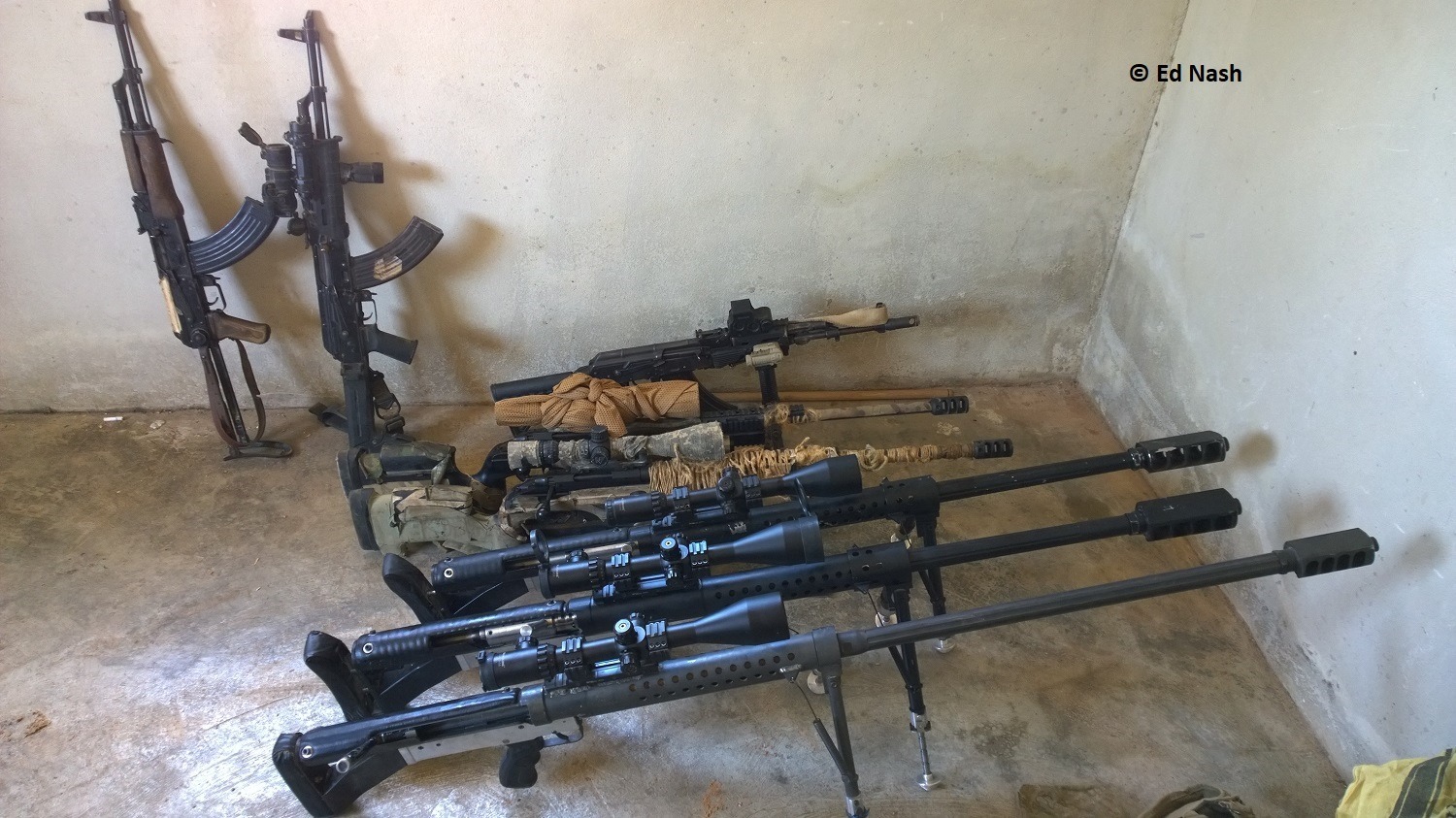
Between June 2015 and July 2016, I volunteered with the Kurdish YPG militia in Syria, fighting against the so-called Islamic State in the first major counter-attacks against that entity which led to its defeat in 2019.
I served for most of that time as a member of the sniper platoon (in Kurmanji Kurdish “Tabur”) of the Mobile Brigade of what was to evolve into the multi-ethnic Syrian Democratic Forces (SDF). As such, it might be of interest to the readers of Silah Report to know a little more about this specialist unit and the weapons they used, as well some of the oddities that the SDF had.
Dragunov SVD:
The Dragunov SVD-63, a 7.62×54mmR chambered self-loading rifle, is the primary weapon of the SDF sniper, and every member of the sniper platoon was required to have one. All of the ones in the platoon at the time of my being a member were Russian (actually Soviet) and dated between 1978 and 1982.
Called the “Karnos” by the SDF, it is positively revered by the SDF. They attribute it with a legendary level of accuracy and lethality. As a result, anyone issued one is given a measure of respect. Unfortunately, it meant that many SDF couldn’t resist handling the rifle. And this could be a problem if you stacked your weapon in a public place for attending briefings. I routinely found someone had twiddled with my scope settings in my absence.
To be fair, in the hands of an experienced shooter the Dragunov is a good weapon, effective enough out to 800 metres if you can get a solid shooting position. It does tend to kick and suffer from barrel jump that can delay a follow up shot, but I found that fitting a bipod helped hugely. It is entirely likely that this was due to poor handling on my part, though I was accurate with this weapon.
The Dragunov is fairly rugged, especially considering it is a marksman’s rifle, though the wooden fore grips are very thin and prone to cracking and breaking if used roughly. It is for this reason, I suspect, that the snipers all bound their fore grips, normally with a compression bandage. This also served to protect the finish on the rifle as well as rudimentary camouflage, as the old Dragunov’s have a glossy varnish on all wooden fixtures.
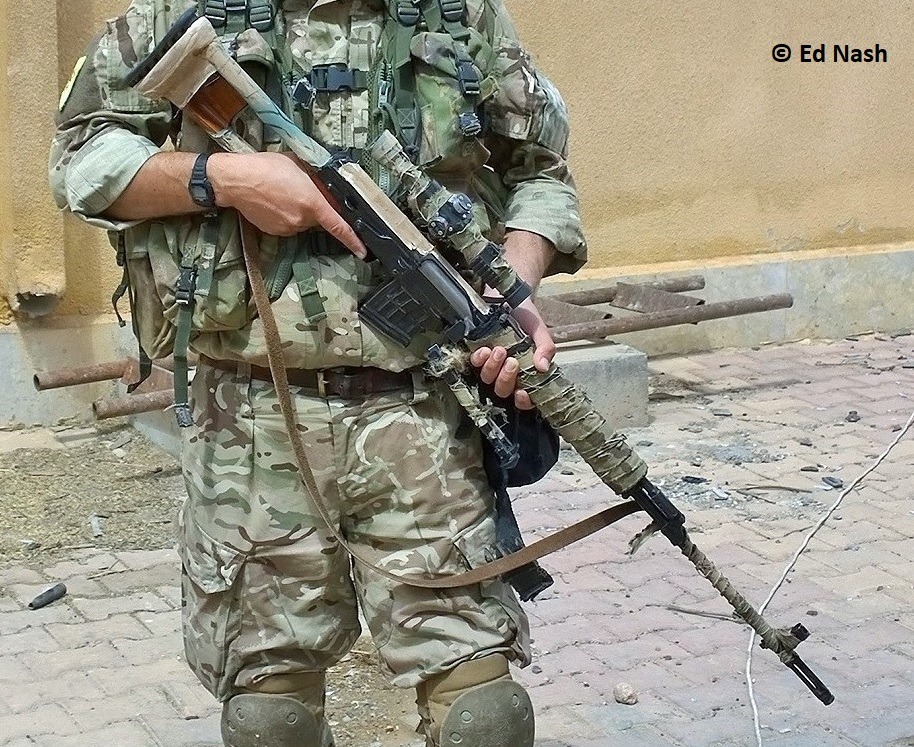
I tried several different camouflage patterns on my own rifle, before settling for this set up (seen above). MTP cloth strips were tied together and wound tightly around the barrel and foregrip, as well as the bipod legs and PSO scope. I also applied white surgical tape to the receiver cover and stock, which I then rubbed with dirt to match surroundings.
Additions I made were the bipod and rubber butt stock extension, both of which were invaluable. The Dragunov was designed for someone shorter than me and as a result I found it necessary to add cushioning to the butt to extend my eye relief. The rubber extender was a genuine Russian article and resolved this issue for me; I suspect modern Russian soldiers have the same issue.
The bipod was extremely useful and, like the butt extender, was a genuine Russian piece. However, it proved surprisingly delicate and very difficult to maintain. The Dragunov was not designed for a bipod, and this item was designed to clamp into the insets in front of the magazine well. This was fine in barracks – but in combat and frontline service they were constantly coming loose, needing tightening several times a day and even just falling off on occasion.
The screws for the sprung leg retaining pins also worked their way loose on bumpy drives (which during the advances were constant) and being tiny were lost instantaneously. I ended up using fence wire to fix the bipod legs in place, making them non-adjustable.
Incidentally, when I first came to the sniper tabur (unit) there was no Dragunov available for me. There were, however, perhaps eight PSLs (a Romanian self-loading 7.62×54mmR chambered designated marksman rifle, similar to the SVD) and what appeared to be a Mauser G98 that had been converted to 7.62×51mm NATO, quite literally gathering dust in the unit armoury.
I asked to take a PSL instead of waiting for a Dragunov, but was refused. The sniper tabur despised these rifles, and refused to issue them. They were said to be “Hungarian Karnos” and of no effective use. For the Kurds, there were two types of SOVBLOC weaponry; “Russian” which is good and “Hungary” which is not. The actual provenance of the gun didn’t matter, they were all “Russian” or “Hungary”.
The snipers had so low an opinion of the PSL that I was told it’d be better if I took the G98! This was described as a good gun that had been used by a former commander of the unit before he had been killed. But the lack of use and cleaning had rotted the barrel, so I was forced to wait for my Dragunov. As another aside, the Dragunov will fit PSL magazines. In fact, the PSL mags are far easier to load into the Dragunov than its own, which can be very tricky and stiff to fit. However, I was told PSL mags do not feed properly and will jam the weapon. I never tested this, but see no reason to doubt it.
Sako TRG 22
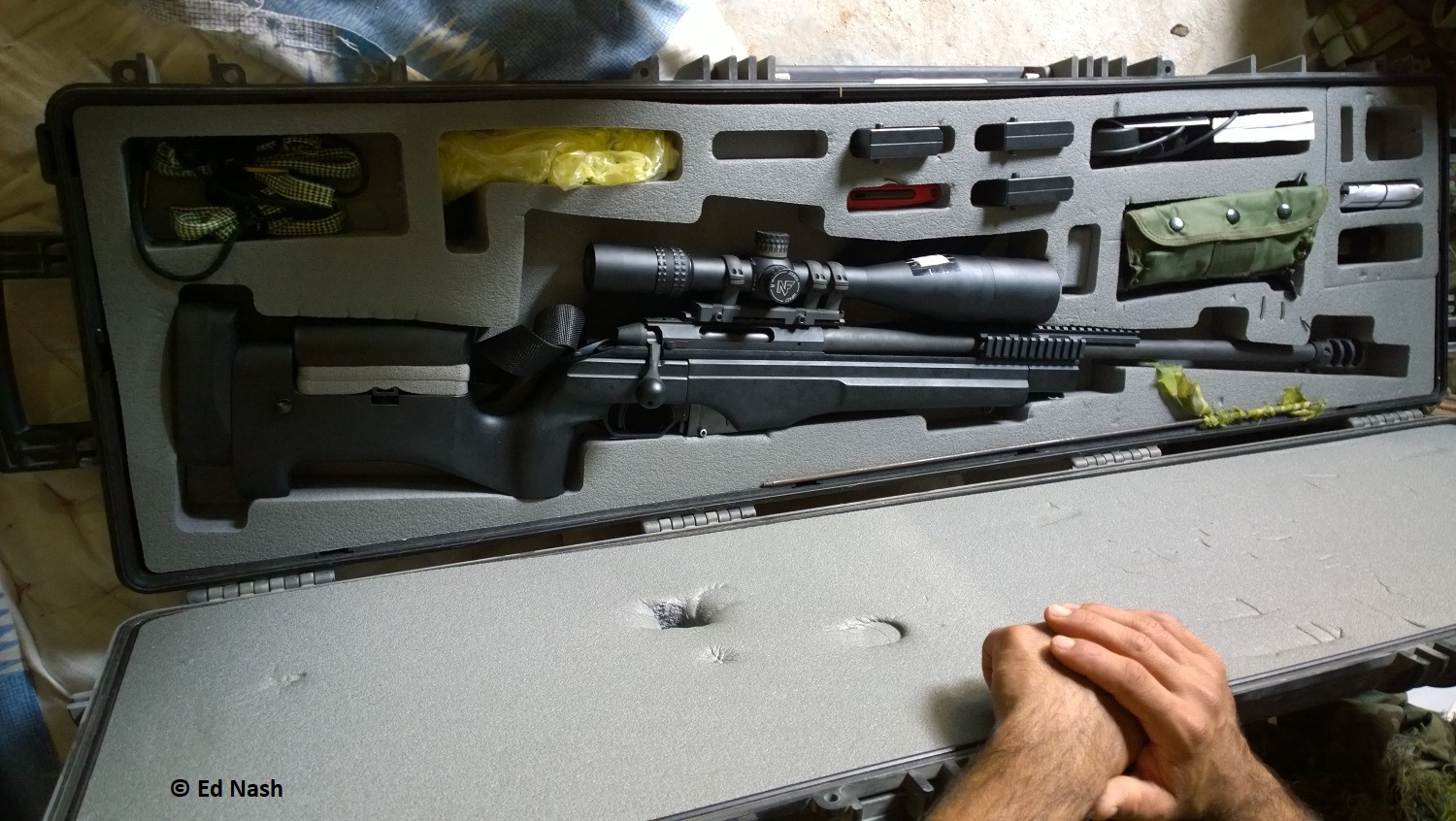
These were the Rolls Royce’s of the sniper tabur. Our unit had two and I don’t know where they were acquired. They were magnificent guns that came complete with custom cases and fitted with .25 MOA scopes. However, these were much more precise weapons than the Dragunovs and ironically, were far less useful for most roles that the sniper platoon was used for.
As a result they tended to be used by the most experienced members of the tabur on specific missions, or by western volunteers with sniper training from previous time in the military. However, in the right hands and properly zeroed they were superbly accurate. I found the lack of kick and barrel jump revelatory after the Dragunov.
Kalashnikovs and M16s
All members of the sniper tabur also had a secondary weapon. The reason for this was that the Dragunov was not considered a good weapon to be have to use in a close range or night battle due to its 10-round magazine and the fact it is difficult to reload quickly.
The standard back-up rifle was the AKM or Type 56 Kalashnikov-patterned self-loading rifles chambered in 7.62×39mm, ideally with a folding stock. These were a collector’s paradise of makes and models, sourced from anywhere the guns were made. Naturally, all the SDF craved a “Russian” model over a “Hungarian” one.
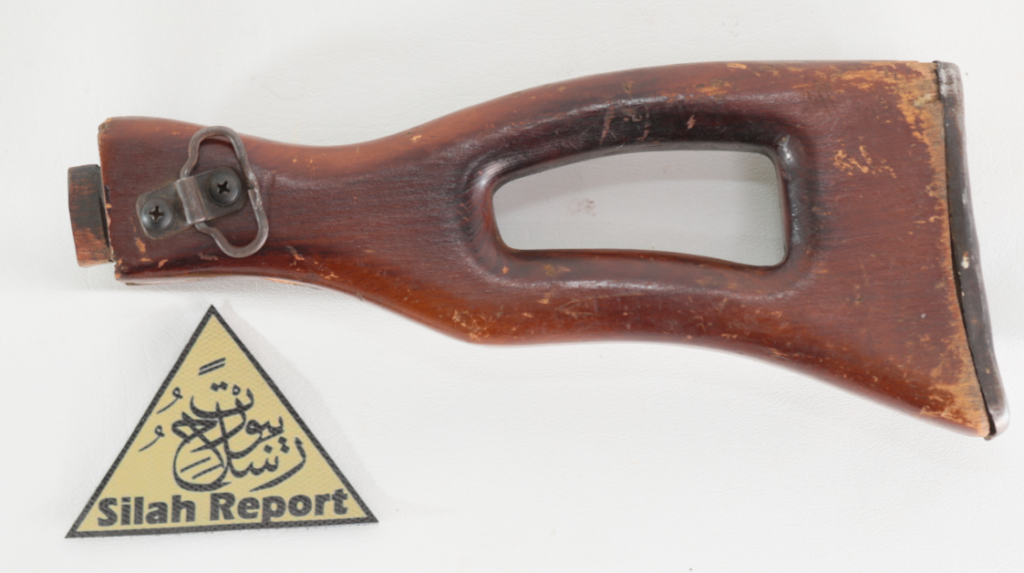
However, the SDF have an interesting quirk with rifles fitted with wooden butt stocks. Rifles refurbished by the SDF at their facility in Rmelan (Hasakah province) would often be fitted with a carved and hollowed out butt stock, reminiscent of the PKM or Dragunov. I am uncertain why the SDF went to the effort of this, but it certainly has an aesthetic quality. I was happy to have one as my first issued rifle and the hollowed stock was certainly strong enough for combat duties.
The SDF also have interesting ideas about tailoring their old uniforms into covers for their weapons, principally their AK’s as these as the most common weapon in use by them. Miles has written an excellent examination of this phenomenon. I personally adopted a different approach to camouflaging my AK. The sniper tabur also enjoyed a much higher issue of M16s due to the unit’s specialist nature. Like the Dragunov, the M16, a self-loading rifle chambered in 5.56×45mm, is held in high regard by the SDF for its greater accuracy over the AK.
Called the “Emiralti” (I’m going by the phonetics as I heard them, the actual spelling I have no clue) the M16 was also a rare weapon, with most being captured from ISIS at the time I was in country. Possession of these guns was a status symbol, even more so with M4 or other carbine variants. The greater accuracy – and often the presence of Picatinny rails as most seemed to be -M16A4 models – meant that M16s where often fitted with scopes. These where often knock-off ACOGs and, though I can’t be sure, I suspect most of them were airsoft models rather than actual scopes.
Because of a lack of familiarity concerning the M16, the SDF had some odd ideas concerning the weapon. Firstly, it was commonly believed that the guns are made in the country of Colombia. The origins of this lay in many of the M16s the SDF possessed were made by FN USA in Columbia, NC, which is marked on the receiver. The SDF also had a strange idea concerning the forward assist on the M16. It was not understood that this feature was designed to force a stuck round into the breach. Instead, it was thought to be a “sniper button”. When one pushed it before shooting, the bullet would go faster and flatter! Nothing could dissuade the SDF that this wasn’t the case, and I remember once having a talk with an SDF soldier who possessed one of the exceeding rare AK-74s. “It is a stronger bullet than the M16,” he said. “The M16 will only shoot through one brick. If you push the sniper button, two bricks. But my Kalash will shoot through three bricks!”
Heavy Anti-Material Rifles (AMR); the Zagros, Şer and Şer Portatives
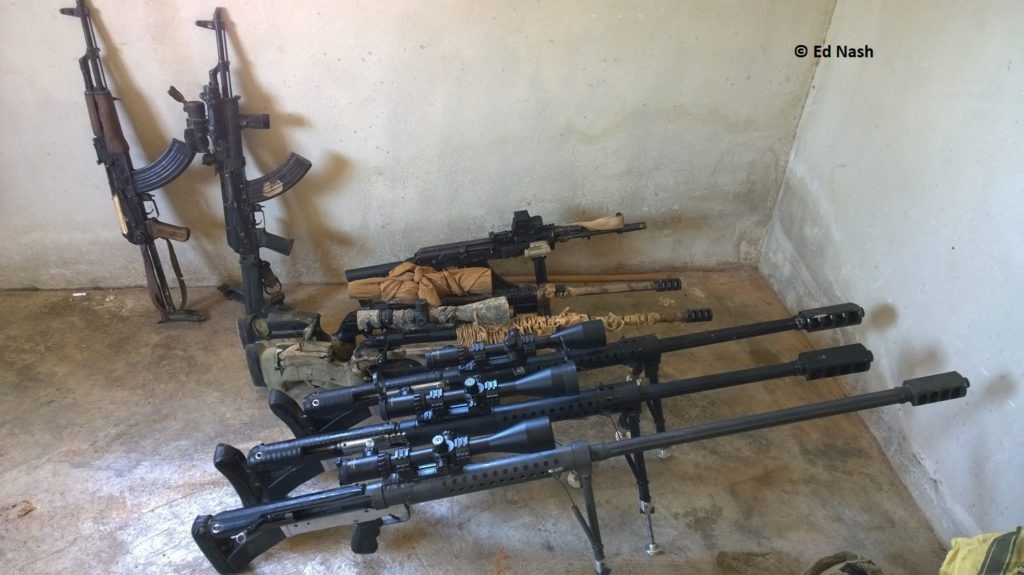
The SDF greatly valued the heavy Anti-Material Rifles (AMR), going to the extent of making several models themselves to fit their requirements. All told, they made rifles in 12.7×108mm, 14.5×114mm and even in the 23mm×152B cannon shell. I did not even see an example of the latter weapon, so can’t really comment, but from what I heard it was somewhat impractical, needing careful siting and sandbagging into position before use. However, two of the other designs I did get to see and use.
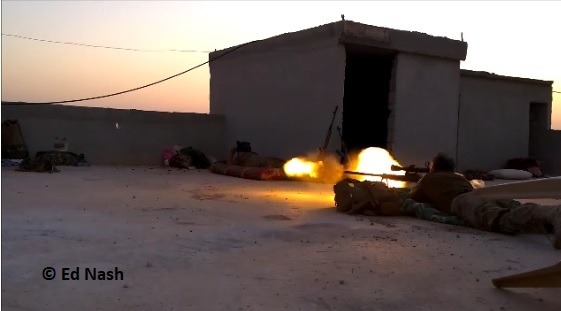
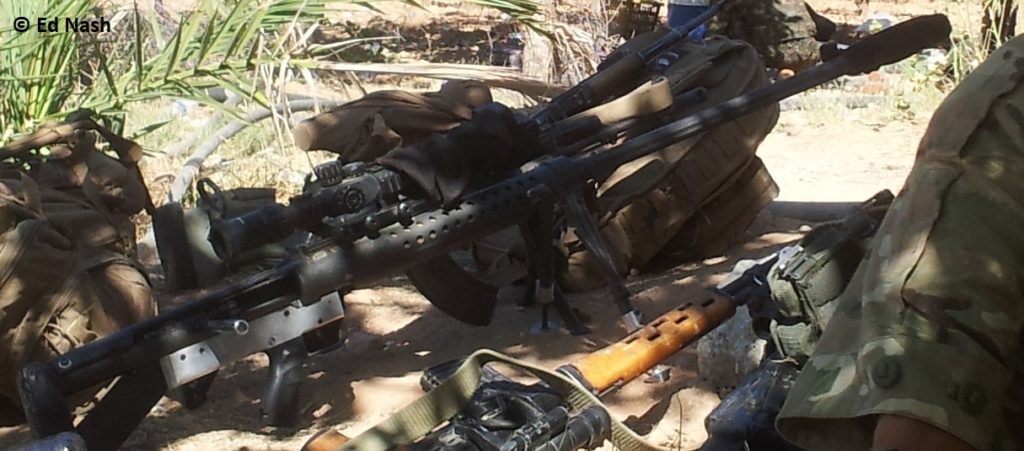
Zagros Rifle and Ammunition
The “Zagros” is the most common of the SDF-built AMRs, firing the Russian 12.7×108mm heavy machine gun round, the Zagros is built using a DShK barrel. Production quality is surprisingly high and the weapon is accurate out to 1000m with the right conditions. The rifle gives a good thump on firing, but is heavy enough that I actually found it more comfortable to fire than the Dragunov, surprisingly.
Due to the presence of overwhelming coalition airpower at the time I was in Syria, ISIS was becoming more and more dependent on surprise attacks by Vehicle-Based Improvised Explosive Devices (VBIEDs) – in plain English, suicide bombers in vehicles. These mounted armoured plates that would resist most small arms fire. Due to a lack of proper anti-armour weapons, the Zagros proved extremely useful in countering these attacks. Using AP and API ammunition, the Zagros was able to disable these threats at a range that prevented them being a threat. Even when used in an anti-personnel role, AP-based ammunition was favoured, as it was very useful for punching through buildings. If an enemy in a window was to be engaged, it was much easier to shoot through the wall to hit him, rather than focusing on the small target aspect that could be seen.
High-Explosive rounds were also highly prized, though extremely rare. One of the major roles for the sniper platoon wasn’t so much killing targets, but providing accurate fire suppression for troops advancing. In this case, the ability to put an HE round through a window was perfectly satisfactory for neutralising a potential threat, even if it only disorientated any gunman who may have been lurking within.
Least popular were standard ball rounds, which we started to receive in great quantities by the time of the Battle of Manbij, in June 2016. Though adequate and of new manufacture, it was generally agreed that API was the preferred round, not least for the distinctive flash that the shooter could use to correct his fall of shot. An interesting note on these ball 12.7×10⁸ rounds. Newly produced and delivered in pristine card packaging (in contrast to our previous and old Soviet bloc supply) they were marked as “hunting rounds”. I dread to meet the animal that needed to be hunted with a 12.7mm rifle!
Şer and Şer Portatives
Though the Zagros was the most popular and useful AMR, the SDF also produced a couple of designs using the 14.5×114mm cartridge. This is a real monster that makes the 12.7mm look like a puppy! With a flatter trajectory and a much heavier projectile payload, the 14.5mm is an excellent cartridge for dealing with VBIEDS, structures and even APCs. If the HE round from the Zagros could put off a potential shooter, this round can really ruin his day. I once saw an entire door, frame and all, blown clean out of a house after being hit by one.
The two rifles the SDF built for this were the “Şer” and the “Şer Portative”. The Şer, the original model, was being retired from front line use about the time I joined the sniper tabur. It was a substantial weapon, more akin to a WW2 anti-tank rifle, and – needing two people to carry it – was far more unwieldy than its lighter Zagros cousin. Built around a KPV anti-aircraft barrel, it also had a tendency to break scopes after around fifty shots, or so I was told. The YPG and SDF had limited access to good scopes and tended to get cheap Chinese ones for these rifles. With no real cushioning and a substantial blast from the 14.5mm round, these didn’t last long in combat.
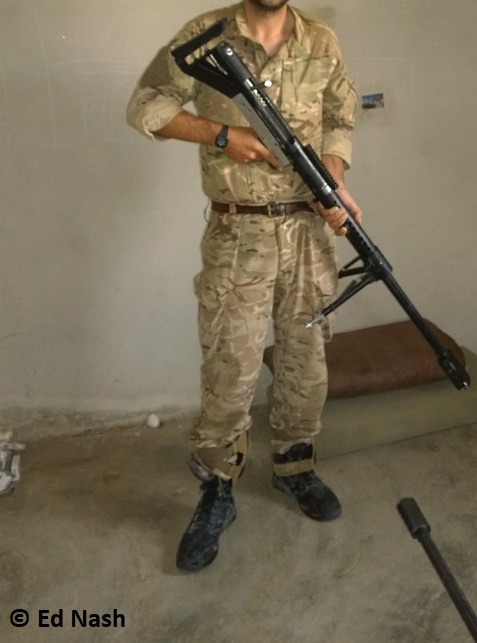
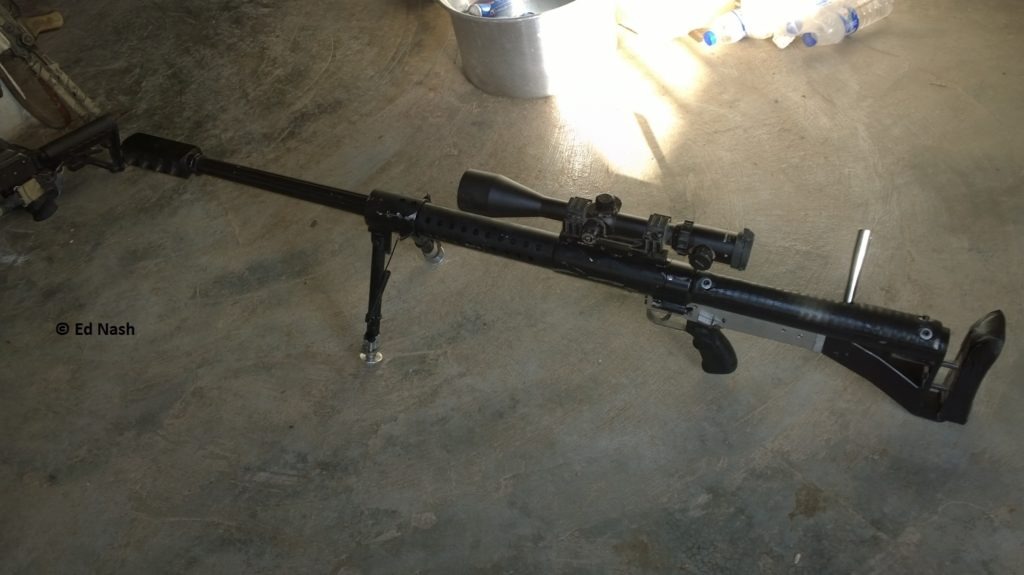
Despite this it enjoyed a measure of popularity amongst the SDF, who appreciated the weapons heavy-hitting abilities, and this no doubt led to the development of its successor, the “Portative” model. This was a much handier weapon, being able to be carried by one person, though certainly no lightweight. It first entered service during the Battle of Manbij, and my unit was one of the first to give it a battlefield testing.
If the original, full-sized Şer was too much for the scopes, the Portative was worse. With a barrel even shorter than the Zagros, the blast was prodigious! Scopes could break after less than five rounds and we would have to bore sight the rifles before each shoot. These would be of limited duration, normally of only a few rounds for harassment at a building as a whole, rather than at a point target. For those sort of shoots, the Zagros was still the best option.
But though we were constrained to more area targeting with this gun, the heavy impact of its round more than made up for it. It proved an excellent harassment and attritional weapon.
This article was kindly written for Silah Report by Ed Nash, who between June 2015 and July 2016 volunteered with the Kurdish YPG in its battle against ISIS in Syria. His book on his experiences there, ‘Desert Sniper’, was published by Little, Brown in September, 2018.
If you enjoy our work here at Silah Report please consider supporting us on Patreon!
Can confirm Bob is right , I was in TMU in til tamir
emiralti. its quite funny to imagine that classic schtick of internationalism in rojava being expressed through this misunderstanding. Your comrades were actually saying “m on altı” which is turkish. “on” being the word for ten and “altı” for six. So they were also just calling it by its name. One does hear alarmingly garbled arabified versions of that though. Otherwise ehmsiksteen is often crudely and lovably pronounced there.