Keeping it Quiet is a series of articles by the Twitter account Everest65. First published on the webpage Calibre Obscura, he has been extremely generous in allowing Silah Report to republish his findings here. Content has been lightly edited. Be sure to look for the rest of the series as it becomes published.
Pistol Caliber Suppression
The blowback action of many PPK/Makarov type pistols is liable to be caused issues by suppression (Particularly with weaker calibers, which may lack the power to always successfully cycle with the suppressor attached). This can be observed in this video and above, in which one Terrorist clearly is encountering issues with the action cycling. These cheap and common pistols, which may well be eastern bloc clones, seem to get the job done, however there are a variety of issues why a pistol (In particular cheaper pistols and weaker cartridges) may not cycle- this including but not limited to:
- Addding the extra weight to the barrel by screwing on a suppressor interfering with the gun’s ability to properly cycle the action after each shot- this can be experienced with browning tilting barrel design pistols- a great explainer over at The Firearm Blog, such as the Glock 19 often used by ISIS.
- The suppressor requiring a lighter recoil spring in order to cycle the action- the suppressor reduces the recoil of the round, meaning the pistol can fail to cycle.
- Inconsistent/weak ammunition also causing the above issue.
These issues can be solved via the use of a Muzzle booster (Also known as a Nielsen device), which typically come with a commercial suppressors in order to ensure correct operation of the pistol. This means also that the pistol does not require a change of recoil spring to use unsuppressed.
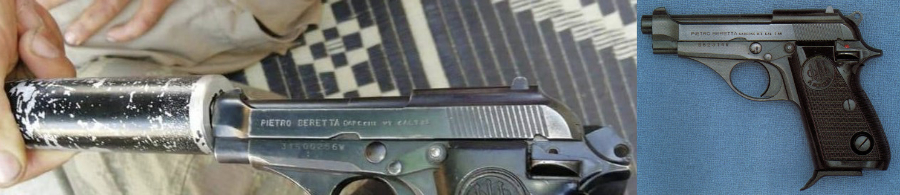
The by far most popular pistol family that I have observed being suppressed is Beretta. Including the 85FS, 70, M1935/1934, and M1951, the latter being by far the most commonly suppressed pistol- appearing in almost 40% of the occurences of suppressed pistols I have catalogued. This 9×19 pistol is extremely common in both Iraq and Syria due to the production of it by the Saddam regime from 1981-2003 (Production restarted from 2009 also, it continues today) and is known as the Tariq for Iraqi-production models. It’s currently in service with the Iraqi Police and other Iraqi forces. The M1951 was also produced in Egypt as the Helwan, and was imported by Libya. It carries 8 rounds of 9×19 ammunition, and is easily confused with a Beretta 92 (Or M9) but is actually its predecessor in terms of design.
 Left Image: Tariq Pistol captured by HTS from ISIS, Idlib, July 2017.
Right Image: Credit- Bob Adams NM

This is very commonplace in general, so is naturally more likely to be used as a suppressor host.
Another pistol with a very similar operation to the Beretta M1951 is the Beretta 85, a more compact pistol than the M1951.
 Left Image: Beretta 85FS (May be 84 or similar, but closest match is 85FS) in use by the YPG to assasinate TFSA (Turkish-Free Syrian Army) militant in Jindires, Syria. 24 June 2018
Right Image: Chromed Beretta 85FS, .380 ACP, Commerical Sale in the United States
The Model 70 series is smaller again. It is chambered in .32 ACP, again uses the falling locking block design and is famously popular amongst intelligence agencies such as the Mossad, though I have only seen it used once in Syria- by the YPG. This example may be a 70, 70S or 71, meaning that it could be chamberd in .22 LR, .32 ACP, or .380 ACP. This pistol is likely the to be the quieter suppressed compared to 9x19mm Pistols.
 Left Image: Turkish Army and FSA arrested an YPG member who was carrying a Model 70 with suppressor. Afrin, Syria, July 2018. This was evidently for covert operations by the YPG.
Right Images: Beretta Model 70 Example- .32 ACP
 (For Sale on Illicit Arms Sales Group on Facebook, Libya. December 2015. .380 ACP or .32 ACP- Beretta M1935/1934. This suppressor may be commercial production.)
It’s easy to mistake all of these pistols on first glance to the Beretta 92 (Made famous as the M9), but curiously I have yet to see any examples of these being suppressed by any party in Iraq, Syria, Yemen or Libya. One of the key advantages of these Berettas are their falling locking block operation- this results in much much less barrel movement compared to pistols such as the Glock 19, Ruger P95 (Both seen in Iraq) pistols with browning tilt-barrel designs – that need a booster or light recoil spring to cycle effectively as mentioned above.
The design of the suppressors used by ISIS Baghdad is detailed by two arabic-language videos from ISIS Baghdad in 2015, which shows some impressive craftsmanship with suppressors that resemble western supppressors such as those from Silencerco or AAC. We can see an Glock 19 in use- many thousands of these flooded Iraq after the Iraqi Police/Army was supplied them, and users promptly sold them on. A 2007 estimate gives 80,000lost, a number which is sure to have risen since.
 Left to right: Manufacturing the suppresor baffle, spraying the suppressor tube, and testing it. There is a noticable volume decrease.
The manufacturing abilities of ISIS are evidently mature, which any observer would know from their existing arms manufacture (Mortars, Rocket Launchers, RPG-7 clones etc.) Here’s an image of the internals of the AAC Ti-Rant 9MM, which appear similar to this ISIS design:


Left 3 Images: A comparison of ISIS K baffle design
Other Images: Images of various pistol calibre K baffle designs from American commercial manufacturers
They have separate removeable baffles (Stacked as opposed to a monolithic core) that are machined using a metal lathe and certainly appear to be of high quality. These “K baffles” are regarded as harder to manufacture than a monolithic core.
The monolithic core is one solid piece of metal which has had sections machined out of it or sometimes created through casting. The stacked baffles are a series of individually created baffles which are stacked together to create the core. From a manufacturing standpoint, the monolithic core is much easier to create from time and materials. It is simply a matter of programming the design into a CNC machine then setting the machine to begin cutting the pieces of metal into the core. The stacked baffles take a little more precision, supplies, and labor. The baffles must be perfect to ensure that they are aligned straight to avoid baffle strikes, plus the baffles must almost lock into place together to keep them from moving and messing up the alignment. The second difference involves the length of the silencer in comparison to the amount of decibel reduction; “silencer efficacy”. A stacked baffle design can more effectively work the gases and therefore can make a quieter silencer with less length. The increased surface area of the stacked baffle design also helps to pull the heat out of the gases faster which also aids in reduced decibels.
Dakotasilencer.com, Monolithic Core Baffles vs Stacked Baffles
The manufacturing process for the K baffles is very similar to this video on YouTube:
This suppressor design is also modular, as an very similar design is shown and used on an MP5A3, a rare gun in ISIS hands. This Submachine gun fires at a rate of 800 rounds per minute, and is a highly formidable close quarters weapon.
 Note ejection of 9×19 casing
 Note custom muzzle cap/device. This gives the appearance of an integrally suppressed to MP5 to a degree, but this model is standard.
 The suppressed MP5A3 in action. This full auto spray put at least 10 rounds in a very short time into the side of the car in the first image. It then crashes.
Specifications given for this suppressor are identical to the Glock one, which is conceivable, but we cannot tell if the device for the Glock contains a Muzzle Booster (SMGs and Rifles don’t require one), but the diagram spotted on the wall in one section of the MP5 Video may contain a sketch of one, as well as dimensions for baffles and the suppressor itself.

I’m currently trying to translate this rough draft and dimensions given into a detailed diagram of this ISIS-designed suppressor- any assistance on this would be very helpful, please contact me on Twitter if you think you recognise the parts/or read the writing.
The Video also gives some dimensions of this suppressor, whilst also allowing other observations:
- Outside diameter is given as 38mm, inside diameter of the muzzle is given as 9mm (This must probably higher, as an exact 9mm diameter hole wouldn’t allow the .355 bullet to exit cleanly), and the length is 20cm.
- They claim it was designed and manufactured by their mechanical workshop of Wilayat Baghdad and that tt was manufactured with “high precision” and the manufacturing division used “computers and other advanced mechanisms” in their work.
- The size of the silencers are in line with international standards
- The silencer can be used for a long time (Claims to be forever, though all silencers wear) and doesn’t break down easily.
- The normal 3 lug mounting device on the MP5A3 has been removed and replaced with a new mounting system, which appears to be a threaded end welded to a end cap. This would allow using both suppressors on either weapon system, assuming a thread similar to 1/2X28. However, a possible muzzle booster would have to be removed or vice versa for interchangeable use.
There isn’t any current public data I can find regarding the manufacture of threaded barrels for any weapon that IS employs, but it would be well within their capabilites. It’s also possible that ISIS have a source for a threaded barrels for the Glock 19, as by default supplied to the Iraqi Police these did not have a threaded barrel, which disallows attachment of a suppressor. This also applies to the Beretta models shown in use, though it is entirely likely that there has been Syrian regime (Or Iraqi) leakage of suppressor ready pistols (And suppressors themselves), given the sheer amount of Ghanimah captured by IS over time. ISIS suppressors share a fairly consistent design in ISIS hands in Syria and Iraq, varying only in size, showing some level of standardisation and skill across their areas of operation.
A Second Variant?
Yemeni and Libyan examples vary in size and design details- here’s an image of a PPK Captured from ISIS in Libya with what appears to a cup style suppressor adaptor (With no suppressor visible) welded to the barrel:
 Walther PPK in .32ACP Captured in ISIS houses along with FN FAL & AK rifles, huge quantity of ammo, Benghazi, Libya, August 2015.
Circled is what seems to be a screw hole- I think this is for mounting of suppressors- a different method than the ISIS Baghdad one above, but one that is simpler and requires less machining. In the below screenshots of a video from Yemen, a screw is shown:

The assasins hold the suppressor, which is not something that’s recommend or required with commerical suppressors. We also don’t see this with IS Iraq. If the mounting solution is inferior, then this can be explained, or this may just be a variation of training or typical practice of their fighters in Yemen. This below image seems similar, yet lacks the screw:
 An alternate design- From “More More Workbench Silencers – George Hollenback”
They seem to function reliably, or reliably enough to usually run through a whole magazine for the purposes of an covert assassination of a single target (Or multiple unresisting ones, which can be seen in the 2012 video mentioned above). After all, at the tactical level, if multiple rounds are being fired in quick succession, the militant is in a firefight, which these pistols and suppressors are not meant for- as opposed to their use on Rifles, though both are used for sudden covert attacks.
Rifle Calibre Suppression
My conversations with Abu Salman Belarus (A Malhama-linked Twitter account) has confirmed various details- That Malhama produce these suppressors themselves and they are indeed standardised, that these suppressors screw straight onto the rifle- meaning the muzzle break is removedand that they have at least 2 individuals (Some kind of workshop/engineering division) that manufacture these suppressors that aren’t fighters.
Whilst Western Forces have very stringent requirements for construction and durability of these devices, groups such as HTS, who are using indigenously produced versions in every recent image or video I have seen so far of them putting suppressors to use, would be able to fabricate and replace as desired.
These designs are similar in external appearance to modern russian (Zenitco) suppressors and western designs. Whilst suppressors are far from generally issued (Standard equipment being essentially an AK variant, mag pouches, and some form of uniform with some body armour usage) HTS and affiliates’ Inghimasi units have used suppressors in attacks on regime positions on a number of occasions, as shown by the images in this piece.
There is also sporadic examples of Rebel suppressor use, manufacture and sale. This is again reflective of the overall trend in the theatre, but these examples do not seem to be as standardised as those shown by ISIS etc.