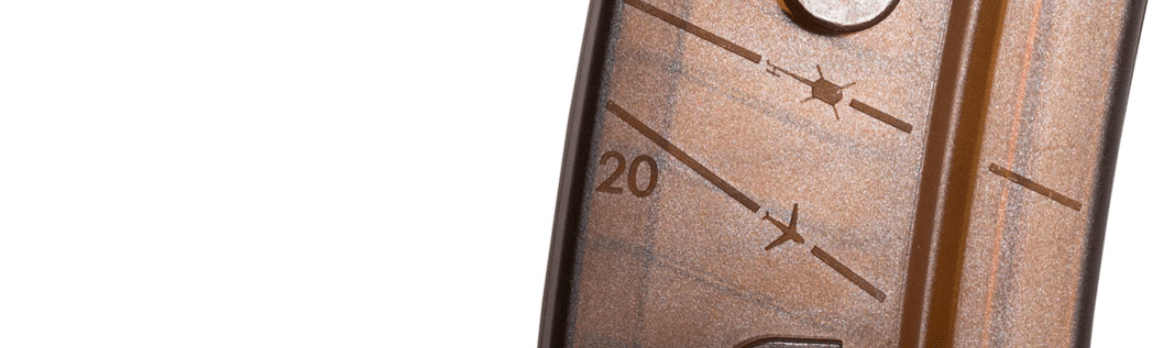
A peculiar feature of recent Turkish Armed Forces (TAF, also Türk Silahlı Kuvvetleri/TSK in Turkish) service rifles is a 21st century twist on the employment of small unit volley fire. To achieve this, TAF operational requirements have incorporated a rifle magazine-based schematic system that aids in low altitude anti-aircraft engagement procedures.
The HK33E is a 5.56×45mm self-loading rifle, a licensed version of Heckler & Koch’s HK33 which is produced in Turkey alongside the 7.62×51mm G3A7 infantry rifle. It entered service with the Turkish Armed Forces (TAF) in the 1990s. Both rifles are produced under license by state-owned MKE in Turkey. The HK33E is approximately half a kilogram lighter than the G3 and is also shorter in length. In TAF service the HK33E replaced the G3 where it is still issued today, despite mass production of the MPT-76. Numerous TAF soldiers have informally commented that they actually prefer the HK33E in use.
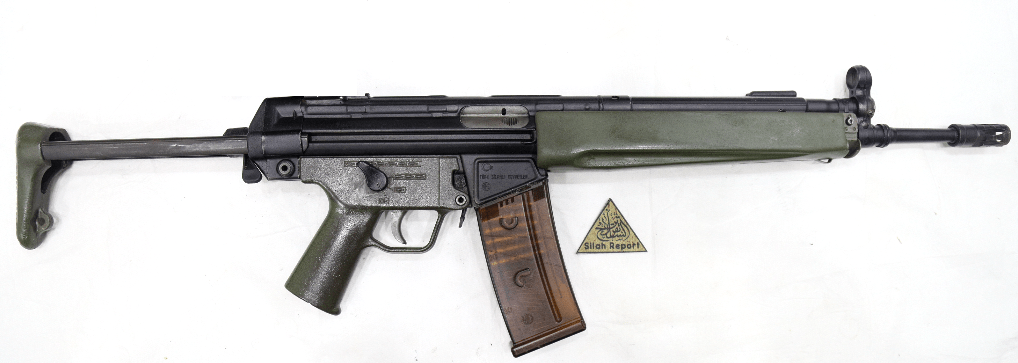
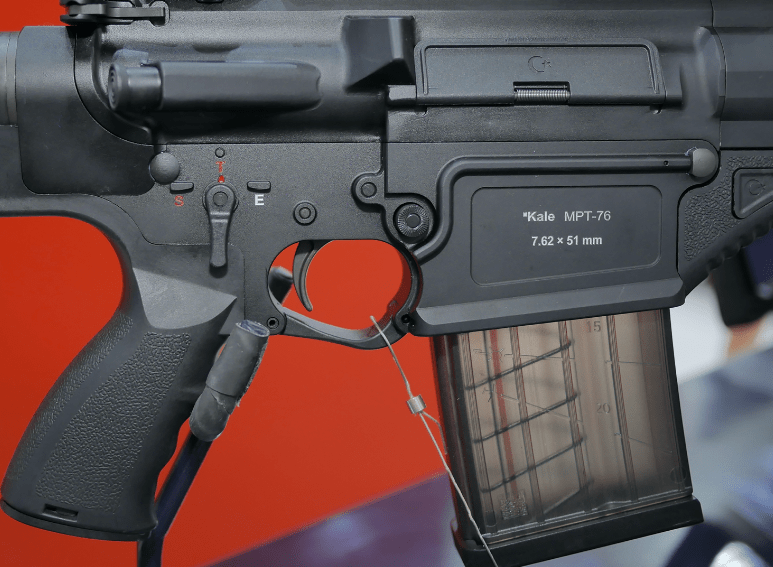
The MPT-76 (Milli Piyade Tüfeği-76/National Infantry Rifle-76) is an 7.62×51mm infantry rifle produced within the Modern Infantry Rifle project created by the Defense Industry Directorate in order to meet the TAF infantry rifle needs, replacing G3 and HK33E rifles in TAF service. A statement made in August 2019, stated that the number of National Infantry Rifles (the MPT-76) in use recently exceeded 40,000. Manufacture and shipments of these new rifles to Turkish forces continues.
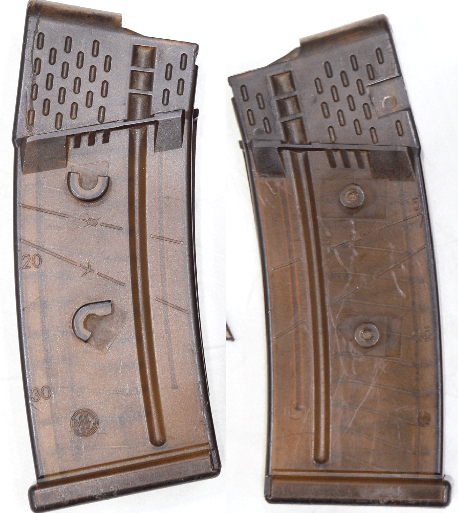
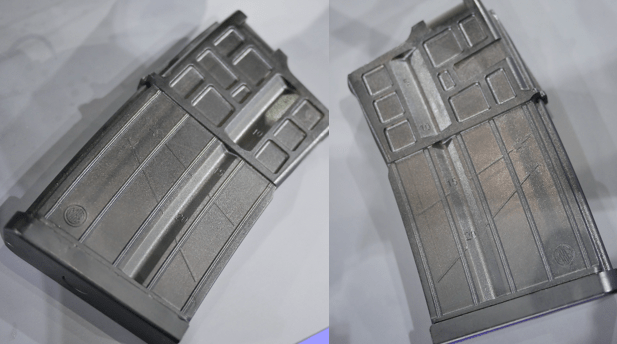
Both the new and earlier rifles are united by one unusual feature – anti-aircraft aiming marks on their magazines. Appearing on the MPT-76’s translucent magazines are two stadia lines that diverge at a 14-degree angle. The upper stadia line has a pictogram of a helicopter while the lower stadia line has a pictogram of an airplane. According to TAF sources, the purpose of these stadia lines is to aid in the engaging of low-level aircraft in flight.
The instructions given below have been shared by two TAF soldiers who served in different periods but corroborate each other in terms of the prescribed technique used. They have requested anonymity at this time.
How to aim at the aircraft is a different topic of discussion. The basis for this aim is volley fire and must be performed by a unit such as a squad or platoon, rather than an individual soldier, to succeed.
First of all, the soldiers kneel, for incoming aircraft they aim at the tip (nose) of the aircraft. This is where the lines on the magazine are used. They supposedly help the soldier aim the rifle and give the aircraft sufficient lead. The aim is to align the nose of the aircraft with these lines. Therefore, in such a situation, conventional sights are unnecessary while aiming at aircraft. It is determined which of the lines on the magazine will be used according to the incoming aircraft, whether it be a helicopter or aeroplane. After the line and aircraft are aligned, the soldiers begins to lean back as the plane approaches. As soon as they lie on their backs, they start volley fire. Depending on the situation, it is also said that tracers can be used. Two veteran accounts from the 1990s state the following:
“ 335 kd olarak egitimini islahiye 106. topcu alayinda yapmis olan askerlerdir bunlar. netekim karsidan gelen ucaklar icin tek dizin ustunde oturulur ucagin burnuna hedef alinir ucak yaklastikta sizde geriye dogru kaykilirsiniz, en son sirt ustu yatar hale geldikten sonra ucakla paralel hale gelip gadanallah diyip g3 piyade tufeginizle ateslersiniz. eger ucak sag ya da sol cenahtan geliyorsa sarjorunuzle hedef tayini yaparsiniz, sarjorde 3 adet cizgi bulunmaktadir bunlarin arasindaki mesafeki yanlis hatirlama ihtimalim vardir 2,5-5-10cm dir; 2,5 cm lik mesafe icin pirpirli ucaklar icindir tufeginizi ucagin sagdan ya da soldan gelmesine gore yan cevirirsiniz ve 2,5luk cizgiyi ucagin burnuna verirsiniz ve ucakla birlikle tek dizinizin ustunde donerek uygun konumda ateslersiniz, 5lik icin bombardiman ucaklarinda, 10luk ta ise jet ucaklari icindir.” [1]
Translation:
“This training is also given to the soldiers who have trained as 335 seniors in the 106th artillery regiment of Islahiye. As a matter of fact, you start in the kneeling position for oncoming enemy aircraft, and aim at the nose of the plane, you will slide backwards as the plane approaches. You will be parallel with the plane as your back touches the ground, and you will shoot with your G3 infantry rifle. If the plane comes from right or left flank, you can determine the target with your charge [magazine], there are 3 lines in the charge [magazine], the distance between them (I may remember wrong) is 2.5-5-10cm; For 2.5cm distance, you can rotate your handle [pistol grip] to the tip of the plane from right or left side and turn the line of 2.5cm to the nose of the plane, and freeze it on your knees with the plane and shoot in the proper position, for the bombers for 5, and for jet ends for 10.”
Today, many soldiers think that this training is just a waste of time and has no validity. Some soldiers even question why such tactics will be used when there are MANPAD systems such as the Stinger in service and they view this technique as ‘nonsense’:
“askerliği hava savunma olarak yapanlar bilirler ki bu eylem günümüz şartlarında kolpadır. yanındaki izbandut gibi eleman 40 kiloluk stinger ı ne diye taşıyo derler adama. tamam g3 mermisi deler geçer de düşman sana ikinci dünya savaşındaki uçaklarla mı gelicek kardeşim? stealth bomber ı çakarlar tepene, ruhun duymaz.”
Translation:
“Those who do military service in an air defense know that this action is kolpad (bullshit) in today’s conditions. Why is bulk with you carrying the Stinger then? Ok G3 bullet pierces. But will the enemy attack you with planes from World War II? You don’t even know when a stealth bomber is coming.”
Another explanation for this technique is to ward off enemy aircraft. An online user states that targeting or attacking enemy troops on the ground can be prevented or delayed:
“burada mantık, geniş bir alana rastgele yayılmış askerlerin aynı hedefe (daha doğrusu aynı bölgeye) ateş ederek baraj ateşi oluşturmalarıdır.
burada hedef, alçaktan uçan helikopterler ve düşük hızlı uçaklardır.
burada amaç, ille uçağı / helikopteri düşürmek değil, mümkün olduğunca “savmak”tır, yani yerdeki birliklere hedef almasını, saldırmasını engellemek ya da geciktirmektir.”[3]
Translation:
“The logic here is that soldiers shoot over a wide area by aiming at the same target (or more precisely at the same area) to form a volley fire. The target is low-flying helicopters and low-speed aircraft. The goal is not to bring down the plane/helicopter, but to “defend” it as much as possible to prevent or delay its targeting of attacking troops on the ground.”
As a result, even if standard rounds are used within an effective range, there is a chance that the pilot could become frightened of the incoming small arms fire. Of course, this tactic completely reveals the position of the troops, possibly due to the tracer rounds used in the course of the attack.
However, it is very difficult to believe that this method is in use today. The usefulness of the system is doubtful especially in asymmetrical, counter-insurgency warfare. It is very unlikely that an irregular force will have aircraft or helicopters in asymmetric warfare. At the same time, the regular Turkish army have much more advanced anti-aircraft equipment than infantry rifles.
It is also increasingly common to see technologically advanced anti-aircraft weapons in use with irregular, insurgent forces engaged in modern guerrilla warfare.
In addition, any irregular troops would not want to lower their mobility or reveal their position using such a technique, unless absolutely necessary. Furthermore, modern thermal vision technology can easily detect large bodies of troops long before an aircraft approaches them.
This is why some irregular foreces will use sniper and anti-materiel rifles if they have to organize an attack on an aircraft (especially helicopter) with a small arms, as they want to maintain their distance as much as possible.[4]
On the other hand, these diagrams and the training provided in using the magazines may have a psychological effect. When faced with enemy aircraft soldiers may feel helpless and panicked. The anti-aircraft volley firing may not be very effective but it does give conscripted soldiers something to focus on as a team during a stressful situation. some of the soldiers can panic and lose control. Those who receive and believe in this training may remain calmer in the belief they have something they can do when they encounter a possible enemy aircraft. This prevents the person from panicking and contributes to the continuity of the chain of command.
The purpose of this anti-aircraft volley fire training is to develop the infantry’s ability to act jointly in the most extreme combat conditions. Of course, this training can be ignored depending on the regions where troops are service. In conflict zones (especially in the Kurdish regions) where asymmetric models of war are valid, this training is not given to soldiers. Although this tactic is losing its validity with the developing technology, TAF acts with the logic of “hope for the best, prepare for the worst”.
Testing the Technique
The TAF method calls for shooters to be engaging aircraft that are flying directly overhead, over a soldier’s position. We tried testing this on a horizontal plane as overhead fire was not feasible at the shooting range we attended. As readers can see in the video below, there is no second focal point to correctly align the magazine stadia lines with a moving aircraft. Thus, the barrel is at an angle to the linear travel of the aircraft, making shots at any range at an angle to where the shooter ideally would want to place their point of impact.
This article was contributed by Yigit, a researcher tracking the armament of non-state armed groups to include IED tactics, techniques, and procedures.
References:
‘MPT-76 NATIONAL INFANTRY RIFLE’, SSB, <https://www.ssb.gov.tr/WebSite/contentlist.aspx?PageID=379&LangID=1>
Yıldırım, Göksel, 08/20/2019, ’40 thousand delivery success in the National Infantry Rifle’, AA.com, <https://www.aa.com.tr/tr/savunma-sanayisinde-yerli-silah-mesaisi/milli-piyade-tufeginde-40-bin-teslimat-basarisi/1560194>
[1]: Original quote: ‘shooter on the plane’, eksisozluk, <https://eksisozluk.com/entry/22775620>
[2]: OQF: ‘dropping aircraft with g3’, eksisozluk, <https://eksisozluk.com/entry/22775638>
[3]: OQF:’dropping aircraft with g3′, eksisozluk, <https://eksisozluk.com/entry/22775899>
[4]: ‘Military helicopter was opened in Hakkari’, T24, 2013, <https://t24.com.tr/haber/hakkaride-askeri-helikoptere-ates-acildi,232467>
Привет, вебмастера — кто уже сталкивался, зачем нужны входящие ссылки?
Поймал инсайт и понял —
всё SEO держится на ссылках.
Пробовал закупаться на биржах, но результат нестабилен.
Вышел на решение, о котором давно мечтал.
Кому интересно — зацените обратные ссылки .
Нашёл пошаговый гайд без воды.
Ссылки индексируются быстро и дают трафик.
Так что если ищете рабочий способ, рекомендую заглянуть.
Переходите и читайте, пока доступно
https://kwork.ru/smm/40414239/1000-podpischikov-v-telegram-chat-kanal-s-garantiey-30-dney-vygodno
WOW just what I was looking for. Came here by searching for
инновационный криптовалютный кошелёк http://mtthub.org/groups/life-after-%d0%bb%d1%83%d1%87%d1%88%d0%b8%d0%b5-%d0%ba%d1%80%d0%b5%d0%b4%d0%b8%d1%82%d0%bd%d1%8b%d0%b5-%d0%bf%d1%80%d0%b5%d0%b4%d0%bb%d0%be%d0%b6%d0%b5%d0%bd%d0%b8%d1%8f/