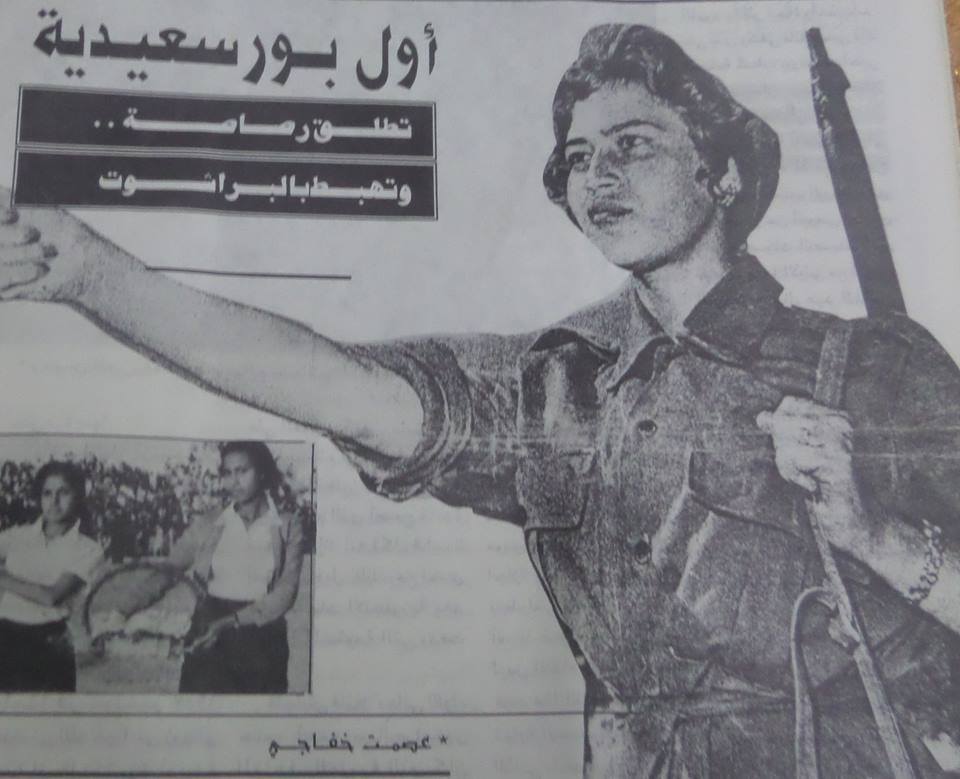
Whenever you think of female warriors in the Middle East, the very first thing that crosses the Western mind is the YPJ (Women’s Protection Units), an all-female Kurdish militia that fights with other Kurdish militias such as the YPG (People’s Protection Units). Of course, with the war raging against ISIS, and the terrible atrocities committed against women, the global media fixated their spotlights on the female warriors who fought tooth and nail against a patriarchal, barbaric and medieval-minded opponent.
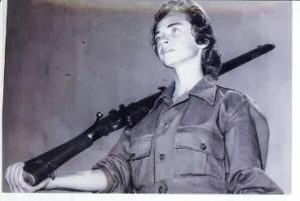 Within modern Arab history we have examples where women carried arms and fought as well.
In this article, I will cover one such incident which is about the Egyptian women who volunteered to join armed militias when Egypt was facing its darkest hour, with a tripartite invasion at its doorstep. They showed that women in the Middle East have the courage to rise against tradition and culture when they are forced to take action and contribute to combat.
On 26th of July 1956, Gamal Abdel Nasser (second President of Egypt after the Free Officers’ Coup in 1952) nationalized the Suez Canal. The nationalization led to an outrage in the United Kingdom and France. Secretly they both agreed with Israel to launch a sudden attack on Egypt, with Israel focusing on Sinai and the UK and France on the Suez Canal itself. The war began officially on the 29th of October and lasted nine days until American and Soviet pressure forced the invading countries to pull out. Israel was the last to pull out (March 1957) in addition to protests that occurred back in Tel Aviv against withdrawal. Before completing their withdrawal, the IDF carried out a scorched earth policy by destroying the infrastructure in Sinai and looting industrial grade machinery.
Before the war ended, the Egyptian forces and irregulars in the city of Port Said were pummeled by the Anglo-Franc naval invasion. The aerial bombing extracted a heavy toll on the defenders but nevertheless, they fought in most locations to the last bullet until they had to be completely destroyed by the French paratroopers or the British Royal Marines. The defeat of the regulars didn’t mean the end of the confrontations whatsoever, an infant insurgency was growing in the city of Port Said and if it wasn’t for the abrupt ending for the war, the insurgency could have grown to a massive scale. In the short period of the occupation, incidents of kidnapping and assassination against British officers have occurred.
Back in Cairo, Nasser focused on pulling most of his forces from Sinai so they wouldn’t get cut off by the Anglo-Franc forces from the back. Nasser had an incredible popularity amongst not just the Egyptian public, but also in the entire Arab world. Egyptians volunteered in droves to recruitment centers, men and women, young and old, to prepare for what they believed to be the inevitable scenario of Cario being invaded by the British and the French for the second time since the 19th century.
The Egyptian media played an important in focusing the spotlight on the young ladies who volunteered to protect their country and homes Most were equipped with a combination of British armaments such as the iconic Lee Enfield rifles, SKS semi-automatic rifles from the Soviet Union, and Lanchester submachine guns as seen in the following pictures.
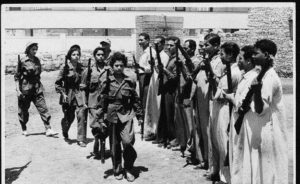
Notice the “Egyptian home guard” equipped with Lee Enfields. 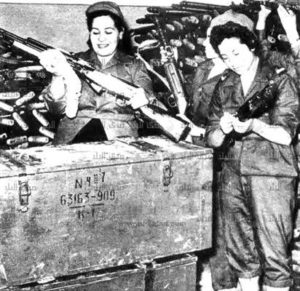
Both female volunteers are holding SKS rifles and a man behind them holding a Lanchester SMG.
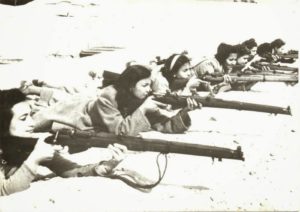
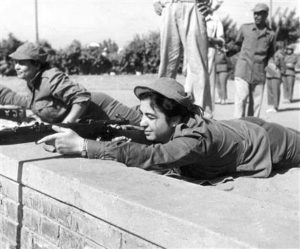
Marksmanship training with Lee Enfields
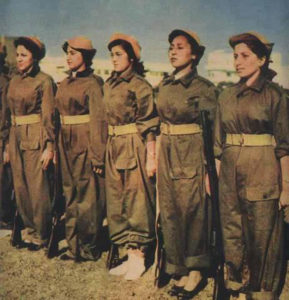
A very rare colored photo of female volunteers armed with Lee Enfields 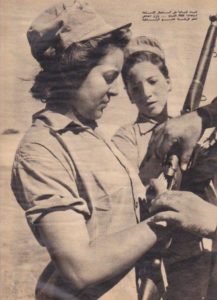
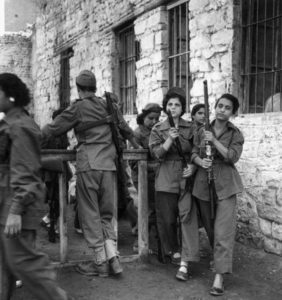
Ladies carrying Lee Enfields and a male soldier beside them armed with a Lanchester. 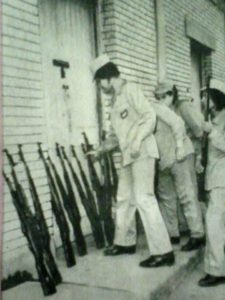
Due to the low quality of this photo, I believe the rifles appear to be SKS’s and Lee Enfields.
There are many other incidents where Arab women ended up carrying arms in modern history, ranging from the wars in Northern Africa, to Lebanese Civil War and the ongoing Arab-Israeli conflict. Even groups such as Al-Qaeda and ISIS have used armed women before, and no doubt we will see much more participation and contribution of Arab women in future wars of the region.