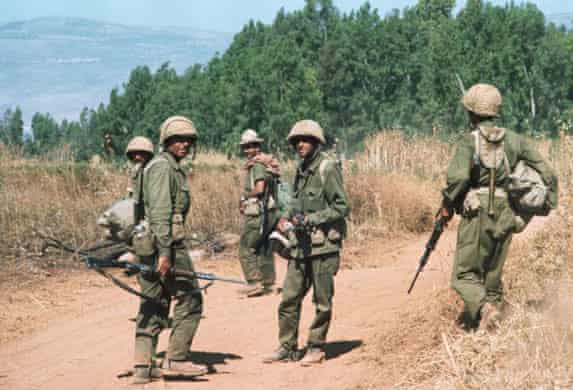
Welcome to the 29th episode of the Silah Report Podcast! We recently had the pleasure of speaking with Michael, a former veteran paratrooper in the Israeli Defense Forces who participated in the Yom Kippur War (known in the Arab world as The October War). Michael shared his experiences in the IDF starting with his training, which had a lot of surprises hidden for us, all the way up to his role in the Yom Kippur War in 1973. We also enquired about the types and origins of firearms he encountered during his service that his Arab adversaries had used. Later on, Michael would end up serving as a firearms instructor (specializing in Warsaw Pact weaponry) and after that a firearms specialist for a private firm.
Note: The views of the individuals we interview on the Silah Report Podcast represent themselves only and not the views of Silah Report. In Silah Report, one of our core tenets is to remain apolitical and unbiased when it comes to our research. Indeed, in Silah Report we have members from different ethnicities, religions, and political views. We do not let our personal convictions affect the quality of the content we provide to our audience and we do our best to provide you with the most accurate and unbiased information available.
If you’d like to have your questions answered by our panel during an edition of the podcast, please support Silah Report on Patreon and submit questions as often as you like! You will also gain access to longer version of the podcast.
Check out the podcast here and listen along with the photographs below!
https://soundcloud.com/silah-report/v29-michael-the-idf-veteran-of-the-yom-kippur-war
Podcast Running Order:
Introduction
Paratrooper Training- “Terrible Marksmanship”
IDF- “Money Vortex, Innovative Initiative, and Family Cohesion”
Uzis and FALs
The Yom Kippur War
Introduction
Michael joined the IDF in November 1967 and managed to join a paratrooper unit. He explained that he would always seek to stay as far as possible from home even if it meant switching to another unit. During the period that came after the Six-Day War and the Yom Kippur War, Michael would have been in one of the forts built on the banks of the Suez Canal and all the way out in one of the bunkers on the Jordanian front. Michael said that he actually witnessed the Jordanian army fighting the PLO (Palestinian Liberation Organization) in an event that will go down in history as the “Black September” which began on September 1970. Before the Yom Kippur War, Michael was discharged and decided to continue his studies at a university. Later on, he would return to the IDF as a junior officer. When the Yom Kippur War erupted, Michael found himself fighting on the Syrian front for an extremely brief period of time before getting relocated to Sinai and from there to Egypt’s mainland.
Infantry Training- “Terrible Musketry”
Michael surprised us with details no one would expect to be attributed to the IDF, terrible marksmanship. According to Michael, before the arrival of Mickey Hartman, a senior IDF officer who carried out a massive overhaul to small arms training, marksmanship was not emphasized in training. Most Israeli riflemen at the shooting range would fire around three rounds from their issued firearm (which in most cases was the Israeli variant of the 7.62x51mm FN FAL self-loading rifle, known as the Romat). Mishandling of firearms and negligent discharges were extremely common as well. Michael would end up at one point being a range officer given his experience with firearms during his childhood as his father was a high ranking military officer.
IDF- “Money Vortex, Innovative Initiative, and Family Cohesion”
Michael explained to us the “triangle” that basically summarizes the IDF. The IDF, especially during the height of the Arab-Israeli conflicts, had an extremely limited budget and hence the IDF would end up having to limit ammunition consumption for training and purchased used rifles. Another element is the innovation and the initiative; the IDF has always encouraged initiative amongst its members all the way down the hierarchy reaching ‘grunts’ [private soldiers]. If a private had an idea that is better than that of a general, for example, he would not fear speaking out his mind, unlike many other militaries where such an act might have heavy consequences especially if your thoughts do not match that of your superiors. Innovation is also considered a keystone in the IDF and combined with initiative, it helped the IDF adapt very quickly against new challenges they would face on the battlefield rapidly (such as tactical countermeasures to the threat of ATGMs).
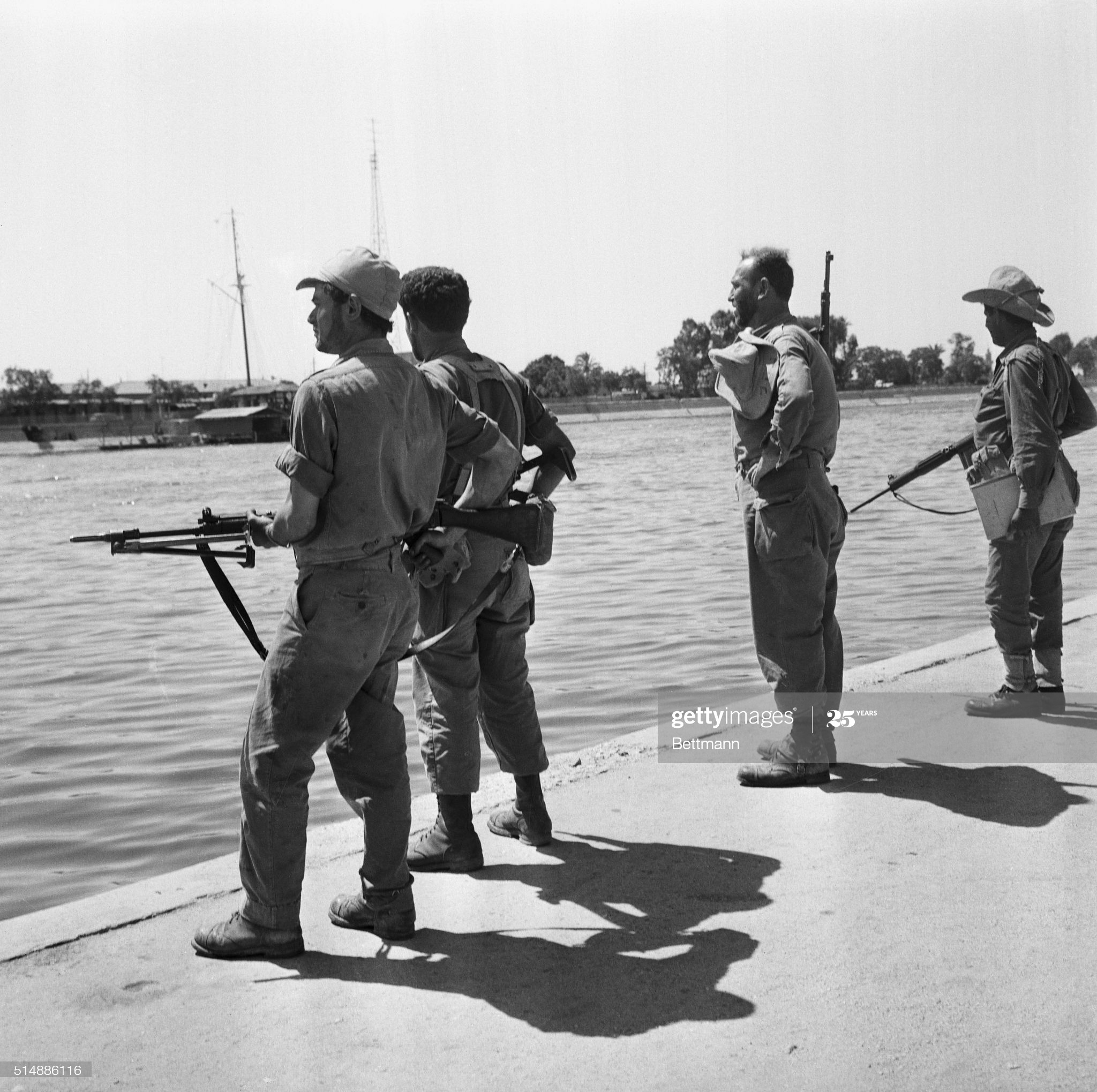
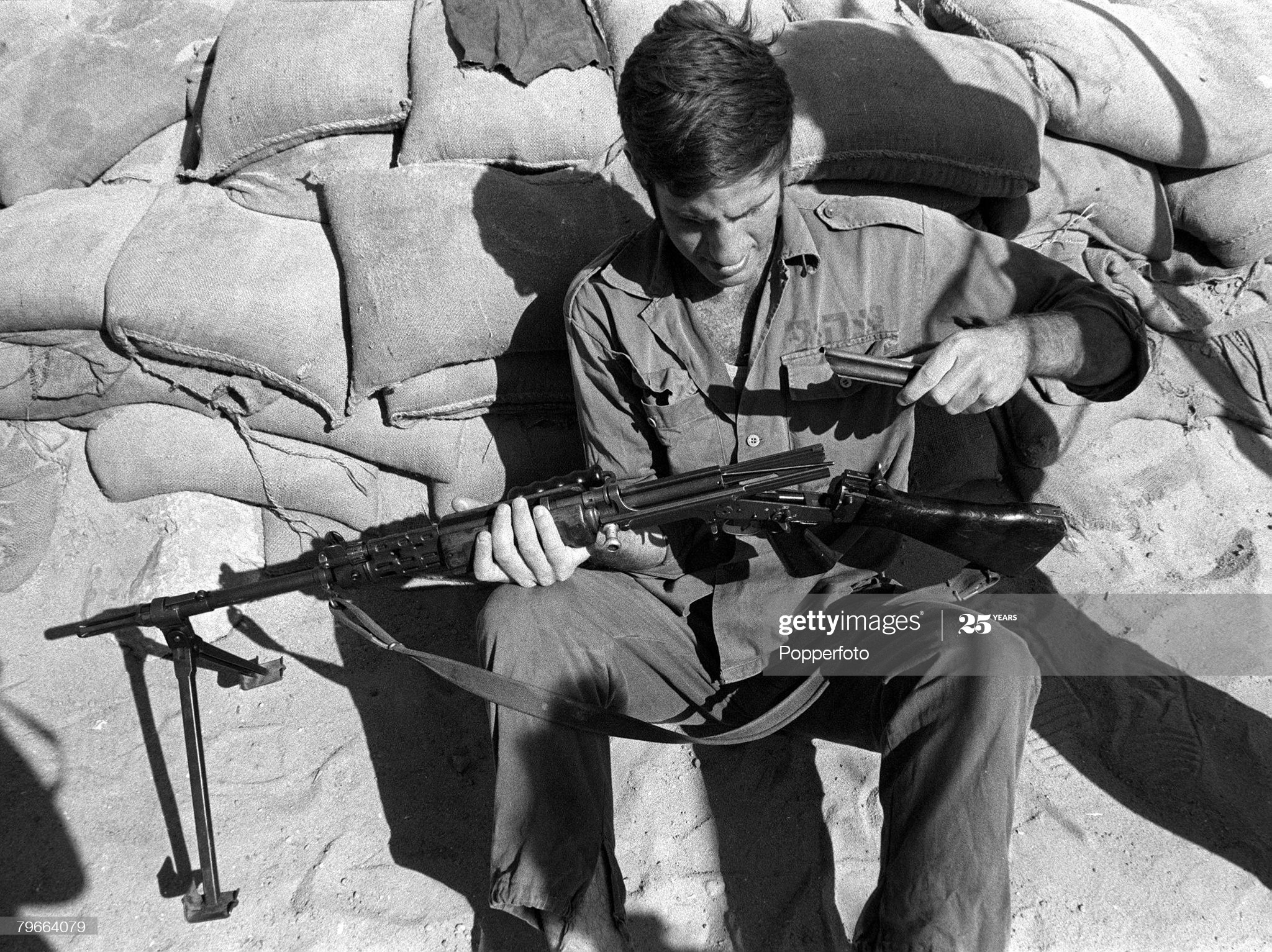
Miles inquired about various topics related to firearms and night battle tactics and improvisations which Michael was happy to discuss. For Michael, he would pick the Uzi, 9x19mm submachine gun, if he had to choose between it and an HK MP5. The Uzi in his eyes is a reliable firearm as long as you are not using it beyond its limited range. In terms of the classic IDF infantry rifle of the period, the 7.62x51mm self-loading FAL rifle, he said “it works” as it does its job in engaging enemy infantry effectively at long ranges (for typical riflemen) but it was very heavy, and environmental changes affected its performance. Michael went on to discuss firearms and the captured enemy weapons prior to the Yom Kippur War.
When the war erupted, Michael was attached to a reserve battalion that would be deployed to the Egyptian front, but before that Michael explained that he and his comrades ended up initially fighting on the Syrian front while they were not supposed to be there and were eventually relocated. Michael did not get involved in any major battles during the war or any intense skirmishes but managed to see captured ex-Egyptian firearms from previous intense fighting especially the infamous “Chinese Farms”. He saw a lot of 7.62x54R SG-43 medium belt-fed machine guns, 7.62x39mm AK-pattern self-loading rifle variants, RPD light machine guns and Mosin-Nagants bolt action rifles. Pistols were highly coveted by the Israeli troops and unfortunately, he was not able to find one. He was stationed on a mountain in Egypt called “Ata’qa” which overlooked the city of Suez. Michael was not involved at all in the Battle for Suez city but he would engage Egyptian logistic boats at night trying to reach the besieged Third Egyptian Army. According to Michael, he came under artillery barrage more than direct gunfire and his unit suffered very light casualties. His unit was the very first unit that was supplied with M72 LAW anti-tank weapon, which he states was very effective at taking out infantry in open spaces and dealing with certain armored vehicles such as the T-34. He actually fired an M72 (lost it due to action as he said) at a derelict Egyptian T-34-85 and he was impressed by the results. The ceasefire was enforced on the 24th and that was it for the Yom Kippur War (or was it?). Michael gave us his thoughts on Dayan, who was seen as a legendary war hero especially after the Six-Day War, but apparently not all Israelis liked him even before the Yom Kippur War.
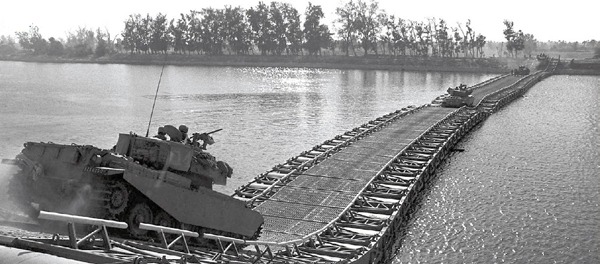
Fig. 1.3. IDF’s Centurion tanks crossing a rolling bridge to the other side of the canal during the war. (Source: G73 Historians)
We will have another episode with Michael as we still have tons of questions for him and if you want to get the extra details then make sure to check the SoundCloud recording and support us on Patreon for access to the full interview!
Patreon
If you want to support our work on researching small arms and light weapons in the MENA and Central Asian regions, please consider joining our Patreon support network that allows us to get articles, videos, and podcasts such as these to an international audience. Check us out at www.patreon.com/SilahReport
The Izzy FAL charging handle doesn’t “move so you can thump it and clear a double feed”. It was, however, a just-as-ill-conceived way to have a forward assist. If you look on a proper Izzy FAL carrier, there is a notch in the rail that the handle pushes into. That allows you to manually push the carrier forward.