The Legend of the Egyptian Thompson

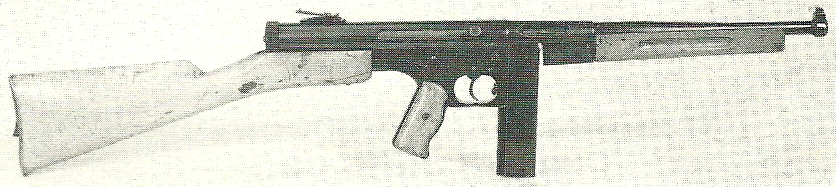
There is a one of a kind Thompson submachine gun variant that remains hidden from the public eye for more than fifty years at the National Firearms Centre in the United Kingdom (NFC catalog reference page here). The so-called “Experimental Egyptian Thompson” caused a lot of confusion and rumors to spread about Auto Ordnance and Kilgore Manufacturing Company for years but the mysterious Thompson’s mystery was finally resolved.
This is the picture of the Egyptian Thompson, and before I get into the details of the “Silah” (weapon, in Arabic, the more you know!), here is what was written on a small arms enthusiast’s website–

“An Egyptian-manufactured Thompson submachine gun copy made in the early 1950’s. The barrel is an original Thompson barrel made by Auto Ordnance Corp. but everything else was made in an Egyptian state factory. It is of poor quality. Interestingly, the body is cylindrical rather than rectangular, and the cocking is on the right side.”

According to the description, Auto Ordnance was in one way or another, involved with this Egyptian prototype, but according to an article written in Small Arms Review, “The Kilgore Manufacturing Company, Westville Ohio” by an author named “Tom Davis, Jr”, that’s not the case at all. Initially, the article mentions a book written by Thomas B. Nelson called “The World’s Submachine Guns” where he mentions the weapon in question and calls it “Experimental Egyptian Thompson”, that it was produced in the early 1950’s and had an Auto Ordnance markings on the top of the receiver!

The author of the article goes ahead and proves that Auto-Ordnance wasn’t involved and there are no markings for the company on the receiver whatsoever. He mentions a British firearm research known as John Cross who checked the weapon out in the NFC who had the following to say on the weapon as the article quotes him-

“This submachine gun is very crudely made. There are no markings or numbers of any sort on any part of the gun. The gun pictured in Mr. Nelson’s book is indeed the same gun as on display at the National Firearms Centre. There is no background information on this gun at the Centre. However, a careful study of the Register of Firearms at the Centre indicates the acquisition would have been in the 1956 timeframe, around the exact time of the Suez Campaign of 1956…”

Along with additional pictures posted on the article’s website for the dismantled receiver, we can safely presume that indeed, Auto-Ordnance had nothing to do with this Thompson.

Mr. Cross went ahead describing the weapon down to its smallest detail-

“The buttstock appears to be sawed off from an Italian Carcano rifle and has a poorly fitted alloy No. 4 butt plate. The foresight is similar to the Thompson Model M1A1 but homemade, and the rear sight is taken from some old military rifle, possibly a Martini. There is no provision for semi-automatic fire. It contains only two Thompson parts, the magazine and barrel – which is screwed only hand tight into the receiver. The extractor and the front part of the reduced diameter of the bolt have been brazed on the rear section of the bolt and then badly case hardened in an open furnace. The firing pin is machined into the breech face of what could possibly be the front section of a M1A1 Thompson bolt. Interestingly, the mainspring cap is the sawed-off base of an EC 43 steel .45 caliber ACP casing. The mainspring was either originally not long enough or had broken and had been brazed together. The bolt body consists of a rear section of several sections welded together. The pistol grip is a machined block with the grips made of several sections of 1.5mm steel welded together in the same style as a Lewis gun. Despite appearances, the magazine catch is not from a Thompson gun.”

In classic British humor, he stated the following “As I had not remembered to bring my suit of armour or safety glasses with 1 inch thick glass, no attempt was made to fire this weapon!” The “silah” sounds like a real DIY (Do It Yourself) Middle Eastern firearm, and probably one of the first in the 20th century!

In the end, this was a “Thompson-ish” weapon made and used to fight the Anglo-French occupation of Egypt and as I am Egyptian and therefore biased as hell, unfortunately, I see it as a crude weapon made that is a manifestation of Egyptian willpower to fight back. True, Egypt was invaded and occupied by almost every superpower or major civilization throughout history, but there are Egyptians, who are willing to stand up and fight back although all the odds are against them. On the other hand, you might see whoever made that weapon as a brainwashed patriot who fought for the wrong cause. Perhaps one day I might be able to see the silah in person.
A Look at the Hakim Service Rifle within Modern Egyptian Memory

This post has been written by a friend of the Silah Report, Adham S. Adham is a native Egyptian himself who has taken a look at the Hakim service rifle through the lens of a historic relic in modern Egyptian history. He runs an excellent Twitter feed called Bewildered Arab.

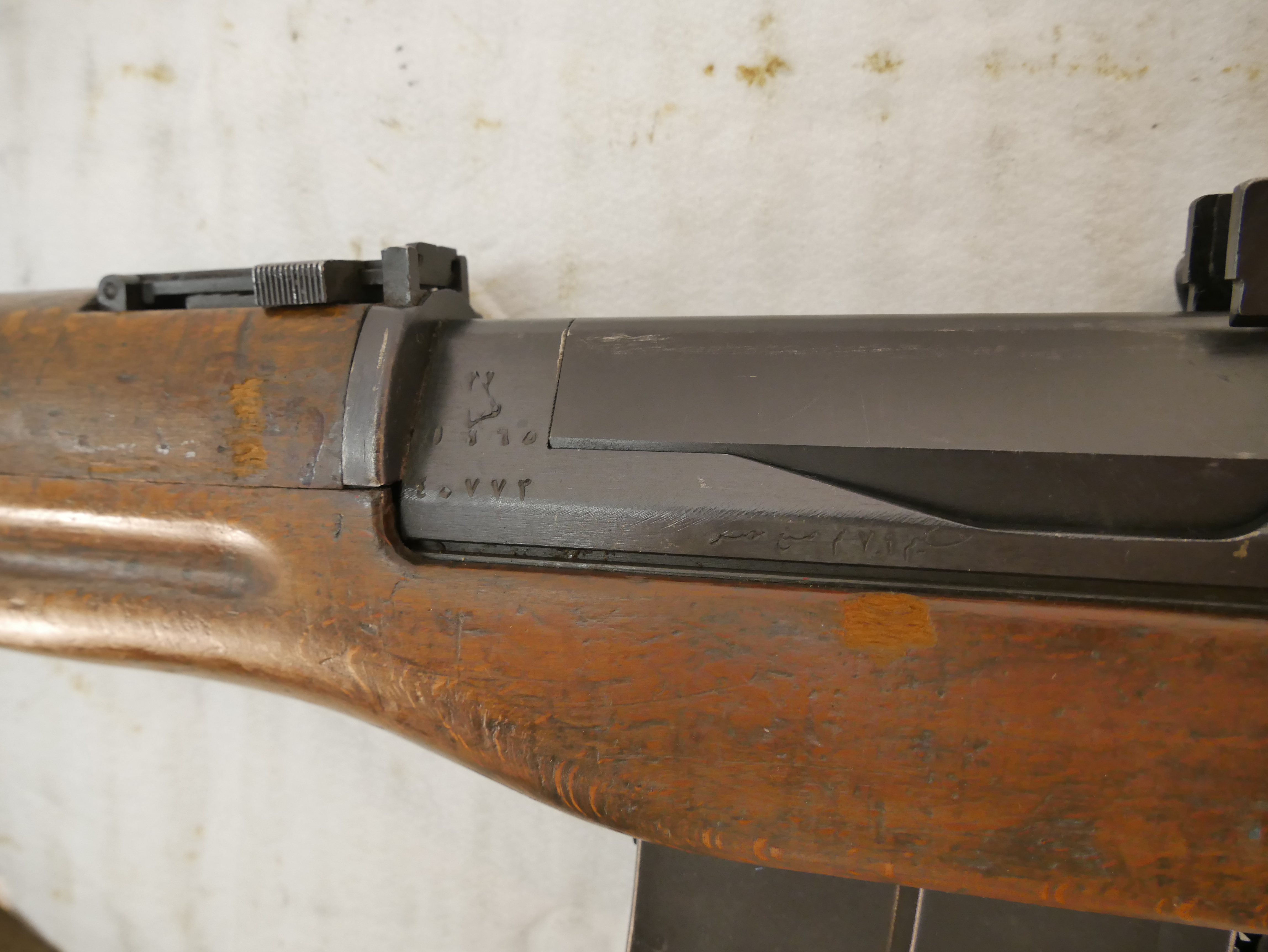
A relic from the past, Hakim used to be the standard rifle in the Egyptian armed forces before Egypt switched to the 7.62X39. Chambered in 8mm Mauser, it’s a very deadly and accurate semi-automatic rifle. The rifle now is considered a Curio and Relic firearm by the United States’ Bureau of Alcohol, Tobacco, Firearms and Explosives. Indeed, its design is ancient, the rifle now belong in either a museum or some firearm owner who seeks to add yet another exotic rifle to his collection. Some take it out to the range on a good sunny day, some just have it stored up collecting dust. Either way, they can’t access the Hakim’s secrets. I am not speaking about its physical design or the tools used to manufacture it, but something else. The “soul” of the rifle itself is what they will never be able to touch, feel, or embrace. They aren’t native Egyptians, and no matter how badly an owner loves the rifle, he will never be able to synchronize with its soul. Go hand the rifle to an uneducated Egyptian peasant who got conscripted and given run of the mill Maadi AKM and tell him “This rifle, your country made that rifle.” Once you have seen the look on his face, you might perhaps find some sense in what I said.

Why though? Why the Hakim? Egypt’s military industry produces a variety of weaponry and munitions, what’s with the attachment to the Hakim. Even before the Hakim’s creation, Egypt used to manufacture armaments, why specifically the Hakim? I would chuckle at first if someone asked me that, then I might proceed to fail to contain my tears as I try to provide an answer. That rifle, was born with Egyptian hope, dreams and ambitions embedded into it. Egyptian workers in the Factory passed on all of that as they were producing the rifle. All of that became part of the rifle’s soul. The rifle became an embodiment of the bright future the Egyptians believed that one day it will become a reality.  A reality never came, but what came was conflicts and battles, from the never-ending series of mountains in Yemen, a top cliffs and in villages, facing hordes of royalists charging like a Human tide, to snipers hiding behind ever rock and inside every cave. To the hot deserts of Sinai, where the Sun is as ruthless as the IDF’s armor blitzkrieg.

What came after the wars was worse, corruption, decadence, collapse of education, nepotism, cronyism at every level of society, downfall of logic and reason that coexisted with faith to the backward mentality of Wahhabism that almost monopolized faith due to Saudi oil money. Terrorism and insurgency due to all the reasons mentioned previously and that’s just for starters. Economy is collapsing faster than any Egyptian can blink, apprehension for the crime of expressing your views is even faster.

What can we do? What can I do? I turned my head while asking these questions and saw my imaginary Hakim resting on the wall beside the door. I can feel it staring at me, at us, the rifle might not be perfect, but it didn’t fail us, we failed it. I have yet to find someone who complained about the quality of the Hakim. The Hakim, even with its flaws, was made to be a survivor of battles, no matter how many warzones it witnessed, it will still be a reliable weapon that could save it user’s life. The rifle knew what it was made for, to defend our future, no matter how terrible or how many warzones it must face. The rifle’s design might have been purchased from Sweden and the tools, but it was built with Egyptian hands and filled with our dreams. The very dreams my people betrayed.

We had the chance of becoming a developed nation, we had the chance of becoming a beacon for hope in a region overwhelmed with wars, diseases, corruption and ignorance. We could have been better, this rifle proves it, and the HA-300 project proves it. The Hakim feared it might become incapable of fulfilling its role, but with all its wisdom “Hekmah”, it couldn’t have foreseen our failure.

The sadness overwhelms, the Hakim doesn’t ask you, the Hakim doesn’t bother you, but it bothers us. It will keep haunting us until we become better. The rifle will keep asking why, until someday in the future, in the hot sands of Sinai, cities are built, factories are built, we no longer depend on the fragile tourism, and a well-educated regular marksman with a DMR “Hakim-2” stands at his post staring towards the East and believes deeply inside of him, when the time calls, the Hakim-2 will not fail him, Hakim-2 will keep on its ancestor’s path. Till then, the sadness overwhelms and the shame is heart ripping.