This guest article is written by Christopher Cowan, an avid reader and supporter of Silah Report.
Alongside Brown Bess muskets and Lee-Enfield pattern rifles, Martini pattern rifles are perhaps one of the most iconic and ubiquitous guns of the British Empire. First fielded in the 1870s, the Martini-Henry saw service in all corners of the Empire, from the plains of the Serengeti to the peaks of the Hindu Kush.

A single shot rifle, the Martini Henry utilizes a falling block action. It is chambered in the rather burly .577/.455 Martini Henry, a .45 caliber round-nosed slug fitted into a necked-down .577 Snider casing. The Martini Metford and Martini Enfield were the natural progression of the platform. Both firearms utilize the same falling block action, merely rechambered and/or rebarreled in .303 British. By the time they were fielded in the mid 1880s, they were of little practical use to frontline combat units given the adoption of the magazine-fed Lee-Metford (1).
That said, both the Martini Metford and Martini Enfield saw continued use among local colonial forces, as well as by civilians as sporting rifles (2). Perhaps owing to its proliferation, reliability, and simplicity, Martini-pattern rifles existed long past their official retirement as a service rifle. Widely manufactured and traded across the Middle East and South Asia for a good deal of the 20t h century, these rifles saw usage among irregular fighters as late as the Soviet invasion of Afghanistan. While likely the last time Martini-pattern rifles saw any serious usage in armed conflict, examples continue to turn up on occasion (3).
The proliferation of Martini-pattern rifles throughout South Asia is a subject for another article if not a book. Beyond Afghanistan and Pakistan, Martini-pattern rifles have remained prolific in the Sultanate of Oman. Martinis are as common a sight in souvenir shops in Muscat’s Sooq Mutrah as they are for sale alongside other assumedly functional firearms in Nizwa Sooq.


Given Oman’s history, the widespread presence of the Martini-pattern rifles is understandable. Oman has historically occupied a major crossroads of Indian Ocean trade; at one point the Omani Empire itself stretched from Zanzibar off the coast of modern-day Tanzania to Gwadar, modern-day Pakistan. At the center of this empire was Muscat. Even following decline in imperial power and prestige, Muscat remained an important center for trade well into the early 20t h Century. Trade in all manner of goods, including weapons, was largely unrestricted; Muscat subsequently grew into a major regional hub for arms trading at the turn of the century (4).
While the early Twentieth Century marked a high-point in the proliferation of Martini-pattern rifles in the Arabian Peninsula as well as South Asia, Martinis remained popular weapons in Oman until rather recently. There are cases of them being used to hunt the now-protected Arabian Oryx in the 1960s, as well as documented cases of their use by irregular fighters in the Dhofar War during the 1960s and 1970s (5).

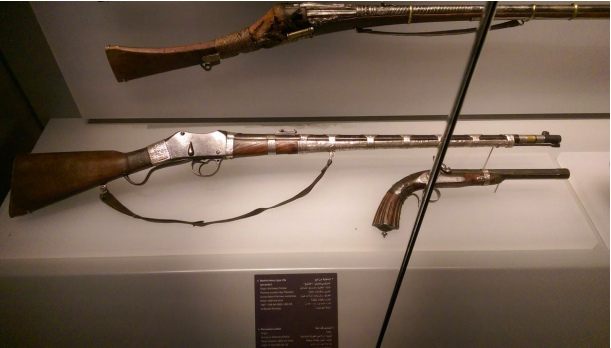
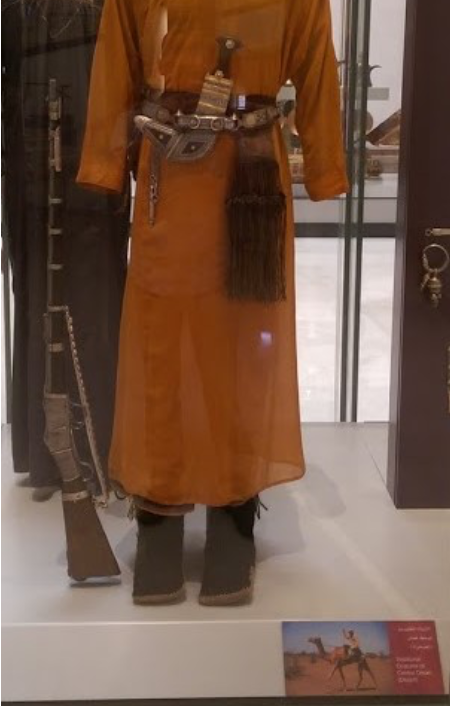
To this day, it is possible to occasionally see Martini-pattern rifles toted for ceremonial as well as practical purposes. In Dhofar, for example, shepherds can be observed carrying Martini-pattern rifles to protect their animals from predators. As a ceremonial piece ornately decorated Martinis are a commonplace, as are their accompanying cartridge belts. Both are often highly decorated, and frequently observed for sale to tourists. Good examples of both can also be observed in the National Museum in Muscat.


Examples of Martini-pattern rifles and cartridge belts at the National Museum in Muscat, Oman. Photos by author.

Despite being outdated by modern firearms technological and doctrinal standards, the Martini-pattern rifle has persisted long past its official military retirement in both a practical and cultural capacity. There just as much to be said of the simple elegance of the design as there is the skill required to use one effectively. Likewise, the continued prominence of the Martini-pattern rifle in Arabian firearms-culture alongside other weapons speaks to the eminence of the rifle.
Sources
(1) Rifles and Machine Guns
(2) Rifles and Machine Guns
(3) https://atwar.blogs.nytimes.com/2010/12/10/rifles-of-advanced-age-remain-in-use-in-afghanistan/
(4) R.M. Burrell 10; Arming the Periphery 116 5 Oryx Martini; 9781780969053
Works Cited
Burrell, Robert M. “Arms and Afghans in Makrān: an episode in Anglo-Persian relations 1905–1912.” Bulletin of the school of oriental and African Studies 49, no. 1 (1986): 8-24.
Cashner, Bob. The FN FAL Battle Rifle. Botley, Oxford: Osprey Publishing, 2013.
Chew, Emrys. “3: The Arms Trade in the Western Indian Ocean.” In Arming the Periphery: The Arms Trade in the Indian Ocean during the Age of Global Empire, 98-159. Basingstoke (GB): Palgrave Macmillan, 2012.
Chivers, C.J. “One Way to Retire an Old Rifle.” The New York Times. December 10, 2010. Accessed June 02, 2018.
https://atwar.blogs.nytimes.com/2010/12/10/rifles-of-advanced-age-remain-in-use-in-afg hanistan/.
F, Nathaniel. “Jumping The Gun (Literally): Saudis Dancing With Guns.” The Firearm Blog. August 12, 2015. Accessed June 02, 2018. http://www.thefirearmblog.com/blog/2015/08/12/jumping-the-gun-literally-saudis-dancin g-with-guns/.
Fowler, Will, and Patrick Sweeney. The World Encyclopedia of Rifles and Machine Guns. London: Anness Publishing, 2007.
Keohane, Alan. Bedouin: nomads of the desert. Trafalgar Square, 1994.
Leung, Canice. “Jumping the Gun | Pictures.” Reuters. August 11, 2015. Accessed June 02, 2018. https://uk.reuters.com/news/picture/jumping-the-gun-idUKRTX1NTN7.
Loyd, M. “The Arabian oryx jn Muscat and Oman.” African Journal of Ecology 3, no. 1 (1965): 124-127.