This guest post was written by Marcello Fantoni, an avid reader and supporter of Silah Report.
“The question is not about the weapon, but the spirit in which you use it.”(1)
For those raised within the dichotomous paradigm of Westphalian war and peace, war is the end of sociability, the exhaustion of every social recourse. Likewise, when that war is over, and sociability is said to return the memories of fracture become encased in temporal and Cartesian distinctions, the material culture of conflict sequestered to the appropriate sterile cases in the vaults of armouries and museums. Yet, conflict is inherently and inescapably sociological (2). It is the birth of a new form of sociability, on the level of both the individual and the collective, and this is a relationship in which the material culture of conflict retains an agency beyond the moment of fighting itself. It is not a relic but becomes the assurance against repeat and symbolic of the new addition to the cultural history and citrisis of a society. We have seen time, and again that material culture is good for thinking, feeling and expression, even eating and drinking (3), but we must, however, remember that it is also for fighting.
Conflict and the conceptualising, organisation and negotiation of it are shaped by the society which engages in it, and the community itself in is turn influenced by it. Conflict and its material culture become inexorable parts of the society’s post-conflict identity, having a fundamental impact on the ordering of the post-conflict reality (4). In this change, the material culture which provided the means to act for the individual attains a symbolic position. It may bestow both a new social life and physical death. Through the analysis of how specific weapons have come to be identified with cultures and the role of conflict in that culture, we shall see that those weapons are far more than the nefarious amalgamations of elements, but intrinsic parts in the development, manipulation and organisation of a society from both the emic and etic perspective. The thick sociological (5) description of the tools which both create and destroy sociability. The voice of the gun.

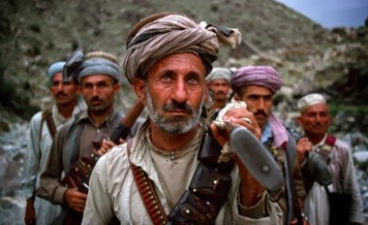
In Central Asia and the Caucuses, firearms have become ingrained in the identity of societies, for many as a response to the years of oppression under successive regimes, but also as part of customary law and social differentiation. But, the adoption of these weapons also reflects the rebirth of an often constructed martial tradition and ideology which often idealises of a fictive golden historical age as a central rallying point for future conflicts. Military traditions are written deep into their histories, and those histories are contained in the weapons which come to symbolise them. In Chechnya and Dagestan, the APS Stechkin machine-pistol has replaced the Shalt Kama traditional dagger and is illustrative of the independence movements of the 1990s and early 2000s as a high-status prestige item linked to the presidential guard of Dudayev and Maskhadov. But, its concealability also reflects the banditry which was born of those same conflicts. For the ethnocultural group of the Cossacks, the traditional Nagaika whip now serves side by side the AK-74M as their identity as an irregular military force is becoming ever more tied to their exploitation as the Russian State’s ready supply of disposable mercenaries and the new Tsar’s enforcers (6). For the cultures of the Northwest Frontier, the AK-74SU and Glock pistols as prestige pieces have usurped the venerable Enfields and Jezails, reflecting both the recent history of the region since 1979 and the preferences of FATA’s ever more discerning customers. Yet, constants remain, the Kukri of the Gurkha and the Kirpan of the Sikhs. Though, for both the colonial manipulation of the, as a “martial race” was born of their use of the 1856 Enfield rifle, which set them apart from the bulk of the British Indian Army who revolted in 1857 over the rumour that the bullets were lubricated with the fat of pigs and cows. Abhorrent to Muslims and high-caste Hindus, but not to the Gurkha and Sikhs.
Through the analysis of the social function and conceptualisation of weapons and those who use them within Central Asian and Caucasian societies, we shall see how they have become inexorably linked to both the past and present of a culture and how it is viewed internally and externally.
Marcello Fantoni can be reached at Marcello.p.a.fantoni@gmail.com
Sources
______________________
(1) Thoreau, H. D. 1860. The Echos of Harper’s Ferry.
(2) Richards, P. 2005 (ed) No Peace, No War: An Anthropology of Contemporary Armed Conflicts. Oxford: James Currey.
(3) Douglas, M. and Isherwood, M. 1979. ‘the world of goods’. London: Allen Lane.
(4) Hallpike, C. R. 1973 Functionalist interpretations of primitive warfare, Man (n.s.) 8/3, 451-70
(5) Geertz, C. 1973. ‘The interpretation of cultures’. New York: Basic Books.
(6) RFE/RL. 2018. Cossack Fighter Laments Russian ‘Utilization’ Of Mercenaries In Syria. https://www.rferl.org/a/syria-Russian-mercenaries-cossack-shabayev–interview/29056934.html. Retrieved 03/05/18.
Suggested Readings.
• Jersild, A. 2002. Orientalism and empire, North Caucasus Mountain Peoples and the Georgian Frontier, 1845-1917. McGill-Queen’s University Press.
• Bourgois, P & Scheper-Hughes, N (2004) ‘Introduction: Making Sense of Violence.’ In Scheper-Hughes, N & Bourgois, P (eds) Violence in War and Peace: An Anthology. (Oxford, Blackwell, 2004)
• Lee. E. W. 20110. Warfare and culture in world history. New York University Press.