In his first guest post for Silah Report Daniel Casingena looks at a 19th century Italian revolver which recently surfaced on social media and reportedly originated in Libya.
This is an interesting find from Libya. The photograph was forwarded to me by AnalystMick, (whom I would like to thank for making possible my first written contribution to Silah Report). The Bodeo Model 1889 was designed by Carlo Bodeo in 1886, as a double action 6 shot revolver chambered in 10.35×22 rimmed using black powder as its propellant. It features a hexagon shaped barrel, a folding, rather than guarded, trigger and a loading gate. These looks draw on the lines of the then popular Chamelot Delvigne Model 1874 revolver, itself used by and renowned among the Italian Army as a robust and practical design. Bodeo, however, made key changes to the original Model 1874, consisting of a reduction in size and weight as well as the omission of certain components to simplify production that gave it its final and unmistakeable look.
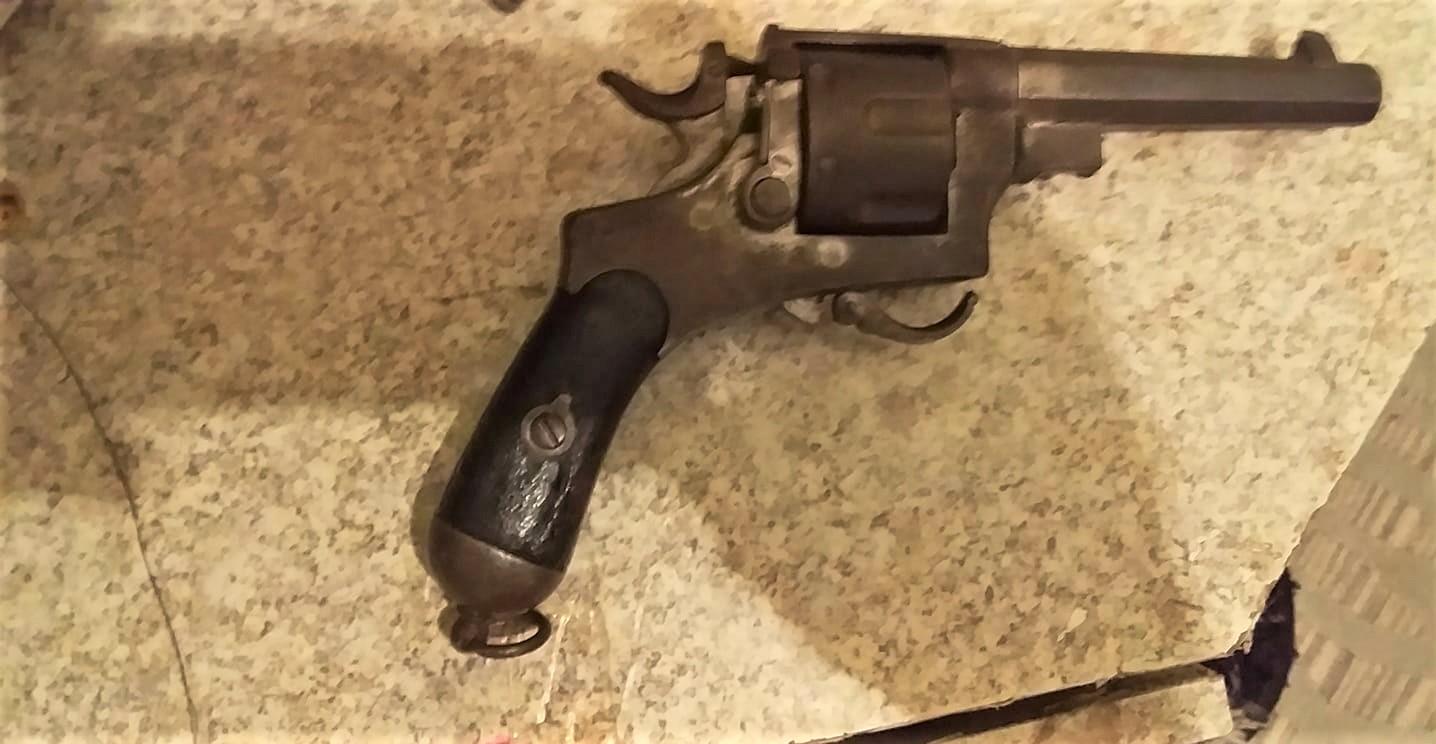
As a result of these changes the Model 1889 weighed 800g compared to the Model 1874’s 1.1kg and was about 50mm shorter in length. Familiar components missing on the Model 1889 were the trigger guard, as well as the fixed ejector rod, replaced in this case with a detachable one, which often got lost, as is probably the case with this example. A takedown knob, however, was added on
the left side of the frame (not visible in this picture) which allowed the side plate to be opened without the use of tools. The revolver’s most distinctive feature is its folding trigger which
made it more compact for storage in holsters. It is worth noting that a more elaborate ‘officer’s model’ was also produced with a rounded barrel and a trigger guard. A ‘lightweight model’ with an even shorter barrel was also available.
An observation about the designer himself, Bodeo also happened to be the head of the Italian Firearm Commission who, in 1889, selected this revolver to become the standard issue
sidearm in the Italian infantry. While scheduled to be replaced with the semi-automatic Glisenti Model 1910 by 1914, it remained in service until the end of World War Two.
As to how this pistol may have ended up in Libya, it is worth remembering that Italy invaded and occupied Libya in September 1911, with military forces remaining there for 3 decades. Following the Invasion of Libya, a campaign of violent repression of rebel factions was carried out by Generals Badoglio and Graziani, culminating in the execution of the rebel leader Omar
Mukhtar in 1931. In December 1940, the Battle for North Africa started, playing out largely in Libya, until the defeat of the Axis powers by Allied forces in May 1943. Being one of the most abundant firearms within Italian infantry at the time it was most likely left there after the war.
Daniel Casingena is a Maltese small arms collector and historian, this is his first guestpost with Silah Report.