“Wildey’s here.”Not only is this the line uttered by Charles Bronson in 1985’s Death Wish III, which served to introduce the world to the Wildey Survivor pistol, but it is also the title of Wildey Moore’s autobiography (Independently published in 2019).Some of our readers may already be aware of Wildey Moore, and his work in the firearms industry. Not only has he designed iconic pistols he was also responsible for founding Jordan’s JAWS state arms factory.
Mr. Moore grew up in New York City, and he would go on to serve as a Weapons Mechanic in the US Air National Guard during the Korean War (1950-1953).It was here that he really developed his knowledge of firearms design while working on standard-issue firearms, such as the M1911A1 .45ACP pistol and the US Rifle, Caliber 30, M1 (more commonly known as the .30-06 M1 Garand).After his enlistment in the Air National Guard was up Mr. Moore would go on to work for several firearms companies, including famous American firms such as Stoeger and Winchester.After making a name for himself within the US firearms industry, the Swedish Government-owned Forenade Fabrikwerken hired Mr. Moore as their new US sales representative and design consultant.While working for this firm, Mr. Moore was introduced to a set of gas-operated pistol prototypes, chambered in 9×19mm, and designed, he believed, in the 1940s.Mr. Moore saw potential in these forgotten gas-operated pistols, and it was at this point that he struck out on his own.Several years later, in 1973, Mr. Moore introduced his massive adjustable gas-operated Survivor pistol, initially chambered in 45 Winchester Magnum.
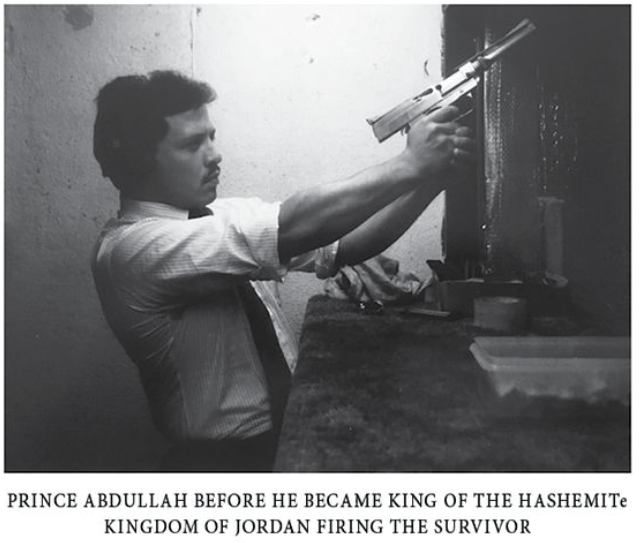
Fig. 1.1. Then Prince Abdullah II tests a Wildey handgun. Wildey’s book mentions that the Palace had a number of his Survivor handguns in the inventory. Some were for personal use while others were earmarked as gifts. (Wildey’s Here, Kindle Version)
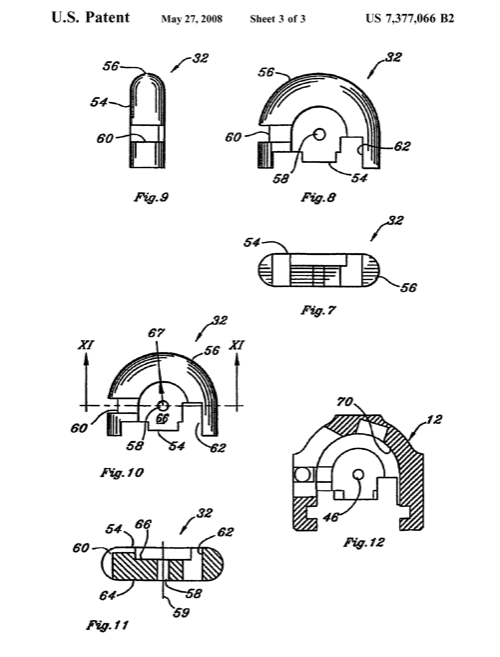
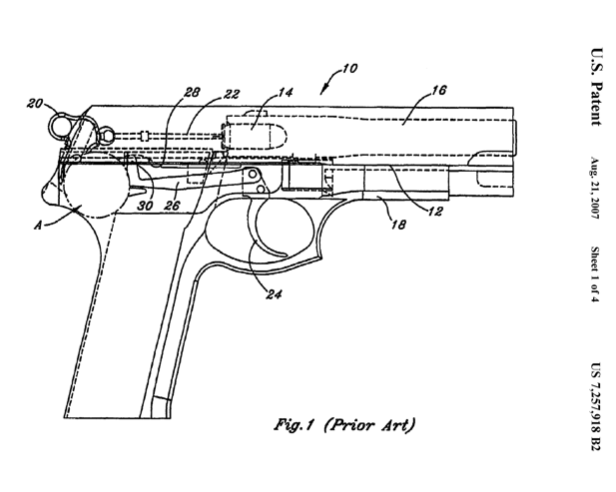
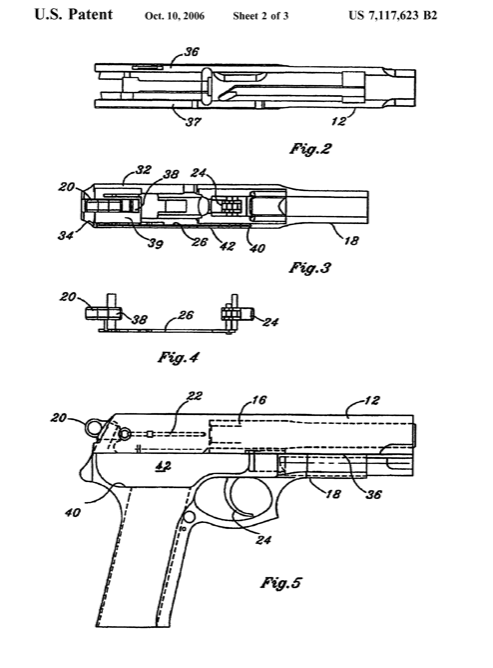
As was referenced at the start of this review, Mr. Moore’s Survivor pistol was featured in Death Wish III.This ‘starring role’, as well as other press in the firearms industry, caught the eye of a certain ‘gun nut’, in the words of Mr. Moore, none other than His Majesty Prince Abdullah II bin Al-Hussein of Jordan.Today, Abdullah II, King of Jordan, but back then (late 1980s), he was simply Prince Abdullah.The Prince made it known to Mr. Moore that he had a great desire to see Jordan develop its own domestic firearms production capability.It would take another decade, when Abdullah II ascended the throne of Jordan in 1999, upon the death of his father King Hussein, that these plans would finally be set in motion.In the spring of 2000, King Abdullah II sent for Mr. Moore and set him to the task of building up Jordan’s new firearms manufacturing infrastructure.Mr. Moore soon found that Jordan lacked even the most basic manufacturing requirements for producing firearms, but with the King’s backing via The King Abdullah Design and Development Bureau (KADDB), Mr. Moore soon acquired machinery and tooling from Germany.This would form the Royal Jordanian Machining Center, which would in turn supply parts for JAWS (Jordan Armament & Weapon Systems).As the first product of JAWS, Mr. Moore designed a handgun, which would be called “Viper”.Mr. Moore earned three US patents on the Viper pistol, which can be seen below:
Fig. 1.2. US Patent #7,377,066 Firearm with a readily interchangeable bolt face (US Patent Office)Fig. 1.3. US Patent #7,257,918 Double action, hammer trigger mechanism for a firearm (US Patent Office) Fig. 1.4. US Patent #7,117,623 Frame construction for with removable side plate (US Patent Office)
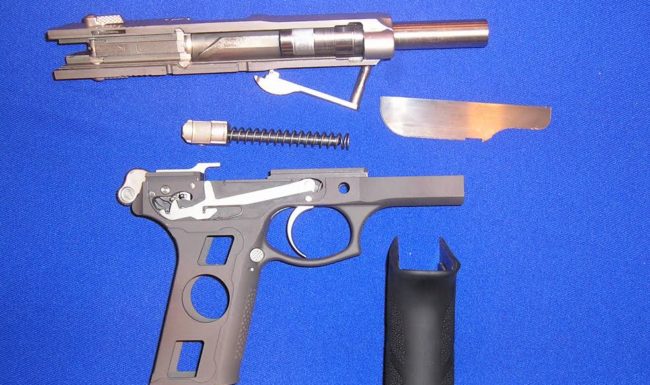
In addition to the patented design features above, the JAWS Viper was to be a multi-caliber handgun with rotary barrel short-recoil action and ambidextrous controls.The Viper had the makings of a unique and interesting handgun, but it was not to play out that way.In 2006, just as the Viper was ready for mass production at JAWS, Mr. Moore suffered a stroke that essentially crippled him, and he was never again able travel to Jordan.Concurrently, there were changes in leadership at KADDB (the parent organization of JAWS), and that new leadership sought to remove Mr. Moore from his position at JAWS entirely.This eventually led to Mr. Moore suing JAWS, KADDB, and even the King of Jordan himself.To avoid the press of a trial, the King of Jordan returned his own 51% interest in JAWS as well as Mr. Moore’s personal company (Wildey FA) at no cost.The lawsuit was subsequently dropped.Mr. Moore eventually sold Wildey FA, and the rights to his Survivor pistol to Charlie Rhoades in 2015, and he now lives at home in Connecticut with his wife, Linda.
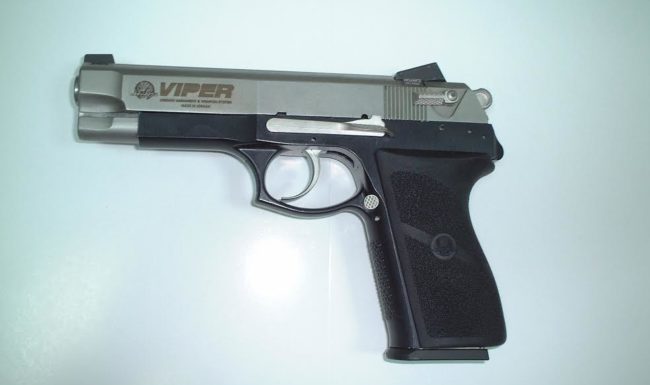
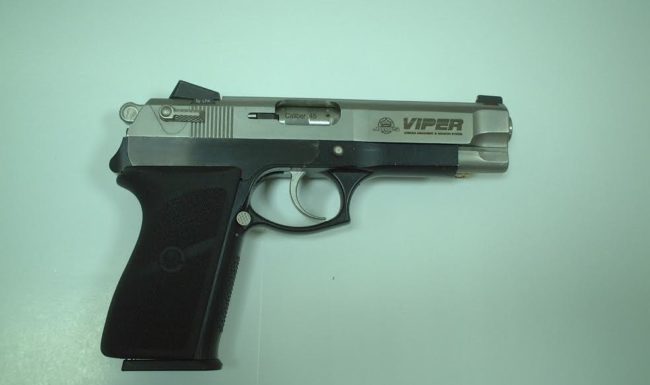
Fig. 1.5. Left Side View of JAWS Viper (Source: courtesy of Maxim Popenker)Fig. 1.6. JAWS Viper Stripped Down to show major design features. Note the unique removable bolt face insert in the slide, the removable side plate, and the rotary unlocking barrel (Source: courtesy of Maxim Popenker)Fig. 1.7. Right Side View of JAWS Viper (Source: courtesy of Maxim Popenker)
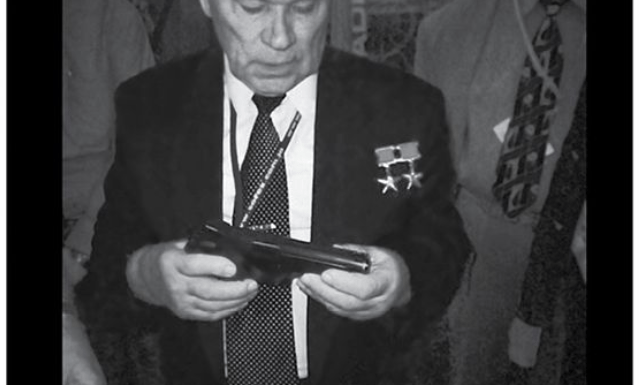
Wildey’s Here is an autobiography, written and published by Wildey Moore himself, it is not meant to be a reference book, rather it is Mr. Moore’s recounting of his life and experiences.For example, throughout the book Mr. Moore often tells anecdotal stories that, while making for entertaining reading, must be taken with a grain of salt.In one of these accounts, Mr. Moore describes showing the Viper pistol to Mikhail Kalashnikov, as follows:
“It further helped that the gun had the blessing of Mikhail Kalashnikov. In Abu Dhabi, I had the privilege of having him critique the Viper pistol. By this point he was already well into his 80s and approaching 90. He took the pistol and examined it thoroughly. When he finished, Kalashnikov took off his tie pin and gave it to me as a sign and as a medal of his approval. This was his way of honoring the design. It’s hard to think of a better endorsement than from the designer of the greatest assault rifle of the 20th century. The Viper pistol had arrived and not only that, but people knew it.”
Did Kalashnikov truly approve of the design, or was he simply being polite to a fellow designer?That is a question that cannot be definitively answered.Another aspect of Mr. Moore’s autobiography is that he often injects his own personal political and religious beliefs at random times.
One example includes suggesting that the Bush family’s interests in a defense company, call ‘The Carlyle Group’ has seen both President George H.W. Bush and George W. Bush seek war in order to stoke profits for their company. In another section he laments that that the institution of marriage was not what it once was and that “the necessity of salvation is further obscured by our language which has been perverted to the point where meaning can be difficult to apprehend.”
While Mr. Moore is verbose regarding his personal belief system, he is relatively sparse with any description or technical data regarding the JAWS Viper handgun. He only briefly mentions the three patents listed above in the following quote:
“What we eventually made of the Viper was a semi-automatic pistol with the capability of rapidly accepting different calibers by a simple exchange of barrels, extractors, bolt faces, and magazines. I was awarded three new patents in the US during the development stage, patents which have gained worldwide recognition in every country JAWS has filed for them. The first of these was the double action hammer trigger mechanism; the second was for a removable bolt face; the third was for a readily removable side plate.”
This lone paragraph is the only description of the JAWS Viper handgun throughout the entire book.Considering how proud Mr. Moore was of his other work and beliefs, it is a shame that he barely bothers to describe what was arguably his greatest design. Perhaps his minimal discussion of the pistol is an effort to protect his work, though this seems at odds with the intended audience for the book who will be most interesting in Mr. Moore’s firearms. The Viper was the product that was to launch a firearms manufacturing revolution in Jordan, and its design was worthy of more than three sentences in this book.
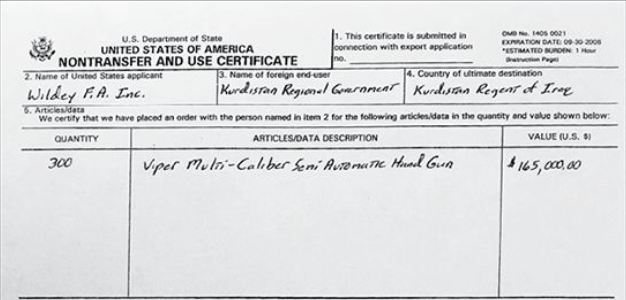
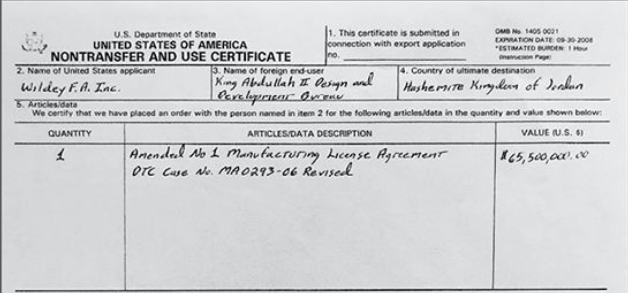
Fig. 1.9. Export license for the Kurdistan Regional Government. It is not known if these 300 Viper handguns made it to Kurdistan (Wildey’s Here, P146 Kindle Version)Fig. 1.10. Manufacturing license from the State Department between KADDB and Wildey Firearms (Wildey’s Here, P147 Kindle Version)
Wildey’s Here does exactly what it was meant to do.It gives us an up-close and personal look at the life of a proud firearms designer.We definitely come out of reading this book with a better understanding of Wildey Moore.Where it comes up short, is where it most concerns researchers of MENA-based firearms history.We are given only a small dose of the Viper pistol that was to initiate domestic firearms manufacture in Jordan.From the little that Mr. Moore gives us, we see a pistol with many features that were almost ahead of their time.While DA/SA semiauto pistols were all the rage in the late 90s and early 2000s (when the Viper was conceived), ambidextrous controls were still a novelty rather than the norm.The photos included with this review show a pistol that reminds me of popular self-loading pistols of that era (Beretta M92, SIG P226, and even the Ruger P85) while having a design as unique as it’s designer.It’s sad that this pistol did not see more than a paltry production (only 150 or so were made for the Palace Guard, according to Mr. Moore), and that Mr. Moore could not provide the research community with more details and primary source documentation on the JAWS Viper.
Nate Boyan has been a firearms enthusiast for 15 years and is constantly consuming books or videos to do with historic firearms research. Upon discovering Silah Report, Nate found a new passion in researching firearms from the MENA region, and hopes to contribute to Silah Report’s mission in any way that he can. For a day job, Nate works as an Engineering Officer on an oil tanker in the US Merchant Marine.