On March 12, 2015, offices of the Turkish Armed Forces (TAF) officially announced that rifles used in military service would be fitted with an enhanced trigger guard shell, flaring over the left and right sides of the factory trigger guard.[1] Some observers outside Turkey initially interpreted these enhanced trigger guards as an anti-riot modification or an apparatus that protects the triggers from external tampering in a struggle. The purpose of using these trigger guards, however, is darker than it appears. The concept was developed to prevent TAF soldiers from committing suicide using their G3 self-loading 7.62×51mm service rifles.
According to a report on ‘Daily Sabah‘ on March 14, 2015, “more Turkish soldiers died from suicide than combat in 10 years… In the last 10 years, 818 Turkish soldiers were killed in clashes, while in the same period, the number of soldiers who committed suicide amounted to 934”[2].
Considering that the suicide rate is so high in the TAF, taking measures seems extremely obligatory. There are many reasons for these suicides in the TAF, among these the psychological impacts experienced in the military and racist policies towards minorities. Since military service is compulsory in Turkey these issues emerge frequently. The development of this trigger guard merely seeks to treat the symptoms of the problem, not the causes.
Editors Note- It is important to stress that these ‘Suicide Prevention Trigger Guards’ were intended to be used by units that were mainly composed of Turkish conscripts, and not the ‘Operating Forces’ so to say. That is, the units using these rifles aren’t the same infantry units that are operating in PKK-areas or currently in NE Syria and Idlib. The intent was to prevent suicides among those serving their required term of enlistment in these more rear-echelon garrison units.
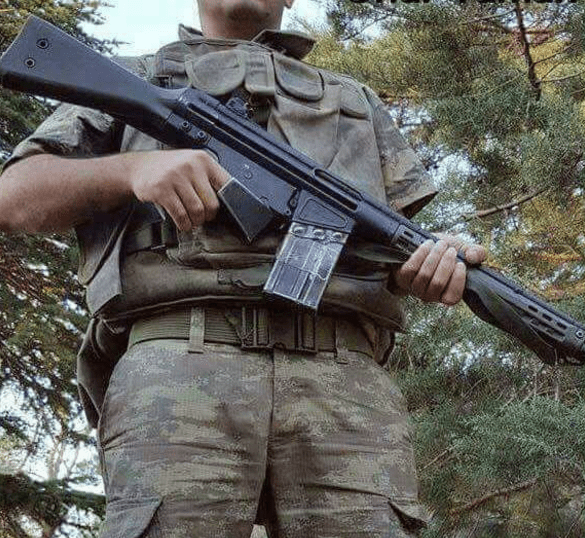
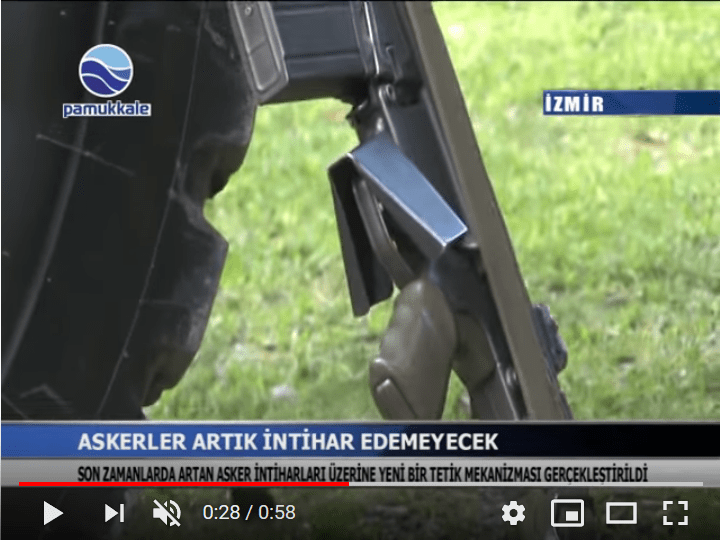
The working principle of this mechanism is very simple. A stamped metal plate is attached to the weapon’s receiver with a spot weld, in position to surround the trigger guard. Therefore the trigger can only be accessed when the pistol grip is grasped and the weapon used normally, if a soldier attempts to point the weapon at their face, he cannot access the trigger because of the guard.
Many, however, argue that these trigger guards are not a good solution. One of the biggest reasons for this situation is that many families think that their children may have been murdered instead of committing suicide.[3] Even though many deaths in the military are suspicious the authorities do not always launch a full investigation and families believe some of the deaths are written off and recorded as suicides.[4]
The most important point of criticism about the trigger guard is that if a person is determined, it will not prevent suicide. People have suggested that it is merely “the government’s effort to avoid responsibility”. When it is examined thoroughly, it is seen that the government does not eliminate the factors that cause suicide, it only makes suicide a little more difficult. On a forum site called Tabancatufek, a user ‘Zemre10’ makes the following comment:
“When I saw that it had no barrier properties for people taller than the average, I started to think that this apparatus is an apparatus that was made up only by the upper tier to get rid of responsibility.”
(Tr: Ortalamadan uzun kişiler için herhangi bir engelleyici özelliğinin olmadığını gördüğümde, bu aparatın sadece sorumluluktan kurtulmak için üst kademenin uydurduğu bir aparat olduğunu düşünmeye başladım.) [5]
Someone who uses a G3 rifle with these trigger guards says the guards are uncomfortable, prevent good trigger discipline and can cut fingers:
“Do not think about applying trigger discipline, because it cuts your fingers. The most comfortable position is to put the hand in the apparatus next to the trigger guard. Otherwise, it is very difficult to insert fingers.”
(Tr: Tetik disiplini uygulamayı düşünmeyin parmağı kesiyor. En rahat pozisyon eli aparat içine tetik korkuluğunun yanına koymak .Diğer türlü parmak sokmak falan çok zor.) [7]
It is even possible to come across comments saying that seeing this mechanism inevitably evokes suicide:
“It is a different irony that it reminds you of suicide every time you see this apparatus, rather than preventing Suicide!.” [6]
Sayın Ahmet Özalp, ben de ilk gördüğümde sizle aynı duyguları hissetmiştim. Fakat sonra çoğu insan gibi bu aparatın işe yarayıp yaramadığını test etme gereksinimi duydum. Ortalamadan uzun kişiler için herhangi bir engelleyici özelliğinin olmadığını gördüğümde, bu aparatın sadece sorumluluktan kurtulmak için üst kademenin uydurduğu bir aparat olduğunu düşünmeye başladım. İntiharı engellemekten(!) ziyade, bu aparatı her gördüğünüzde size intiharı hatırlatması da ayrı bir ironi. Açıkçası başka ülkelerde böyle bir uygulama var mı bilmiyorum.
Someone who did their military service in 2013 made an interesting point, noting that rifles fitted with the guard are given to soldiers on watch. According to this recollection, it was for soldiers keeping watch in a tower. It is also interesting to note that the soldiers on duty in the tower at that time were not issued ammunition for their weapons:
It had to be this piece in the weapons of those who went to the towers, not to the prestige watches like sancak (‘flag’ in english), headquarters, etc. Otherwise, the tower and communication station watches under our responsibility were kept without bullets as per the orders.”
(Tr: Sancak, karargah vs.gibi prestij nöbetlerine değil ancak kulelere nöbete gidenlerin silahlarında bu parça olmak zorundaydı. Aksi taktirde doldur boşalt Bu arada bizim sorumluluğumuzdaki kule ve muhabere istasyon nöbetleri yine emir gereği mermisiz tutuluyordu.) [8]
From here, it can easily be said that the TAF only went to simple solutions in suicide measures. However, none of these methods eliminates the factors that cause suicide.
Although the introduction of this mechanism was officially shown in the news in March 2015, it appears that it has been tried in various divisions, at a minimal level, for a number of years prior. The date of the use of the mechanism may go back to 2012 when we examine comments posted on various sites. For example, a user on a different site states that they used this mechanism in December 2012:
“I went to the military in December 2012. They gathered all the guns in the master unit so that maintenance would be done. When it came, this triangular mechanism was installed. We were on watch as a headquarters division, but there were no bullets in our guns.”
(Tr: Aralık 2012’de askere gitmiştim. Usta birliğinde tün silahları topladılar bakım yapılacak diye. Geldiğinde bu üçgen mekanizma takılmıştı. Biz karargah bölüğü olarak nöbet tutuyorduk ama silahta mermi yoktu)
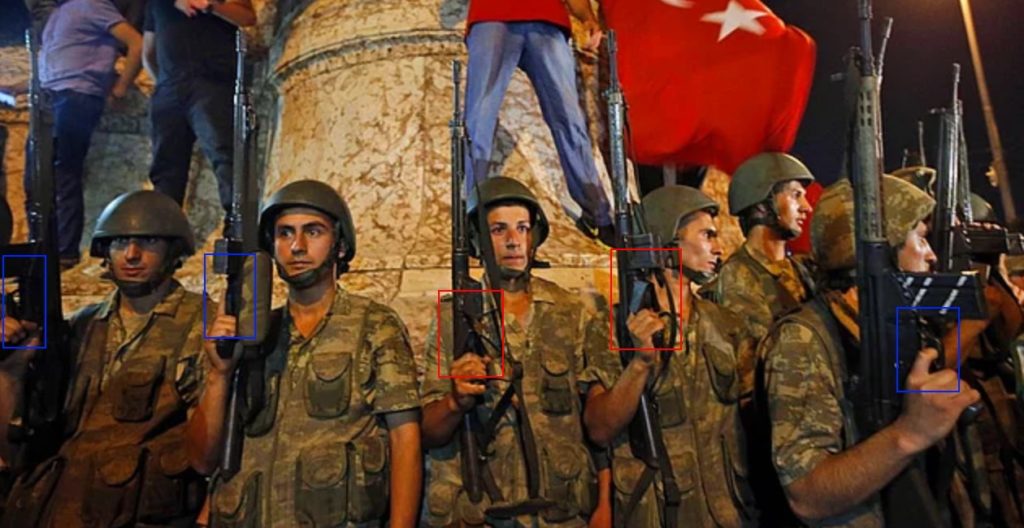
It is also worth noting that the adaptation is seen only on Turkish Army G3 rifles. Similar trigger guards have not been seen fitted to the new MPT-76 rifles. It is not known whether this mechanism will eventually be used on the MPT-76, but the TAK continued to issue G3 rifles to soldiers in service. From the photographic evidence available we do not often see soldiers issued with G3 which are equipped with the suicide prevention guard. It is not difficult to theorize that the rifles with guards may only be issued to privates on watch – potentially because they are not under constant supervision with their rifles. When the photos were taken on July 15, 2016 are examined, we see that even within groups of soldiers the use of this trigger guard appears extremely low.
In practical terms it appears to be a short-sighted answer to a much deeper problem. In operational terms the guards not only prevent good trigger discipline but they also add a hindrance to the soldier’s weapon with the guard projecting outwards and likely snagging on kit and other objects like foliage. As former soldiers have also mentioned the guard is a constant reminder of suicide and as such likely also has a negative impact on individual and unit moral.
It has not officially been disclosed just how many of these guards were produced or how many guns they were installed on or indeed if the practice continues. This also helps to explain why the guard is rarely seen and often misunderstood when it does appear.
This article was contributed by Yigit, a researcher tracking the armament of non-state armed groups to include IED tactics, techniques, and procedures.
If you enjoy our work here at Silah Report please consider support us on Patreon
References:
1: ‘Soldiers can no longer commit suicide’. Milliyet.com,<https://www.milliyet.com.tr/gundem/askerler-artik-intihar-edemeyecek-2027070>
2: Atakan, Didem. 2015. ‘More Turkish soldiers died from suicide than combat in 10 years’. Daily Sabah, <https://www.dailysabah.com/turkey/2015/03/14/more-turkish-soldiers-died-from-suicide-than-combat-in-10-years-panel?fbclid=IwAR29cyAwK6Dtv7Fc-czbC9BqInn0HP40yFxmdBjQvL9Mzb7SR16BPoxHsjk>
3: ‘Minister Yılmaz: Families do not believe their children are ‘suicide”, Vicdani Ret Derneği,<https://vicdaniret.org/bakan-yilmaz-aileler-evlatlarinin-intihar-ettiklerine-inanmiyor/>; ‘Families: Suicidal reasons for soldiers are not credible’, Vicdani Ret Derneği, <https://vicdaniret.org/aileler-askerlerin-intihar-gerekceleri-inandirici-degil>
4: ‘Families: Suicidal reasons for soldiers are not credible’, Vicdani Ret Derneği, <https://vicdaniret.org/aileler-askerlerin-intihar-gerekceleri-inandirici-degil>
5: Forum post, 2017, ‘Trigger Guardrail Suicide Prevention Storage’, Tabancatufek.com, <http://www.tabancatufek.com/forum2/showthread.php?tid=14300&pid=340439#pid340439>
6: ^Ibid
7: Forum post, 2017, ‘Trigger Guardrail Suicide Prevention Storage’, Tabancatufek.com, <http://www.tabancatufek.com/forum2/showthread.php?tid=14300&pid=340448#pid340448
8: Forum post, 2017, ‘Trigger Guardrail Suicide Prevention Storage’, Tabancatufek.com, <http://www.tabancatufek.com/forum2/showthread.php?tid=14300&pid=340439#pid340439>
Suicide is touch man. Our
battalion lost at least over 2 dozen Marines to suicide.
What do you think was happening to him mentally?
A little late to the party, aren’t you fellas?
A guy in my battalion, blew his brains out while on guard duty when I was serving.
But frankly, all the signs were there before it happened. It was very clear that he was unwell. But there are no systems in place to weed out people with mental illness.
“the military and racist policies towards minorities” I do not agree with this state ment my father was a kurdish liutenant in the taf there are lots of high ranking kurdish official in the taf even head of the army is circassian I think you should change that part because of these ststements lots of non turkish people believe that taf is not friend lt against kurds and others