Roughly six months into Operation Iraqi Freedom, the commander of United States Central Command testified before the U.S. Senate Committee that, “there is more ammunition in Iraq than any place I’ve ever been in my life, and it is all not securable.” So, how can a country with a nearly limitless stockpile of weapons and the indigenous Tabuk production facility also be the birthplace of such arcane rifles? Operation Iraqi Freedom changed the Iraqi black market arms trade forever and, in a matter of two months, turned Tabuk rifles into artifacts only found in history books, obscure sales, and black-market trading.
Hussein Kamil, Saddam Hussein’s son-in-law and head of Iraq’s Ministry of Industry and Military Industrialization, publicly announced in May of 1989, that Iraq was developing a local defense industrialization program in order to produce all the weapons and equipment the Iraqi armed forces would need by 1991.
By 2003, the CIA reported that Iraq had 51 state-run companies (many with multiple locations) devoted to armaments. These companies were divided up into many different areas of expertise such as ‘R&D, Design, and Construction’, ‘Propellant, Explosives, and Munitions’, ‘Chemical Companies’, and ‘Conventional Armaments Companies’. The last category, “Conventional Armament Companies” included the Al Qadisiyah State Establishments located in Al Mahmudiyah, Baghdad. Al Qadisiyah, in particular, focused on small arms manufacturing consisting of Kalashnikov self-loading rifles, machine guns of various calibres, RPG-7 launchers, and mortars among other products.
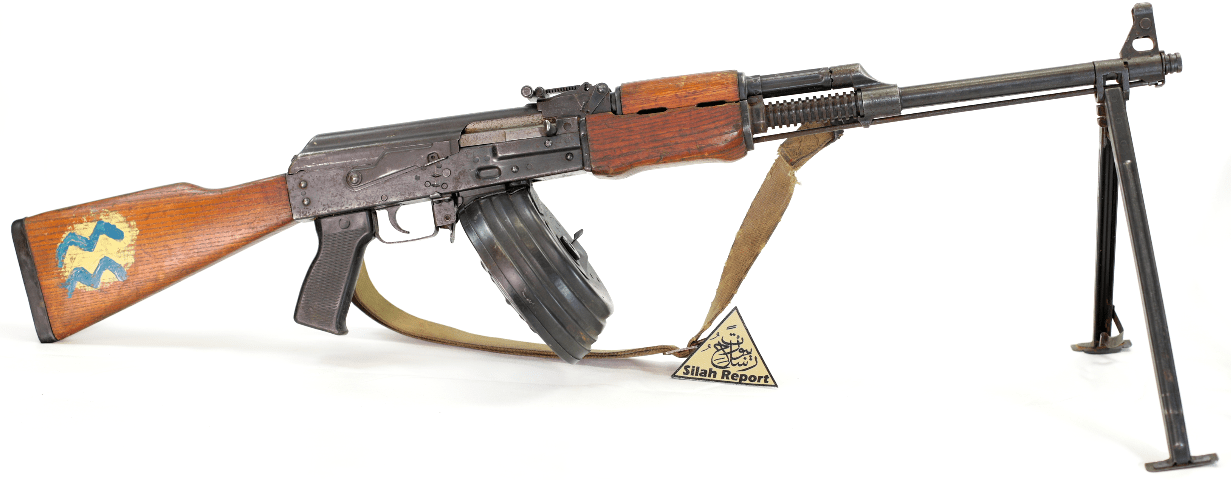
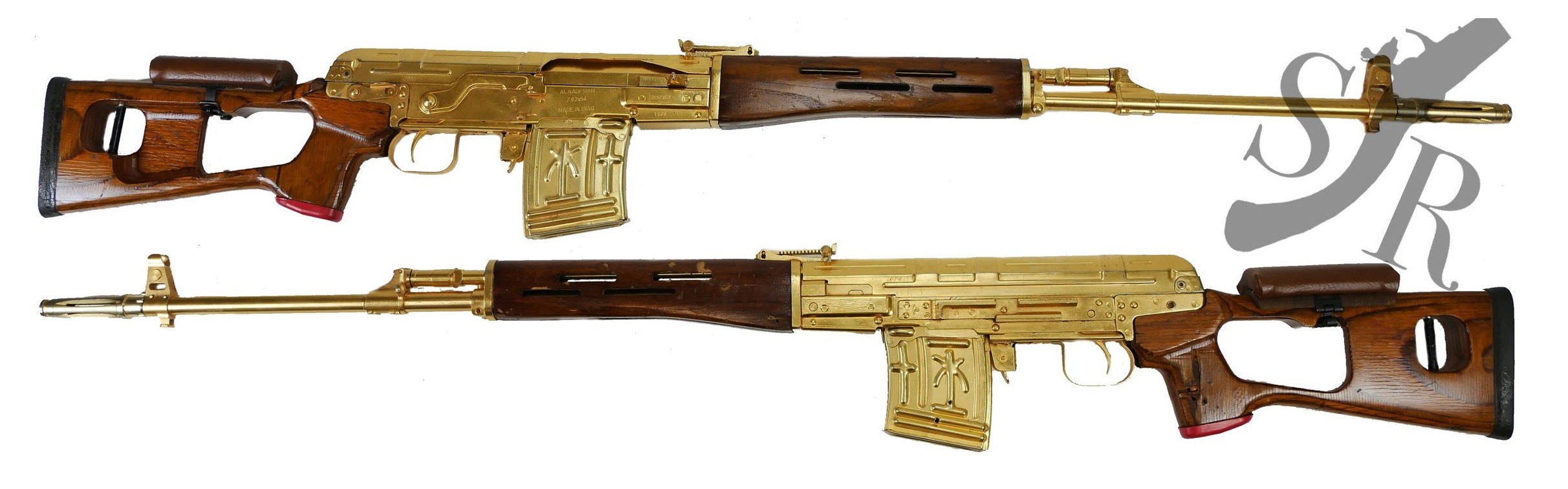
These ‘Kalashnikov rifles’ as the CIA put it, are in actuality the Tabuk series of service rifles, the Baby Tabuk carbine, the Quds RPK light machine gun, and the Al Qadisiyah sniper rifle – all chambered in 7.62×39mm. Kalashnikov-patterned rifles based entirely off the Yugoslavian M70-series of 7.62×39mm self-loading rifles and produced on machinery purchased from the Yugoslavian dictator, Slobodan Milosevic in the late 1970s and early 1980s.
Little did Saddam and Milosevic know, the facilities they would ultimately establish would one day also become the main command post for Major General David H. Petraeus and the 101st Airborne Division while Operation Iraqi Freedom unfolded and Saddam plummeted from power. The United States and its coalition allies invaded Iraq on March 17th, 2003, the Iraqi government capitulated on May 3rd. Many areas fell into a state of anarchy and began experiencing widespread looting of government buildings, museums, factories and military compounds.
U.S. and coalition forces were so unprepared for such an instantaneous free fall into lawlessness, establishing public order and maintaining basic infrastructure became high-priority before initial combat operations even came to an end. Also during this time, U.S. and coalition forces scrambled to set up command centers and gain control of high-value munitions sites which would later be investigated in the search for Weapons of Mass Destruction.
At some point early on, the main Al Qadisiyah factory compound became home to the US 101st Airborne Division. It has been reported that the facility was an admirable home base because of the pre-existing perimeter wall with strong points for guards, a six storey office building and was located next to a warehouse it was also in a sheltered position just half a mile from a major highway. It’s tough to say if the Al Qadisiyah facility was untouched prior to the 101st Airborne setting up shop. What we do know is, the 101st Airborne was forced to press north one day prior to the 75th Exploitation Task Force team arriving to inhabit the compound briefly leaving it empty.
In just one day, the facility was stripped of nearly all assets, an unintentional fire had scorched part of the compound, and brand new rifles were on their way to local markets to be sold for a reported price of $83 apiece. The Washington Post cited an eye witness of the Al Qadisiyah looting as saying: “some took office furnishings and equipment, but most focused on weapons. They took what they could carry, or brought carts. One man is said to have backed in a truck.” Sadly, April of 2003 marked a pivotal moment for black market arms and global terrorism. Literal mountains of arms and munitions were flooding the streets and arming militias and terror groups with supplies that are probably still being used on battlefields today.
A 2007 report published by U.S. Government Accountability Office illustrates the scale of munitions looting during this time by detailing:
Hundreds of tons of explosive materials that had been documented by the International Atomic Energy Agency prior to March 2003 at the Al Qa Qaa explosives and munitions facility in Iraq were lost after April 9, 2003…the seemingly targeted concentration on storage areas suggested that much of the looting in the areas assessed was conducted by organized elements that were likely aided or spearheaded by Iraqi military personnel.
Further details outlined the most likely destination for much of the stolen machinery, explosives, and arms are Syria, Iran, and regional militia and/or terrorist groups. Sami al-Araji, the deputy minister of industry at the time of the invasion, explained that it appeared to be a highly organized operation that pinpointed specific plants in search of valuable equipment. “They came in with the cranes and the lorries, and they depleted whole sites,” Dr. Araji said. “They knew what they were doing; they knew what they wanted. This was a sophisticated looting.”
Dr. Araji also explained the systematic looting operations were then followed by rounds of less sophisticated thievery. “The first wave came for the machines,” Dr. Araji said. “The second wave, cables and cranes. The third wave came for the bricks.” This was no exaggeration either.
From The Washington Post:
Ali Jamil, another young man who witnessed the looting, said boys and men in their teens and twenties poured into Al Qadisiyah as the word spread. Some took office furnishings and equipment, but most focused on weapons. They took what they could carry, or brought carts. One man is said to have backed in a truck.
“They took the rifles so they can sell them,” Jamil said. “They can get 150,000 dinars for one rifle,” or about $83 at today’s unofficial exchange rate.
Among the many products of this plant was a presentation set of highly decorated 9mm pistols. Today the grounds were scattered with blue velvet cases, but not one of the pistols — made for Baath Party dignitaries — was left.
In 2005, a Western diplomat familiar with satellite reconnaissance done by the International Atomic Energy Agency told the New York Times, “Al Qadisiya had almost vanished.” Ironically, in the six to eight weeks following the onset of Operation Iraqi Freedom, while museums and historical sites were being stripped of artifacts and rarities, Tabuk rifles themselves were falling into obscurity and becoming plundered artifacts of history in real-time.
This article was written by Jared Lender. Jared lives and works in St. Louis area as a marketing professional. He is a hobby gunsmith and his curiosities about firearm design and international gun cultures bring him to the SR community.
If you enjoy our work here at Silah Report please consider support us on Patreon
Sources:
Ministry of Industry and Military Industrialisation (MIMI)
THE CONFLICT IN IRAQ: THE LOOTING
Looting Is a Double Loss for U.S. Forces
How the US let al-Qaida get its hands on an Iraqi weapons factory
Addendums to the Comprehensive Report of the Special Advisor to the DCI on Iraq’s WMD
1ST INFANTRY DIVISION:SOLDIER’S HANDBOOK TO IRAQ (UNCLASSIFIED//FOUO)
Also, presidents of Yugoslavia, including after Tito: https://en.wikipedia.org/wiki/List_of_heads_of_state_of_Yugoslavia#:~:text=Office%20of%20the%20President%20of%20Yugoslavia%20instituted%20in%201953.,president%20for%20life%20in%201974.
Slobodan Milosevic was still a bankar in the late ’70/early ’80, he still did not really start his political career.