The integration of female soldiers in IDF combat roles is a much-debated topic in Israel the last decade or so. Today we will ride on the wayback machine to a time when the place of women in military service was very different.
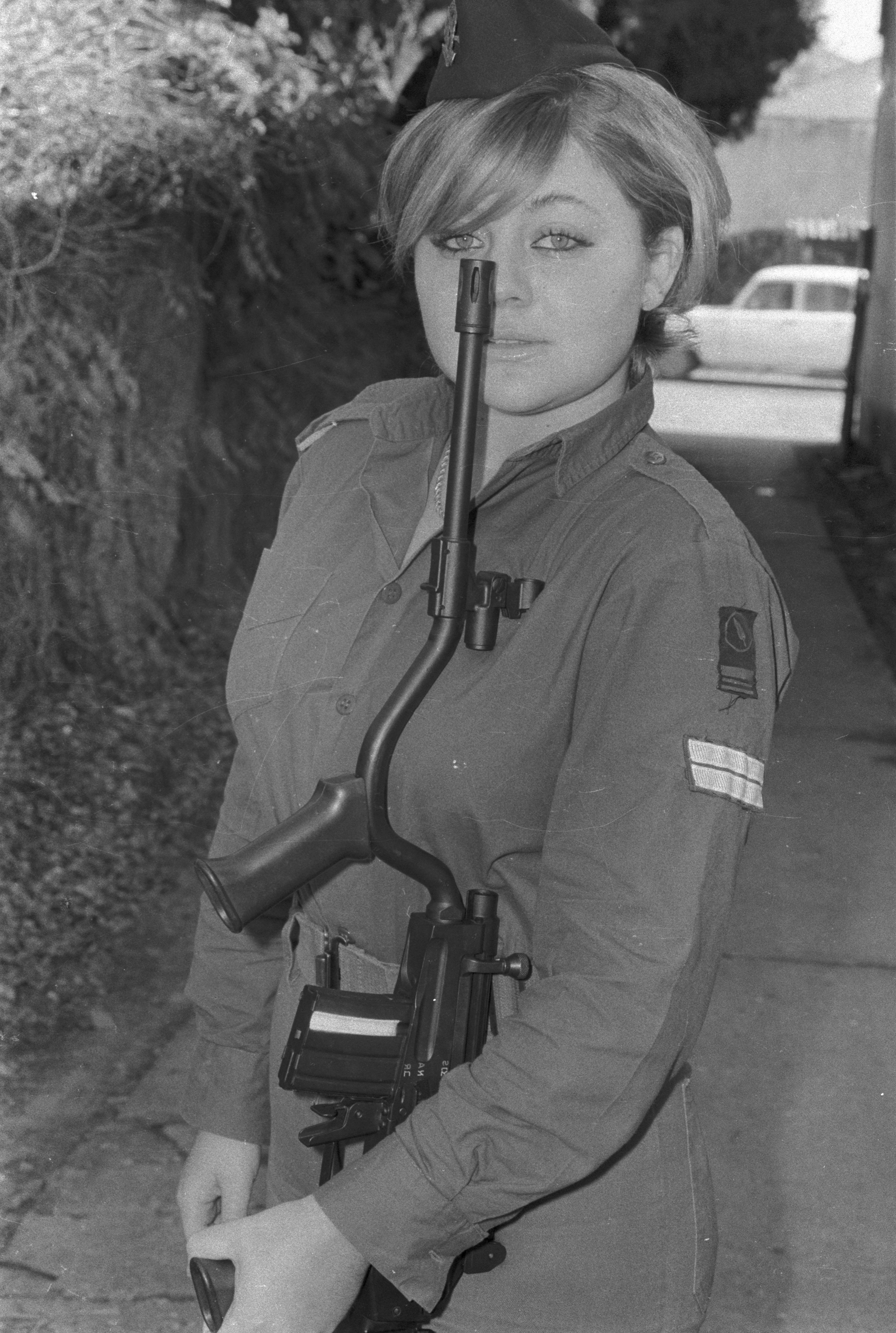
In the December 8 1982 issue of the IDF weekly magazine, Bamahane, a short news piece was published with bold letters titled: “The end of discrimination! A major victory to the women’s liberation movement; a Galil assault rifle developed especially for female soldiers!”
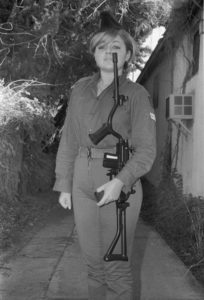
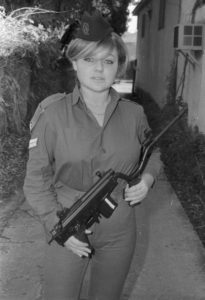
The paper includes several pictures taken of an IDF female soldier ‘modeling’ a bent barrel Galil AR and further explanation states that the most problematic issue with designing a feminine rifle is that regular rifles keep colliding in the soldier’s breast whenever it was carried and practice in foot drills.
According to the news piece the development of the gun took two years and was tested by 350 female soldiers that were “carefully selected for their outstanding physical characteristics”
That ‘news piece’, as you might guess by now, wasn’t a real news report. It was the weekly satiric column called ‘על הגבול’ which literally means ‘On The Border’ but the more accurate translation means ‘Borderline’.
The prop gun was manufactured by none other than Yisrael Galil , the inventor of the Galil, for the satiric column.
The gun was a modified Galil AR with an absurdly bent barrel and vertical foregrip attached instead of the regular foregrip. The bolt carrier lacks a gas piston and there was no gas tube. All removed to achieve the described breast clearance. In one of the photos, the rifle is lacking a buttstock.
The gun was issued with a 12 round magazine, presumably to lighten the load on those top-heavy girls in uniform. The magazine is in fact a blank magazine used to propel rifle grenade.
The column summarized that since the rifles were introduced into military service they already proofed their value and the developer is flooded with purchase orders.
(SR welcomes our first guest author, Yoel M. who will be discussing an interesting historical phenomena when it comes to the Israeli Defense Forces)
To understand the root of the IDF “hitchhiker’s magazine” we must begin with some context. Israel is a
small nation geographically, from North to South the country is only 263 miles (420Km). This same geography
that dictates military strategic plans also dictates military leave arrangements.
Because the front line are based just an hours drive from population centers, this enabled the IDF to release
soldiers for weekend vacations to return home. Not all the bases have good public
transportation options and as a result soldiers use to hitchhike on their way home and back
to base.
In the late 1980s and early 1990s, Palestinian fighters would take advantage of this situation and start to
kidnap soldiers to bargain for their comrades at Israeli prisons. These fighters
pretending to be Israelis would offer soldiers a ride. The tactic was usually to
arriving with no passengers to bus stations and offer a soldier a ride, the soldier would seat in
the front seat next to the driver, a few minutes down road the driver would stop and take in another
hitchhiker, this time the driver’s companion would sit behind the soldier and when the time
is right to attack and strangle the soldier from the rear.
IDF orders at that times were that soldiers are prohibited from moving with magazine inside the
rifle on their way to or from home. Most Israeli drivers having been IDF veterans themselves
usually also demanded the soldier to remove the magazine and cycle the
gun manually to check there is no round in the chamber before allowing the soldier in.
To counter the threat of kidnapping soldiers and against military orders, some troops would retrofit their
M-16 STANG magazines. They would saw off the magazine box and spring and weld the magazine
bottom floor plate to the new shorter box forming a magazine short enough to be totally
concealed inside the M-16 magazine housing.
There is, of course, no official data regarding the capacity of those homemade devices but it
fair to assume that 10 rounds is their maximum theoretical capacity.
Extracting the magazine was also an issue as those magazines were lighter than regular
STANG and often the welds on the floor plate brushed against the magazine housing inner
walls they often won’t drop when needed. With no exposing surface to grip to
extract the “hitchhiker magazine” some soldiers chose to shorter the magazine further and
weld or rivet small knob to the floor plate for easier magazine extraction.
The way the magazine would potentially work is that the soldier would insert it into the magazine
well and simply walk with it as a seemingly unloaded rifle to avoid any military police
checks and drivers demanding that a magazine be removed before entering the vehicle. If
the driver demands to manually cycle the bolt, the soldier will pull the charging handle while
pretending to verify that the chamber is empty only to load a round into the chamber from
the magazine.
Either way, the soldier plan to enter with his rifle loaded, only to be used in case of a hijacking
attempt. Iif the soldier is right handed when he sits in the passenger seat, the rifle would lay on his lap with the
barrel pointing towards the driver. In case of strangling from the rear the soldier could
theoretically operate the gun to shoot the driver.
The main problem with these magazines was the reliability. Those homemade fabrications
often misfed rounds, stacked in the housing and would drop or break open un-
expectantly when the welding failed.
Another problem was the increase in firing accidents the magazine caused, soldiers at home or
back at base could forget there is a magazine in the gun. More dangerous is the soldier’s
young siblings that might find the seemly unloaded gun and try to play with it.
Needless to say, the IDF didn’t take kindly to its soldiers initiative or the hitchhiking for that
matter and set to prohibit both. The military police was ordered to find and confiscate
hitchhiker’s magazines and penalties of up to a month in military prison to whom it was in
possession or those who tried hitchhiking.
Simultaneously officers were instructed to release soldiers for vacation only at days and
hours when public transportation was due. Moreover the army reluctantly spent money
paying private bus companies for transporting to and from central bus stations during the weekends.
Eventually, usage of the magazine became redundant as there was no longer a threat to IDF soldiers and the practice
went away.
As for its actual combat test and evaluation the magazine was never reportedly used in any kidnapping
attempt. One potential use I found in an online forum which I can’t verify or disprove was to
insert the magazine in the gun in what called “Peaceful Patrols” in Gaze and West Bank urban areas,
as the brass had the novel idea of “Winning Hearts and Minds” by send patrols without
magazines in the guns (only in the pockets of their vests). Some soldiers realized that their lives were worth more than
any hearts and minds campaign, and thus used these “Hitchhiker Magazines” while they were patrolling, to give them a
better chance of reacting to a threat.
Sadly there is no photos of the “Hitchhiker Magazine” online, the manufacturing of it done
against IDF orders and the magazine before social media and cell phones with
cameras appeared. In the end the concealed “Hitchhikers Magazine” achieved its goal as it still
invisible from Google’s all seeing eye.
Although not an Israeli magazine modification, this commercial five round magazine would have approximated what the “Hitchhiker’s Magazine” would have looked like in the 1980s and 1990s.