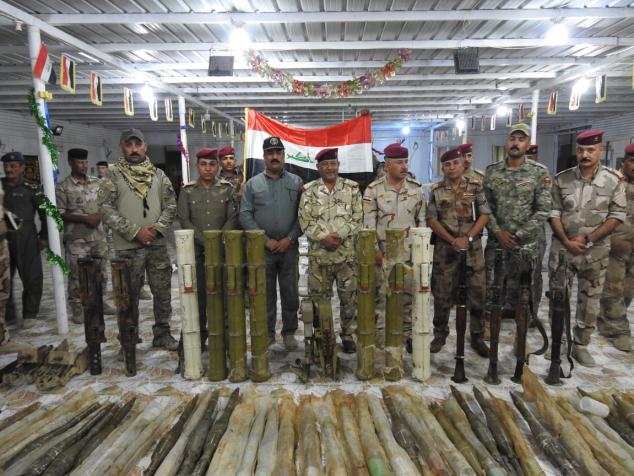
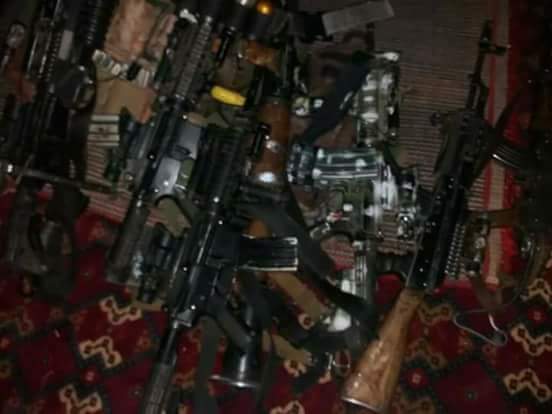
In the 12th episode of Silah Report Podcast we were joined by Adham, Vlad, Daniel, Miles, Ataka, MENA, Analyst Mick, and Abdullah Khyber. We answered four questions submitted by Patreon supporters of Silah Report and discussed an ISIS weapons and munitions cache recently captured by Iraqi security forces.
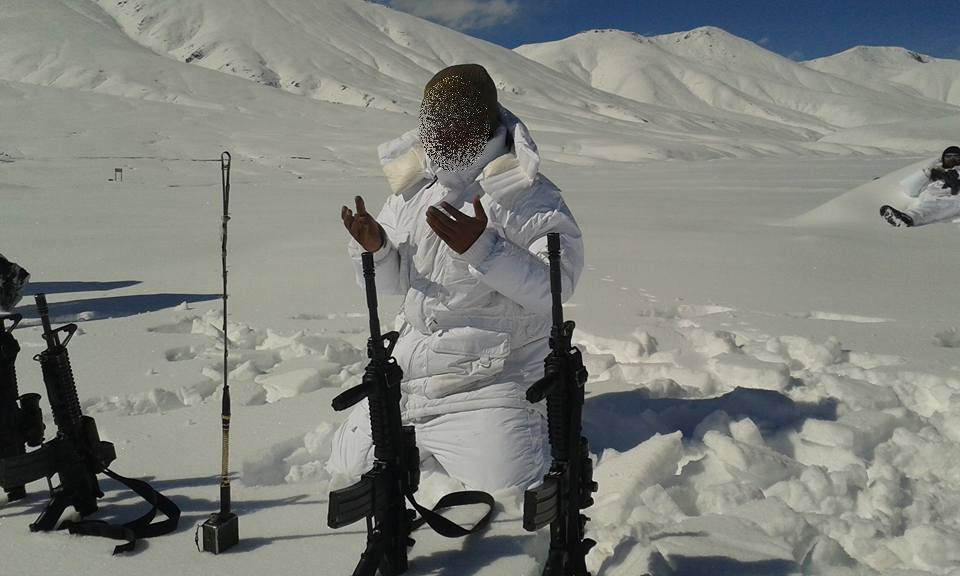
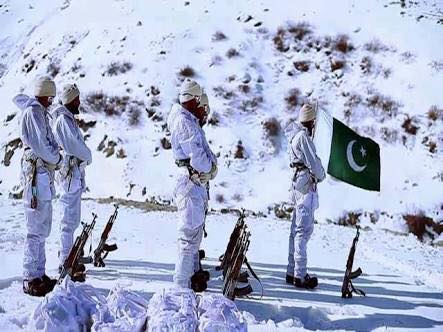
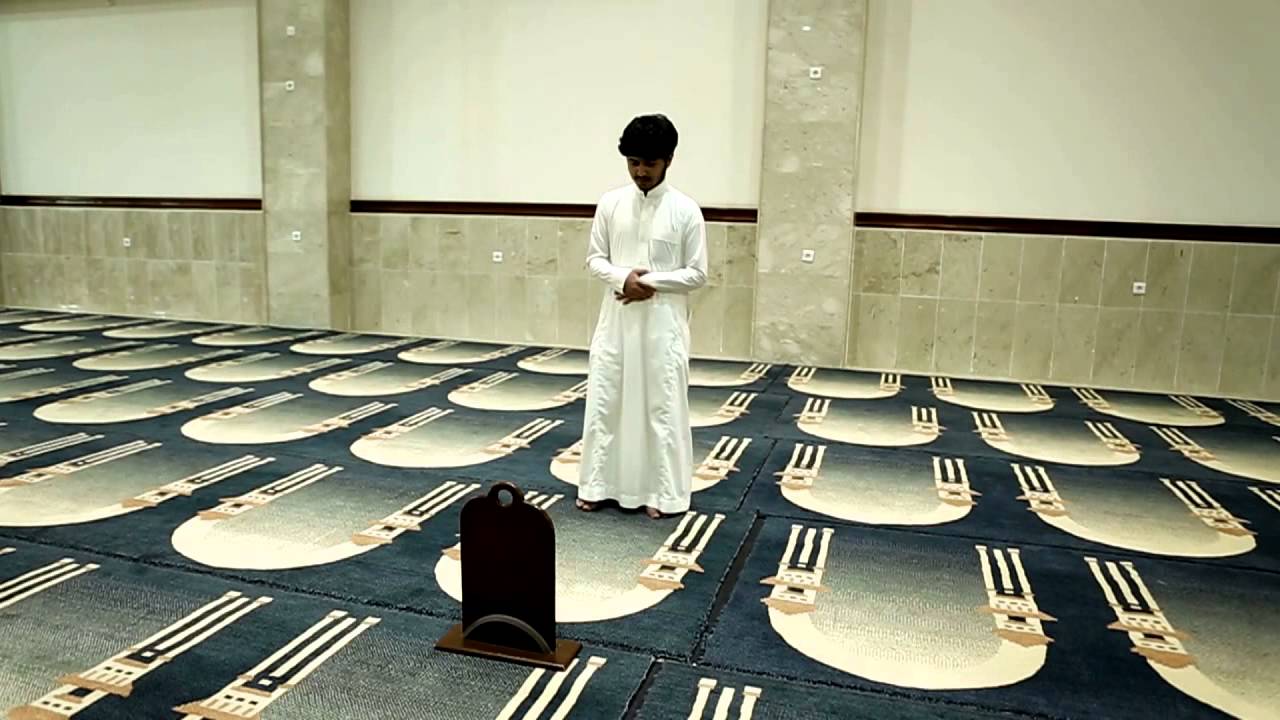
Recent photographs of Pakistan’s Special Service Group have surfaced in which members of the group are conducting mountain warfare training in the snow. Of particular interest is of the group conducting their Salat, or daily prayers. The prayers themselves aren’t so much as interesting as is what the soldiers are doing with their weapons. The M4s and in another picture, Kalashnikov patterned self-loading rifles are stuck into the snow in front of the soldiers praying, butt first.
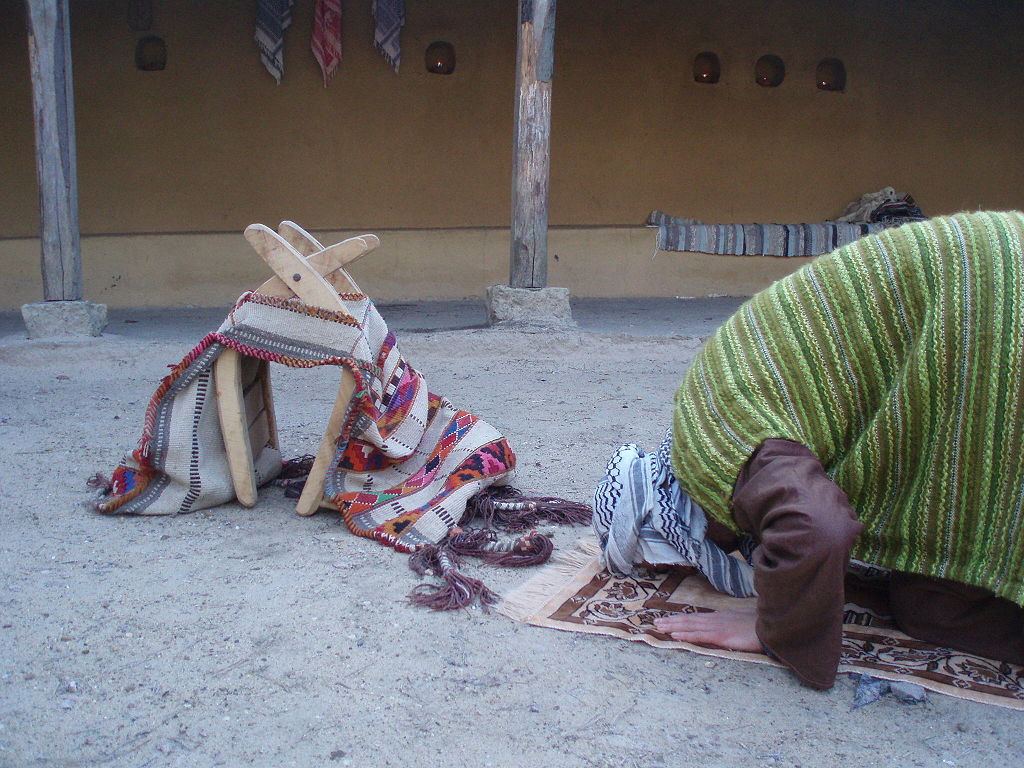
Although not really utilized today throughout the Islamic world, the practice dates back to the early Islamic period where one would place an object in front of them so other people would know not to walk in front of them during their salat. Specifically, it is called a Sutrah, or سترة in Arabic, meaning screen, or cover. There are some Hadiths on the topic but again it isn’t in wide use today.
Sahl ibn Abu Hathmah narrated: إذا صلى أحدكم إلى سترة فليدن منها لا يقطع الشيطان عليه صلاته The Prophet said: When one of you prays facing a sutrah he should keep close to it, and not let the devil interrupt his prayer.
The Messenger of Allah said: لا تصل إلا إلى سترة، ولا تدع أحداً يمر بين يديك، فإن أبى فلتقاتله؛ فإن معه القرين Pray facing a sutrah, and let no one cross in front of you while praying. If he insists, then prevent him by force because he is accompanied by shaitan.
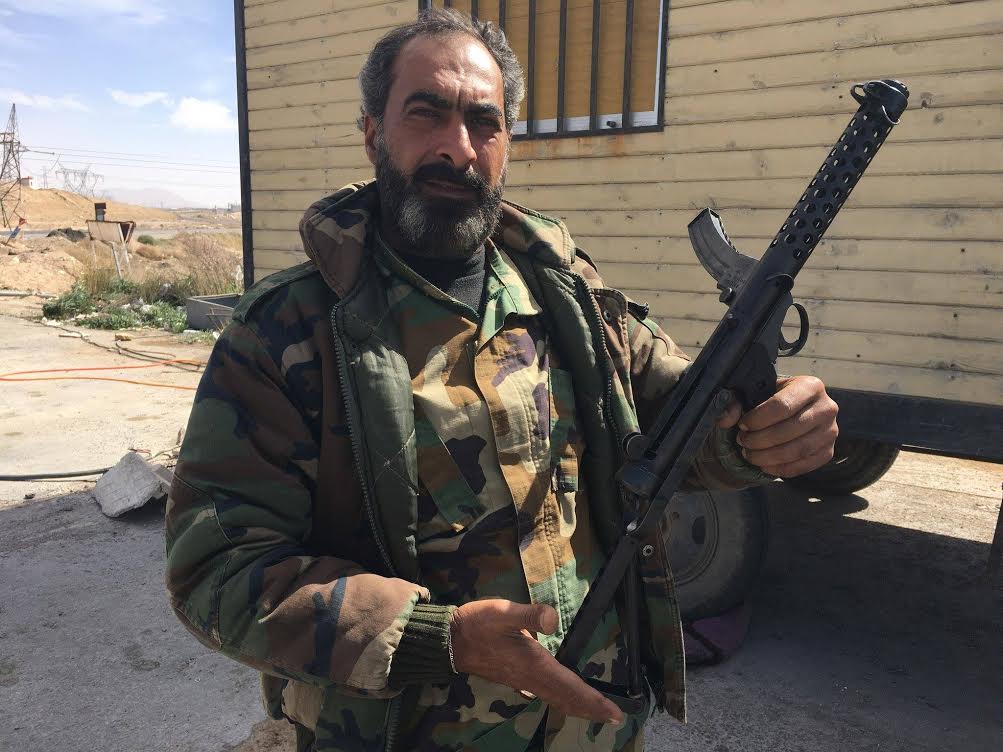
On the 10th March, Broń. Milmag, the Polish defense magazine, posted an intriguing photograph on their facebook page. The photograph had the short caption, which once translated, reads: “Syria Ad2018. 9-MM MACHINE GUN STERLING MK 4 / l2a3 used by a government soldier.”
Plenty of surplus World War Two weapons including the StG-44, MG42, Mosin-Nagant, K98ks and even French MAS-36s have been sighted in Iraq and Syria during the regions current multi-sided conflict. Sightings of the Cold War era- Sterling submachine gun, however, have been few and far between.
The Sterling submachine gun was developed by George Patchett at the Sterling Arms Company during the latter half of World War Two. Following extensive testing in the late 1940s and early 1950s the British Army adopted Patchett’s submachine gun to replace the Sten gun. It entered British service as the L2A1 in 1953, evolving quickly to its final form the L2A3. The L2A3 was produced commercially by Sterling at their plant in Dagenham, UK from 1956 until 1988 with an estimated 211,000 produced.
The Sterling was subsequently sold commercially and licensed for overseas production in both Canada (leading to the C1 Submachine Gun) and India (leading to the 1A Machine Carbine). Sterling successfully marketed the commercial version of the L2A3, the Mk4, to over a dozen countries around the world from Malaysia, to Libya, to Iraq.
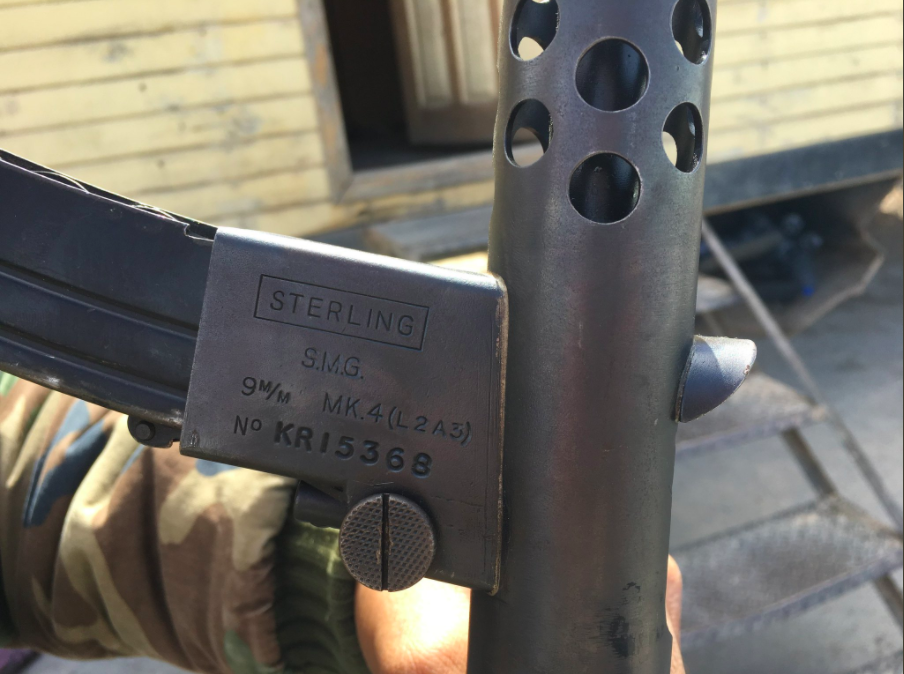
The weapon featured in the photograph appears to be in remarkably good condition. Following some digging I was able to find what I believe to be the original posting of the photograph online. Posted on Twitter by @Edward_Sn0wden on the 9th March. The twitter post includes a second photograph showing the Sterling’s magazine housing and markings. The photographs are credited to Alexander Kharchenko but sadly no location is mentioned. The caption suggests that the weapon might be a captured trophy.
From the available photographs the weapon appears to have a matte, rather than crackle paint, finish – this is either an original contract choice or a later armory refurbishment. The weapon is also fitted with an original Sterling produced commercial production 34-round curved double stack, double feed magazine – one of the most reliable submachine gun magazines ever developed.
We are lucky enough to have a second photograph showing the weapon’s markings in full: ‘STERLING SMG 9m/m MK4 (L2A3) KR15368’. The serial number, beginning with ‘KR’ dates the gun as a pre-1972 Sterling and refers to Kenton Redgrave, the Sterling company’s long-time director. The serial number dates the weapon, according to the serial number ranges, listed in The Guns of Dagenham (1996) by Peter Laidler, to 1957. This date would fit with the 1956-63 Iraqi contract which supplied 13,241 Mk4s to Iraq, first to King Faisal II’s military, and then to the Iraqi Republic, following a coup that deposed Faisal in 1958. The Iraqi Sterlings later saw action during the Iran-Iraq War and to a limited degree during both the Gulf War and during the 2003 Iraq War.
While rare the Sterling has been spotted in the region before, three years ago CJ Chivers, the New York Times investigative conflict journalist and author of The Gun, shared a photograph of a Mk4 with a straight Sten magazine in use by the Mahdi Army in Sadr City, Iraq.
While investigating the photograph above, an Iraqi fighter came forward and told me about his ‘heirloom’ Sterling Mk4 which had belonged to his father, an Iraqi soldier killed during the Iran-Iraq war. Interestingly, this Iraqi heirloom Mk4 dated from June 1964, suggesting that the Iraq contract may have extended beyond the 1963 end date indicated by Laidler.
The Iraqi gentleman also advised that the Sterling was known to him, and possibly regionally as the ‘غدارهمصريه’, which translates to ‘Egyptian Contract’ or Egyptian Submachine Gun. It seems that the Sterling has come to be confused with, or at least associated with an Egyptian submachine gun. While the Egyptian Army did purchase a number of commercial Mk3 Sterlings in 1954-5, Egypt never produced a copy of the Sterling, instead opting to copy the Carl Gustav m/45 to create to the Port Said, produced by Al Maadi.
How a Syrian government soldier might have come into possession of what is likely an Iraqi Sterling submachine gun is one of war’s intriguing mysteries. Regardless of how he acquired it appears to be in excellent condition for a 50 year old weapon.
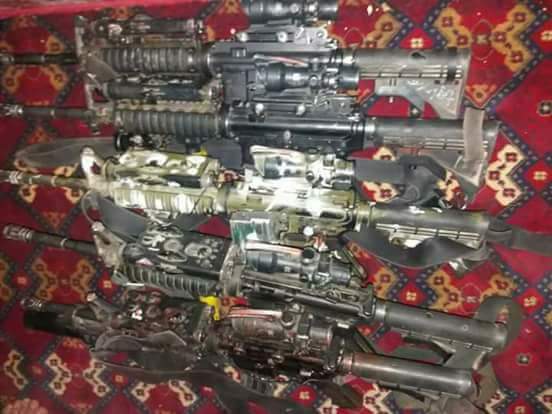
Recently disclosed photographs supplied to Silah Report have suggested that the local GoIRA supported militias are armed with more than the standard Kalashnikov self-loading rifles often seen throughout the country. One example of these forces is the Afghan Local Police, or ALP. Although these forces are seen as cost-effective, many local Afghans compare them to the days of the War Lords that roamed the country in the Civil War.
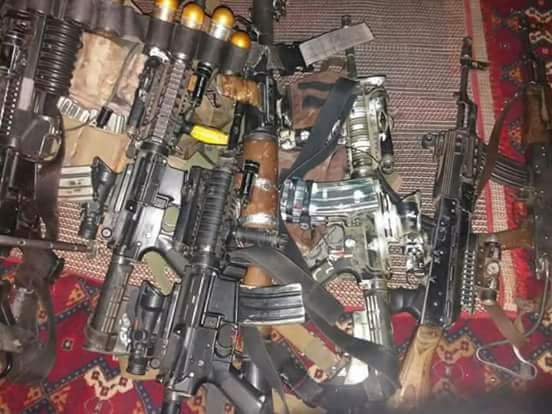
The photograph below depicts five 5.56x45mm NATO M4-patterned carbines in configurations that are identical to that of the ANA Commandos. This includes the AN/PEQ-2 TPIAL mounted at the 12 o’clock position on the Picatinny rail, the Trijicon 4x RCO day optic, the MaTech BUIS, and even the spray painted rifle in the center. Also present is a 40x46mm NATO M203 UBGL mounted to the carbine at the bottom. Notice on the painted carbine the coupled STANAG magazine inverted from a usual “rounds up” position.
As indicated by this photograph, a small arms inventory such as this is consistent with what the ANSF Commandos are generally issued.
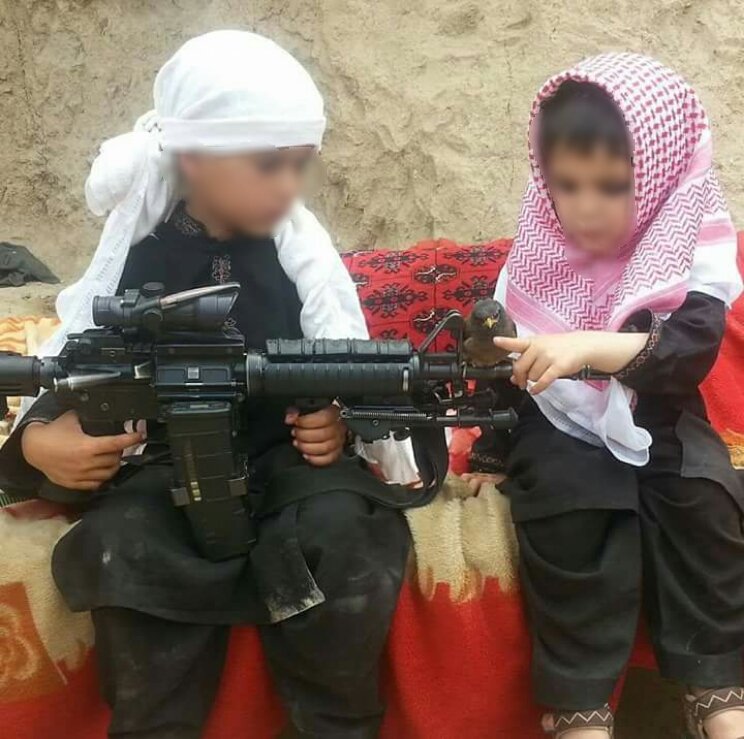
This photograph was provided by the same source and features a similar magazine coupling technique as illustrated above. What appear to be UTG rail covers and what is most likely a Harris bipod copy appear to be third party modifications from the standard issue. Myna Bird perched on the 6-inch barrel comes unissued.
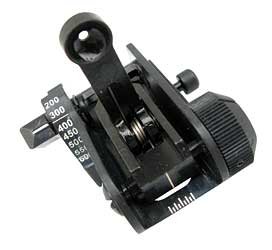
MaTech BUIS as in use.
However in this angle present are Streamlight TLR Picatinny mounted weapon lights, in addition to Kalashnikov patterned rifles, which are rarely in use by ANSF Commandos, if at all. Although rare, there are some TLRs that have been spotted among the group.
Although contextual information about the photographs are scare, a source has suggested that the militia checkpoints are perhaps funded by a shadow entity with a large supply budget. Such as the “Kandahar Strike Force” that was indeed set up by the CIA. In Afghanistan, this is immediately assumed to be the “CIA”, but until we have further information, we cannot venture more into the origins of these carbines.
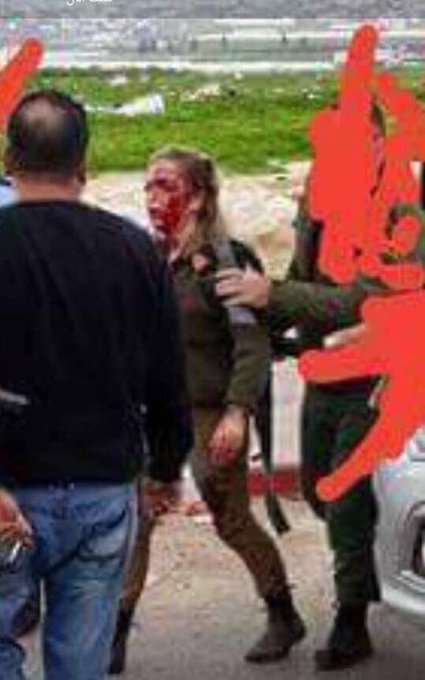
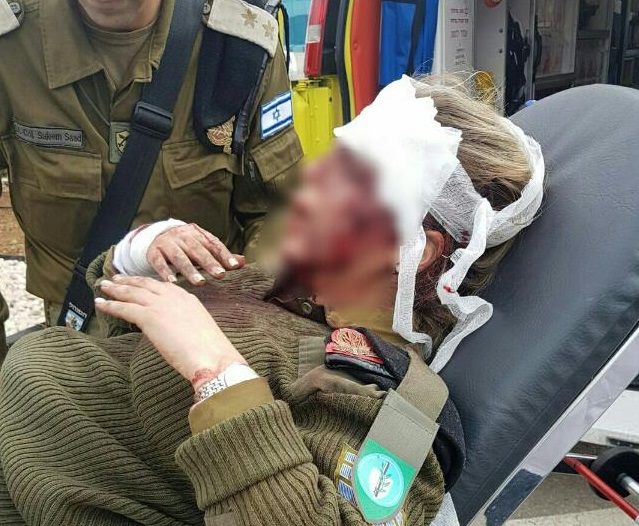
The two soldiers, a man and a woman, were lightly to moderately injured. Images of the female soldier’s bloody face circulated on social media after she was injured by shattered windshield glass. She was evacuated to a hospital in Afula.
Video from the attack shows the mob haranguing and attacking the soldiers as they cried out.
An initial investigation found that the soldiers had been misdirected to the Palestinian city by the Waze navigation app on their journey from Shavei Shomron in Samaria to Afula in the Jezreel Valley.
A Palestinian Authority policeman intervened to protect the Israeli soldiers, ultimately firing into the air to disperse the crowd. Over 100 members of the PA security forces were called out to escort the soldiers to safety and return their jeep to Israel, according to a PA security official interviewed by the Jerusalem Post, who also said that the effort was made both to protect human life and prevent Israeli reprisals against Jenin.
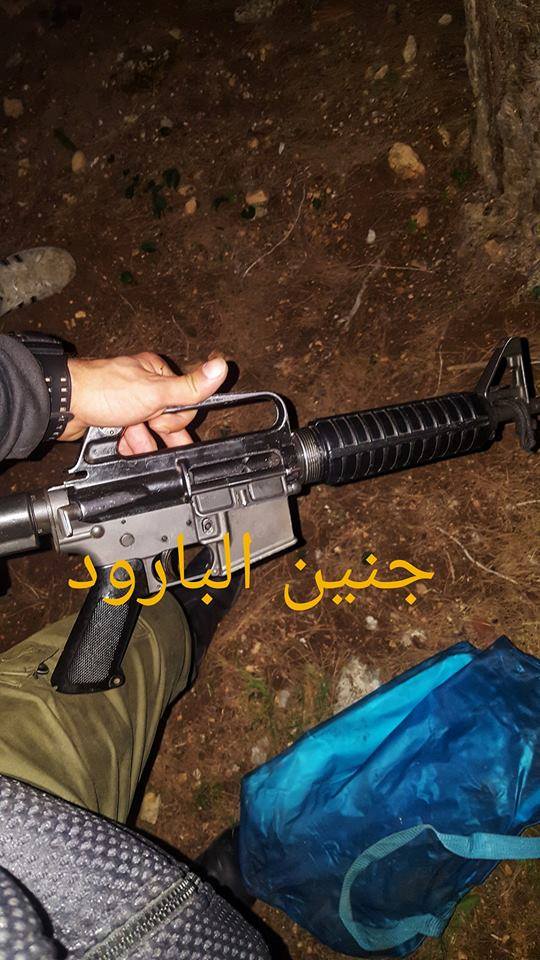
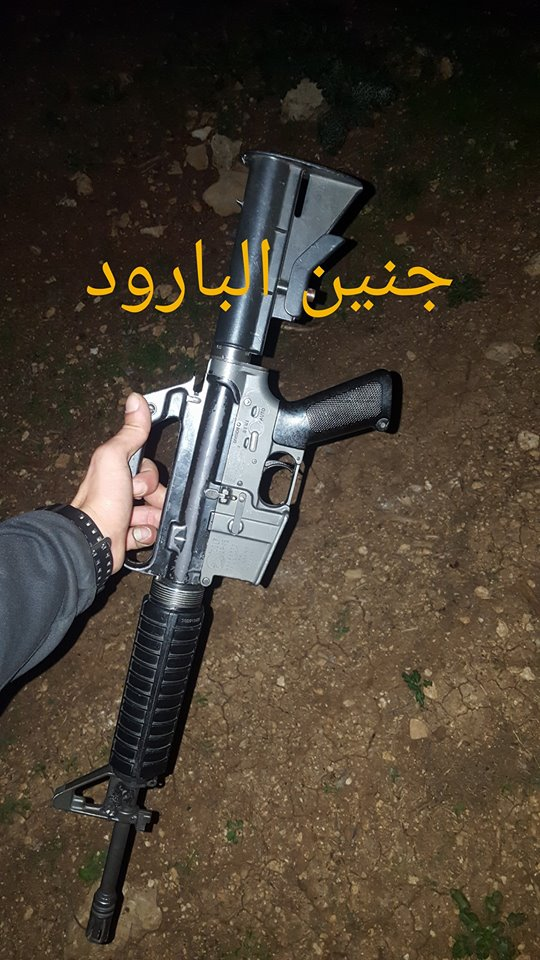
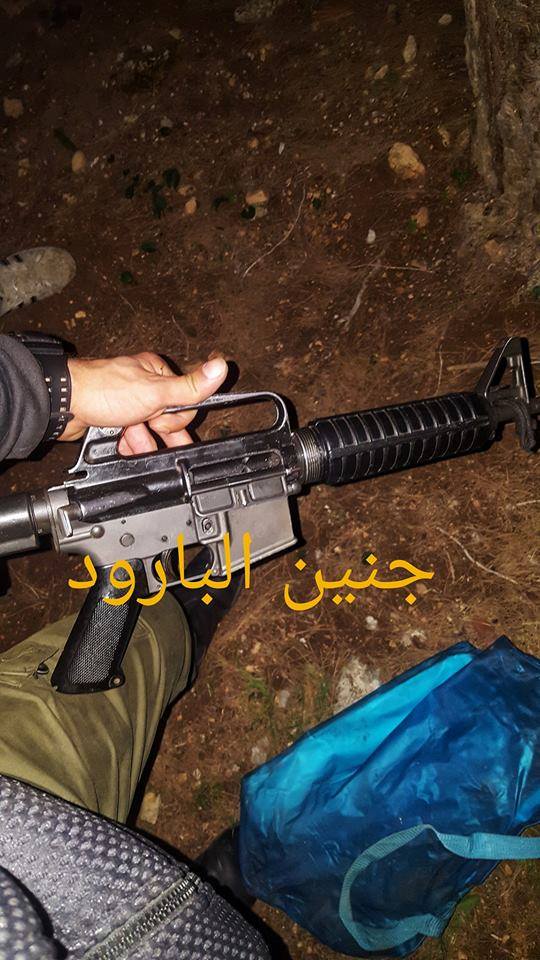
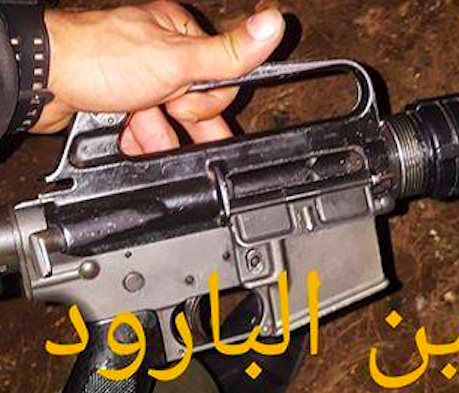
Various Palestinian social media outlets have released images of a Colt CAR15 that appeared to have been returned to IDF forces after the encounter. The IDF has made extensive use of U.S. CAR15s, M16A1s, M16A2s, and even M4s for a number of decades, currently supplementing the IWI Tavor now in service with frontline troops.
Notice the earlier A1 forward assist and A1 rotary dial rear sight. In addition, notice the shorter telescoping stock which is signatory of the CAR15 series. Also note that the upper and the lower receiver don’t match, possibly indicating that the two parts were interchanged throughout the life of the rifle.
But more interesting than the rifle is the fact that the bolt and charging handle appears to be missing from it. This could have been intentional on the part of the Palestinians who captured the rifle.
The Israeli soldiers appear to have taken a beating but fortunately are still alive. They probably could do with a remedial land navigation course, and not rely on Waze to get from one tactical objective to another.
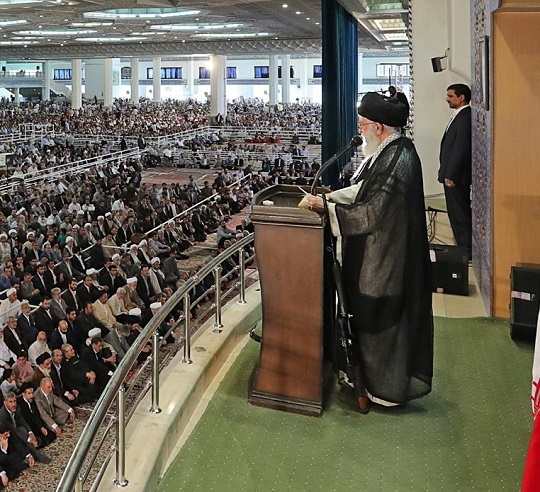
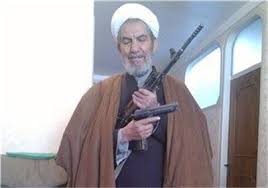
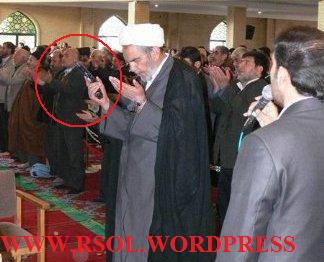
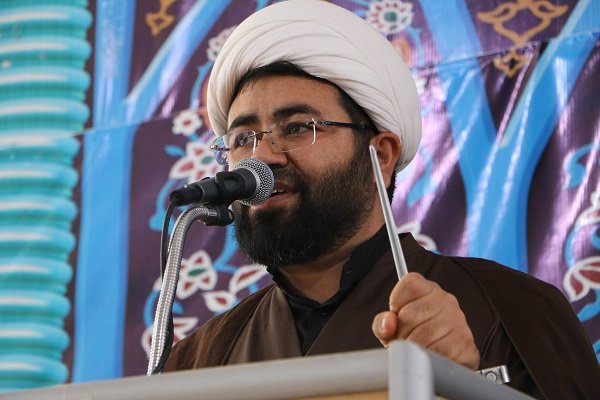
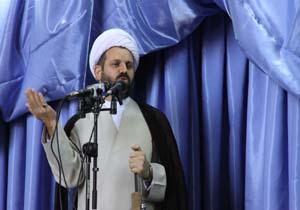
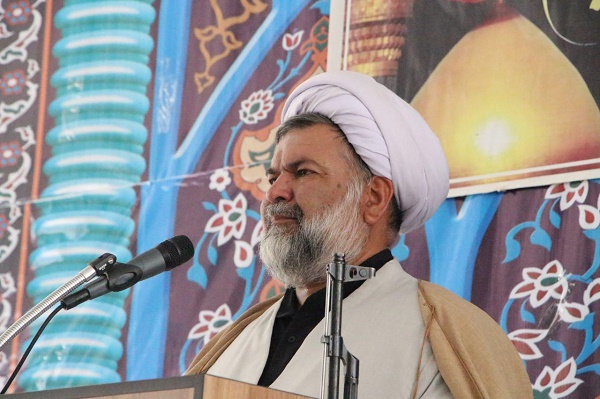
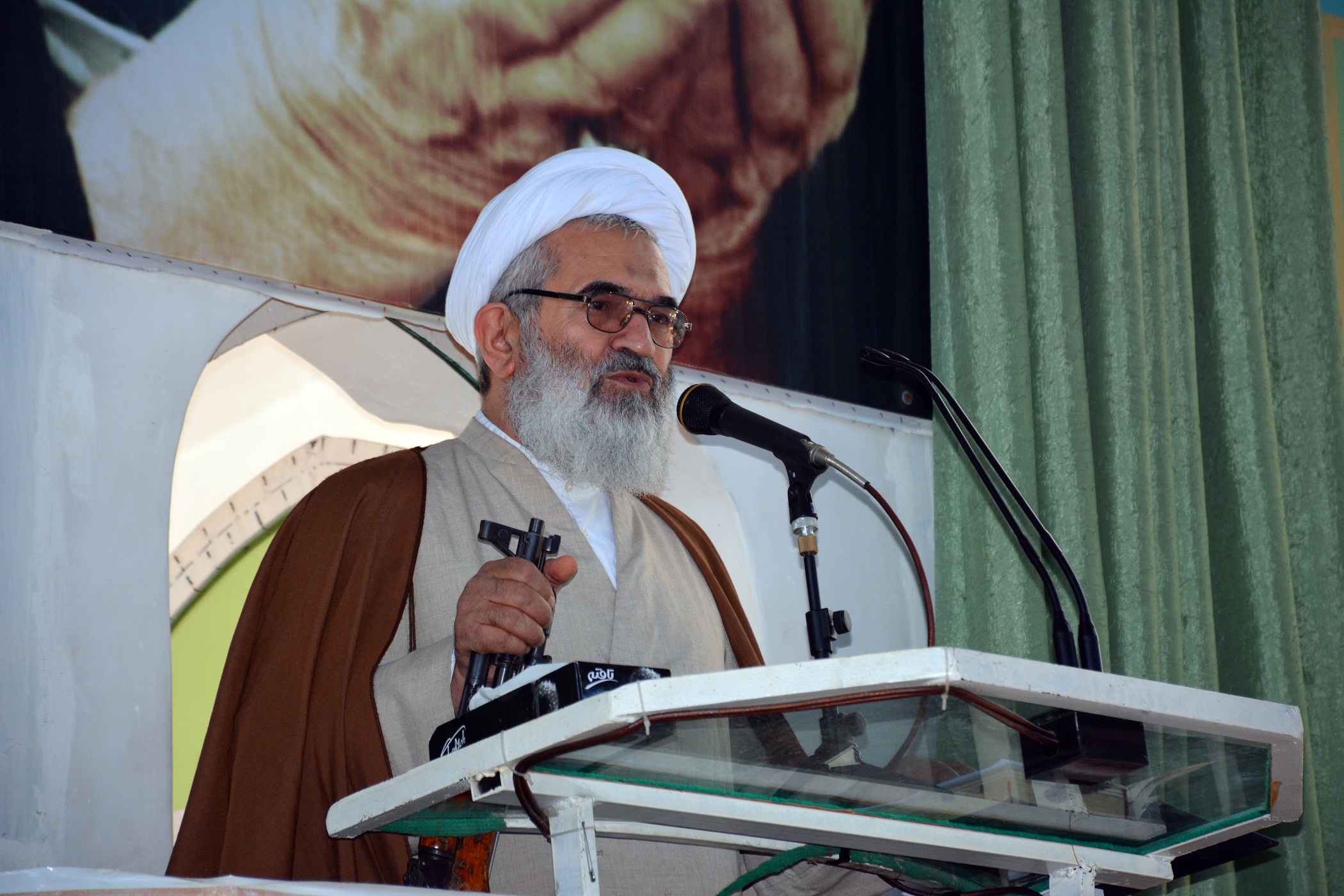
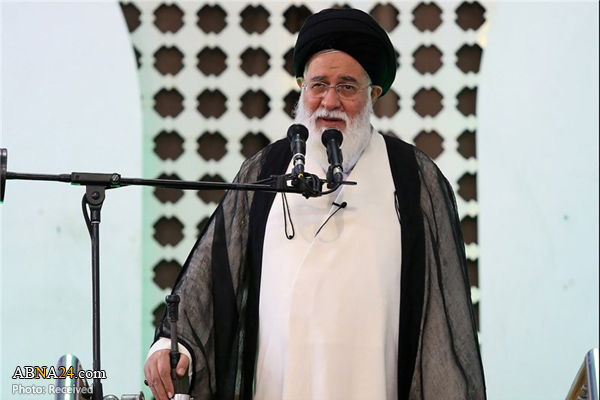
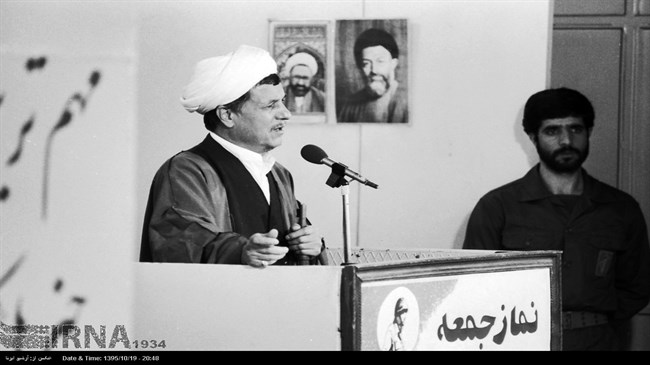
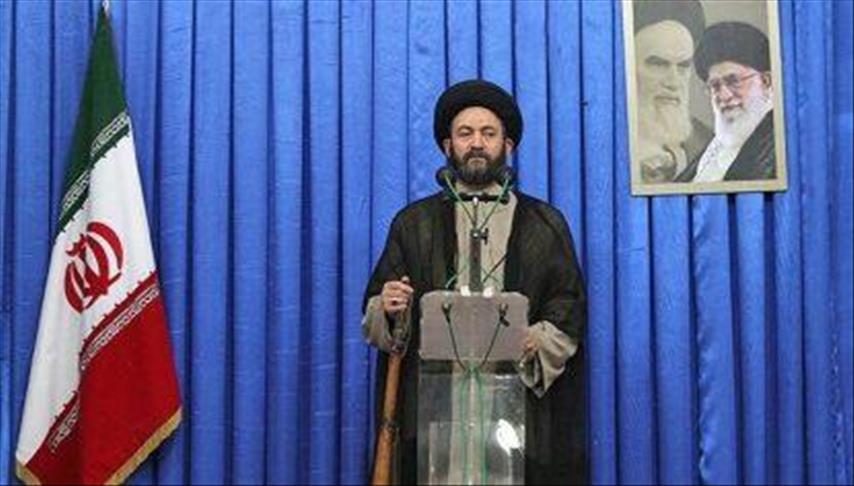
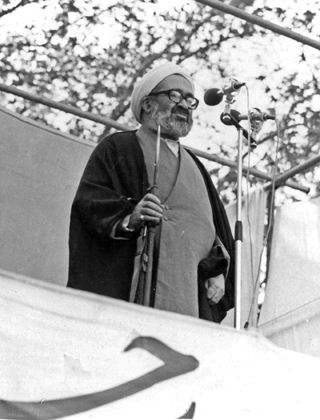
In a previous article on Silah Report authored by Ali Parsa and generously donated by him from his website Aliparsa.com, Ali specifically mentioned an interesting practice done by Iranian Shi’a Imams during Friday Khutbah Prayer services. Imam’s in Iran are known to hold on to various rifles while giving their Khutbah sermons. Ali mentions that this comes from a Sunnah of the Prophet Muhammad (ﷺ) where it mentions that the Prophet always held the “Weapon of the Day” while giving his own sermons. Going into a little searching I found this paragraph on Islam QA that gives some background behind this-
In a tradition recorded by Imam Abu Dawood, it is narrated that the companion, Hakam bin Hazn Al Kulfi (RA) said, ‘We witnessed Juma with the Prophet (SA), and while standing (to deliver the khutba), he was leaning on a staff or bow. (Abu Dawwood – Chapter of a person who delivers a khutba and leans on a bow). Based on this narration, scholars have stated that holding the staff while delivering the khutba is commendable, as it was a practice of the Prophet (SA). In this regard, the great jurist, Allama Shami recorded the following: – ‘Certainly taking the staff is a Sunnah just as standing’. (Raddul Mukhtar).
Now, I’m not nearly as versed in the Sunnah as Iranian Shi’a clerics, but in this instance it makes no mention of a “Weapon of the Day”, which Imams in Iran appear to interpret as meaning whatever primary weapon is issued that is used to defend the Islamic Republic of Iran. That is certainly one interpretation of “Weapon of the Day”, perhaps similar how a “Uniform of the Day” is in many armed forces regulations around the world informing troops what uniform to wear. The explanation above refers to a “Staff”, which the Prophet appears to simply mean something to lean on, gain physical support from, and show to emit a sense of authority in front of a congregation. We have similar examples of Prophet Moses’s staff and there are other religious texts that reference a staff as well.
A key note to mention here is that this practice is only adhered to in the Islamic Republic when it comes to gripping actual firearms during the Khutbah sermons. It doesn’t appear to even exist in other Shi’a dominated countries or countries under Iranian influence to the extent that it does in Iran.
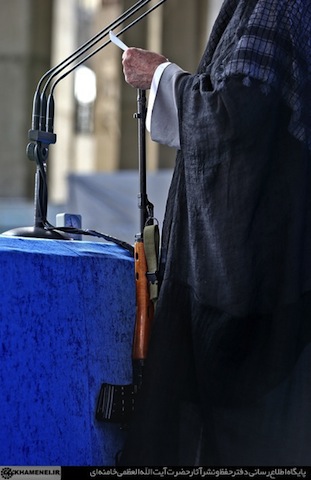
Now, going back to sort of the entire reason why Silah Report exists (apart from general small arms & light weapons analysis), is that we serve to make sense of these cultural phenomena when it comes to the intersection of small arms and the regions we are interested in. A prime example is this Blaze post in 2015 that is entitled “Can You Spot What Iran’s Khamenei Was Holding During His Speech on the Nuclear Deal? The Mainstream Media Ignored It”.
The post goes to great length to try and psychoanalyze the geopolitical ramifications of Imam-i-Khamenei gripping what is most likely a Chinese export copy of the 7.62x54r mm SVD Dragunov marksman rifle.
The article mentions that-
To drive home the point, the supreme leader’s official website posted a close up photo captured from beside the podium of the gun which even showed the magazine jutting out
…
But the most potent sign of all reflecting his message – the gun balanced under his left hand holding his speech notes – was left unmentioned.
It’s unlikely that if the speech had been given by an American or any Western politician that this scene setting detail would have been overlooked, especially given the hotly debated issue of guns.
The AP’s website had this photo of Khamenei holding the gun, but it was not mentioned in the copy in the accompanying article
By now, I hope readers of this article will realize the odd stance that The Blaze is taking on this Dragunov. Of course the Iranian media didn’t mention it because this is in fact actually a completely routine practice done by Imams at every organizational level throughout the religious hierarchy in Iran. Should the Iranian media have thoroughly mentioned the microphone in front of Imam-i-Khamenei’s face as well?
Now, this post isn’t to slander a conservative news outlet for getting something wrong. Any viewpoint from any source at all that is worthy of correcting in a cultural, historical, or social light will be equally scrutinized. This one just so happened to stand out as a prime reason why we at Silah Report are dedicated to our jobs at hand, to fill this void of historical and cultural knowledge by analyzing the technical with the cultural.
For more information on other Imams holding small arms during sermons, check out this Farsi language post on the topic, literally discussing what certain Imams prefer to hold during their Khutbahs.
From the post, in Farsi-
به گزارش پارسینه، برکف گرفتن سلاح توسط امام جمعه، سنتی است اسلامی که ریشه در صدراسلام دارد، نمادی از آمادگی دفاعی در برابر دشمنان اسلام حتی در محراب و محل نماز، بعد از پیروزی انقلاب اسلامی، مرحوم آیت الله طالقانی که با حکم امام خمینی، احیاگر سنت نماز جمعه بود، بار دیگر این سنت اسلامی را زنده کرد. آیت الله طالقانی در برابر پیشنهاد برخی از انقلابیون که به وی پیشنهاد کردند از شمشیر به عنوان سلاح خطیب امام جمعه استفاده کند، این پیشنهاد را رد کرد و “سلاح روزآمد و مدرن” را به دست گرفت.
در اوایل انقلاب اسلامی، سلاح ژ-3 تفنگی بود که امامان جمعه تهران و شهرستانها در حین ایراد خطبه جمعه به دست می گرفتند که در سالهای بعد، اسلحه از رده خارج “برنو” جای ژ3 را گرفت.
در میان ائمه جمعه، آیت الله حسنی امام جمعه ارومیه به داشتن سلاح های متعدد از جمله کلت و گرینوف در نماز جمعه شهرت دارد و معمولا بر خلاف ائمه جمعه دیگر از سلاح کلاشینکف در محراب نماز جمعه استفاده می کند.
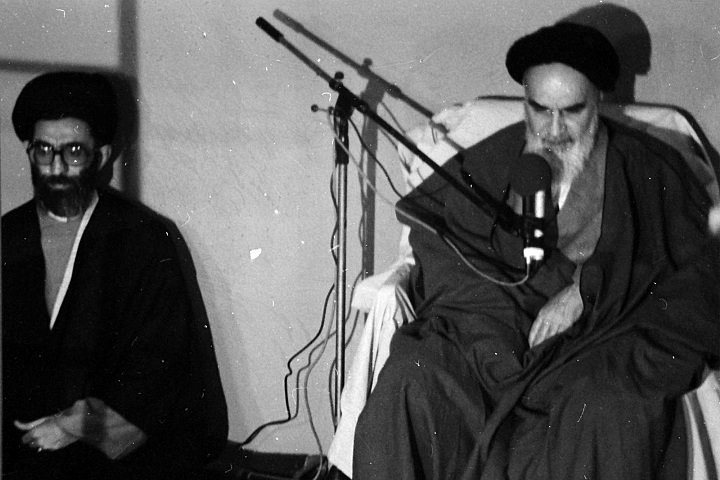
As a quick sidenote by scanning photographs online, it doesn’t appear that the initial Supreme Leader of Iran, Imam-i-Khomeni adhered to the practice. Although it should be noted that senior Imams during his time did partake in it, as evidenced in the black and white photographs above.
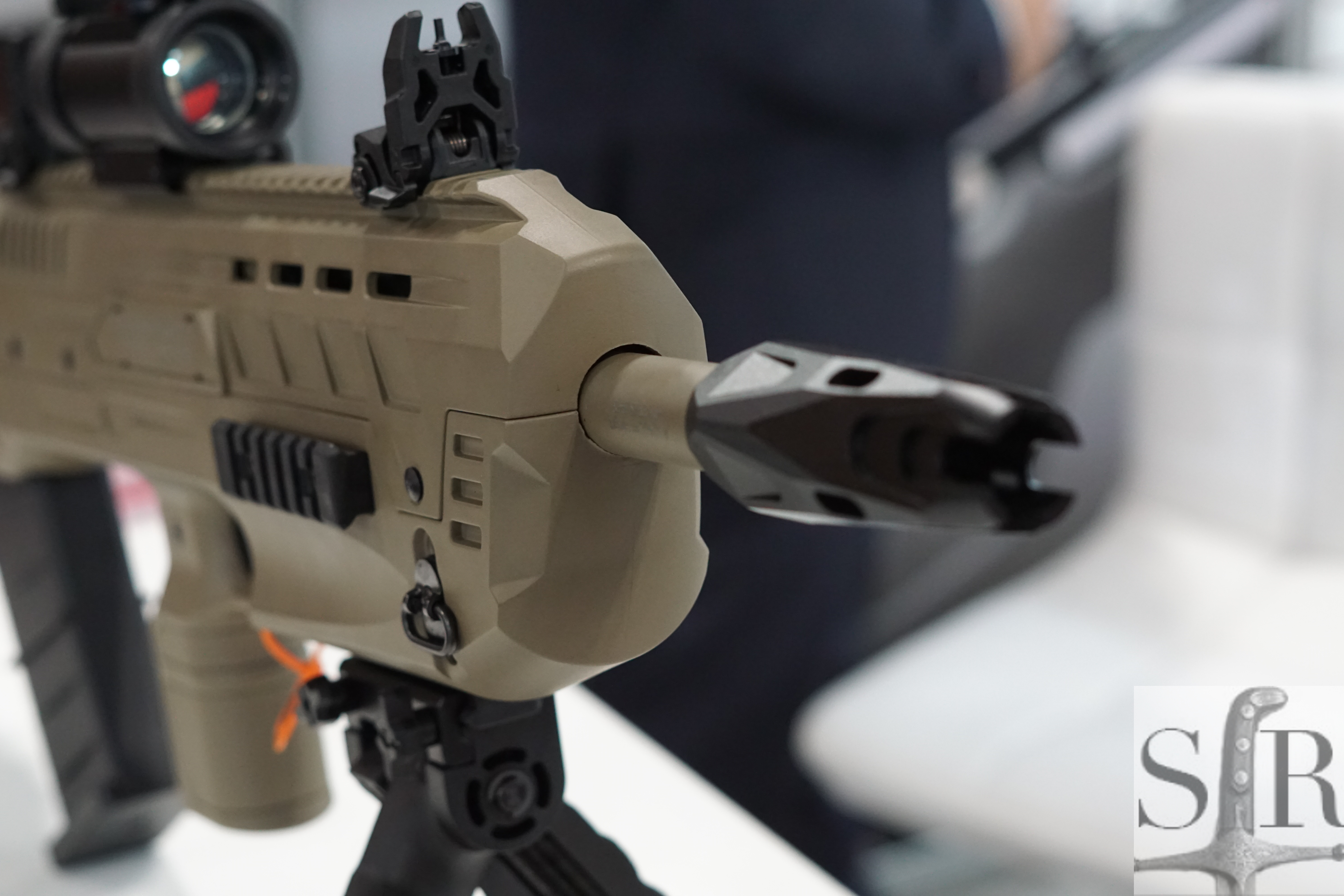
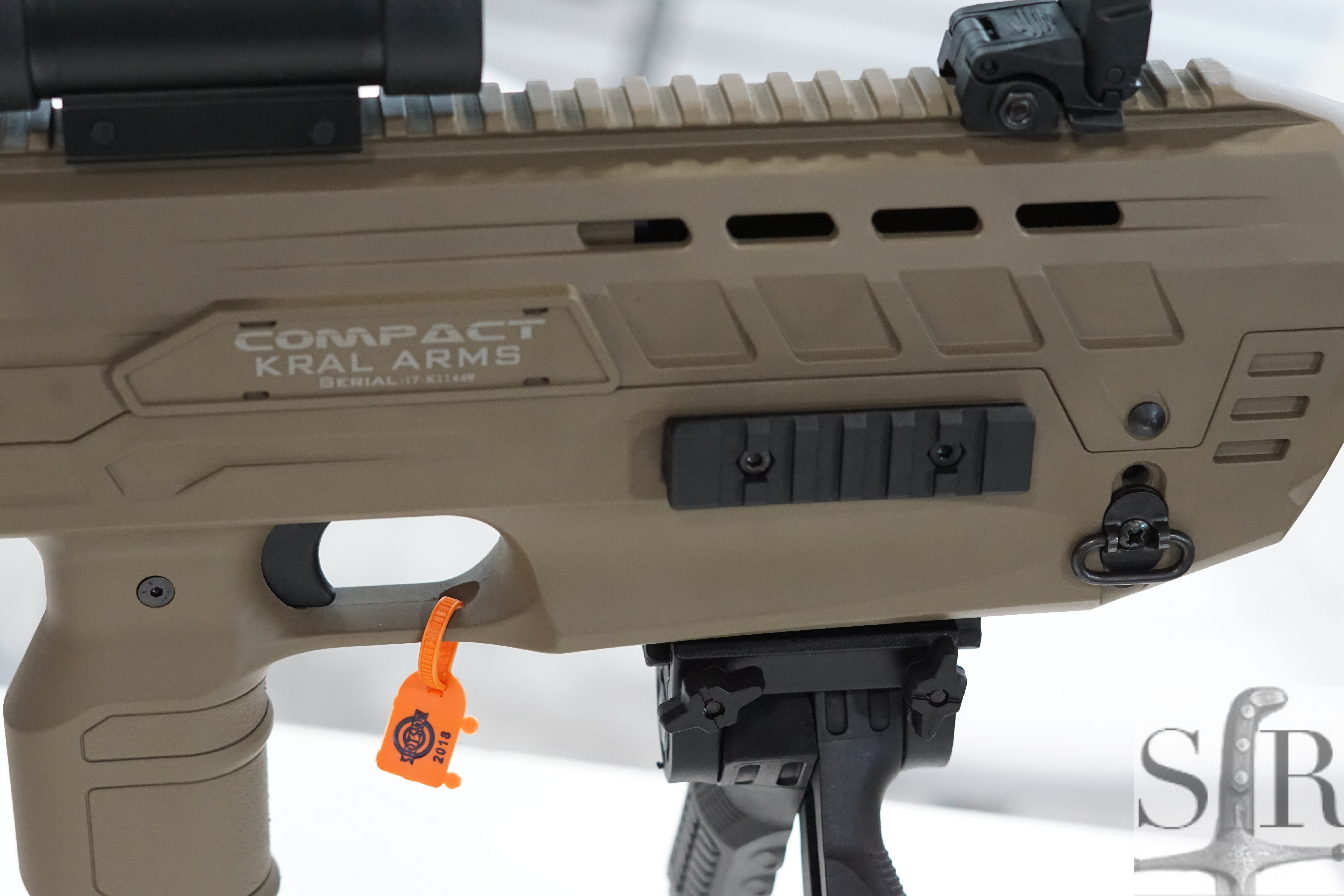
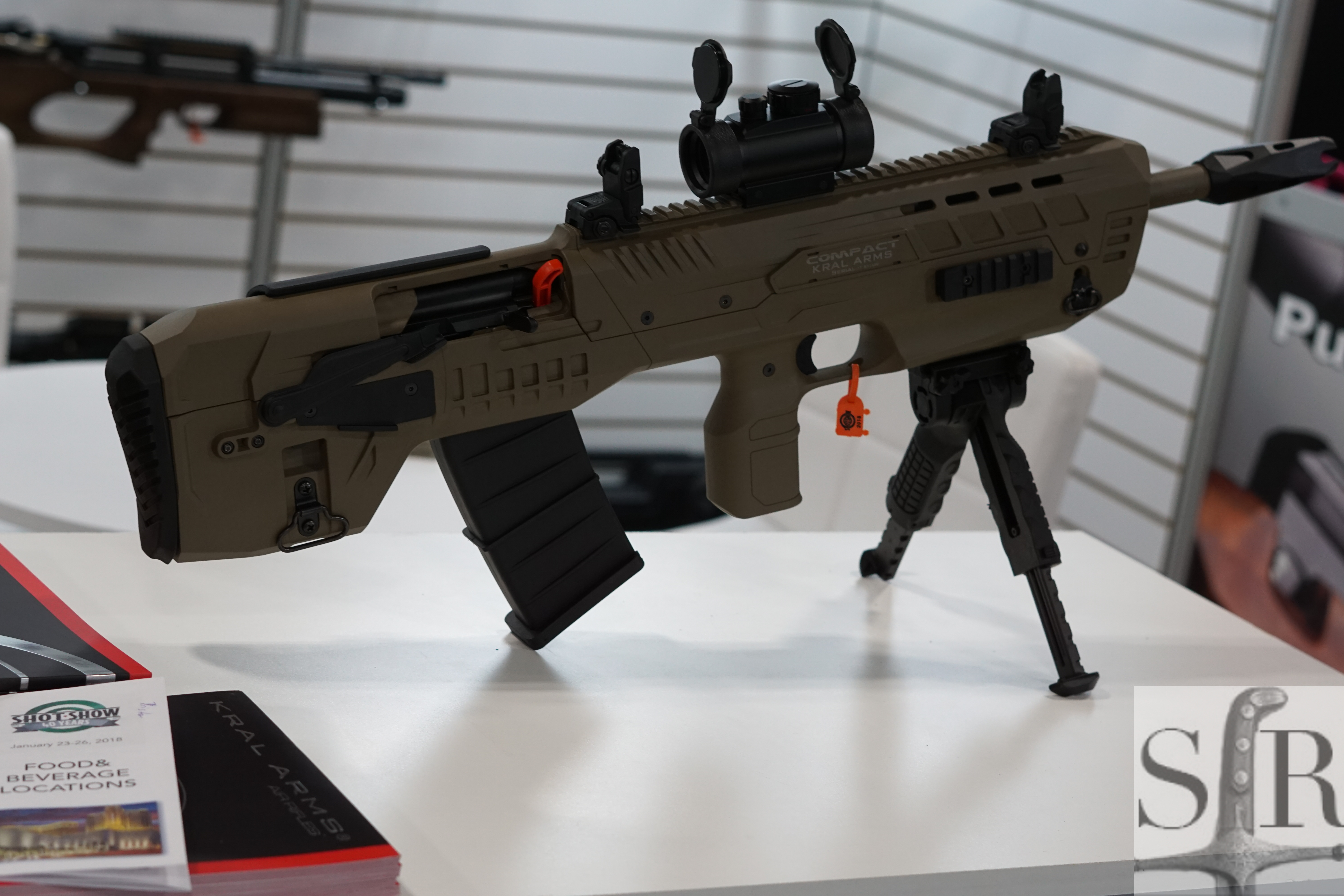
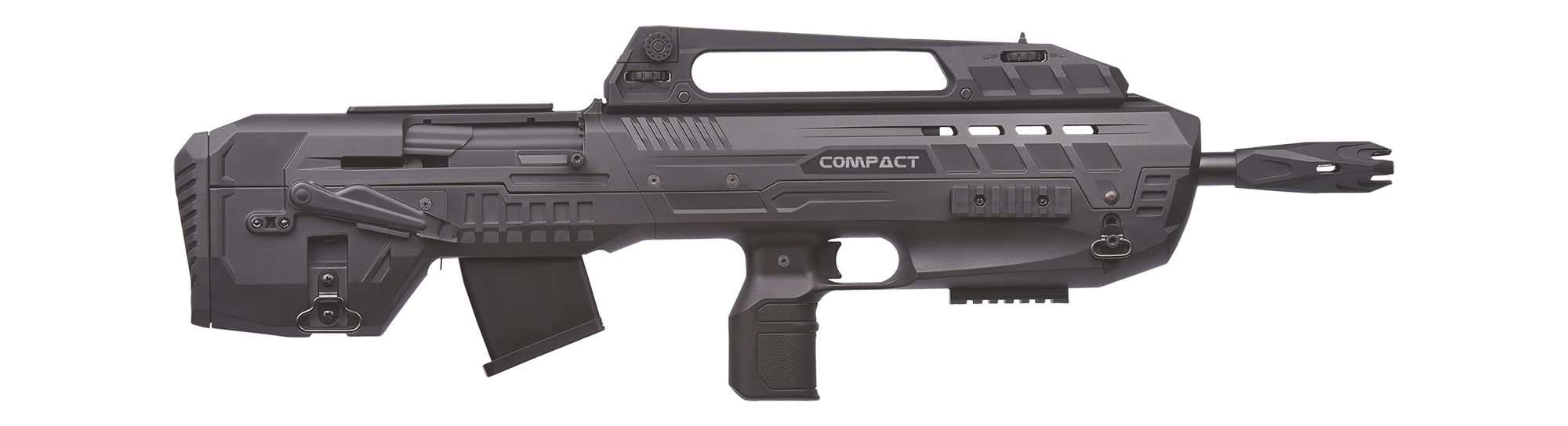
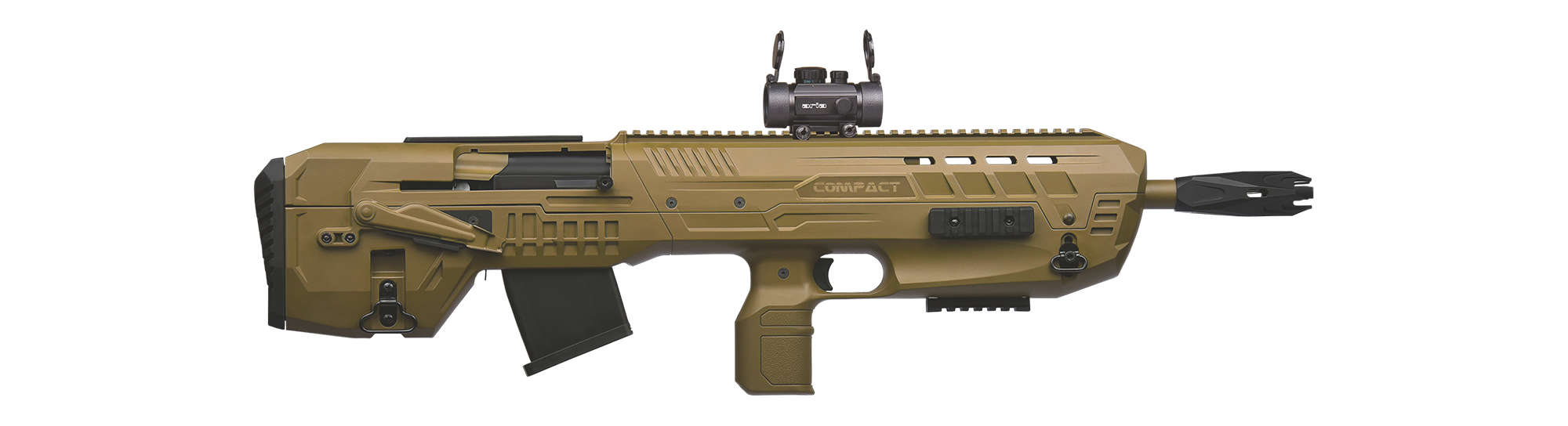
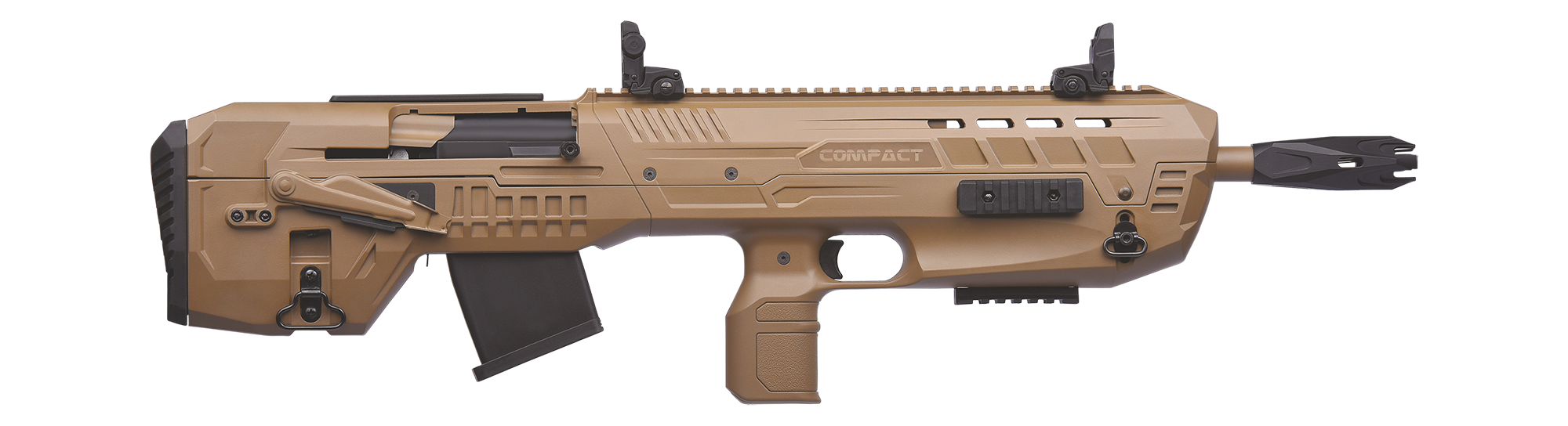
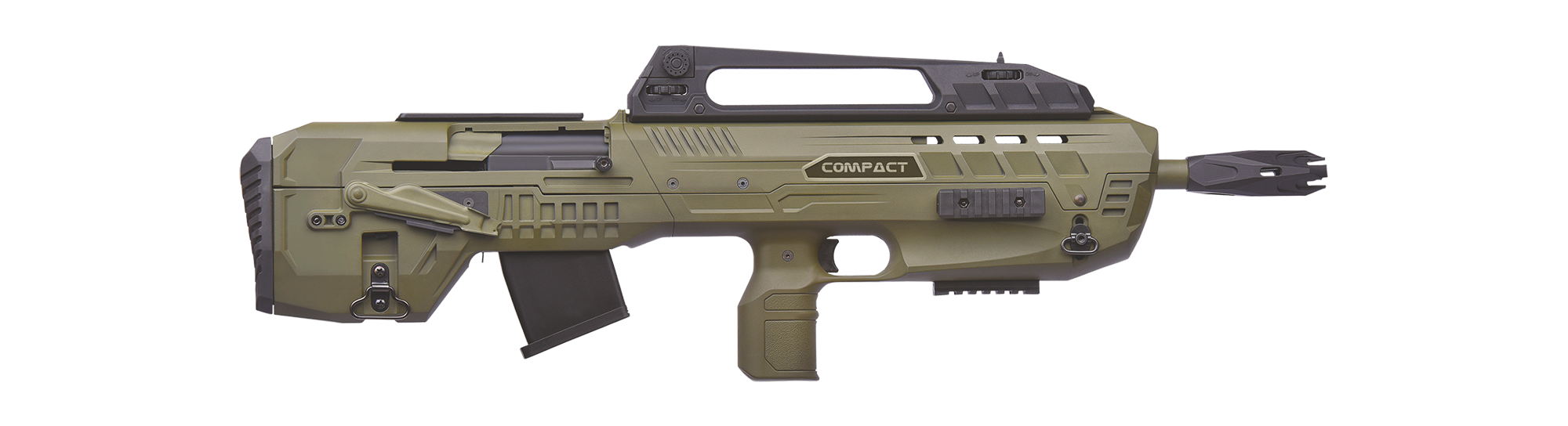
Kral Arms brought out their “Compact” 12 Gauge bullpup semiautomatic shotgun at SHOT 2018 this year. Essentially the “Compact” is the companies previous 12 Gauge XPS Kalashnikov patterned shotgun fit into the polymer frame of a bullpup. It retains the safety lever externally. There is a trigger bar that extends to the Kalashnikov trigger mechanism in the rear.
The shotguns are offered with red dot sights, plain BUIS sights, or an improvised A2 handguard that extends the entire length of the Picatinny optics rail. Magazines offered are either a 2, 5, and 8 shell configuration.
There are four available finishes: Black, Burnt Bronze Cerakoted, Dark Earth Cerakoted, and OD Green Cerakoted.
“Krinkov”, where does it come from and how have we gotten to it? There are a number of theories about it, some truer than others, but we’ll examine each one, and I will provide what I have come up with so far.
The first theory is that it is Russian. At face value, this could seem true, by simply hearing the word “Krinkov” to a non-Russian speaker, it might sound Russian. However, this is by far, not the case at all. Tim from Military Arms Channel has an excellent dialogue on this, explaining that the Russians have an entirely different nickname. I’ll take an excerpt from Maxim Popenkers site, World Guns:
Since its introduction the AKS-74U, unofficially known as a “Ksyukha” (variation of a Russian woman name) or “okurok” (cigarette stub)
In addition from Max’s book Assault Rifles, we have this entry:
Since its introduction the AKS-74U, unofficially known as a “Kysusha” (a variation of a Russian female Ksenia), “Suka” (bitch), “Suchok” (small tree branch) or “Okurok” (cigarette stub)
And this is Tim from Military Arms Channel, explaining some of that from the Russian side.
Tim is correct in his explanation of what Russians would call it, but the biggest problem I have with his explanation is that he completely dismisses the role of the Afghan Mujahaden, saying that it is a “nonsense word”. In addition, he speculates that maybe the first AKS74U taken off a Russian who was named Krinkov. The theory doesn’t hold any weight because for one, Krinkov isn’t a Russian name or in any sort of Russian vocabulary. Also, the fact that Pashtun speaking Mujahideen could speak or even read Russian is very, very rare, many of them being illiterate in their own language of Pashtu (illiteracy is an extremely large problem even in current day Afghanistan/Peshawar, and was much more so in the early 1980s). Furthermore, the circumstances of the Mujahideen capturing weapons from the Russians involved very little live prisoners. We’ll get into this in a bit as well, but for the overwhelming majority of the time, the AKS74U was issued to helicopter and armored vehicle crew members. Contrary to popular belief, the amount of Russians captured in Afghanistan during the war, and the amount of Russians fleeing to the Mujahideen side was extremely low as well. Most of the time, the only way Mujahideen could get their hands on Soviet equipment was through disabled vehicles wherein the Russian occupants would already be dead, or through the corrupt selling of Russian arms to the Mujahideen by either Russians themselves, or Afghan government troops.
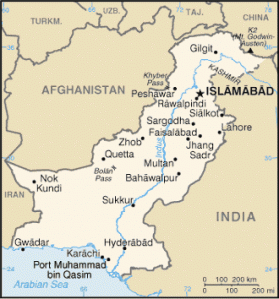
Most of the Mujahideen and Pashtun speakers that would have contributed to the name “Krinkov” would have been near Peshawar and in the eastern regions of Afghanistan.
The second theory is much more recent, but it originates from a gun shop in Naples, Florida. The shop was called “Krinks” and was run by a certain Paul Mahoney, who in the early 1990s was one of the first AK builders in the States to really take advantage of deactivated AKS74U kits, and put them together. The quality of them left much to be desired, but the fact of the matter is that the first mass producer of “Krink” kits in the United States was this guy Paul Mahoney with his gunshop “Krinks”. This might have certainly been one of the reasons why the name started to gain in popularity in the States, but it doesn’t help us at all in the actual etymology of the name.
My problem in the whole name origin is that we constantly see this theme of loosely attributing it to the Mujahideen, but yet there hasn’t been a single effort to get right to the source and really examine how that name might have even come about. Maybe it is ethnocentrism, maybe it is on account of laziness, maybe it is just accepting the status quo and not moving on. Either way, I’m going to present evidence that points to that fact that the name is actually a Pashtu word that has entered into our vocabulary, and is a testament to a twist in linguistics in the Pashtu language.
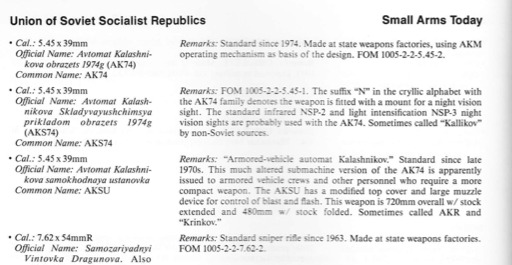
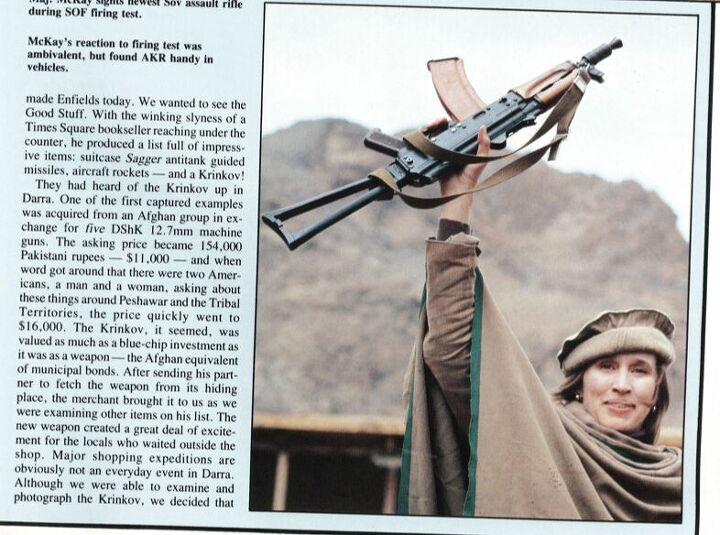
To begin with, we have to examine how the existence of this carbine became known about in the United States. I’ve often heard the claim that Soldier of Fortune magazine was the first entity to bring knowledge about the AKS74U, and even the AK74 to the West. I think this claim is more of a support for Soldier of Fortune’s reputation than any actual truth. Because just by looking at the facts, the famous Soldier of Fortune article that was run about the AK74 was in 1982, and the article about the AKS74U was in the July 1984 edition of the magazine. Looking at Jane’s Infantry Weapons from that era, and before, we see entries for the AKS74U, Sometimes labeling it as an AKSU 74, an AKSU and also as an “AKR”. This name most likely originates from Ian V. Hogg, as he was tied in with various intelligence circles at the time, that somehow came up with AKR. We still see this name in 1989, with Edward Ezell’s book, Small Arms Today.
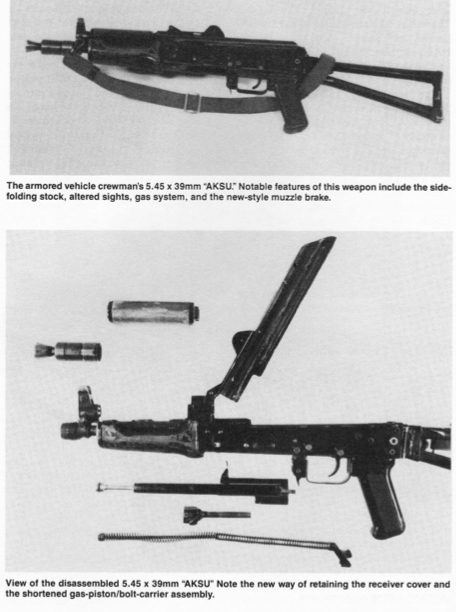
Above is from Small Arms Today, and below is from “The AK47 Story“, both by the late Edward Ezell. Above he refers to it as the AKR/Krinkov, and below the “AKSU”. Both published in the late 1980s
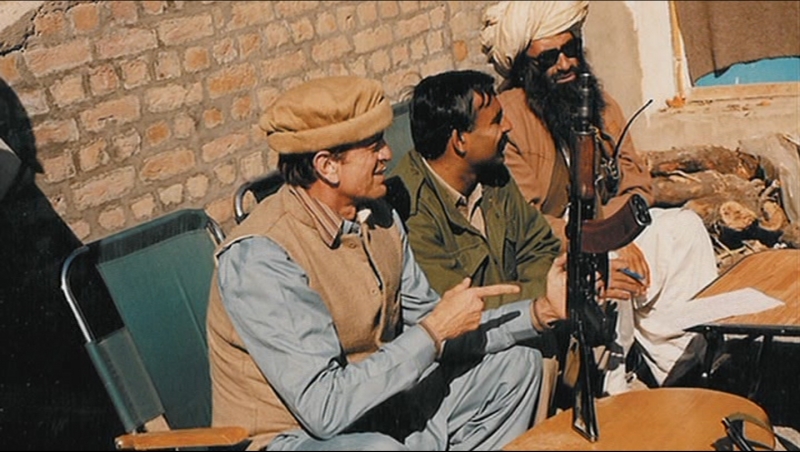
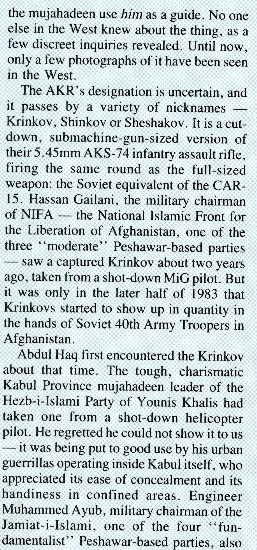
But going on to who actually deserves the credit of “discovering” the AkS74U, we have a sentence from the July 1984 edition of Soldier of Fortune, in which David Isby does an entire article about reviewing this new carbine, while he and an American Army Major are in Pakistan. He claims that initial knowledge of the carbine is from Ian Hogg, who in turn heard about it from a certain Peter Jouvenal. This guy was a video journalist, who has been in and out of Afghanistan since the late 1970s, and is extremely important because he captured one of the only video shots of Taliban leader Mullah Omar in person.
Below is the text from the Soldier of Fortune article detailing the origins and name of the AKS74U.
Peter Jouvenal, right, with Osama bin Laden. Probably the actual “discoverer” of the AKS74U in the West.
Within the Soldier of Fortune article, David Isby takes the name from the Afghans he was with. However, he mentions two other names “Shrinkov” and “Shesakov”. These two names are also important, but because of the linguistics involved, I’ll get to that in a second.
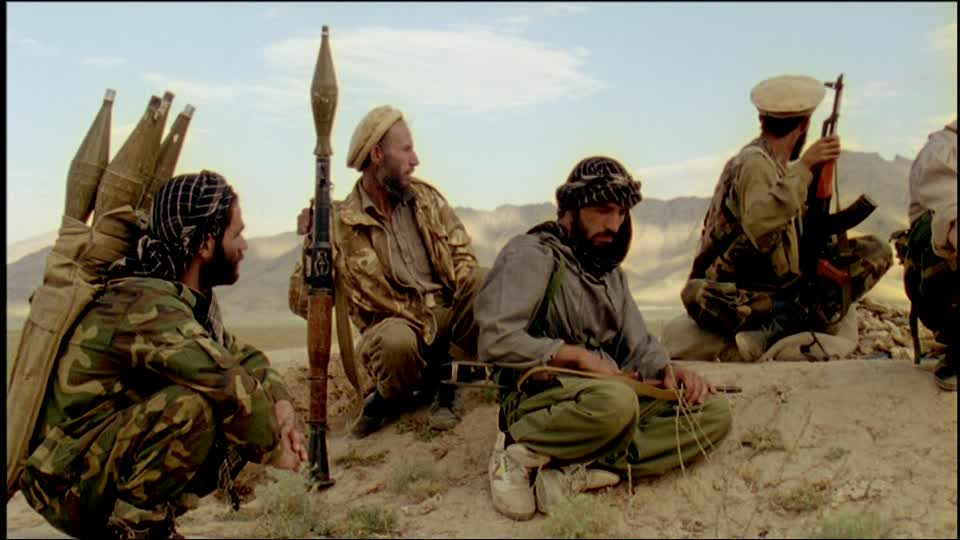
As mentioned earlier, the difference between this article, and any other article on the internet, is that I’m going to the actual source of the name, which is from the Pashtu speaking peoples of eastern Afghanistan, and Pakistan. The name is not a “nonsense” word, it is a Pashtun word. I’ll start this off by showing a clip from a movie called Son of a Lion. Quite an interesting movie, it was made by an Australian EMT on his own dime, after 9/11, going to Peshawar and filming a storyline about a young boy who works in the arms trade but really wants to go to school to become educated. The culture and language displayed in the movie are phenomenal, but from a firearms perspective, it gives us an in-depth look at the arms trade in Peshawar. Apart from a few actors, the rest of the movie is completely shot amid the markets and daily life of the North West Frontier Province of Pakistan. There aren’t any “props” or staged settings. The locations are real, and so are the small arms portrayed. But in it, we have this one scene where the main character takes a “Krinkov” out to a customer to test fire it. He also mentions the connection with Osama bin Laden.
https://youtu.be/KzN1-M37RiY?t=17m40s
Now, to understand why the reference to Osama bin Laden was even mentioned, we have to understand a little behind why the AKS74U became prominent among first the Mujahaden, and then today among families of status. As mentioned previously, the weapon was only ever issued out to crew members of helicopters and armored vehicles. Contrary to popular belief, this wasn’t a favorite of the Spetsnaz at all, although it originally started out as a proof of concept for Soviet Special Forces. It was quickly ditched for the AKS74 because the longer barrel proved to be better in the vast distances that the Spetsnaz found themselves operating in. This from an interview that I conducted with Marco Vorobiev, a Spetsnaz Veteran of the Afghan war.
Miles Vining- I noticed in some of your talks that you don’t have much love for the AKS74U?
Marco- Well its alot of fun. Lets talk about it from a far away point here. The gun is a tool in a toolbox to complete a certain job. And the job could be a regular contact fight, lets say 500-400 meters, to include maybe clearing houses or compounds. So from that regard you want something small, maybe be able to use it in close quarter combat, something really, easy to handle, easy to maintain. Well that is fine, considering if you are a police officer going through a house. It shoots 5.45 as well, so thats good for wounding. On the other hand, as a carbine, you need to be able to hit targets out to 300 meters. You can do that with an AKS74, no problem, even with an M4. But the AKSU? You might if you spray half a magazine in that particular direction. But I even have one, I shoot it for fun, I get a big old smile on my face. It’s fun to shoot, it’s just like rrrrrrrrrrp, almost like a little toy so to speak. Mikal Kalshanikov himself told me that he loved it, although he was a very anti 5.45 guy, but he was a big fan of the AKSU for some reason. But you put yourself in an actual gunfight, with people screaming everywhere, trying to get comm up, you taste the metal of adrenaline in your mouth, and now you are trying to pick out targets in the distance… it’s really hard with that gun. We were always trying to get rid of it for the AKS74.
Thus, the weapon was strictly for crew members. And if we look at the context of the Soviet-Afghan War, the biggest hinderances for the Mujahideen, were the Hind attack helicopters, and the BMPs. In fact, if you look through Soviet photographs of the war, there is much evidence to attest to this, with helicopter crews even having thigh holsters carrying their AKS74Us. Thus, taking one of these monsters out of the fight would be one enormous victory for a small band of fighters, but more importantly, proving that you took one down would show everyone how brave or good you were. And what better way to prove it than to take a weapon that only these troops would have on them, an AKS74U? It not only proves that you were competent, but it also gives you something to defend yourself with. Even in the Soldier of Fortune article, we see just how rare and sought after these things were, even rising in price after word was passed around that an American was looking for one in Peshawar.
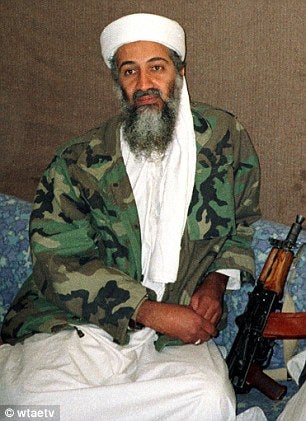
Now, Osama bin Laden claimed back to his Yemeni and Saudi buddies back home that he fought in the Soviet-Afghan War. But the actual truth of the matter is that he probably was never near any of the fighting, most likely staying in a rear echelon capacity, directing funds and supplies to the front (if he even did that). But, on his return to the area in the mid-1990s, we have a multitude of pictures of him, with an AKS74U by his side in the camera frame. This was very deliberate, to the point of the gun sellers in Peshawar even telling the customer that “This is the Osama gun”. Although Osama never took down a Soviet armored vehicle or Hind, the fact that he was carrying the carbine showed a status symbol, and he was able to identify much more easily with local Pashtuns who didn’t understand his Saudi background but absolutely understood his choice of weapon.
The placement of that AKS74U in the camera frame is entirely on purpose.
Somewhat off track, but this is important to understand how the name came to be, because even today, the AKS74U occupies a very lofty position as a status symbol in eastern Afghanistan and Peshawar.
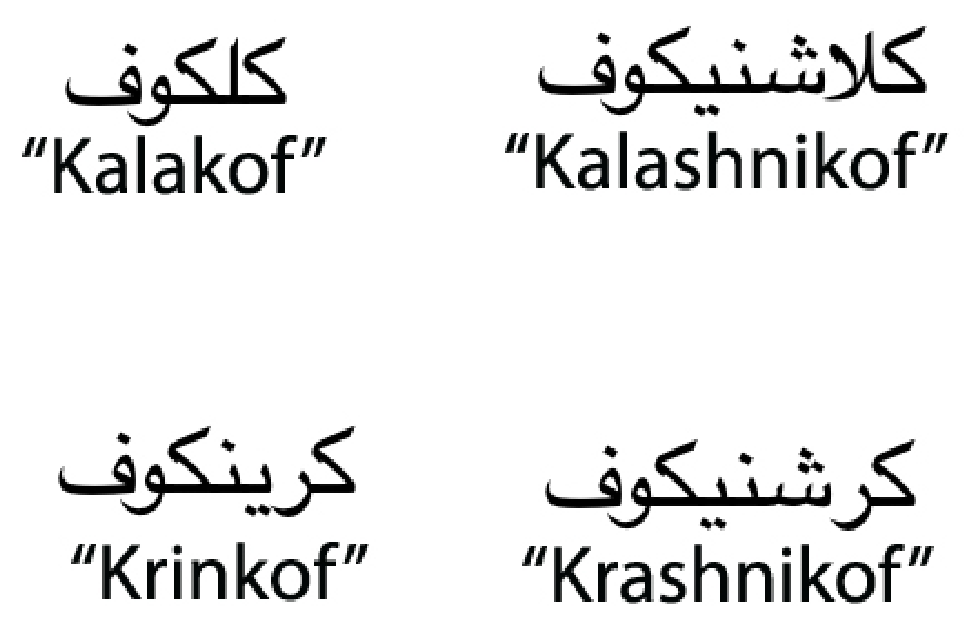
A close Afghan contact from Jalalabad mentions two names for the AKS74U, the first one which is popular in Jalalabad, is “Kalakov” and the second one is “Krinkov”. If you hear somewhat of an “F” sound at the end of the word, that is because there isn’t any “V” consonant in Pashtu, speakers instead using an “F” or a “W” sound to simulate a “V”. Now, remember what David Isby said the other names for the carbine were? “Shrinkov” and “Shesakov”? Using a little knowledge of the Pashtu language, the names pair up to be the same word. There are two dialects of Pashtu, the southern, or Kandahari, and the eastern, or the Nangahari. So looking at this words, “Krinkov” and “Shrinkov” are actually the same word, just pronounced differently, while “Kalakov” and “Shesakov” are a little more different, but dropping the “la” sound, the words are also the same.
From the full form of the word on the right, going into the nickname for the AKS74U on the left, the differences between the top and bottom are in different Pashtu areas of speaking.
But how exactly did these words come about? As my friend mentioned, adding an “ov” to any word makes it Russian-ized in Pashtu. So that explains the last part of the word, and the first part is probably a bit of vocabulary added on, to signify the importance of the AKS74U as a status symbol. Because it isn’t just any old “Kalashnikov”, its a “Krinkov”, and you know I got it from that Hind I blew out of the sky a week ago. Another tidbit that my friend brought up after the camera was off, is that for some reason, in Jalalabad, the Pashtuns refers to the Kalashnikov rifle as that, a “Kalashnikof”. However, in other parts of eastern Afghanistan, the same name is actually pronounced “Krashnikof”. And this might actually be the truest jump to “Krinkof”, as going from “Kalashnikof” to “Kalakof” is very similar, as is going from “Krashnikof” to “Krinkof”. In both cases, the “L” in the first one, and the “R” sound in the second one are maintained in their nickname for the short rifle.
I hope this was an informative article and was able to really get to the point of “Why do we call it this?”. If anything, the most important part of all of this, is that the word isn’t a made up, nonsense word, but instead has very important historical and cultural attributes and an etymology that comes from a defining moment in history. There is much evidence to point to the fact that Afghanistan might just have been the straw that broke the Soviet Unions back, and this word directly came out of that struggle. In addition, it is a Pashtun invention, and is still very much alive and well in eastern Afghanistan and Peshawar.
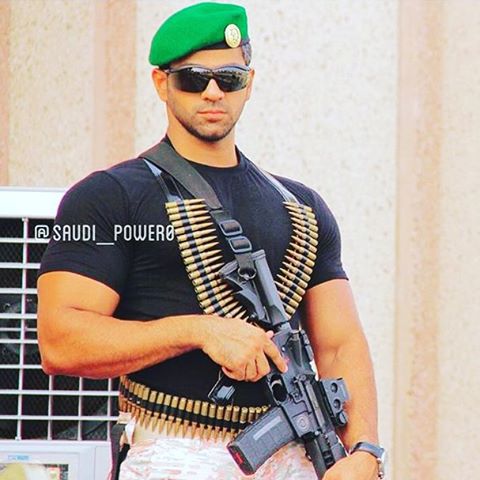
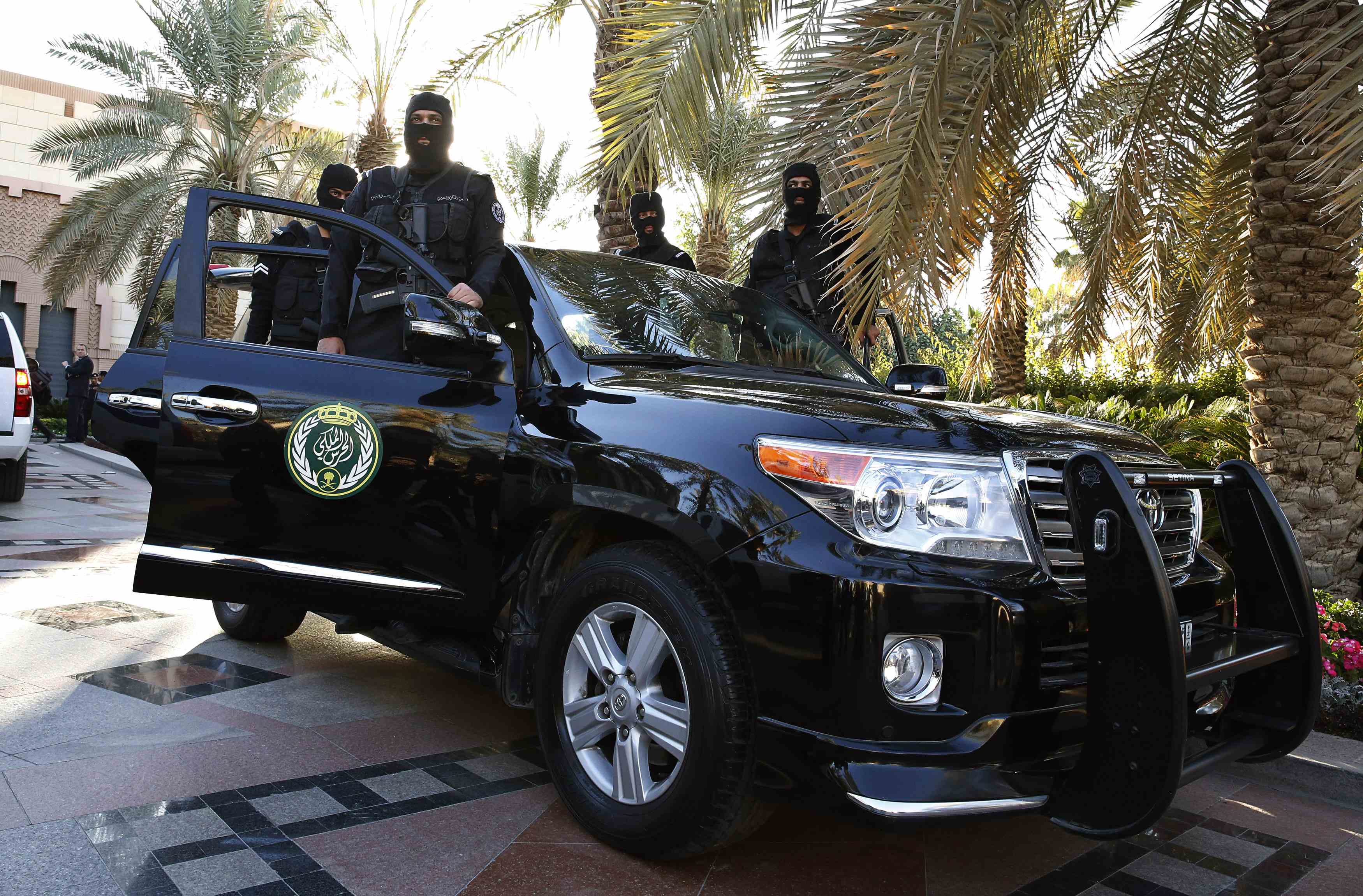
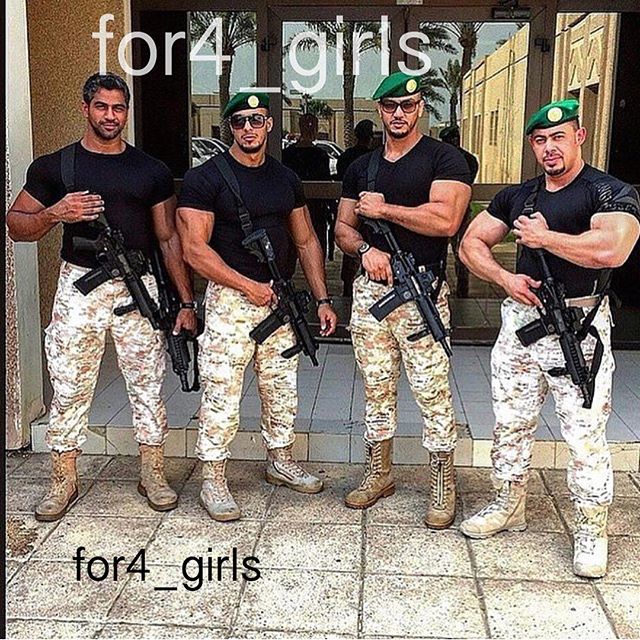
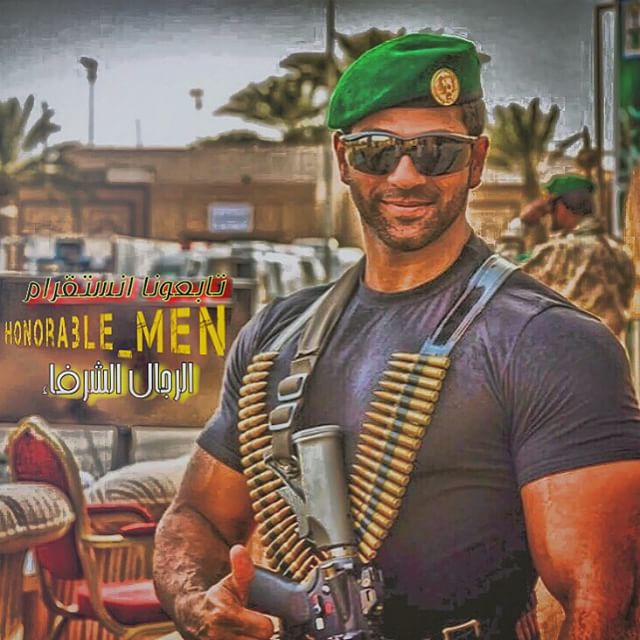
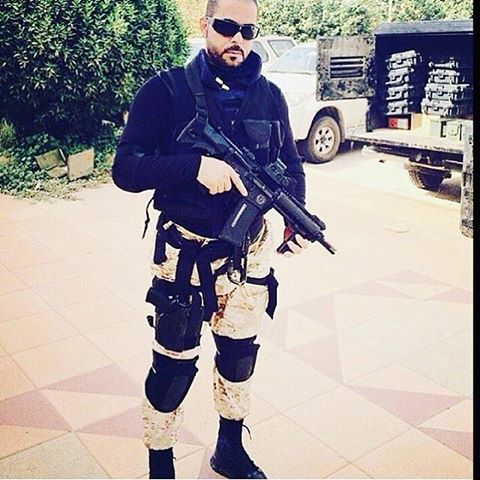
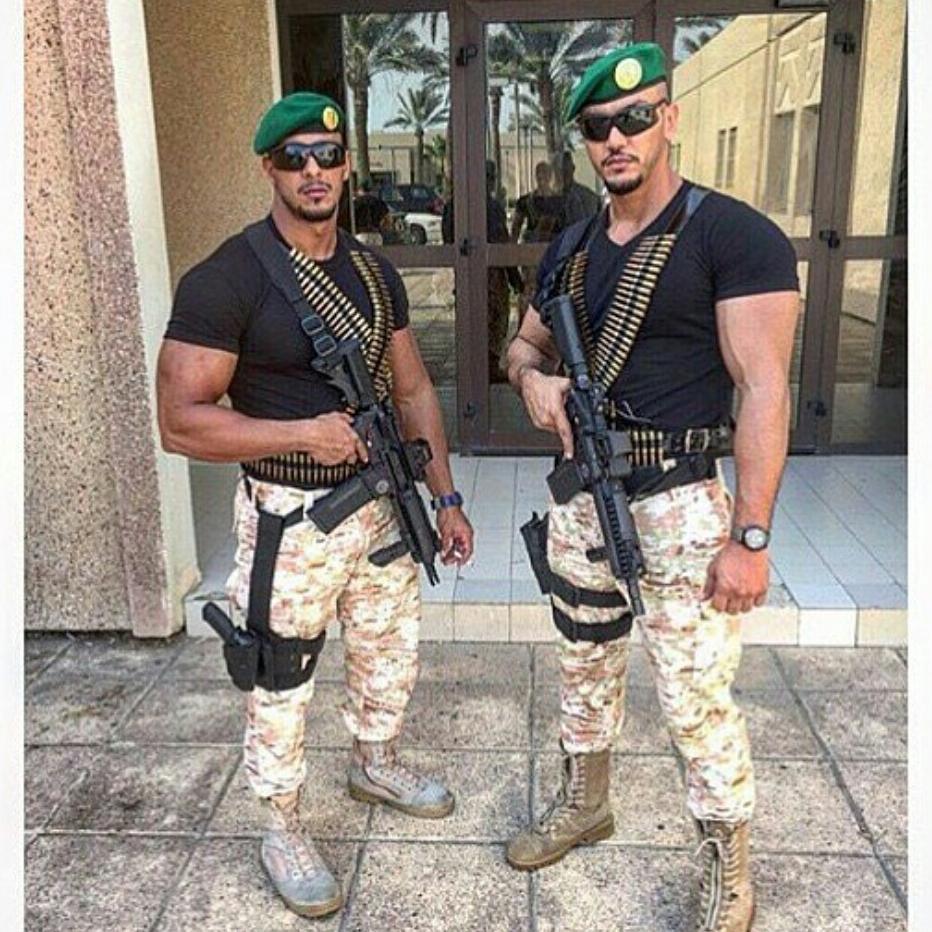
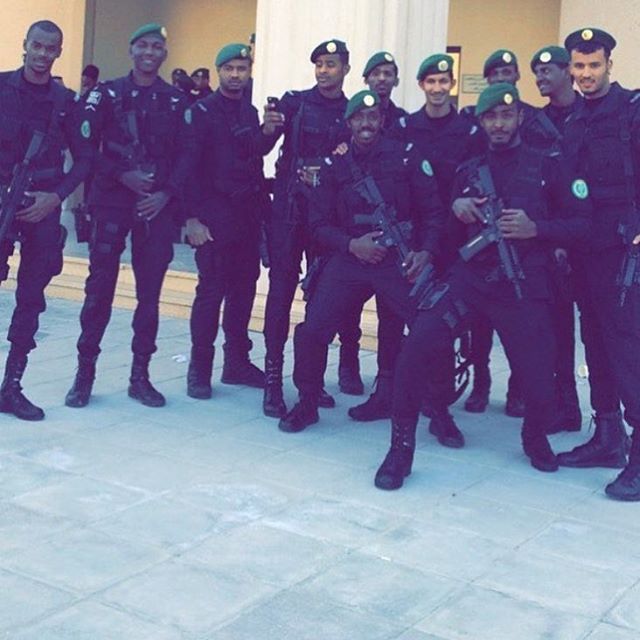
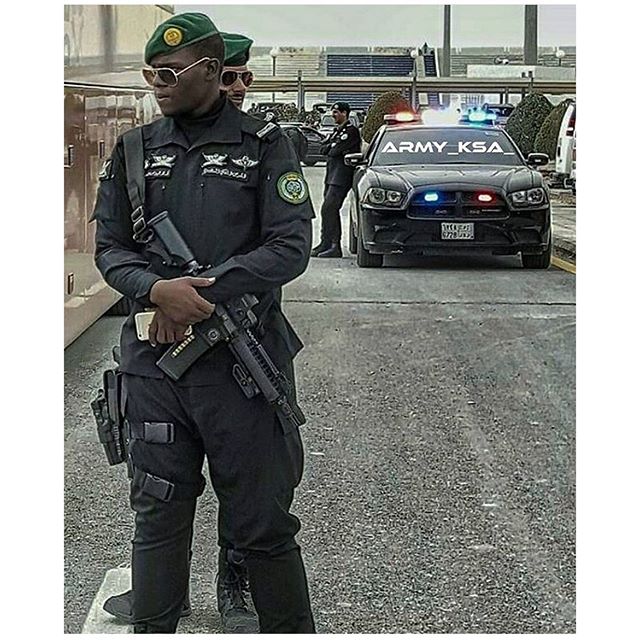
The reigning King (currently King Salman) of the Kingdom of Saudi Arabia, otherwise known as the “Custodian of the Two Holy Mosques”( خادم الحرمين الشريفين) and his enormous family has numerous lawyers of protection surrounding him due to the numerous threats upon the absolute monarch. One of these layers is known as the Saudi Royal Guard Regiment (لحرس الملكي السعودي). This unit has been profiled numerous times on social media, both in the observance of their protection duties, but also simply as casual encounters with members posting photos of themselves and their mates that eventually end up on Instagram and other social media sites. The guards are unique and identifiable in that their uniforms are black with bright green berets. However, they have been seen wearing the desert digital trousers that the Saudi Royal Army uses as well.
Notice the shape and design of the carbine on the left. It is an LWRC UWIC.
Saudi commandos guard the front of Erga Palace as U.S. President Barack Obama arrives to meet with Saudi Arabia’s King Salman in Riyadh January 27, 2015. Obama sought to cement ties with Saudi Arabia as he came to pay his respects on Tuesday after the death of King Abdullah, a trip that underscores the importance of a U.S.-Saudi alliance that extends beyond oil interests to regional security. REUTERS/Jim Bourg (SAUDI ARABIA – Tags: POLITICS MILITARY)
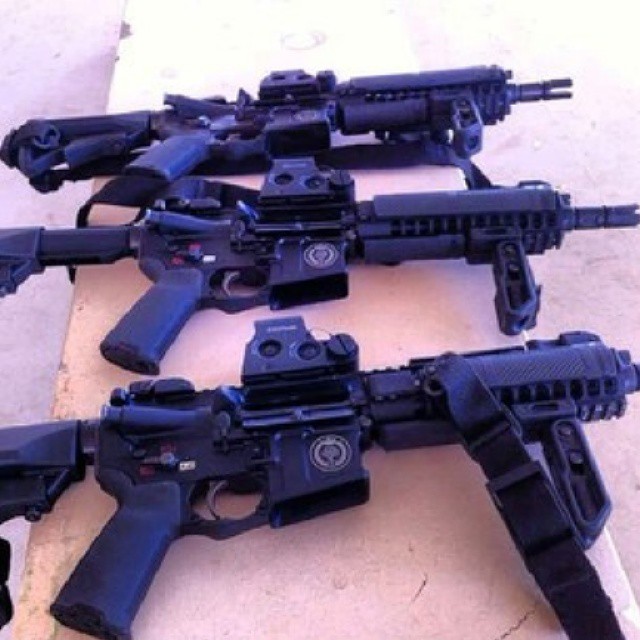
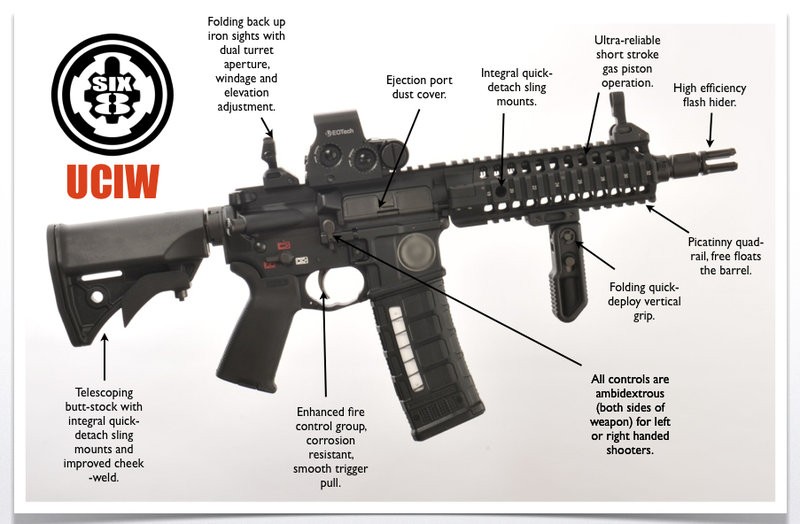
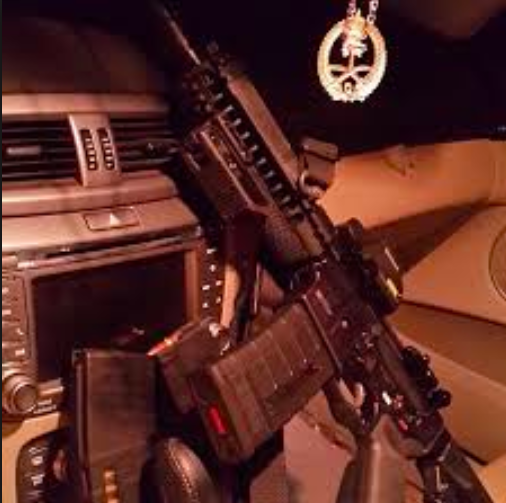
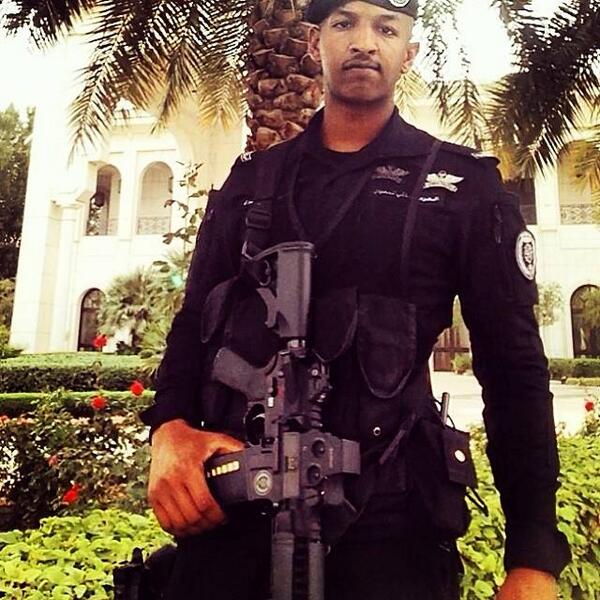
An interesting facet of this group is that it has been seen armed with LWRC UICW (Ultra-Compact Individual Weapon) carbines chambered in 6.8x43mm Remington Special Purpose Cartridge (SPC). The LWRC UICW is distinctly recognizable due to the shortened buffer tube and almost mini-SOPMOD stock. It also has an 8.5-inch barrel, making it very handy for close protection work, and moving in and out of vehicles.
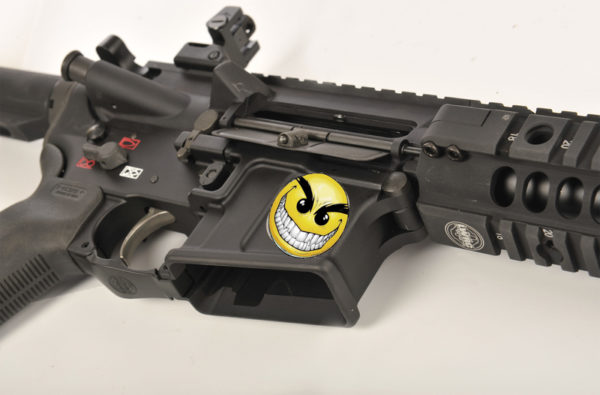
A unique point about the Saudi LWRC UICWs is that they all have the unit’s crest etched in white on the right side of the lower receiver, on the magazine well. Apart from that identifier, these carbines are outfitted with EoTech XPS2 holographic sights, Magpul pistol grips and see through 30 round magazines, Picatinny rail covers, BUIS sights, a folding vertical foregrip, and what appears to be a Vicker’s Tactical (or at least an imitation of one) two-point sling mounted on QD release points. All of the carbines have a select-fire capability. The overwhelming majority are in a black finish with matching furniture, but we do have one example so far of a green stock, with a matching green sling.
We also have this graphic that was created for the carbine as a promotional piece. Notice on the right side of the magazine well how the crest is completely blurred from view. It would appear to be that this crest was actually the Saudi Royal Guard Regiment but blurred for publication.
Very similar to the case of this one as well-
These carbines were a part of a contract with Saudi Arabia, through the U.S. State Department beginning in Feburary 2012 and ending the next year, worth $109 Million. From a statement from the LWRC Facebook page–
In Feb of 2012 LWRCI signed a $109 million dollar 18 month contract with the Government of Saudi Arabia, sanctioned by the U.S. Department of State and U.S. Congress. This is the largest direct commercial to foreign government sale of firearms in the history of the ATF Exports Branch. $109 million dollars of foreign money coming into Maryland to a company that is five years old. In these economic times, this is a story that the Department of Business and Economic Development can be very proud of. New jobs; developing a workforce; and stimulating the economy.
Specifications from Defense Review-
Caliber: 6.8mm SPC
Barrel Length: 8.5″
Weight (unloaded): 6.25lbs (8.5″ barrel)
Length (overall): 24-27.25″ (8.5″ barrel)
Rate of Fire: Semi Auto or Select Fire 700 rpm (+/- 100rpm)
Rifling: 1/10″ RH
Stock/Pistol Grip: LWRCI/Magpul MOE
Sights: LWRCI Folding BUIS Front and Rear
Magazine: Magpul 30 rd. P-Mag
Muzzle Device: LWRCI flash hider 5/8×28 TPI
Colors Available: Black”
This is a Saudi social media channel on Youtube that shows extensive footage of the Royal Guard Regiment during various training demonstrations.
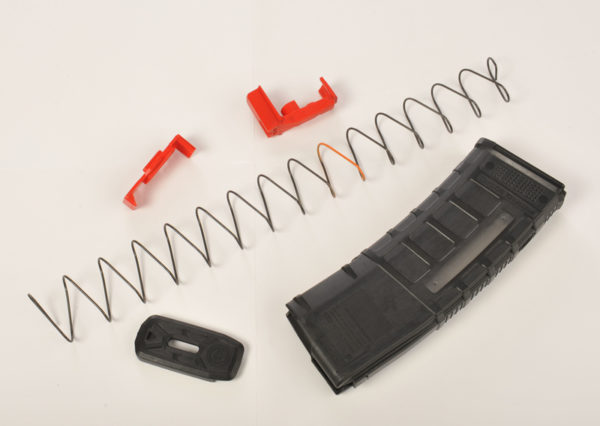
The Magpul 6.8x43mm SPC magazines that are used with the Saudi Royal Guard Regiment were actually developed in close coordination with LWRC. They are readily identifiable by the bright red follower and internal baseplate. You can still purchase them in the United States for $26.97 on Cheaper Than Dirt. From the website-
Magpul PMAG magazines are designed for the LWRC 6.8 pattern AR lower receivers. These magazines were built specifically as a result of a partnership with LWRC and Magpul industries. These magazines feature the new constant curve geometric body, anti-tilt follower and other minor improvements. The polymer magazine reduce overall magazine weight by half without sacrificing durability. Magpul 6.8 magazines are a must have if you own a compatible LWRC rifle chambered in 6.8 SPC.
Silah Report took some time to ask a native Afghan from the province of Mazar-i-Sharif to talk about various colloquial names that Afghans have for popular small arms in use by the Mujahideen and in the modern era. This interview is not verbatim and has been edited for clarification.
SR- Please explain the Dragunov?
Interviewee- So the Russian name Dragunov actually isn’t used in Dari, or in Afghanistan. Instead, we call it “Draz-nuf” (درازنف) In this case, “Draz” (دراز) Dari means long or lengthy, and that name is given to that rifle due to its overall length being longer than most small arms such the Kalashnikov, Krinkov, and Shinkov. That’s why they call it “Draz-nuf”, the “Draz” for “Lengthy” or “Long”. Likewise, with names like Krinkov, or Shinkov, these are names given to various small arms by the Mujahideen in the Soviet War. They don’t represent the actual Russian name for them.
SR- Was the “Draz-nuf”/Dragunov a special rifle among those who used it? Only choose Mujahids would use it?
Interviewee- I think so because they used it as a sniper rifle due to the optics that came with it. You can focus your target very well and then shoot it. That’s what I have seen in movies as well. But it isn’t as expensive or as sought after as the Krinkov as far as I know. Carrying a Krinkov is sort of a show-off, something a Captain, a commander, would do. Everyone would talk about how “That guy was carrying a Krinkov, or his bodyguards carry a Krinkov”. But that status symbol isn’t the same with the “Draz-nof”.
SR- What are some other names? Such as PKah, Makarov, etc…?
Interviewee- Yes, PKah, they call it by another name of “Grin-nuf”.
SR- What about the RPG?
Interviewee- This is sometimes called a “Rockeet” (راکت) or “Rockeet-Tandaz” (راکت تندز) This is because “Rockeet” is obviously the missile that is fired out of that barrel, and “Andakhtan” is the Dari verb “To Throw” (انداختن) so “Rockeet-Tandoz” is an instrument that is used to throw a “Rockeet”.
SR- What about the .303 Lee Enfield?
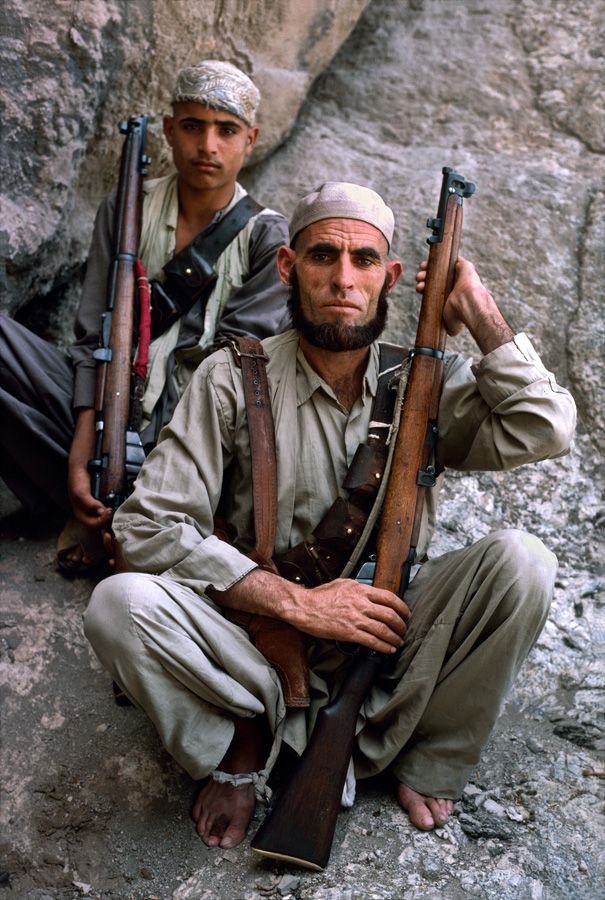
Interviewee- We call these “See-Sahd-See-Bor” ( سه صد سه بور) See-Sahd-See means three hundred and three in Dari, meaning the caliber .303, and “Bor” for the diameter of the barrel. I’ve seen these rifles in old people’s houses and people would say “My grandfather carried this”. And “Karabine”, is another kind of gun, but it isn’t a rifle, it is shorter, shooting single rounds instead of automatic fire. We also have “Dushka” for the DShK Heavy Machine Gun.
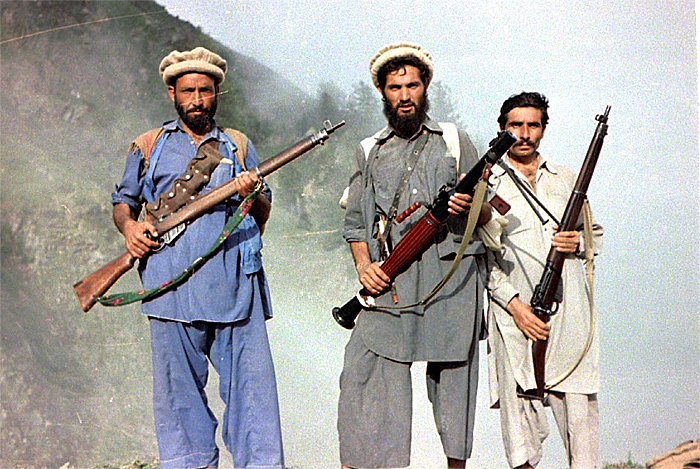
Afghan fighters hide during Soviet bombardment, Jalalabad, Nangarhar, Afghanistan, 1981