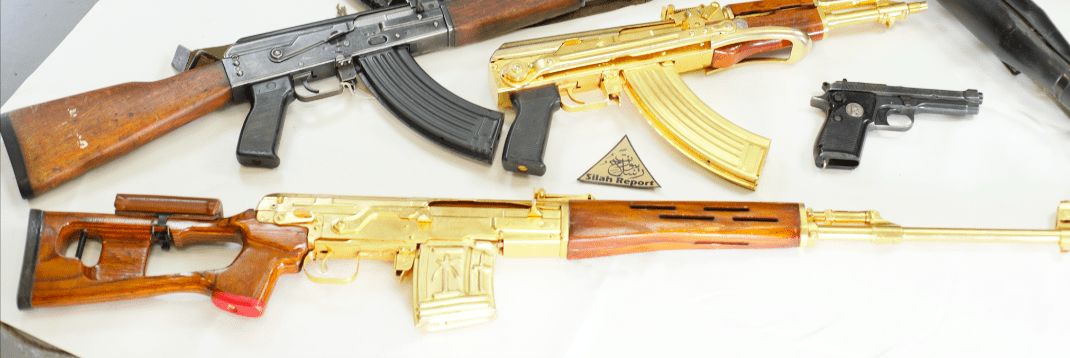
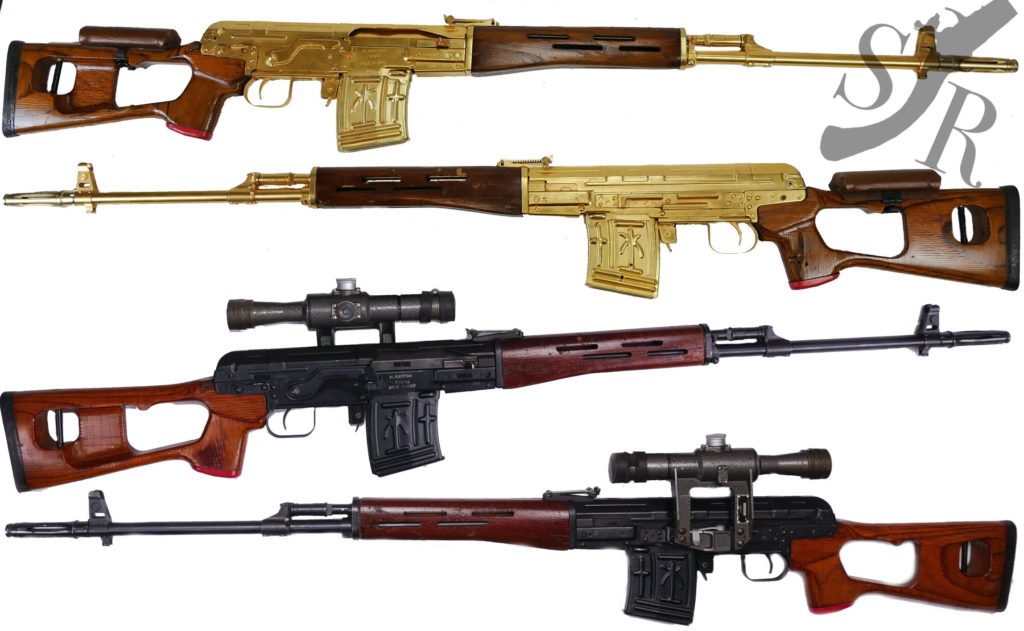
Perhaps one of the more elusive Dragunov-clones in recent small arms history, the 7.62×54mmR Al-Qadisiyah (or al-Kadesiah – depending on transliteration) precision rifle is one of only two precision rifles that Saddam Hussein’s defense armaments industry al-Kadesiah Establishments produced from the 1980s until 2003 (other being the 7.62×39mm Tabuk Sniper). Named after the 637 A.D. Battle of Al-Qadisiyah in which an advancing Islamic army fought against Persian Sassanian forces in what is now southern Iraq. Iraq’s indigenous small arms took their names after famous battles, commanders or important landmarks.
The 7.62×39mm Tabuk AK-patterned self-loading rifle is named after another important battle in the Islamic Conquest (630 A.D), the Tariq handgun after the successful commander that led Muslim armies into Spain (Tariq bin Zayd), the al-Quds M71B1-copy is from the historic Arabic word for Jerusalem, and the al-Nasirah RPG after a city in Palestine. Saddam’s emphasis on landmarks in Palestine played along with his interest in being seen as a champion of the Palestinian cause.
From the small sample size that we have been able to research with, there appears to have been two production runs of Al-Qadisiyah rifles. An early initial batch that might have run from 1988 to 1991 and then another lot in 2003, just before the U.S. invasion of Iraq. We still don’t know how many in total were produced but a ballpark estimate would be in the several thousand range, with perhaps not more than 10,000 rifles ever produced. What we know about the intent and use of the Al-Qadisiyah is even less. Similar to many of Iraq’s indigenously-produced small arms, it doesn’t appear that many of them ever saw combat or were even intended for combat use in the Iraqi Army, Republican Guard, or paramilitary Fedayeen forces. Historical photographs, videos, and interviews with pre-2003 Iraqi Army forces reveal that many soldiers could easily serve a term of service without seeing a Tabuk, Tariq, or an Al-Qadisiyah. A prime, statistics-based example of this is at the reserve collection of the Marine Corps Museum, which has several hundred captured Iraqi Army items spanning Desert Storm and post-2003, the overwhelming majority of which are not Iraqi-produced.
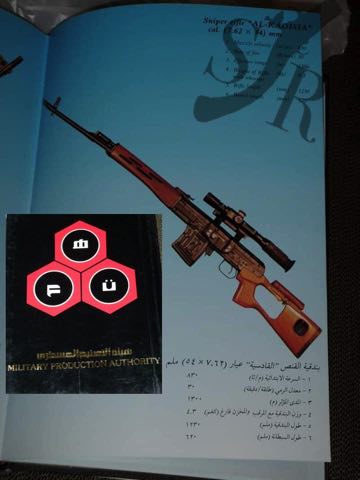
What little we know of the Iraqi defense industries publications has come to us through the catalog seen below, which was distributed at the 1989 Defense Exposition in Baghdad, where many of Saddam’s defense products were listed thoroughly in Arabic and English throughout this publication, the Al-Qadisiyah rifle, of course, being one of them, featured here with an inset photograph of the cover.
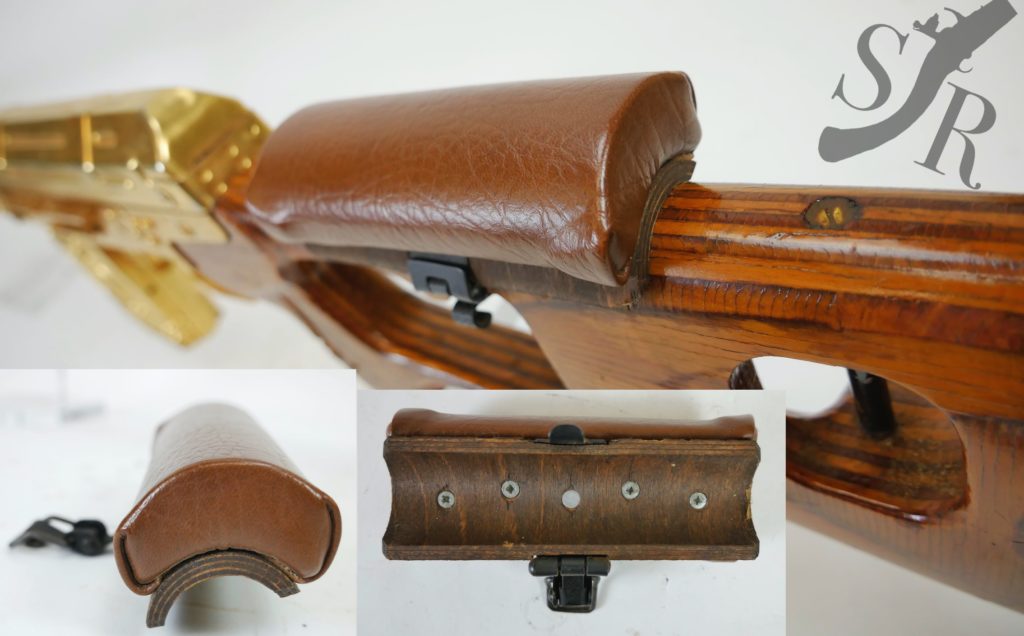
With the exception of the Tabuk rifles, al-Quds RPK light machine guns, and al-Nasirah RPG launchers, a critical component of these indigenously produced weapons appears to have been as a gifting mechanism, both within Iraq as an award, promotion, or to the family members of soldiers killed in battle, and to foreign governments overseas (Gaddafi of Libya and Mubarak of Egypt are two known examples). Indeed, some of these gold-plated Al-Qadisiyah’s, and Baby Tabuks are inscribed in Arabic on the forward hand guards:
A Gift from President Saddam Hussein, President of the Republic of Iraq
هَدِيَّةُ السَّيِّدِ الرَّئِيسِ صَدَّام حُسَين رَئِيسُ الْجُمْهُورِيَّةِ الْعِرَاقِيَّةِ
Hadiyya al-Sayyid al-Raʾīs Ṣaddām Ḥussayn Raʾīs al-Jumhūriyya al-ʿIrāqiyya
(Transliteration/Translation courtesy of MENA Symbolism)
One rare example in the case of Tariq handguns has this inscription roll-marked on the slide:
Al-waṭan sharf al-muqātil – Hadiyya al-Raʾīs al-Qāʾid Ṣaddām Ḥussayn li-man dāfaʿa ʿan waṭanihi.
الوطن شرف المقاتل – هدية الرئيس القائد صدام حسين لمن دافع عن وطنه
The nation is the honor of the warrior – A gift from the president, the leader Saddam Hussain for whoever fights for his country.
(Transliteration/Translation courtesy of MENA Symbolism)
However, not all of these gold-plated small arms would have any particular phrase stamped into them, many are simply gold-plated without any additional markings.
Interchangeability
What makes the Al-Qadisiyah distinguishable from a Soviet SVD Dragunov are enough features to make the majority of parts from either rifle not interchangeable. This is important because between the Soviet and Chinese Dragunov rifle variants and even the Romanian PSL rifle, users and logistics officers alike have assumed interchangeability when there was none to begin with, something causing problems downrange. An example is with PSL magazines because they can latch into place in a Al-Qadisiyah magazine well, but without actual modification to the rifle or the magazines, their tolerances are off just enough that the rounds will not feed when charged. This hasn’t stopped rifles already in theater being altered by fighters on the ground which are often forced to make do with limited supplies.
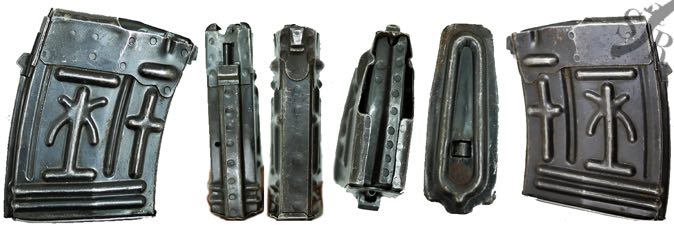
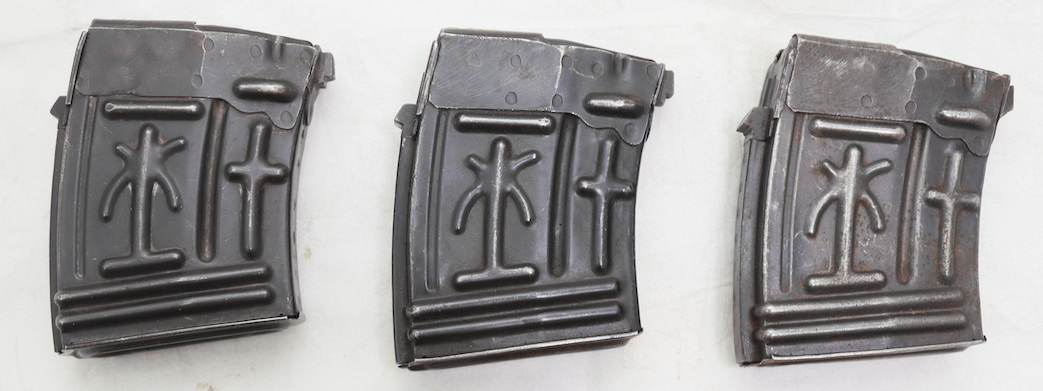
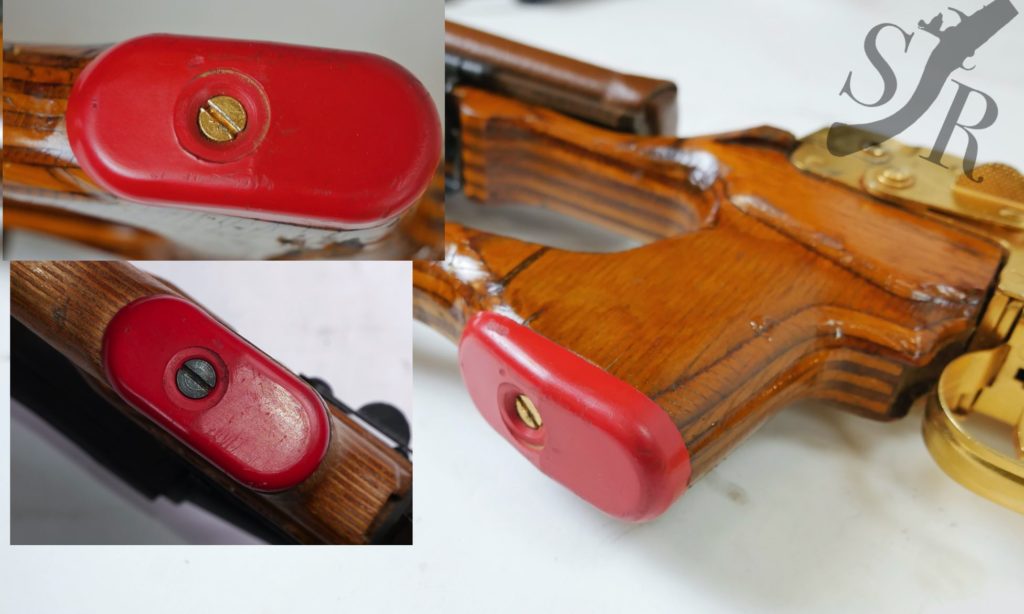
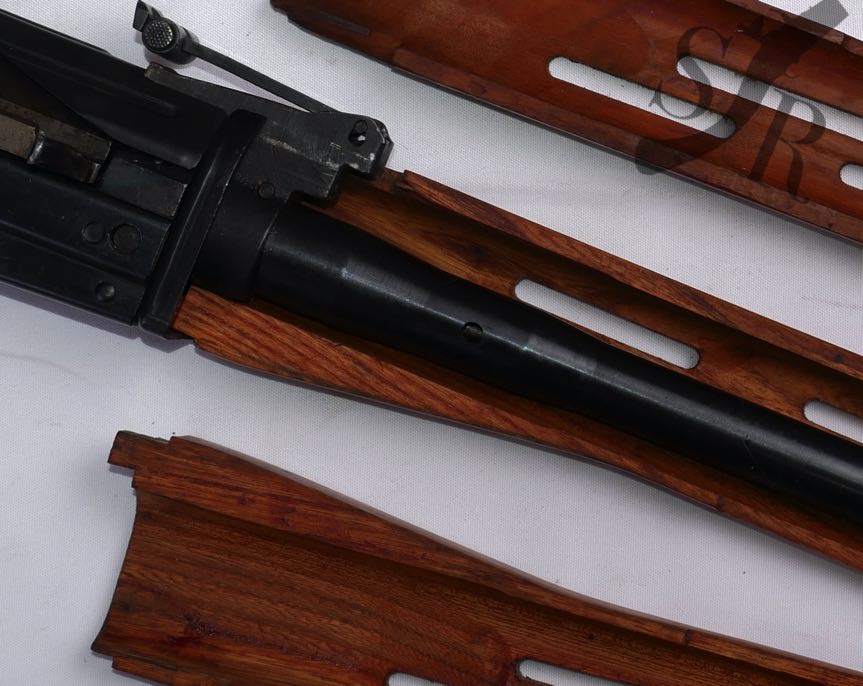
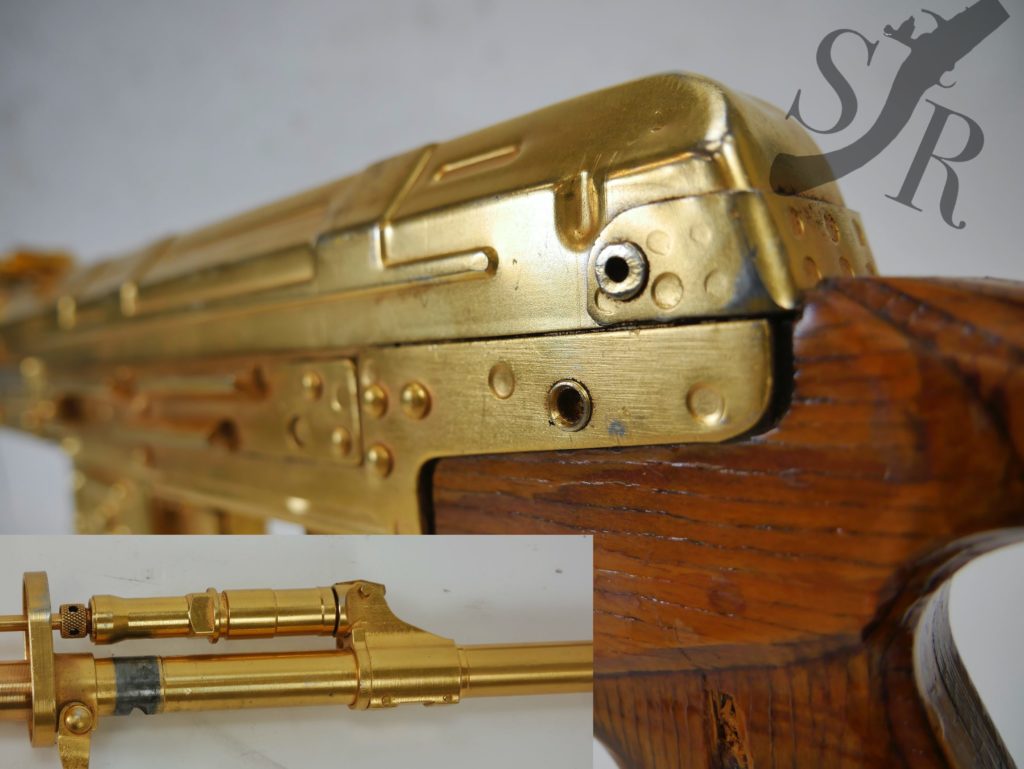
Outwardly and from afar, the two rifles are virtually indistinguishable, but upon closer inspection, we find that the Al-Qadisiyah is actually a poor clone of the Soviet SVD. Operationally the two rifles are identical, both utilizing a short-stroke gas system acting on a multi-lug rotating bolt, however, the Al-Qadisiyah’s gas tube cannot be adjusted, the bolt is akin to the bolt from a Kalashnikov self-loading rifle with its three lugs and rotating in the same direction (a Dragunov’s bolt rotates opposite of a Kalashnikov due to the cut of the lug paths). All Al-Qadisiyah rifles also have a red-capped plastic pistol grip. A very important distinction is in the receiver construction, the Al-Qadisiyah is a two-part stamped steel receiver with a thickness of 1.5mm, while the Dragunov is a single-piece milled receiver. Another key visible differences are in the Al-Qadisiyah’s palm tree embossed magazine, four cooling slats in the handguard versus six in a Dragunov, and rear sights without any Cyrillic markings on the Al-Qadisiyah. Scopes used in the series are mainly Yugoslavian OM-M76 4X optics, but also seen are older Soviet PSO-1 and Romanian LPS Type 2 optics.
Al-Qadisiyah Variants
After a thorough study of available examples of Al-Qadisiyah rifles in reference collections, open sources, and on display in museums, there have been three basic variants that have come to light. We begin with the serial number lot numbers in that all the available Al-Qadisiyah rifles surveyed begin at the 50000XX serial number range. This is on par with other Al-Qadisiyah Establishments products such as 9×19mm Tariq handguns which fall in a 313XXXXX range, al-Quds RPKs in an early 300XXXX range, folding stock al-Quds in the 400XXXX range, and Tabuk self-loading rifles that can fall in a number of different serial number ranges.
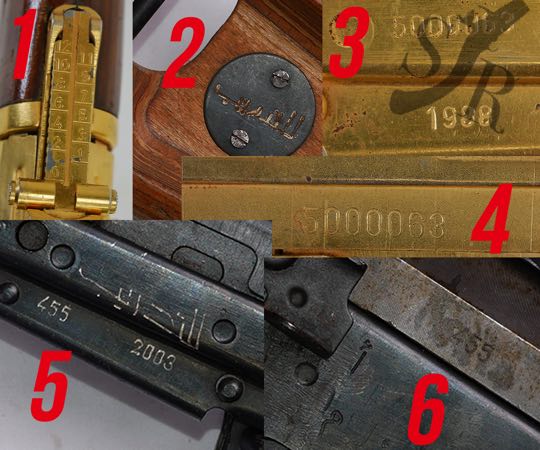
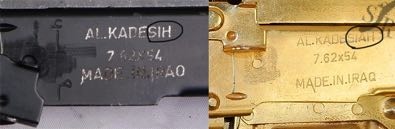
The earliest variant we observe are gold-plated rifles from 1988. These rifles have not been observed to come equipped with scopes, but appear to have scopes in their velvet carrying cases. They have also been seen separate, in plastic bags. They have a full and matching serial number stamped on the lower receiver, bolt carrier, and receiver cover, a year stamp below the serial number and have the marking “AL.KADESIAH, 7.62×54, MADE.IN.IRAQ”. Note that ‘Al Kadesiah is an alternate transliteration of Al-Qadisiyah. At least one of these rifles has been spotted with the gift inscription and Tariq bin Zayd medallion pressed into the wooden handguard, but others haven’t.
After this golden presentation variant comes a standard field grade variant which appears to have been intended for troop issue. The rifle is identical to the first variant but is not gold-plated and has “KADESIH” instead of “SIAH”. Year samples are from 1991 and 1992. Some of these feature a shortened two-digit serial number on the receiver. Note that the serial numbers ascend from the earliest rifle in 1989, indicating a constant serial number block regardless of year.
Our next variant, a drill purpose rifle, emerged in 2003. In the examples examined a hole has been drilled in the barrel underneath the handguards just forward of the chamber at the 3 o’clock position. This has resulted in at least one such rifle suffering a catastrophic malfunction when fired in Iraq. The usual marking on the right side of the receiver is no longer there, instead switched to the left side and now laser-etched with “للتدريب/lel-tadreeb” in Arabic, which means “Training”, in addition to a three-digit serial number and the year of manufacture. The same phrase is also imprinted on a metal medallion that is embedded in the righthand side of the stock.
Of these three variants surveyed out of a total of fifteen rifles spread between the United Kingdom and the United States, nine are gold-plated presentation rifles, four are field grade rifles, and only two are drill purpose from 2003. These numbers fit with the attitude that the rifles were primarily a gift or ceremonial item as opposed to combat arms. As stated before, interviews and media research of Iraqi armed forces have revealed that the Al-Qadisiyah did not appear to see much use in Iraqi combat units.
|
Technical Specifications |
|
|
Caliber |
7.62×54mmR |
|
Magazine Capacity |
10 rounds, proprietary Iraqi magazines |
|
Overall Length |
48.42 inches |
|
Barrel Length |
24.48 inches |
|
Barrel Internals |
4 Grooves, 1:10 right-hand twist |
|
Weight |
9 Lbs, 14 ounces, loaded with scope attached |
|
Effective Range |
1,300 Meters |
|
Sampled al-Kadesiah Rifles (capitalized letters for nomenclature ending) |
|||
|
Type |
Serial Number |
Year |
Location |
| Presentation | 50001XX | Unknown | Seabee Museum, Port Hueneme, CA |
| Presentation | ? | ? | 3rd Infantry Division Museum, Fort Stewart, Georgia |
| Presentation | ? | ? | DIA entrance lobby display, Washington, DC |
| Presentation | ? | ? | Airborne Assault Museum, Duxford, UK |
| Presentation | ? | ? | National Infantry Museum, Fort Benning, Georgia |
| Standard | ? | ? | National Infantry Museum, Fort Benning, Georgia |
| Presentation | ? | ? | JFK Special Warfare Museum, Fort Bragg, North Carolina |
| Presentation (x2?) | ? | ? | Washington Navy Yard, Washington DC |
| Drill Purpose | 4XX | 2003 | Pheonix Defense |
| Drill Purpose | 331 | 2003 | Designated Marksman Website |
| Standard (SIH) | 5001860 | 1992 | NFC Collection, Leeds, UK |
| Standard (SIH) | 5XXXXXX | 1991 | Pheonix Defense |
| Standard (SIH) | 5001859 | 1991 | forum.Gunboards.com |
| Presentation (SIAH) | 5000063 | 1988 | USMC Museum, Quantico, Virginia |
| Presentation (SIAH) | 5000208 | 1988 | NFC Collection, Leeds, UK |
| Standard (SIH) | 5000690 | 1989 | Dave Fortier Article Sample in Iraq |
Sources:
Iannamico, Frank, AK-47, The Grim Reaper, Chipotle Publishing, (2013)
DesignatedMarksman.Net, Iraqi Al Kadesiah (also known as Al Kadesih) Sniper Rifle 7.62x54R
USMC Museum Reference Collection
Pheonix Defense Reference Collection
This article was originally published in Small Arms Review SADJV12N1
If you enjoy our work here at Silah Report please consider supporting us on Patreon!
Elvis, can you send us an email, miles@silahreport.com, let’s talk more about this.
Okay…. now you’re talking. That has honestly never been brought up before, and seriously makes perfect sense, given how much modification/mixing Iraq did in state production. As an example with the baby Tabuks, using Bulgarian laminated handguards. Look at any Baby Tabuk and you’ll notice the ports are mismatched, because the one is simply chopped down.
Next time you have a chance, compare the receiver of the Al Kadesiah to an RPK.. I had them side by side at one point, and it looked to me like they used an RPK receiver blank (or a Yugo M70 or 72) with an extension riveted on the back. It would make sense if the Iraqis were making Yugo pattern guns already.
Excellent article on this obscure rifle. The only thing I can add is that I’ve seen a number of Tabuk Sniper/Al-Kadesiah screw on flash suppressors that had checkering put on them at the factory. Presumably to make them easier to grip while unscrewing. I’m afraid I don’t know what the serial number of the weapons they were on was however.