In 1869, the Emir of Afghanistan, Sher Ali Khan, began a process to rapidly improve the quality and quantity of artillery pieces in the Afghan Army. Informed by the experiences of the First Anglo-Afghan War (1839 to 1842) and internal territorial wars that he had previously fought, Sher Ali was determined to see his forces equipped with the latest rifled iron breech-loading guns. Whilst he was able to achieve this, his successes would be short-lived. Ultimately, failings in leadership and discipline would prove more important than his modernised guns.
Editor’s note: This article is adapted from a longer piece published by the Ultima Ratio Project.
The British launched the first campaign of the Second Anglo-Afghan War in November 1878, and quickly won a series of victories that put them on the road to Kabul. Emir Sher Ali Khan died on 21 February 1879, leaving the Afghan military under the command of his son Yaqub Khan. An uneasy peace with the British was reached, but did not last long. After a local uprising and the massacre of their embassy mission in Kabul on 3 September 1879, British forces moved to capture the city and punish the perpetrators. Yaqub Khan fled to the safety of the British and the rebel forces were unable to seriously hinder the British. By 8 October, scarcely a month later, both Kabul city and the Sherpur Cantonment were under their control.
At the outbreak of hostilities, the British had recorded 379 artillery pieces in the Emir’s possession. Of these, 256 were captured during the course of the Second Anglo-Afghan War. Of these captured weapons, 214 were taken by the Kabul Field Force in their capture of the city in October 1879. The defeat of the Afghan forces in Kabul had seen the fruits of nearly a decade of industrialization seized in a single engagement. The 214 guns captured during the occupation of Kabul (between 6 and 12 October 1879), were recorded as follows:
12-pdr gun – Afghan (4)
9-pdr SB Bronze gun – Afghan (2)
6-pdr SB Bronze gun – Afghan (16)
3-pdr SB Bronze gun – Afghan (51)
8-inch SB Bronze Howitzer – Afghan (2)
12-pdr SB Bronze Howitzer – Afghan (5)
8-inch SB Bronze Mortar – Afghan (6)
5 1/2-inch SB Bronze Mortar – Afghan (6)
24-pdr SB Iron gun – Afghan (2)
20-pdr BL Iron rifled – Afghan (6)
12-pdr BL Iron rifled – Afghan (6)
9-pdr BL Iron rifled – Afghan (14)
8-pdr BL Iron rifled – Afghan (6)
6-pdr BL Iron rifled – Afghan (22)
4-pdr BL Iron rifled – Afghan (11)
7-pdr ML Iron rifled – Afghan (26)
8-pdr ML Steel rifled – Afghan (21)
65 of these guns were of a more modern breech-loaded (BL) pattern – all made from iron, with some of the largest guns six 20-pdrs being breech-loaders. There were some 47 muzzle-loaded (ML) rifled guns with just over half of these being cast from iron. 94 of the guns were older-pattern bronze, smooth-bore (SB), muzzle-loading cannon, with the largest number of these being 3-pdrs.
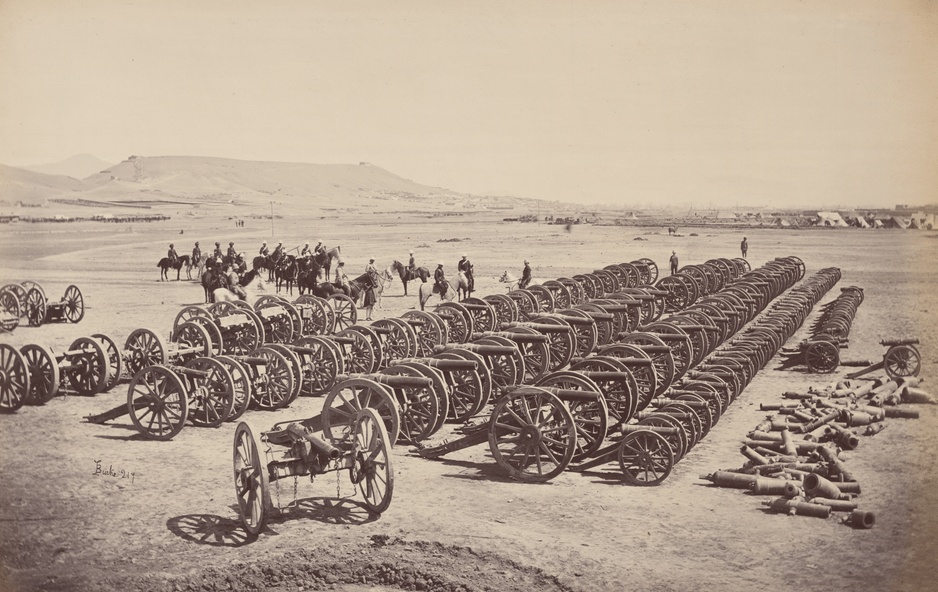
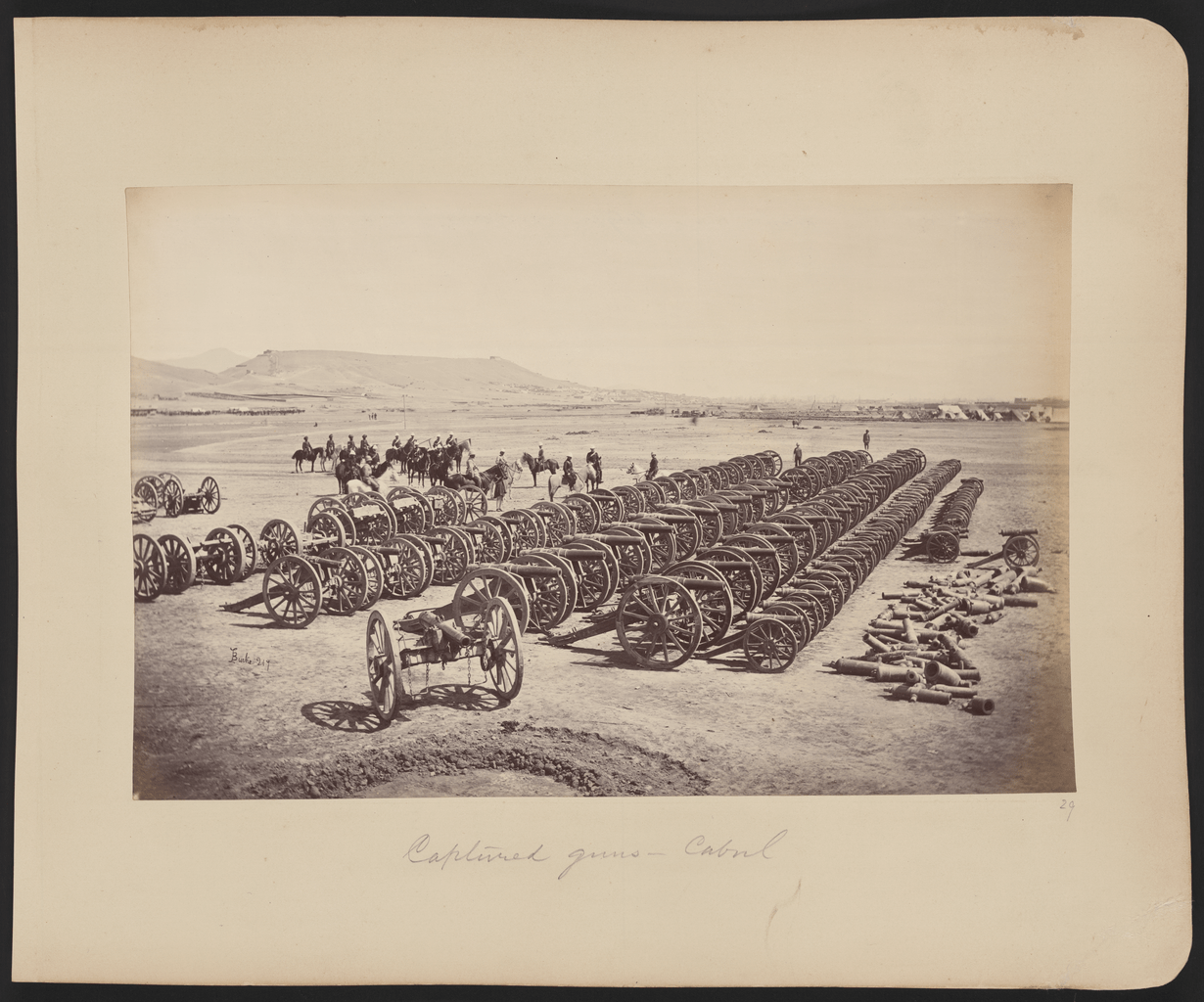
One image, labeled in pencil “Captured guns – Cabul”, shows many of the guns captured following the engagement (see Fig. 1.1). The image, taken by John Burke at the Sherpur Cantonment, shows the commander of the Kabul Field Force, Major General Sir Frederick Roberts, and his staff on horseback inspecting the captured guns. It showcases the wide variety of sizes and patterns of artillery pieces in the Emir’s possession before the conflict. The image shows at least 105 guns.
Despite Afghanistan’s manufacture of modern guns, these were rendered useless by a lack of military leadership and poor tactics. Following the capture of Kabul, the workshops built by Sher Ali were completely destroyed by explosions at the Bala Hissar, almost entirely undoing the Emir’s efforts. Afghan arms technology suffered a serious setback until Emir Abdul Rahman Khan began construction of a series of modern, steam-powered workshops in 1887.
Sources
Burke, John. 1880. Afghanistan 1879–80. Photography album. Available via:
<https://www.wdl.org/en/item/11534/#page=3&collection=afghanistan-1879-80>.
Hensman, Howard. 1882. The Afghan War of 1879–80. 2nd ed. London: W.H Allen & Co.
Intelligence Branch Army Head-Quarters, India. 1907. The Second Afghan War, 1878-80 Official Account. London: John Murray.
N. R. Jenzen-Jones, Vernon Easley & Miles Vining. 2020. ‘Panāhpur: A history of the Martini rifle in Afghanistan, 1878–1925’. Arms & Armour, Vol. 17, No. 1, pp. 80–106.
Jack Shanley is a small arms researcher interested in SALW, diffusion, & innovation and is a research assistant at Armament Research Services.
If you enjoy our work here at Silah Report please consider supporting us on Patreon!