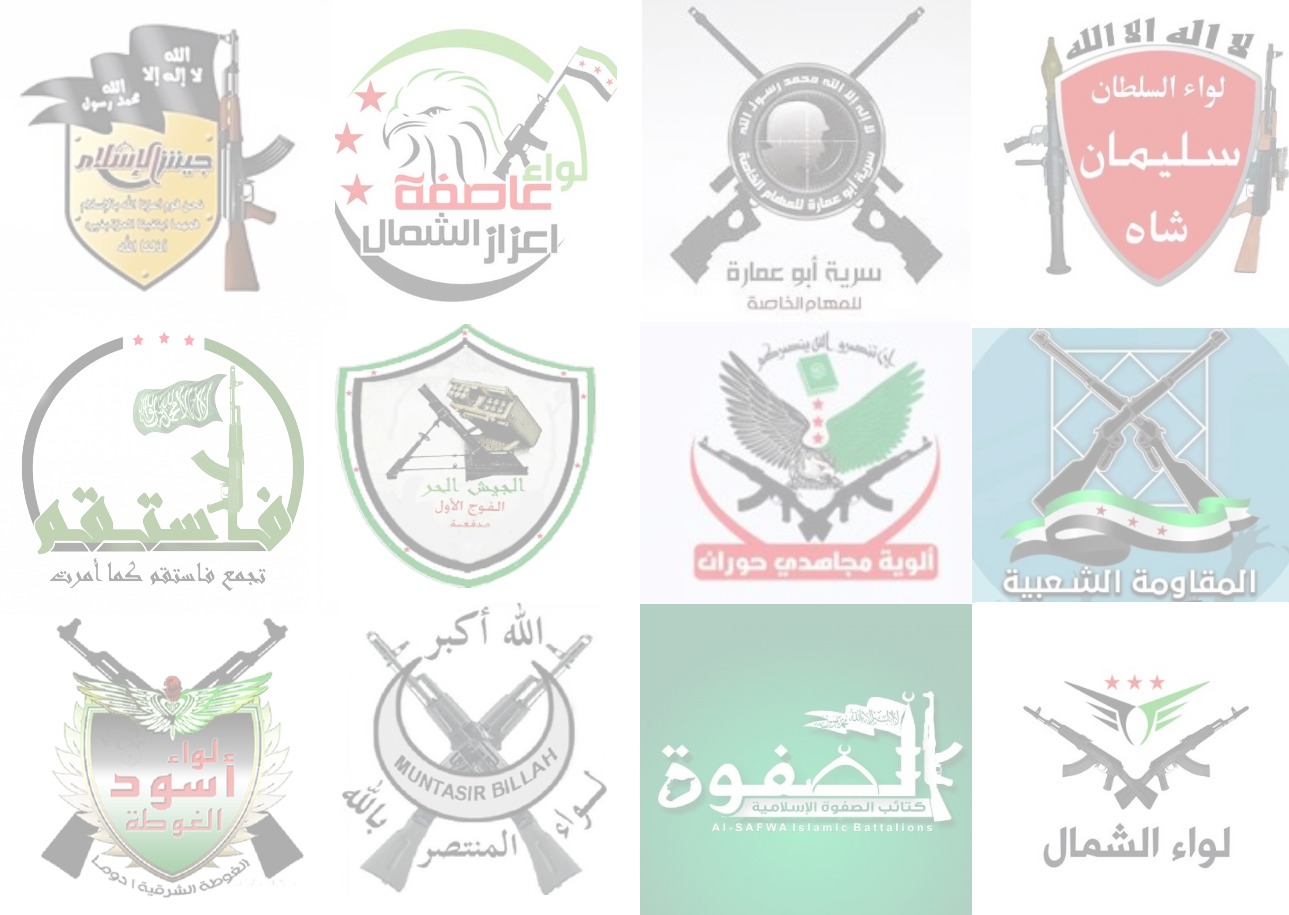
The Syrian Civil War is an extremely complex conflict, not least in terms of its innumerable state and non-state actors, armed groups, popular militias and foreign contractors. Despite the obvious confusing chaos and dreadful complexity caused by a large number of participants it does offer a representative sample frame for academic research. For any researcher looking for a realistic subset of armed factions and political movements within the wider region, Syria provides an interesting case study. In this exclusive series, I examined Syrian armed groups from across the entire political spectrum who at one point or another during the war featured a firearm in their official crest. My goal is to present a statistical overview of the small arms used in this military imagery, and to share some interesting information I was able to deduct.
In this first part, we will examine Opposition-affiliated groups, limiting the scope of my research to any armed group having effectively fought at any given time of their active existence under an official logo depicting a firearm. I found a total of 48 of these well-defined sample units affiliated to the loosely connected collection of politically aligned entity known to observers as the Opposition. Despite the possibility of having overlooked some minor groups, I’m fairly confident to assert that a sample frame of 48 factions suffices for this part. Further articles will examine crests in use by Regime-affiliated groups as well.
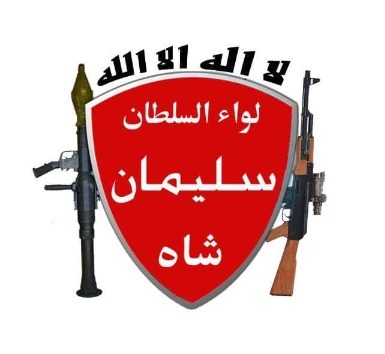
This chart shows each featured small arms and light weapon (SALW) model and the amount of times it appeared on the relevant crests in months. USSR-manufactured arms feature a staggering 70% of all arms counted in total, as was expected, and are mainly represented by the traditional AK-47-pattern designs (including the common AKM). In contract the Liwāʾ Rijāl al-Ḥarb, operating within the Second Legion of the Syrian National Army and a participant in the Turkish-backed campaigns against IS (Islamic State) and the Syrian Democratic Forces (SDF) in north-eastern Syria, resolutely chose the 7.62×54mmR SVD-63 “Dragunov” self-loading designated marksman’s rifle for their crest. There is, however, no indication that the group specializes in targetted operations using the SVD-63 or special-operation techniques to explain the prominent position of the rifle on their crest. The RPG-7 appears at least three times, reflecting its popularity and ubiquity on the Syrian battlefield as one of the most common shoulder-launched rocket-propelled grenade launchers available. Liwāʾ al-Sulṭān Sulayman Shāh (part of the Turkish-backed SNA’s First Legion), Liwāʾ Shuhadāʾ Ḥawrān and Katībat Fidāʾiyīn Ḥawran (both part of the now defunct US-backed Southern Front) all feature the RPG-7 in their emblem.
It is interesting to note the relatively common prevalence of American-made SALW in the visual military imagery of Opposition-affiliated factions, totaling for 18% of firearms counted. The 5.56×45mm M16A2 self-loading rifle is definitely the most popular, followed by the M4A1 carbine. It should be interesting to follow this research up with an additional look into US-funded groups. I wanted to know if a significant difference would arise between funded and non-funded groups in the statistical frequency of American-produced firearms featured on crests. A total of 17 factions from among the 48 Opposition sample units used in this research are officially considered supported by the USA at a certain point during the war, and hail mainly from the Southern Front operations room or the northern Syrian National Army. Among these 17 US-funded factions, the prevalence of US-made firearms was only 17.6%. Among the 31 non-funded Opposition-affiliated factions remaining, this was 16.1%. This means that the status of operating with US funding didn’t have any significant influence on the prevalence of US small arms on crests within the Opposition sample group, noting a difference of a mere 1.5%. This doesn’t necessarily reflect the situation on the ground, since the use of American small arms effectively seeing combat remains mainly reserved to these funded groups.
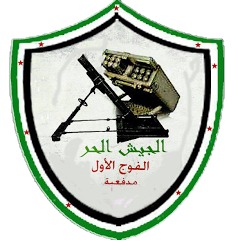
In addition to the M16A2 and M4A1, there are some interesting choices to be noted as well. Al-Fawj al-Awwal Madfaʿiyya, the artillery regiment of the 1st Brigade, an American-backed Opposition-affiliated group operating as part of the SNA, features the M19 60mm mortar and the M270 MRLS, two iconic American artillery systems. However, neither the latter nor the former have been observed to be actively present among Opposition forces and this crest is therefore highly symbolic albeit somewhat unrealistic. Even less realistic is the choice to feature crossed Winchester Model 1886 rifles by the obscure al-Muqāwama al-Shaʿbiyya in the country’s south. Waging an urban guerrilla war with proven hit-and-run tactics has placed this group among the more effective anti-Regime insurgent fighting forces. Their crest, however, is probably derived from the popularity Western and neo-Western movies still enjoy in large parts of the Middle East (the Winchester Mod. 1886 appears in among others The Edge (1997) and in Hostiles (2017)).
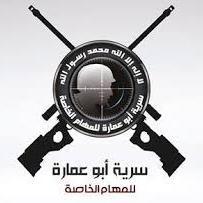
Featuring firearms on one’s crest that do not reflect the reality on the ground is a recurring issue. The firearms tend in that case to represent a specific function or image rather than the actual weapon itself. The crest used by Sariyya Abū ʿAmmāra (Abū ʿAmmāra Special Tasks Brigade), for example, features two crossed British L96A1 bolt-action precision rifles manufactured by Accuracy International. These have not been seen in Syria at all, but they symbolize the special-operations and long-range capabilities character upheld by the Sariyya Abū ʿAmmāra, known for its operations behind enemy lines, assassinations and IED ambushes. A similar example lies in the German H&K G3, a rarely spotted weapon used primarily as a designated marksman rifle by foreign-backed Opposition groups like Jaysh al-Islām and Jaysh al-Naṣr. And yet, the G3 is featured in a prominent position on the crest of the Jaysh Idlib al-Ḥurr coalition. The G3 represents the idea of German quality, reliability and an inherent connection to both the West and Turkey, where the rifle is made under license by MKE.
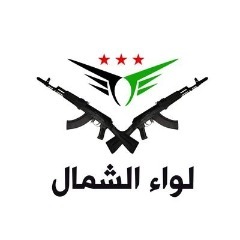
Last but not least, there is a noticeable presence of modern Russian firearms, most notable the 5.45×39mm AK-74M and AK-103 self-loading rifles. On the ground these are associated mostly with the Russian-backed Syrian Arab Army, but have been trickling into the ranks of the Opposition as well. Since the AK-103 model is associated almost exclusively with Russia and their Regime allies, featuring them in an Opposition-affiliated group’s crest is quite provocative, alluding to capture (ghanīma) of arms and therefore victory through battle.
We might in conclusion note that the USSR still enjoys a massive influence on Syrian Opposition-affiliated groups, and by extension, armed factions across the Middle-East. Especially through the AK-47 and AKM pattern rifles as a recurring symbol featured on official crests with a near-mythical appearance. Western-produced weaponry, however, has definitely found its way to the forefront of Opposition iconography, especially the case for the US Army’s M16A2/A4 and M4A1. This trend reflects the political reality of Syria’s Opposition factions, many of who were supported or at least tolerated by American and European powers in an effort to curb Iranian and Russian influence on the country. The fact that Turkey has now adopted that supportive role may indicate a future in which Soviet and American small arms on Opposition-affiliated crests are going to be surplanted by Turkish-made firearms.
Further research on other groups in Syria will be posted on Silah Report. For an overview of the raw data I used to create the Opposition-affiliated sample group, please refer to this file.
If you enjoy our work here at Silah Report please consider supporting us on Patreon!