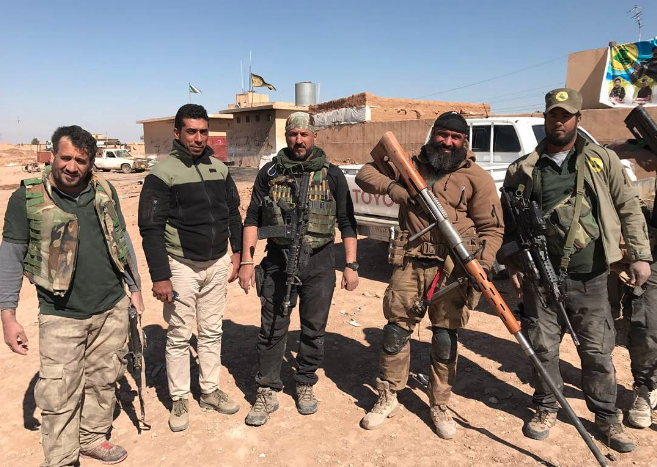
Homemade Anti-Materiel Rifle With Iraqi Militia

C5rKjNRWAAAvjh5.jpg

A Polish small arms magazine recently posted this to their social media page. It appears to be of a group of Iraqi militiamen from the Imam Ali Brigade, as is evidenced by the circular yellow patch with a Kalashnikov over an image of a green country profile of Iraq . The bearded militiaman is posing with a huge bolt action anti-materiel rifle. These DIY conversions had been seen multiple times during the Syrian conflict. Supposedly this gun uses either 14,5mm (from KPV or KPVT) or 23 mm (from ZU-23-2) barrel with an improvised receiver, bolt, trigger mechanism, furniture and bipod. You can also see a picatinny rail section mounted on top of the receiver for attaching a scope.

I guess they use the survived barrels from guns with damaged or destroyed mechanisms. Otherwise, it won’t be justified to take the barrel from a functional heavy machine gun or automatic cannon. Although depending on the situation it can be the case, too.

When making the new stock and forearm, the gunsmith definitely tried to make it look like an SVD/Al-Kadesiah.

Note also the other guys’ weapons: an AK, M4 Carbine and an M249 SAW LMG.

334

The Shi’a Imam Ali Brigade (Cited Source- The Observers)

The Iraqi Shiite militia known as the Imam Ali Brigades is accused of having committed multiple war crimes in the fight against the Islamic State organisation in Iraq, including summary executions and torture of captives. But its brutality isn’t the only thing fuelling the militia’s notoriety – it also has a well-oiled communications strategy.

In June 2014, Shiite leader Ayatollah Sistani made an appeal for mobilisation against the Islamic State organisation. Numerous Iraqi Shiite militias were formed after this announcement.

These new formations joined the four large, already-existing Shiite militias in Iraq: the Badr Brigade, founded in Iran in 1982; Saraya al-Salam (the “Peace Brigades”), which is directed by the radical Shiite religious cleric Moqtada al-Sadr; Asaib Ahl al-Haq (the “League of the Virtuous”); and, lastly, the Iraqi Ketaeb Hezbollah.

The Imam Ali Brigades have distinguished themselves by resorting to extreme violence. The militia, made up of combatants trained in Iran or Lebanon, has faced widening criticism since the release of a YouTube video showing men wearing the Imam Ali Brigades insignia burning a man.

Optic Mounted PKM in Syria (2016)

Kurdistan Insider posted this video of a Syrian Army advance in Aleppo in 2016. Most of the PKM variants being used in the Syrian conflict have been seen without any sort of optics platforms mounted to them, this is mostly because of the lack of equipment that many of these rebel groups can capture.

However in this case, it appears to be a thermal or at least an IR capable optic platform due to the bulbous appearance, in addition to the numerous knobs which might be battery caps for power. In addition the eye piece appears to be fitted or contoured to the shooter’s eye, indicating a bright screen that needs to be shielded during times of low light. Because this is a Syrian Army position, it is most likely that the optic is Russian supplied.

Screen Shot 2017-02-20 at 11.34.11 PM.png

In the same video clip, what appears to be an AK century series rifle being used by frontline soldiers, possibly in 5.45x39mm due to the straighter magazine in use.
Screen Shot 2017-02-20 at 11.34.31 PM.pngScreen Shot 2017-02-20 at 11.34.21 PM.png

Type 1, 2 Kalashnikovs Spotted

This photograph recently appeared on the social media account of a Kalashnikov aficionado, showing both a Type 1 and Type 2 Ak47 (not AKM) featured in the photograph. The Type 1 and Type 2 are exceedingly rare today, having been taken over by the much more produced AKM and associated variants across the world.


This was taken in Helmand province, Afghanistan by a contractor based there, probably in the Kajaki district. His testimony to this photograph is as follows-

I took that pic in Helmand Province, Afghanistan while I was there between 2012-2014. We had 7 or 8 Type I’s, 6 of which were issued to local national security force members we were mentoring. There were maybe 5-6 Type II’s including one that I estimated had less than 500 rounds through it (the underside of the trigger and disconnector still had cosmoline on it, and the auto sear and other internal parts still showed 99% blued finish with ZERO signs of wear.

The Type 1 is easily recognizable by the curved trunnion, while the Type 2 is identified by the square depression above the magazine, on the receiver. The Type II is a stamped receiver, while the AKM, Type I and Hungarian AMD65 above them are stamped.


Much Thanks to Buck T. for the input on this post!

AR70s in Iraq

Images gained from Iraqi social media groups have indicated the transfer and usage of 5.56x45mm NATO Beretta AR70s. Specifically there has been one rifle spotted with the Shi’a Al-Abbas Brigade. The Al-Abbas Brigade was originally formed in Syria in 2012 but after heavy losses with Daesh moved to Iraq in 2014.

c4jfmovuoaa-ofj

Some of these AR70s appear to have been modified with Airsoft picatinny rail handgun systems to provide a picatinny interface. The Italian rifle never received an upgrade to a picatinny system having been replaced by Beretta’s ARX-160 instead. The rail in the title photograph looks to be a very common AR Airsoft rail coming out of China with the oval vents, very similar to many handguards from UTG. However the example below might be one of the Daniel Defense fakes with the 12 o’clock gas tube vents actually installed at the 6 o’clock position. Both examples show an M16A4 handguard mounted to a rail section that covers the top portion of the rifle, leading S.R. to believe that they might originate from the same source or small arms market.

c0gmajoviaebsn9

Safir AR Magazines in use by Peshmerga, Iran

Safir Arms is a Turkish firearms company that primarily produces .410 AR clones. However, the company debuted a 5.56x45mm NATO AR magazine in 2014 along with a bullpup rifle under the name T-14 that shared a number of AR components. The rifle never seemed to have advanced past a prototype stage, but the magazine design included was turned into a manufacturing run. Currently it is listed on the company’s website and in the catalog. The listed magazine and bullpup rifle appear below along with a modular adaption of an AR rifle.

t1816730509_959895579865_6921342533509956338_n screen-shot-2017-02-13-at-10-28-04-pm

Unlike similar polymer magazines such as Magpul’s Pmag and ProMag’s signature polymer magazine, the Safir Arms version has four columns along the side of the magazine, in addition to a ribbed portion that sits below the magazine well of an AR when inserted. Observe the differences in the photographs of the Magpul and Promag-

cola18-1-large images

However, recently the same magazine design has appeared in usage with certain Peshmerga forces, specifically security forces armed with NEA Arms PDWs in Kurdistan. In addition it also appeared in a recent Iranian defense weapons exposition in Tehran. Whether or not the magazine has been copied by the Iranians and being manufactured locally is unknown at this point in time.

With the Peshmerga in the ARES post-

7

And at the Iranian exposition-

screen-shot-2017-02-13-at-5-12-39-pm 991098-1000

FP’s Take on Malhama Tactical

Malhama Tactical has been covered through numerous defense and small arms websites recently but this is the first time the print magazine Foreign Policy has ran an article on its unique guns for hire status. The group is led by an Uzbek fighter, who appears to have had some previous military training at an enlisted level.

Screen Shot 2017-02-10 at 7.14.56 PM.png

From FP-

The group’s leader is a 24-year-old from Uzbekistan who goes by the name Abu Rofiq (an Arabic pseudonym that means father of Rofiq). Little is known about him other than that he cycles through personal social media accounts rapidly, using fake names and false information to throw off surveillance efforts. In virtually every video and photo posted online, he wears a scarf or balaclava to cover his face from the nose down, leaving visible only his narrow dark eyes and long, somewhat tangled, pitch-black hair. He speaks fluent Russian, but with a slight Uzbek accent.

Since launching in May 2016, Malhama has grown to do brisk business in Syria, having been contracted to fight, and provide training and other battlefield consulting, alongside groups like the al Qaeda-affiliated Jabhat Fateh al-Sham (formerly known as the Nusra Front) and the Turkistan Islamic Party, a Uighur extremist group from China’s restive Xinjiang province. And despite recent rebel setbacks in Syria, including the loss of Aleppo, demand for Malhama Tactical’s services in the country is as strong as ever, Abu Rofiq told Foreign Policy in an interview conducted over the messaging app Telegram.

But he is also beginning to think about expanding elsewhere. His group is willing to take work, Abu Rofiq says, wherever Sunni Muslims are oppressed. He cites China and Myanmar as places that would benefit from jihad. He also suggests that Malhama Tactical might go back to its roots, returning to fight in the North Caucasus against the Russian government.

The group’s videos do show a certain degree of tactical proficiency, but lack the finesse that comes with being an NCO, such as this video covering casualty aid under fire. The casualty is assessed and treated, but there is very little respect to security being provided.

https://www.youtube.com/watch?v=4OxLah2rgMM