Saudi Adds AK-103 to MIC Production Line Up

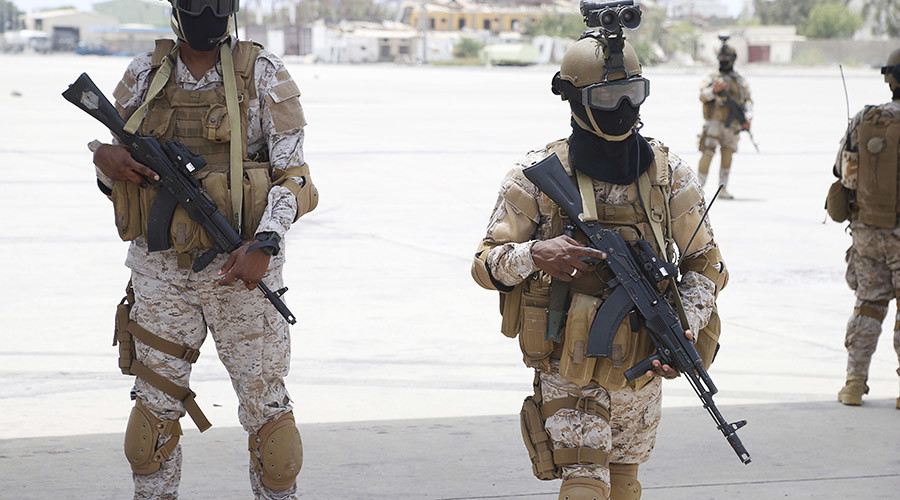
The Russian defense export company Rosoboronexport has recently announced within a larger agreement that the Saudi Arabian state owned Military Industries Corporation will soon be manufacturing 7.62x39mm AK-103 rifles in the Kingdom, along with ammunition. Saudi Arabian armed forces are already using the AK-103, along with the 5.56x45mm NATO G36K within the National Guard, but these are mostly imported from Russia itself. G36Ks have already been seeing local production for some time, many of which are ending up on arms markets in Yemen on the side of the Houthis. One of the main reasons for this move is possibly due to the cheaper cost of producing the rifles rather than buying them outright.

From the news report on Arab News-

Russia’s Rosoboronexport said it has struck an initial licensing agreement that could lead to the Kalashnikov being made in the Kingdom.
The agreement covers the “production of Kalashnikov AK-103 assault rifles and cartridges for various purposes,” a statement said.
A memorandum of understanding between the two sides could also see Russia supply Saudi Arabia with Kornet anti-tank guided missile systems, rocket launchers and automatic grenade launchers.
The preliminary deal also involves the transfer of knowledge in the defense field to Saudi Arabia. The Kingdom has set a target for half of its significant defense budget to be spent within the country.
This plan now includes the “localization” of the AK-103 assault rifle and its ammunition, according to the Saudi Press Agency.
Improvised Mauser Suppressor (OIF)

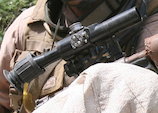
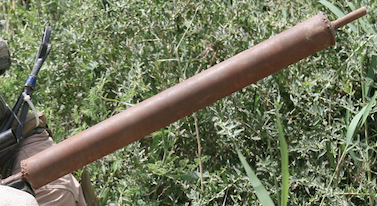
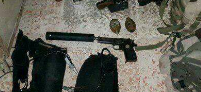
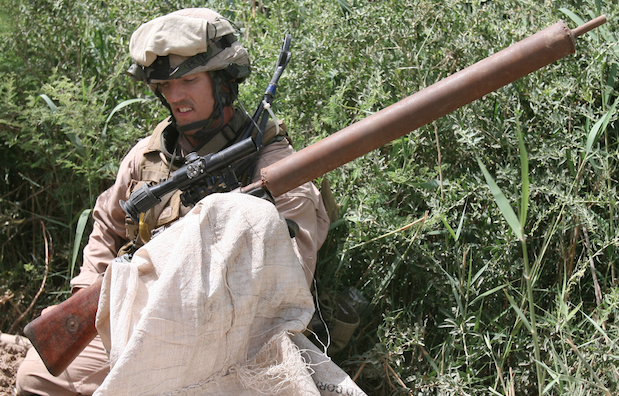
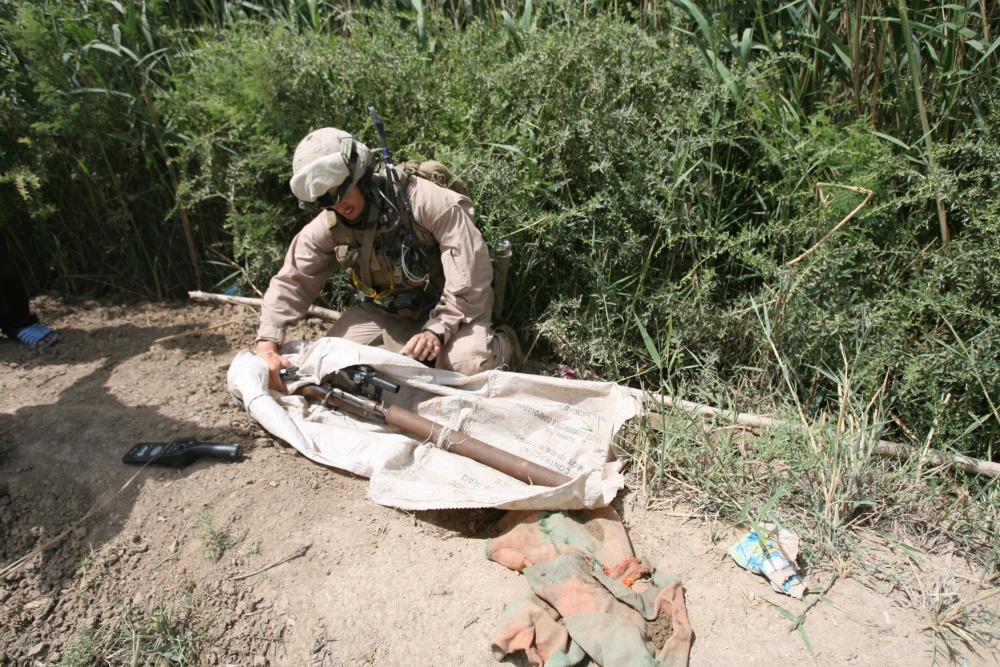
This photographs was posted on the U.S. Department of Defense Media Activity’s public domain website DVIDS along with another one featured on Silah Report. Both depict improvised suppressors captured by U.S. Infantrymen while on operations in Iraq.

The rifle appears to be a Mauser 98K with the stock sawed off just past the chamber. Because of the proximity to Iran and the incredible amount of Iranian surplus found in Iraq, it would appear from conjecture that this rifle is a Persian Mauser, manufactured in the time of the Shah in the 1940s-50s, later being replaced by the M1 Garand through U.S. Foreign Military Sales programs in the 1960s. Unlike the previous M16A1 rifle we posted about, this improvised suppressor appears to have involved much more work, with a much larger diameter pipe being welded around the actual barrel of the rifle at both the front and rear of the pipe. There is a section of much smaller diameter pipe protruding from the main one, but this doesn’t appear to be the barrel.

The scope mounted on this rifle is a Cold War era PSO-1 optic designed to mount on the optics rails usually riveted to the left side of a Kalashnikov or Dragunov receiver. It is unclear how this is mounted to the Mauser’s wood stock, unless an actual Warsaw Pact rail were somehow screwed into the wood stock itself.

Iraqi Insurgent Improvised M16A1 suppressor (OIF)

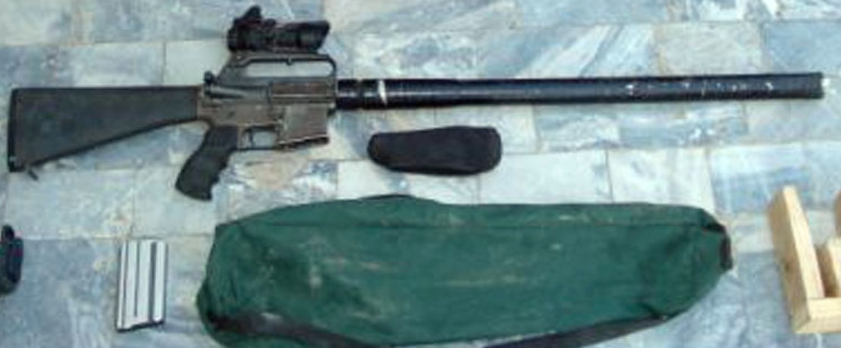
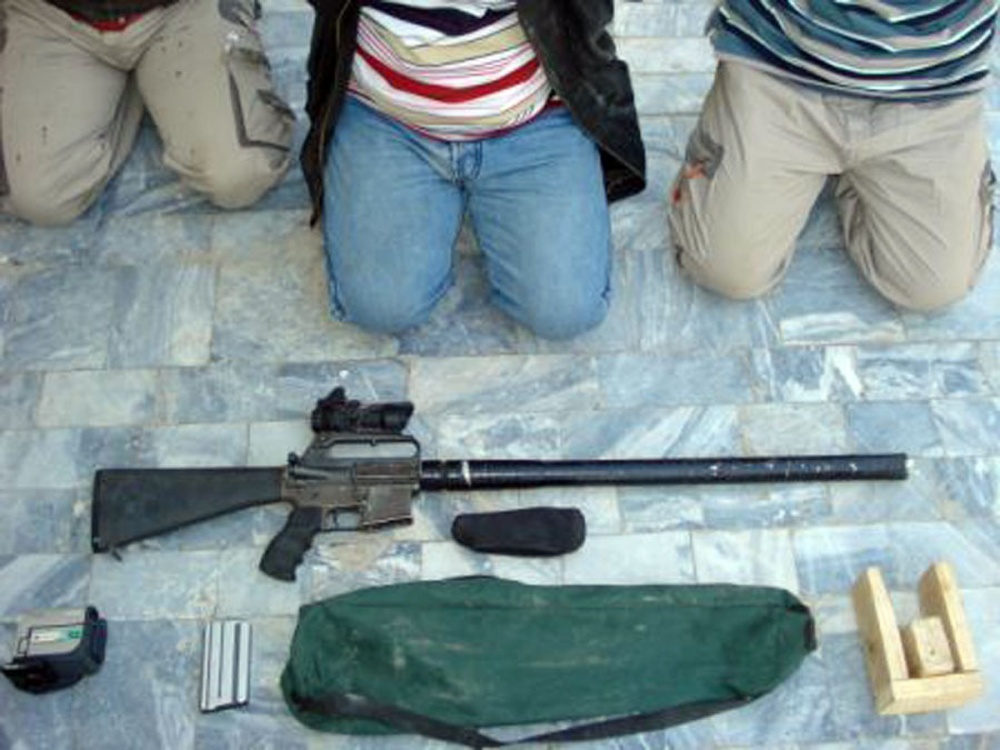
This photograph was posted on the U.S. Department of Defense Media Activity’s public domain website DVIDS along with another one that will be featured on Silah Report. Both depict improvised suppressors captured by U.S. Infantrymen while on operations in Iraq.

From the photograph description-

The confiscated items lay on the ground in front of three men arrested as a suspected sniper team in the northeast Baghdad neighborhood of Haay Ur, Jan. 17. The men were arrested by the 3rd Battalion, 4th Brigade, 1st National Police Division and the 3rd Battalion, 42nd Brigade, 11th Iraqi Army Division as the men attempted to carry out an attack on American forces in the area.

This first photograph depicts what appears to be a 5.56x45mm NATO M16A1 self-loading rifle due to the lack of a rear sight as a separate unit although the photograph is a little blurry to confirm this. The improvised suppressor appears to be some sort of muffling material wrapped around the standard 18 inch barrel of the M16A1, and then continues past the standard muzzle for about a foot of length. From the bulge just past the chamber, it appears that the standard barrel nut has been retained, and one can notice the taper of the barrel and gas tube in the shape of the suppressor. Mounted atop the carrying handle is a Trijicon 4×32 RCO. The grip is not a standard A2 grip and is most likely of commercial after market manufacture.

If the self-loading rifle is indeed an M16A1, the rifle might be a black-market trade from Lebanon or Israel where the M16A1 has seen extensive use by multiple armed entities. The presence of the pistol grip would support this assertion, as it could have been added along the way. It certainly isn’t from a captured U.S rifle. The chances of a Soldier or Marine mounting an after-market accessory such as a grip are extremely slim, and the chances of it being captured are even slimmer. In addition, the 20 round “Vietnam Era” magazine is further indicative that the rifle was initially fielded in Lebanon or Israel due to the amount of surplus equipment being sold to those countries.  It probably isn’t from a private military company either as M16A1s are rarely seen in use among these entities, 14 or 16 inch barrel length M4s being the preferred AR variant.  The Trijicon however would certainly appear to be a U.S capture or otherwise lost piece of gear, with the scope neoprene cover indicating that it was most likely newly issued or rarely used when acquired.

Construction of the improvised suppressor is harder to identify. It would appear that it is some sort of muffling or noise absorbing material stuffed inside a pipe( possibly metallic) the length of the entire suppressor. There appears to be another pipe, one of larger diameter than the main one, that connects both the main pipe and the barrel nut, thus enabling the contraption to stay in place. The entire pipe further appears to be wrapped in black tape of some sort, possibly to prevent any shine from a position of concealment. Whether or not the suppressor actually works, or how long it can adequately suppress is unknown at this point.

Sealing the deal on this capture is the video camera present, showing that the insurgents captured here were probably using the camera to film their shots on U.S troops for propaganda value, eerily  to the “Jubba” sniper videos that plagued troops based in Baghdad. Unconfirmed rumors about the “Jubba” sniper have stated that the actual shooter was using a Remington 700 shooting out of a loophole of a taxicab. A set up such as this suppressed M16A1 could just have been used in the very same way.

Suppressed Tariq Handgun

This image appeared on a recent propaganda video with images attributed to Hayat Tahrir al-Sham (HTS), or an Al Queda affiliate group. Among a collection of weapons seized by HTS from a Daesh cache is what appears to be a suppressed Iraqi Tariq handgun. The location of the seizure was in Idlib. The Tariq is an Iraqi … Read more

Sudanese AR10 in the wild, Yemen edition

This photograph was recently found on social media and features a local Yemeni man posing with an 7.62x51mm NATO AR10 next to his friend with what appears to be a modified 7.62x39mm RPK (due to the compensator) mounted with a 45 round magazine. The AR10 in question appears to be one of the largest contracts that Armlite produced of AR10s, which was the Sudanese contract of approximately 2500 rifles in the 1950s. This inference is taken from the proximity of Sudan to Yemen, so it must be stated that this is only a guess as to it’s origins and not a complete conclusion. If we could have seen the rear sight, that would remove all doubt, depending on whether or not the graduations are in Arabic numerals.

This is a little bit about it from Wikipedia-

Firearms historians have separated AR-10 production under the A.I. license into at least three basic identifiable versions, along with various sporting, carbine, and other experimental designs and calibers. The three main variants have been termed the Sudanese model, the Transitional, and the Portuguese model AR-10. A.I. built all of these rifles, beginning with the Sudanese model AR-10. The Sudanese version derives its name from the sale of approximately 2,500 AR-10 rifles of to the government of Sudan in 1958. The Sudanese model was equipped with a very lightweight, fluted steel barrel fitted with a trim, prong-style flash suppressor, a bayonet lug, lightweight fiberglass furniture, and sight graduations in Arabic.[21][22] The Sudanese model weighed only 3.3 kg (7.3 lb) with an empty magazine.[21] The price, including cleaning kit and four magazines, was US $225 per rifle.[23] All AR-10s, whether produced by ArmaLite or by A.I., used the same Stoner-designed 20-round lightweight aluminum ‘waffle’ magazine with pressed-in, corrugated sides, intended to be discarded in combat once emptied.[24]

This particular rifle appears to be in excellent condition considering that it is most likely 60 years old and has existed in a very rough part of the world when it comes to firearms care and maintenance. The young man looks to have affixed a canvas sling to the rifle, in addition to embedding a circular metal piece in the stock, also wrapping something around the buttstock by the rear sight and charging handle.

Weight 3.29–4.05 kg (7.25–8.9 lb) w/o magazine
Length 1,050 mm (41.3 in)
Barrel length 528 mm (20.8 in)

Cartridge 7.62×51mm NATO

.308 Winchester

Action Gas-operated, rotating bolt
Rate of fire 700 rounds/min
Muzzle velocity 820 m/s (2,690 ft/s)
Effective firing range 600m/656yd (ca 700m/765 1/2yds with A.I. 3.6× telescopic sight)
Feed system 20-round detachable box magazine
Sights Adjustable aperture rear sight, fixed post front sight


CZ Scorpion in use by Afghan Commandos

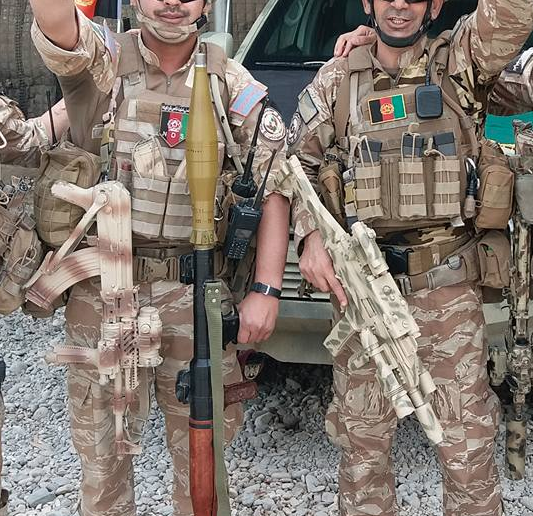
This photograph appeared very recently on Afghan social media pages, showing two ANA Commandos in desert Tiger Stripe camouflage uniforms and most interestingly a 9x19mm CZ Scorpion submachine gun with corresponding magazine pouches. The submachine gun has a number of accessories mounted to the M1913 Picatinny rails, such as the AN/PEQ-2 ATPIAL at the 12 o’clock position, what appear to be two sets of lights at the 3 o’clock and 9 o’clock positions, and what might be an Aimpoint M62 CCO red dot optic. The entire package was given a decent camouflage application that wasn’t applied to the spare magazines.

Judging from the amount of accessories, the lack of camouflaging spare magazines, and the overall presence of a submachine gun in an environment where it would not be very effective, my initial thoughts are that the ANA Commando who is armed with it, is a commander who is carrying the Scorpion as a status symbol. He isn’t actually engaging Taliban with it on combat patrols, but instead allows the weapon to signify his rank. The follow on question however, should be how it and the spare magazines got to the ANA. It would seem highly doubtful that it came through a U.S. supply line due to resources directed towards the ANA are already limited and at that are usually not afforded to such ineffective submachine guns in the battlefield that the ANA and Taliban often find themselves arranged in.

FNH SCAR-Hs among the Taliban

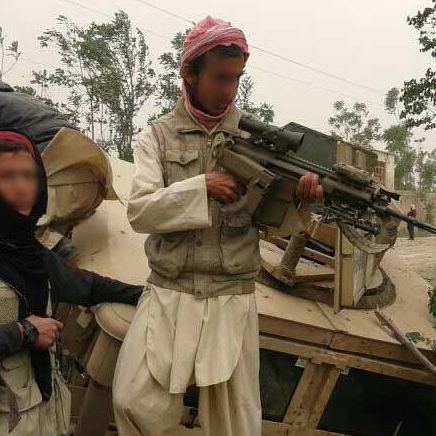
Although very few in number, several news sources have documented the usage of 7.62x51mm SCAR-Heavy rifles in use by the Taliban in Afghanistan. The most recent documentation we have in the summer of 2016 covered by Lost Weapons on Twitter, in addition to the summer of 2015 as covered by Nathaniel F. on The Firearm Blog. There is a possibility that both of these SCAR-Hs are the same rifle over the course of two years, but we can’t exclude the fact that there may be more. How it got into the hands of the Taliban is possibly by way of the Afghan Commandos who are primarily armed with M4A1s but might have been supplied a SCAR-H by their U.S. Army advisors.

e460abf1-c671-4407-be75-7198403d12eaCy0LqQJVEAIXWu7-1

SUSAT On Peshmerga M2

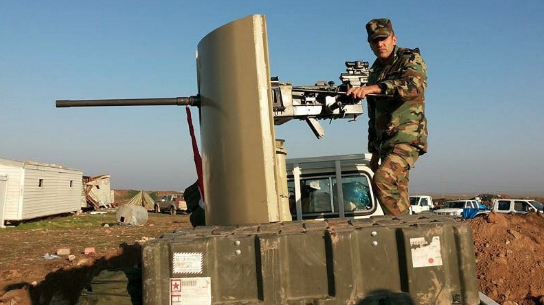
A photograph has recently come out showing a Peshmerga fighter with what appears to be a SUSAT mounted on his M2 .50 BMG Heavy Machine Gun. The mount that the machine gun is cradled in also appears to be a of British design, formerly seen in use on British armored vehicles. SR’s suspicion is that the entire contraption is supplied by British forces to the Peshmerga as defensive material. However, it would also appear that the SUSAT isn’t calibrated to the trajectory of the .50 BMG cartridge, nor is it very well suited for a heavy machine gun in the first place, being designed for a 5.56x45mm rifle.

Israeli “Hitchhiker” Modified M16 Magazine

(SR welcomes our first guest author, Yoel M. who will be discussing an interesting historical phenomena when it comes to the Israeli Defense Forces)

To understand the root of the IDF “hitchhiker’s magazine” we must begin with some context. Israel is a

small nation geographically, from North to South the country is only 263 miles (420Km). This same geography

that dictates military strategic plans also dictates military leave arrangements.

Because the front line are based just an hours drive from population centers, this enabled the IDF to release

soldiers for weekend vacations to return home. Not all the bases have good public

transportation options and as a result soldiers use to hitchhike on their way home and back

to base.

In the late 1980s and early 1990s, Palestinian fighters would take advantage of this situation and start to

kidnap soldiers to bargain for their comrades at Israeli prisons. These fighters

pretending to be Israelis would offer soldiers a ride. The tactic was usually to

arriving with no passengers to bus stations and offer a soldier a ride, the soldier would seat in

the front seat next to the driver, a few minutes down road the driver would stop and take in another

hitchhiker, this time the driver’s companion would sit behind the soldier and when the time

is right to attack and strangle the soldier from the rear.

IDF orders at that times were that soldiers are prohibited from moving with magazine inside the

rifle on their way to or from home. Most Israeli drivers having been IDF veterans themselves

usually also demanded the soldier to remove the magazine and cycle the

gun manually to check there is no round in the chamber before allowing the soldier in.

To counter the threat of kidnapping soldiers and against military orders, some troops would retrofit their

M-16 STANG magazines. They would saw off the magazine box and spring and weld the magazine

bottom floor plate to the new shorter box forming a magazine short enough to be totally

concealed inside the M-16 magazine housing.

There is, of course, no official data regarding the capacity of those homemade devices but it

fair to assume that 10 rounds is their maximum theoretical capacity.

Extracting the magazine was also an issue as those magazines were lighter than regular

STANG and often the welds on the floor plate brushed against the magazine housing inner

walls they often won’t drop when needed. With no exposing surface to grip to

extract the “hitchhiker magazine” some soldiers chose to shorter the magazine further and

weld or rivet small knob to the floor plate for easier magazine extraction.

The way the magazine would potentially work is that the soldier would insert it into the magazine

well and simply walk with it as a seemingly unloaded rifle to avoid any military police

checks and drivers demanding that a magazine be removed before entering the vehicle. If

the driver demands to manually cycle the bolt, the soldier will pull the charging handle while

pretending to verify that the chamber is empty only to load a round into the chamber from

the magazine.

Either way, the soldier plan to enter with his rifle loaded, only to be used in case of a hijacking

attempt. Iif the soldier is right handed when he sits in the passenger seat, the rifle would lay on his lap with the

barrel pointing towards the driver. In case of strangling from the rear the soldier could

theoretically operate the gun to shoot the driver.

The main problem with these magazines was the reliability. Those homemade fabrications

often misfed rounds, stacked in the housing and would drop or break open un-

expectantly when the welding failed.

Another problem was the increase in firing accidents the magazine caused, soldiers at home or

back at base could forget there is a magazine in the gun. More dangerous is the soldier’s

young siblings that might find the seemly unloaded gun and try to play with it.

Needless to say, the IDF didn’t take kindly to its soldiers initiative or the hitchhiking for that

matter and set to prohibit both. The military police was ordered to find and confiscate

hitchhiker’s magazines and penalties of up to a month in military prison to whom it was in

possession or those who tried hitchhiking.

Simultaneously officers were instructed to release soldiers for vacation only at days and

hours when public transportation was due. Moreover the army reluctantly spent money

paying private bus companies for transporting to and from central bus stations during the weekends.

Eventually, usage of the magazine became redundant as there was no longer a threat to IDF soldiers and the practice

went away.

As for its actual combat test and evaluation the magazine was never reportedly used in any kidnapping

attempt. One potential use I found in an online forum which I can’t verify or disprove was to

insert the magazine in the gun in what called “Peaceful Patrols” in Gaze and West Bank urban areas,

as the brass had the novel idea of “Winning Hearts and Minds” by send patrols without

magazines in the guns (only in the pockets of their vests). Some soldiers realized that their lives were worth more than

any hearts and minds campaign, and thus used these “Hitchhiker Magazines” while they were patrolling, to give them a

better chance of reacting to a threat.

Sadly there is no photos of the “Hitchhiker Magazine” online, the manufacturing of it done

against IDF orders and the magazine before social media and cell phones with

cameras appeared. In the end the concealed “Hitchhikers Magazine” achieved its goal as it still

invisible from Google’s all seeing eye.

Although not an Israeli magazine modification, this commercial five round magazine would have approximated what the “Hitchhiker’s Magazine” would have looked like in the 1980s and 1990s.

“Major League Infidel” Comes Full Circle In Iraq

16649184_216451905494784_3182529706248954656_n.jpg

Early in the invasions of Iraq and Afghanistan, an emblem lifted from the Major League Baseball symbol was used to demonstrate the feelings of many American Soldiers and Marines deploying in support of OIF and OEF. It depicted a soldier in place of the traditional baseball hitter, against a background of red and blue, with the figure in white. Of course, the colors red, white and blue were synonymous with the American flag. The phrase “Major League Infidel” was attached at the bottom. Infidel, “Kafir”, or کافر is a popular moniker within the U.S. Military because this is the language used in propaganda videos put out by Al Qaeda, Taliban, or current Daesh groups. Soldiers and Marines hear this and take to the term as a sort of endearment as being unliked. Of course, these same Soldiers and Marines don’t realize that the word “Kafir” exists in Arabic versions of the Christian bible as used by Christian Arabs across the MENA region.


Even the extremely popular Crye Precision brand, that makes top quality camouflage clothing and patterns, has this on their website–


We created this trademarked slogan and icon to remind everyone that all “non-believers” in senseless violence are “infidels” and to celebrate the ones who actually do something about it… the Major League Infidels™

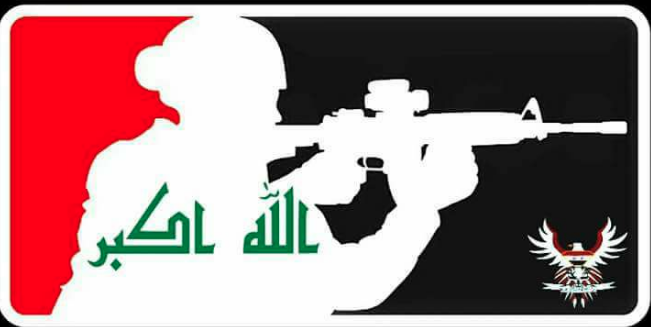
The Islamophobic rhetoric notwithstanding, the symbolism has interestingly made its way into Iraq, by way of the Iraqi ISOF forces. This time the logo is depicting the colors of the Iraqi flag; red, white, and black, with the motto found on the flag- الله اکبر, Allah Ak’bar, or translated as “God is Great”. The figure depicted is that of an Iraqi Special Operations Forces soldier with a raised Rock River Arms 14.5″ LAR-15, and Aimpoint CompM4 optic, both standard issue among ISOF forces. It is probable that the creator of this image wasn’t entirely sure of the original intent and meaning of the MLI originating from the States, but regardless he took the image and used it in a very pro-Iraqi context, which is actually anything but what the intention of the symbol was in the beginning. Thus, it has literally come full circle in the meaning, essentially changing it entirely.

In addition, it is cognisant of a much more important dynamic and that is the admiration and imitation of Iraqi and Afghan forces for U.S. forces. Copying everything from the way pouches are being set up on their plate carriers, helicopter safety lines, even attachments on their small arms to include Airsoft M203 imitations trying to replicate the look of real ones.

Below is a gathering of the original form of the meaning, to demonstrate just how clear the original intent was-

This particular logo has actually gone past the political and cultural ramifications and moved into Call of Duty.