
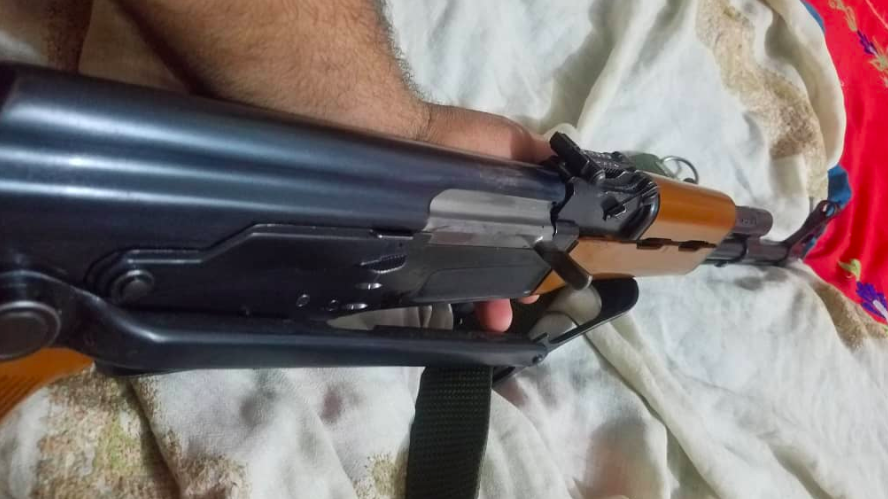
This photograph was recently found on social media and features a local Yemeni man posing with an 7.62x51mm NATO AR10 next to his friend with what appears to be a modified 7.62x39mm RPK (due to the compensator) mounted with a 45 round magazine. The AR10 in question appears to be one of the largest contracts that Armlite produced of AR10s, which was the Sudanese contract of approximately 2500 rifles in the 1950s. This inference is taken from the proximity of Sudan to Yemen, so it must be stated that this is only a guess as to it’s origins and not a complete conclusion. If we could have seen the rear sight, that would remove all doubt, depending on whether or not the graduations are in Arabic numerals.
This is a little bit about it from Wikipedia-
Firearms historians have separated AR-10 production under the A.I. license into at least three basic identifiable versions, along with various sporting, carbine, and other experimental designs and calibers. The three main variants have been termed the Sudanese model, the Transitional, and the Portuguese model AR-10. A.I. built all of these rifles, beginning with the Sudanese model AR-10. The Sudanese version derives its name from the sale of approximately 2,500 AR-10 rifles of to the government of Sudan in 1958. The Sudanese model was equipped with a very lightweight, fluted steel barrel fitted with a trim, prong-style flash suppressor, a bayonet lug, lightweight fiberglass furniture, and sight graduations in Arabic.[21][22] The Sudanese model weighed only 3.3 kg (7.3 lb) with an empty magazine.[21] The price, including cleaning kit and four magazines, was US $225 per rifle.[23] All AR-10s, whether produced by ArmaLite or by A.I., used the same Stoner-designed 20-round lightweight aluminum ‘waffle’ magazine with pressed-in, corrugated sides, intended to be discarded in combat once emptied.[24]
This particular rifle appears to be in excellent condition considering that it is most likely 60 years old and has existed in a very rough part of the world when it comes to firearms care and maintenance. The young man looks to have affixed a canvas sling to the rifle, in addition to embedding a circular metal piece in the stock, also wrapping something around the buttstock by the rear sight and charging handle.

 Translated from Arabic, this reads-
 Many of the photographs are being spread through the


