How Ruger P95s and Sig P2022s Got to Iraq

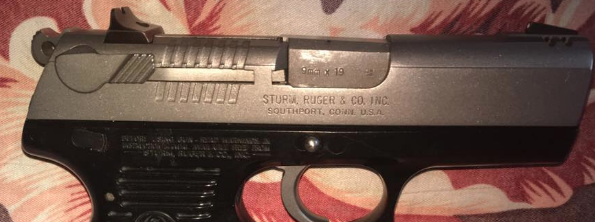
For a while now we’ve seen a number of Ruger 9x19mm NATO P95 handguns flourishing among the social media groups within Iraq. This isn’t a recent phenomena but still, the question remains over where they originated from. Daniel Watters, a noted small arms historian has provided us with some excellent context on the issue, even detailing the specific contracts that pushed 5,000 Ruger P95s, and 5,000 Sig Sauer SP2022s into Iraq.

Back in December 2004, the US Army’s Tank-Automotive & Armament Command (TACOM) posted solicitation W52H09-05-R-0067. They basically wanted 10,000 9x19mm pistols in a hurry, and were willing to place multiple contracts to fill it. Vendors were allowed to bid for as few as 100 pistols up to the full total of 10,000. The most telling portion of the solicitation was that they requested a price for the pistols to be shipped directly to Baghdad.

Before the end of the month. Ruger received contract W52H09-05-C-0058 for 5,000 P95, and SIG-Sauer received contract W52H09-05-C-0059 for 5,000 SP2022.

When outsiders saw the name Tank-Automotive & Armament Command, they assumed the pistols must be for tankers. Nothing could be further from the truth. A subordinate command of the Army Materiel Command, TACOM-Rock Island was responsible for all Army small arms procurement. It also handled orders from other US military service branches, and managed foreign military sales (FMS).
It turns out that the rush order was meant to arm Iraqi security forces ahead of the country’s first post-Saddam parliamentary elections in January 2005. Confirmation can be found in the government report “Iraqi Security Forces: Weapons Provided by the U.S. Department of Defense Using the Iraq Relief and Reconstruction Fund.

The report listed can be accessed here and lists the 5,000 P95s as being purchased for $1,271,700, and the 5,000 SP2022s being purchased for $1,756,550, both on December 12 2004. Both of these appeared to have been designated for the Ministery of Interior and the Ministery of Defense although it doesn’t specify which. We should also note that these 10,000 handguns were only a third of the 38,053 “Generic 9mm Pistols” that were on contract. What those other thirty-something thousand odd handguns were would have to take some researching.


Although very similar in appearance to a Sig Sauer handgun, our sources tell us that this is in fact a blank firing copy.

Israeli “Hitchhiker” Modified M16 Magazine

(SR welcomes our first guest author, Yoel M. who will be discussing an interesting historical phenomena when it comes to the Israeli Defense Forces)

To understand the root of the IDF “hitchhiker’s magazine” we must begin with some context. Israel is a

small nation geographically, from North to South the country is only 263 miles (420Km). This same geography

that dictates military strategic plans also dictates military leave arrangements.

Because the front line are based just an hours drive from population centers, this enabled the IDF to release

soldiers for weekend vacations to return home. Not all the bases have good public

transportation options and as a result soldiers use to hitchhike on their way home and back

to base.

In the late 1980s and early 1990s, Palestinian fighters would take advantage of this situation and start to

kidnap soldiers to bargain for their comrades at Israeli prisons. These fighters

pretending to be Israelis would offer soldiers a ride. The tactic was usually to

arriving with no passengers to bus stations and offer a soldier a ride, the soldier would seat in

the front seat next to the driver, a few minutes down road the driver would stop and take in another

hitchhiker, this time the driver’s companion would sit behind the soldier and when the time

is right to attack and strangle the soldier from the rear.

IDF orders at that times were that soldiers are prohibited from moving with magazine inside the

rifle on their way to or from home. Most Israeli drivers having been IDF veterans themselves

usually also demanded the soldier to remove the magazine and cycle the

gun manually to check there is no round in the chamber before allowing the soldier in.

To counter the threat of kidnapping soldiers and against military orders, some troops would retrofit their

M-16 STANG magazines. They would saw off the magazine box and spring and weld the magazine

bottom floor plate to the new shorter box forming a magazine short enough to be totally

concealed inside the M-16 magazine housing.

There is, of course, no official data regarding the capacity of those homemade devices but it

fair to assume that 10 rounds is their maximum theoretical capacity.

Extracting the magazine was also an issue as those magazines were lighter than regular

STANG and often the welds on the floor plate brushed against the magazine housing inner

walls they often won’t drop when needed. With no exposing surface to grip to

extract the “hitchhiker magazine” some soldiers chose to shorter the magazine further and

weld or rivet small knob to the floor plate for easier magazine extraction.

The way the magazine would potentially work is that the soldier would insert it into the magazine

well and simply walk with it as a seemingly unloaded rifle to avoid any military police

checks and drivers demanding that a magazine be removed before entering the vehicle. If

the driver demands to manually cycle the bolt, the soldier will pull the charging handle while

pretending to verify that the chamber is empty only to load a round into the chamber from

the magazine.

Either way, the soldier plan to enter with his rifle loaded, only to be used in case of a hijacking

attempt. Iif the soldier is right handed when he sits in the passenger seat, the rifle would lay on his lap with the

barrel pointing towards the driver. In case of strangling from the rear the soldier could

theoretically operate the gun to shoot the driver.

The main problem with these magazines was the reliability. Those homemade fabrications

often misfed rounds, stacked in the housing and would drop or break open un-

expectantly when the welding failed.

Another problem was the increase in firing accidents the magazine caused, soldiers at home or

back at base could forget there is a magazine in the gun. More dangerous is the soldier’s

young siblings that might find the seemly unloaded gun and try to play with it.

Needless to say, the IDF didn’t take kindly to its soldiers initiative or the hitchhiking for that

matter and set to prohibit both. The military police was ordered to find and confiscate

hitchhiker’s magazines and penalties of up to a month in military prison to whom it was in

possession or those who tried hitchhiking.

Simultaneously officers were instructed to release soldiers for vacation only at days and

hours when public transportation was due. Moreover the army reluctantly spent money

paying private bus companies for transporting to and from central bus stations during the weekends.

Eventually, usage of the magazine became redundant as there was no longer a threat to IDF soldiers and the practice

went away.

As for its actual combat test and evaluation the magazine was never reportedly used in any kidnapping

attempt. One potential use I found in an online forum which I can’t verify or disprove was to

insert the magazine in the gun in what called “Peaceful Patrols” in Gaze and West Bank urban areas,

as the brass had the novel idea of “Winning Hearts and Minds” by send patrols without

magazines in the guns (only in the pockets of their vests). Some soldiers realized that their lives were worth more than

any hearts and minds campaign, and thus used these “Hitchhiker Magazines” while they were patrolling, to give them a

better chance of reacting to a threat.

Sadly there is no photos of the “Hitchhiker Magazine” online, the manufacturing of it done

against IDF orders and the magazine before social media and cell phones with

cameras appeared. In the end the concealed “Hitchhikers Magazine” achieved its goal as it still

invisible from Google’s all seeing eye.

Although not an Israeli magazine modification, this commercial five round magazine would have approximated what the “Hitchhiker’s Magazine” would have looked like in the 1980s and 1990s.

“Major League Infidel” Comes Full Circle In Iraq

16649184_216451905494784_3182529706248954656_n.jpg

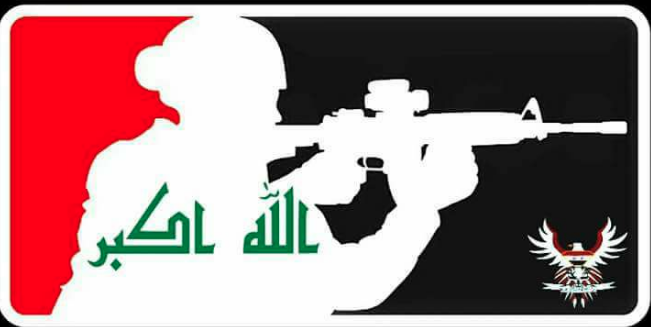
Early in the invasions of Iraq and Afghanistan, an emblem lifted from the Major League Baseball symbol was used to demonstrate the feelings of many American Soldiers and Marines deploying in support of OIF and OEF. It depicted a soldier in place of the traditional baseball hitter, against a background of red and blue, with the figure in white. Of course, the colors red, white and blue were synonymous with the American flag. The phrase “Major League Infidel” was attached at the bottom. Infidel, “Kafir”, or کافر is a popular moniker within the U.S. Military because this is the language used in propaganda videos put out by Al Qaeda, Taliban, or current Daesh groups. Soldiers and Marines hear this and take to the term as a sort of endearment as being unliked. Of course, these same Soldiers and Marines don’t realize that the word “Kafir” exists in Arabic versions of the Christian bible as used by Christian Arabs across the MENA region.


Even the extremely popular Crye Precision brand, that makes top quality camouflage clothing and patterns, has this on their website–


We created this trademarked slogan and icon to remind everyone that all “non-believers” in senseless violence are “infidels” and to celebrate the ones who actually do something about it… the Major League Infidels™

The Islamophobic rhetoric notwithstanding, the symbolism has interestingly made its way into Iraq, by way of the Iraqi ISOF forces. This time the logo is depicting the colors of the Iraqi flag; red, white, and black, with the motto found on the flag- الله اکبر, Allah Ak’bar, or translated as “God is Great”. The figure depicted is that of an Iraqi Special Operations Forces soldier with a raised Rock River Arms 14.5″ LAR-15, and Aimpoint CompM4 optic, both standard issue among ISOF forces. It is probable that the creator of this image wasn’t entirely sure of the original intent and meaning of the MLI originating from the States, but regardless he took the image and used it in a very pro-Iraqi context, which is actually anything but what the intention of the symbol was in the beginning. Thus, it has literally come full circle in the meaning, essentially changing it entirely.

In addition, it is cognisant of a much more important dynamic and that is the admiration and imitation of Iraqi and Afghan forces for U.S. forces. Copying everything from the way pouches are being set up on their plate carriers, helicopter safety lines, even attachments on their small arms to include Airsoft M203 imitations trying to replicate the look of real ones.

Below is a gathering of the original form of the meaning, to demonstrate just how clear the original intent was-

This particular logo has actually gone past the political and cultural ramifications and moved into Call of Duty. 

AK-74s of Kazakhstan Army’s Military Exercises

Kazakh AKs 660x405.jpg

Ministry of Defense of Kazakhstan has recently posted news releases on their website concerning military exercises of high-ranking officers.

Kazakh AKs.jpg

Particularly, battalion commanders of mechanized infantry, paratrooper and marine regiments took part in mentioned exercises. The purpose of that event was to upgrade the qualification of the officers by a number of tactical and strategic classes, defensive and offensive scenario studies, as well as familiarization with new weapon systems.

img_3427_12691.jpg

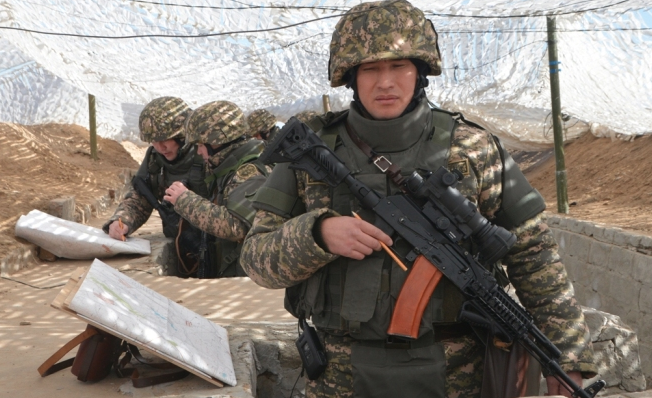
During these exercises, the officers were carrying AK-74 assault rifles, which had some interesting upgrades and mods on them. Let’s take a closer look at each of them.

The railed dust cover, handguard and gas tube cover are most likely made by Russian company Zenit. The dust cover is Zenit B-33 (Зенит Б-33), the handguard is a Zenit B-10M (Б-10М) and the railed gas tube cover is a Zenit B-19 (Б-19). Here is a picture of all three accessories:

Зенит 1.jpg


The stock adapter is probably made by Israeli company FAB Defense. It is the model M4-AK P or a similar one. Some of these stock adapters differ only by the material, which is almost impossible to distinguish by only a visual reference. In any case, it is a conversion stock which allows mounting AR-15/ M-4 rifle stocks on the AK platform. It also has a built-in side folding mechanism. Here is the image of M4-AK P model:

! Kazakh stock FAB.jpg

The buttstock itself is also made by FAB Defense and it is their GLR-16 CP model with an adjustable cheek riser.

704-glr-16-cp-3d-png-Sun-Jan-6-15-34-22.jpg

The angled foregrip mounted on the handguard has the distinct shape of another FAB Defense product – PTK.

699-ptk-png-Sun-Nov-18-13-21-16.jpg


The scope is unidentified, but it is presumably a Russian made one. It is a night vision or thermal scope judging from the looks. Possibly, it is a newer version of NSPU scope. We’ll update this post as soon as we find out the exact model of the scope.

Similar exercises of squad leaders were held too and it is interesting to note that squad leaders were equipped with AK-74 rifles in stock configuration. Judging from that, the upgrades for AK-74s are available for high ranking officers only. Here is a picture of squad leader sergeants firing their AK-74s:

img_3526_13066.jpg

FYI: here is the small arms’ list of Armed Forces of Kazakhstan (from Wikipedia):

Small Arms

  • 9×18mm Makarov PM Standard issue pistol for armed forces.
  • 9×18mm PP-90M1 Submachine gun, used by special forces.
  • 5.45×39mm AK-74 Standard issue rifle of Kazakh military.
  • 5.45×39mm RPK-74
  • 7.62×39mm AKM Reserve units
  • 7.62×54mmR SVD Dragunov sniper rifle
  • 7.62×54mmR PKM machine gun
  • 7.62×54mmR PKP Pecheneg machine gun, used by special forces.
  • 7.62×39mm ARX-160 Assault rifle, used by special forces
  • 12.7mm NSV machine gun

Optic Mounted PKM in Syria (2016)

Kurdistan Insider posted this video of a Syrian Army advance in Aleppo in 2016. Most of the PKM variants being used in the Syrian conflict have been seen without any sort of optics platforms mounted to them, this is mostly because of the lack of equipment that many of these rebel groups can capture.

However in this case, it appears to be a thermal or at least an IR capable optic platform due to the bulbous appearance, in addition to the numerous knobs which might be battery caps for power. In addition the eye piece appears to be fitted or contoured to the shooter’s eye, indicating a bright screen that needs to be shielded during times of low light. Because this is a Syrian Army position, it is most likely that the optic is Russian supplied.

Screen Shot 2017-02-20 at 11.34.11 PM.png

In the same video clip, what appears to be an AK century series rifle being used by frontline soldiers, possibly in 5.45x39mm due to the straighter magazine in use.
Screen Shot 2017-02-20 at 11.34.31 PM.pngScreen Shot 2017-02-20 at 11.34.21 PM.png

Type 1, 2 Kalashnikovs Spotted

This photograph recently appeared on the social media account of a Kalashnikov aficionado, showing both a Type 1 and Type 2 Ak47 (not AKM) featured in the photograph. The Type 1 and Type 2 are exceedingly rare today, having been taken over by the much more produced AKM and associated variants across the world.


This was taken in Helmand province, Afghanistan by a contractor based there, probably in the Kajaki district. His testimony to this photograph is as follows-

I took that pic in Helmand Province, Afghanistan while I was there between 2012-2014. We had 7 or 8 Type I’s, 6 of which were issued to local national security force members we were mentoring. There were maybe 5-6 Type II’s including one that I estimated had less than 500 rounds through it (the underside of the trigger and disconnector still had cosmoline on it, and the auto sear and other internal parts still showed 99% blued finish with ZERO signs of wear.

The Type 1 is easily recognizable by the curved trunnion, while the Type 2 is identified by the square depression above the magazine, on the receiver. The Type II is a stamped receiver, while the AKM, Type I and Hungarian AMD65 above them are stamped.


Much Thanks to Buck T. for the input on this post!

Dostum’s Krinks

The AKS74U “Krinkov” has gained a cult-like following in Afghanistan, dating back to the high status of the carbine in the Mujahideen’s fight against the Soviet Union. Because it was mostly helicopter and armored BMP crews that were issued it, capturing one from a downed helicopter gave tangible evidence to Afghan fighters that they had achieved a battlefield success. In 1981 a Krinkov could be bought for the price of four “Dhushka” heavy machine guns in the gun markets of Dharra Adam Khel.

Today we see the Krinkov alive and well, arming Uzbek General Rashid Dustom’s (now Vice President) security detail. The photographs below are a compilation of instances in which we see Dustom in public with his armed escort, in addition to some photographs of his son at the front with him. The presence of the Krinkov among his security force is both as an effective close range weapon but also is portraying an image of high status and power among all who see him.
%d8%ac%d9%86%d8%b1%d8%a7%d9%84-%d8%af%d9%88%d8%b3%d8%aa%d9%85-%d8%b3%d9%81%d8%b1-%d8%ac%d9%88%d8%b2%d8%ac%d8%a7%d9%86-%d9%88-%d9%be%d9%8a%d9%88%d8%b3%d8%aa%d9%86-%d8%a7%d9%81%d8%b1%d8%a7%d8%af 38295ad7-cff7-4717-ae3e-5dc0d532d9ce_cx0_cy19_cw0_w1023_r1_s 13151489_612021732278536_7452548539425481202_n 82269631-71096696 gen-dostum3

Notice the PSD member in suit with the Krinkov, and how he appears in a number of these other photographs. Warlords, Generals, and Government figures in Afghanistan and Iraq usually have a very narrow circle with whom they can trust and depend because of the nature of their work. This circle of trust is especially small when it comes to their security detail, as these members are fully armed and have an intimate knowledge of their client. Many times in the past, assassinations of major figures have come from these men precisely because of that, dating back to ancient times as well. Whomever this man is, Dustom must have much faith in his abilities, in addition to being fully able to trust him. 11011683_719811008148239_2701183093922873274_n n00069917-b cmect2dukaatuvx gen-_doustum2_770222849 n00070381-b

This photograph is particularly interesting because it shows a modified AkS74u, with Trijicon ACOG, attached flashlight, and what appears to be a picatinny section replacing the handrails.143928811128

Iranian M9-02 Handgun Introduced

Recent news from The Firearm Blog show Iran’s state ran small arms company introducing a new striker fired, polymer framed handgun. The name of the handgun appears to be M9-02 as marked on the slide and it is in 9x19mm NATO. It appears to be very similar to a Walther P99 in dimension and operation. Connections to the P99 might come from Turkey as we know that Iran has a strategic and business friendship with Turkey. From a small arms perspective, at the very same defense exposition these handguns were revealed at, Iran’s newest assault rifle was seen with a Turkish Safir AR magazine inserted on Silah Report. That being said, Turkish company Canik has produced a locally copied version of the P99 as the Canik 55 TP-9. This American blogger has put together an excellent comparison of a Walther P99 and the Canik 55 TP-9, showing the massive similarities.

screen-shot-2017-02-13-at-5-12-16-pm

From TFB-

It appears to be a polymer framed, striker fired, 9x19mm handgun, with much inspiration drawn from a Walter P99 through the method of disassembly and overall shape of the frame. The magazine appears to have an added capacity floor plate, leading me to assume that another magazine is available with a flush fit option. It seems to lack a manual safety, usually a requirement for military handguns, and it appears to have night sights by way of white dots embedded in them. Whether these sights light up at night through the use of tritium or another substance is unclear at this moment.

Iran is going through a substantial rearmament and redesign of a number of weapon systems, to include the primary issue rifle, taking on an AR15 appearance. Earlier, Iran produced a Glock-like handgun called the Raa’d (Thunderbolt), but this appears to have not been adopted in any substantial numbers or at all.

This image shows the differences and similarities between the Walther P99 and the Canik 55 TP-9

20131102_075718

Safir AR Magazines in use by Peshmerga, Iran

Safir Arms is a Turkish firearms company that primarily produces .410 AR clones. However, the company debuted a 5.56x45mm NATO AR magazine in 2014 along with a bullpup rifle under the name T-14 that shared a number of AR components. The rifle never seemed to have advanced past a prototype stage, but the magazine design included was turned into a manufacturing run. Currently it is listed on the company’s website and in the catalog. The listed magazine and bullpup rifle appear below along with a modular adaption of an AR rifle.

t1816730509_959895579865_6921342533509956338_n screen-shot-2017-02-13-at-10-28-04-pm

Unlike similar polymer magazines such as Magpul’s Pmag and ProMag’s signature polymer magazine, the Safir Arms version has four columns along the side of the magazine, in addition to a ribbed portion that sits below the magazine well of an AR when inserted. Observe the differences in the photographs of the Magpul and Promag-

cola18-1-large images

However, recently the same magazine design has appeared in usage with certain Peshmerga forces, specifically security forces armed with NEA Arms PDWs in Kurdistan. In addition it also appeared in a recent Iranian defense weapons exposition in Tehran. Whether or not the magazine has been copied by the Iranians and being manufactured locally is unknown at this point in time.

With the Peshmerga in the ARES post-

7

And at the Iranian exposition-

screen-shot-2017-02-13-at-5-12-39-pm 991098-1000