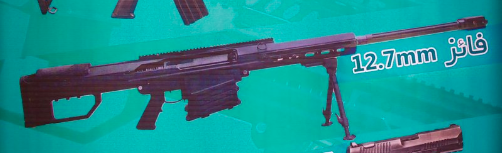
In our first Country Database entry, Silah Report is proud to announce the inaugural addition of the recently introduced Hoveizeh Anti-Material rifle to the Iran country database. The rifle was recently unveiled at IPAS 2017.
Military/LE
IWI X95s, TAR-21s in Nigeria
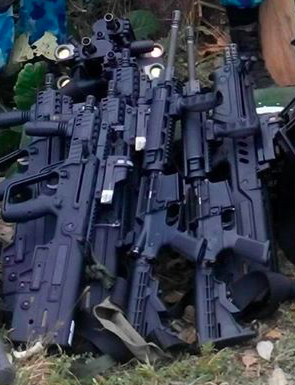
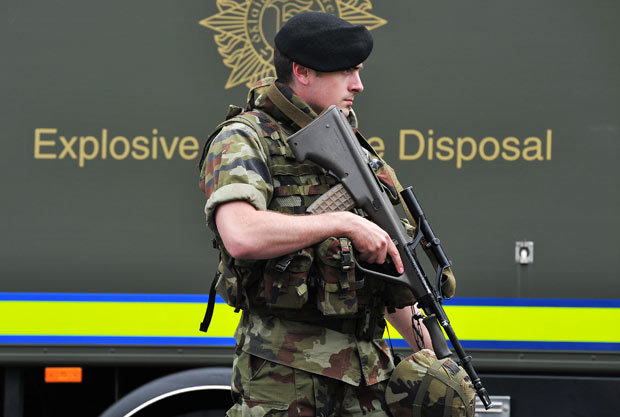
The Israeli 5.56x45mm Tavor is no stranger to the Nigerian defense forces, with the TAR 21 being introduced from Israel in a short barrel variant (around 14 inches) several years ago, and the X95 version seen in Nigeria in 2016 (possibly issued earlier). This photograph of a Nigerian soldier posing with stacked IWI rifles, some being the TAR 21 while others being the X95 versions came out in 2016 on the Nigerian public forum Nairaland, along with numerous other photographs of the defense forces.
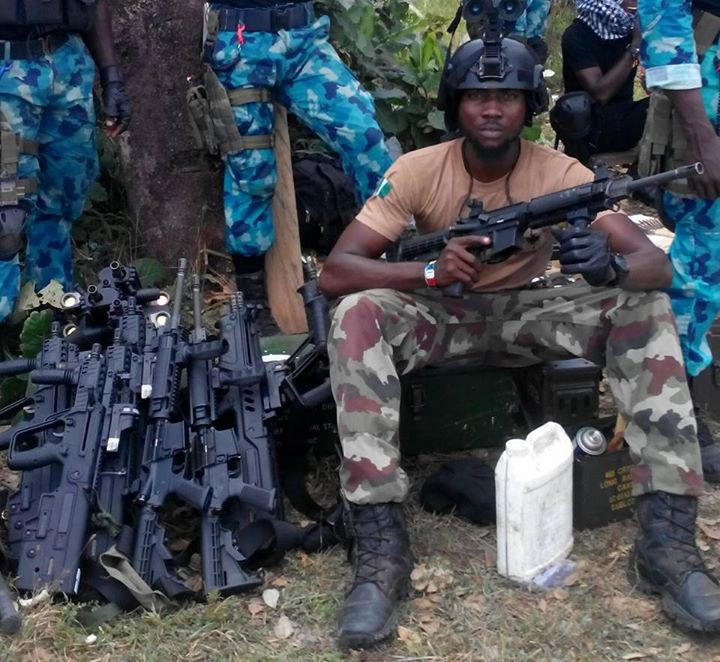
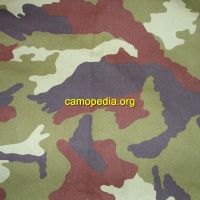
Interestingly he is wearing an Irish Army camouflage pattern introduced in the early 2000s, known as DPM or “Paddyflage” among Irish troops. Image from Camopedia–
Book Review: The Afghan Way of War
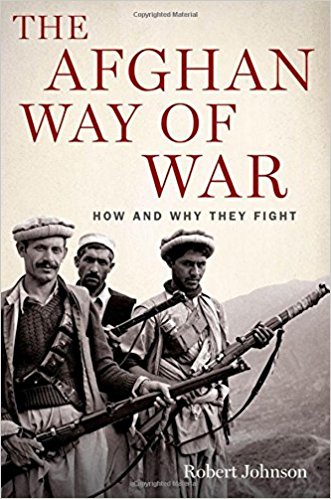
Although former British Army officer Robert Johnson wrote his book, “The Afghan War of War” in 2011, his conclusions and observations are just as valuable, if not more valuable today than ever. The premise of his book is that very few authors, officers, or politicians have throughly studied the Afghan side of many of the conflicts that have taken place in Afghanistan, whether it be Afghans against foreign invaders/occupiers, or civil war within the country such as during the 1990s. What I especially liked about the book was a number of very useful points that Johnson raises, that I honestly had not thought of before. I’ll summarize some of these points below, as these were my key takeaways from the book.
A Nation of a Thousand Tribes
Johnson goes to great lengths to make the point that Western observers have seen Afghans as “unchanging”, the “Graveyard of Empires”, and “fierce tribal fighters”, and this has stereotyped impressions of the Afghans since the first Anglo-Afghan War in the 1840s. Throughout the book we have countless counter-examples where this doesn’t seem to be the case. Where Afghan tactics have changed, altered, and have been reactive to the threats faced, in addition to being proactive and forcing Western troops to be constantly on the defensive.
But there is one constant that hasn’t changed, and that is the tribal and group dynamics that have existed for several hundred years. What we see is that instead of seeing Afghanistan as a single entity, or even an ethnic group as an entity, what is really going on is hundreds of individual tribes, sub-tribes, clans, and families that are essentially looking out for the best option for their individual group. Whether they ally with the British, or with the King, whether the Mullahs decide to go to war at all, whether peace is on the table, etc… Any of these decisions are made for the benefit of the particular group (tribe, clan, village, etc…). And these often change. What is beneficial for a village one month, may be detrimental for it the next. This means that to the British, Soviets, or Americans, it can be increasingly frustrating trying to maintain alliances and agreements.
Something that Johnson doesn’t mention, but a personal observation that I’ve made is how economy plays into these decisions. The lack of a stable exportation or cultivation of any natural resource (other than crops and opium) has been a limiting detractor throughout the countries history and still affects national security today. But when local tribes and villages can’t rely on natural resources like oil, mining, etc… the need to fight tooth and nail for alliances, positions, and funds becomes even more apparent.
Foreign Invaders Unify Afghans
In the example of every invading or occupying force, one of the constant themes is that one of the only forces that has ever truly united Afghans of different ethnic origins in some fashion has been the need to expel a foreign one. Johnson doesn’t point this out explicitly but this is evident in his descriptions of the country before several conflicts. The state of the country under the King appeared to be on the brink of falling apart on numerous occasions, when senior leadership pushed for further hostilities against the British or during the time of communism, against the Soviets. Even under the Taliban during OEF, the need to unite under an Islamic banner instead of an Afghan, or Pashtun one was strategically necessary to be able to sweep tribal differences aside.
Differences in Technology
The first Anglo-Afghan War saw the widespread use of muzzleloading rifles and muskets on both sides of the conflict, with the British armed with the Brown Bess, and the Afghans with the Jezail muzzle loading rifle. Apart from the British cannon and cavalry, the two forces were somewhat equal in terms of actual hardware.
However in the second Anglo-Afghan War this dynamic dramatically changed with the introduction of breech-loading rifles that could not only be reloaded quicker, fired faster, but also more accurately and further. This changed the way Afghan tribesmen attacked British columns. They had to close in faster, not allowing the British to use their artillery, and often attacked at night.
Similarly, in the war against the Soviets, the use of Stinger MANPODS was brought up. The popular misconception is that Stingers helped win the war. Although they did strike fear among Soviet helicopter pilots, especially the Hind attack helicopters, their introduction was too late to make a difference in 1986, when the Soviet Union had already decided to being fighting a delaying action instead of an all-out offensive. In addition, by altering their flying practices to fly at higher altitudes, the Soviets realized they could go outside of the Stinger’s capabilities and lessen the risk.
In Operation Enduring Freedom, the prevalence of IEDs took precedence over light Infantry attacks that the Taliban initially tried to use against the British in Helmand, but suffered costly casualties due to the artillery and air assets. IEDs used by the Taliban deserve to be studied much more in detail due to the complex escalation’s and counter escalation’s executed on each other throughout the entire campaign.
Operation Enduring Freedom/Operation Herrick Observations
One point I think the book could have been improved on is the OEF/Op Herrick. In retrospect, this isn’t really Johnson’s fault because the war is still ongoing, and he can’t have access to many of the after action reports, or even just the massive amount of experience associated with the current operations from hundreds of thousands of veterans and currently serving troops. He picks out specific situations and TTPs that are usually from the British perspective, that doesn’t typify what other forces might have faced in their fight against the Pashtun lead Taliban insurgency.
His conclusion though is flawless in that he identifies that any considerable gains going forward will have to be an Afghan solution to an Afghan problem. Personally I think this has to have enormous emphasis on the countries economy, and being able to become prosperous on exporting natural resources already present in order to actually provide some capitol for a government entirely propped up on international aid money.
Saudi Adds AK-103 to MIC Production Line Up
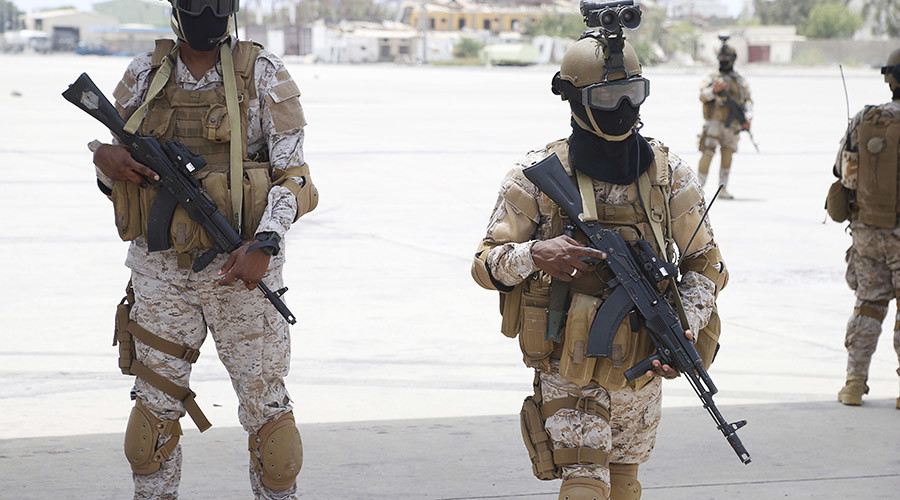
The Russian defense export company Rosoboronexport has recently announced within a larger agreement that the Saudi Arabian state owned Military Industries Corporation will soon be manufacturing 7.62x39mm AK-103 rifles in the Kingdom, along with ammunition. Saudi Arabian armed forces are already using the AK-103, along with the 5.56x45mm NATO G36K within the National Guard, but these are mostly imported from Russia itself. G36Ks have already been seeing local production for some time, many of which are ending up on arms markets in Yemen on the side of the Houthis. One of the main reasons for this move is possibly due to the cheaper cost of producing the rifles rather than buying them outright.
From the news report on Arab News-
Russia’s Rosoboronexport said it has struck an initial licensing agreement that could lead to the Kalashnikov being made in the Kingdom.
The agreement covers the “production of Kalashnikov AK-103 assault rifles and cartridges for various purposes,” a statement said.
A memorandum of understanding between the two sides could also see Russia supply Saudi Arabia with Kornet anti-tank guided missile systems, rocket launchers and automatic grenade launchers.
The preliminary deal also involves the transfer of knowledge in the defense field to Saudi Arabia. The Kingdom has set a target for half of its significant defense budget to be spent within the country.
This plan now includes the “localization” of the AK-103 assault rifle and its ammunition, according to the Saudi Press Agency.
Silah Report Has a New Look!
Silah Report recently undertook a massive transformation, moving servers, changing appearances, working out the new kinks. Because this website is personally run, all this had to take place between actual jobs and other commitments. But we hope you like the new appearance, it certainly is much more professional than the previous one.
We will also update the country database. Originally we intended the country database to be an all encompassing snapshot at the small arms history within a particular country. Although ideal in theory, in practice we found out that it was far too much work. Instead, what we want to do now is to maintain the individual country pages, but ONLY concentrate on small arms exported/imported in large quantities into a country, and small arms produced domestically, either under license or designed indigenously. Essentially we want to recreate what World.Guns.Ru, which is fantastically run by Maxim Popenker, but centered around small arms from the MENA and Central Asian region.
The goal of this database is to allow researchers and future writers to be able to reference back to it, so they can historically piece together how a particular small arm came into a country, or where it might have been bought from, and especially in what time period.
Analysis of Taliban Firing Positions in OEF
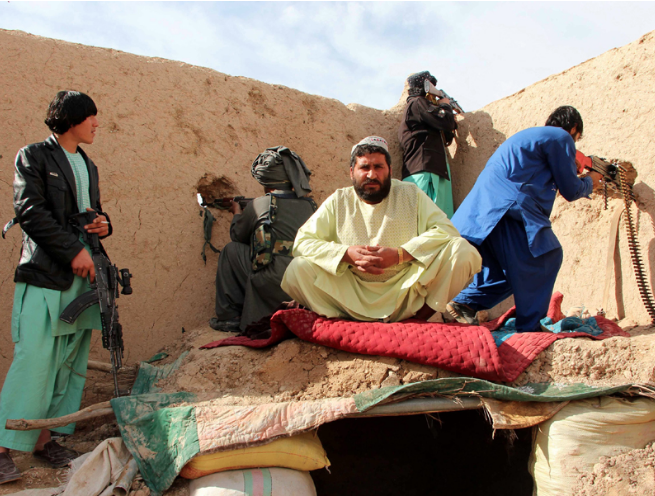
Due to the efforts of ISAF forces during Operation Enduring Freedom, Taliban fighters had to change their tactics constantly to stay tactically ahead of coalition efforts. Because of the reliance on fire support assets and modern armament that much of ISAF could afford, the Taliban in Helmand and Kandahar provinces couldn’t sustain a protracted fight as they could against ANA or AUP positions. Thus the insurgent force had to adapt and overcome. One of the ways in which they employed small arms against ISAF forces was through their usage of compounds and firing positions. Being in Helmand or Kandahar, firing from an open position or fields is almost certainly suicide against ISAF forces because of the lack of egress routes and being cut down. Thus, many Taliban fighters adopted the technique of utilizing “murder holes” as firing positions from compounds. Most of these compounds were taken over from the families that owned them, often threatening them with death if they spoke to coalition forces about the compound’s usage.

Compound/housing structures in rural southern Afghanistan have a number of advantages for maneuver insurgent warfare. Because the walls are made from mud, they can have holes busted through them to use as firing ports, but at the same time can be extremely resistant to incoming rounds, even up to .50 BMG. These compound walls can be anywhere from six feet to twelve feet in height and easily conceal the numerous motorcycles that the Taliban used. Motorcycles are essential for the kind of “shoot n’ scoot”maneuver warfare because of the ease of transportation and the possibility of swiftly getting away from lumbering MRAPs and MAT-Vs along twisting narrow roads. In addition, a single PKM machine gun team could be concealed and broken up among three or five motorcycle driving Talibs. One carrying the receiver, another the barrel, another the ammunition. This way, all three could move to a new firing location discreetly, and most importantly separately.

The Taliban’s worst threat was being fixed in place and destroyed. The force knew that it could not sustain a long drawn out, small arms fight even against a single ISAF patrol. Once their position has become known, the key to surviving a protracted fight is to quickly pick up, mount up, and push to another firing position to further engage the patrol, preferably from a completely different angle than the first one. The problems thus presented to the ISAF patrol were twofold. One the one hand, it would be very difficult to determine the source of the fire, especially if it was from a PKM beyond 400-600 meters. And second, even if the Taliban location was found and positive identification was made, the patrol would have to maneuver around to get into a position to return accurate rifle and light machine gun fire, by which time the PKM position would already be broken down, and repositioned at a completely different angle to the patrol. This entire scenario is also not even taking into account the IED threat that complex ambushes would often be initiated with, thereby adding another layer of complexity to the mix of that ISAF patrol maneuvering.
Firing positions themselves are very well thought out. As an example in the title photograph, typically Talib fighters will use a pre-existing “murder hole” or they will create one themselves as the other photograph shows. Using blankets, they will place them underneath the PKM, and then on the base of the murder hole as well. This way, the ground blanket will catch all the spent shells, and the murder hole blanket will prevent the PKM from leaving black residue on the caked mud. When the MG team leaves the position, all they have to do is wrap up the blanket with shells in it, then use the murder hole blanket to conceal the PKM parts in it and the firing position will appear to have been relatively unoccupied even if an ISAF patrol were to literally get to it after a firefight.
And to conclude this analysis, this a Talib fighter wearing a Marine Corps woodland digital utility jacket!

Note- The title photograph of the firing position is actually of Government ALP fighters, and not Taliban fighters. This photograph was used because it does display what the TTPs that the Taliban utilize.
CZ Scorpion in use by Afghan Commandos
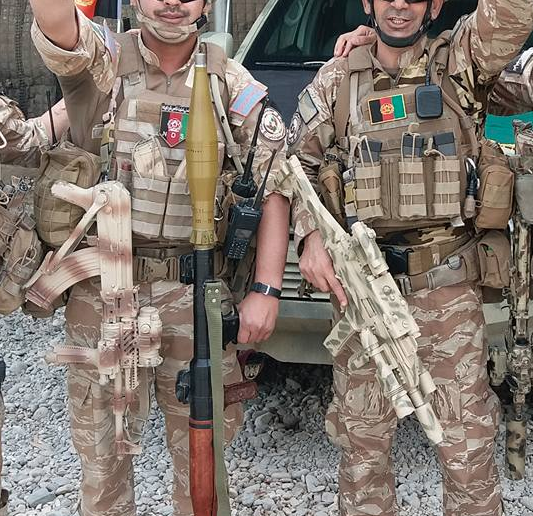
This photograph appeared very recently on Afghan social media pages, showing two ANA Commandos in desert Tiger Stripe camouflage uniforms and most interestingly a 9x19mm CZ Scorpion submachine gun with corresponding magazine pouches. The submachine gun has a number of accessories mounted to the M1913 Picatinny rails, such as the AN/PEQ-2 ATPIAL at the 12 o’clock position, what appear to be two sets of lights at the 3 o’clock and 9 o’clock positions, and what might be an Aimpoint M62 CCO red dot optic. The entire package was given a decent camouflage application that wasn’t applied to the spare magazines.

Judging from the amount of accessories, the lack of camouflaging spare magazines, and the overall presence of a submachine gun in an environment where it would not be very effective, my initial thoughts are that the ANA Commando who is armed with it, is a commander who is carrying the Scorpion as a status symbol. He isn’t actually engaging Taliban with it on combat patrols, but instead allows the weapon to signify his rank. The follow on question however, should be how it and the spare magazines got to the ANA. It would seem highly doubtful that it came through a U.S. supply line due to resources directed towards the ANA are already limited and at that are usually not afforded to such ineffective submachine guns in the battlefield that the ANA and Taliban often find themselves arranged in.
M1 Garands in Jordanian National Parade
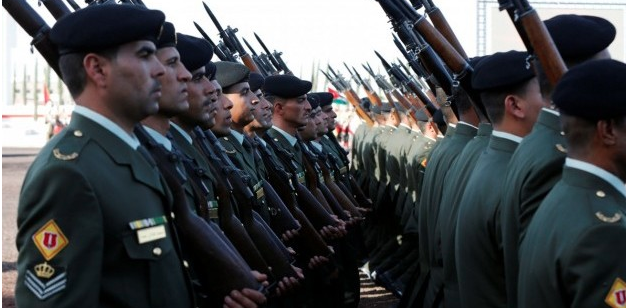
Although not recent (Summer 2016), M1 Garands were plentiful at a parade put on by the Royal Jordanian Armed Forces in honor of King Abdullah II. Among numerous small arms used in the ceremony were M1 Garands (among a contingent of SMLEs) in use by both marchers and cavalry. Obviously, these rifles have been downgraded to a ceremonial status in recent times but they are indicative of an era in which the Jordanians actually used M1s as frontline rifles. How they got there could either be through a Foreign Military Sales purchase from the United States, or it could have been surplus Greek M1s as well. Notice that most of the marchers have their M1s mounted with their bayonets as well.


This image is from Getty Images, showing Jordanian troops armed with M1s in previous years.

Kazakh Armed Forces Preparing for a Military Parade
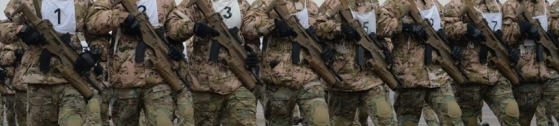

Various branches of Kazakh Armed Forces are preparing for the military parade which will be held on May 9, 2017. The parade is dedicated to the 25th anniversary of the establishment of Kazakh Armed Forces. Although there was no new firearm spotted (yet), it is still interesting to take a look at some of them in the hands of Kazakh military personnel.

In the above picture, the special forces units carry Beretta ARX 160 rifles chambered in 7.62x39mm, which also feeds from AKM pattern magazines. They also have EOTech 512 series reflex sights and GLX160 grenade launchers mounted on the rifles.


Other than mentioned firearms, the rest (majority) of the soldiers taking part in the parade are equipped with AK-74 and AK-74M rifles.


Interesting to note how the weapons from the ’70s are still capable and are the main weapons of many armies. Also, newer weapon systems find their way into the arsenals blending with existing ones. In that sense, it was a wise choice made by Beretta to not only chamber their ARX160 rifle in 7.62x39mm caliber, but also design it to take AK magazines. As you can see that configuration allows countries like Kazakistan to adopt modern rifles without any trouble concerning logistics, compatibility and interchangeability.
If anything small arms related appears during the actual parade, we’ll post about it here on Silah Report.
Did Jordanian SF Purchase SIG MCXs? Or Just King Abdullah II?
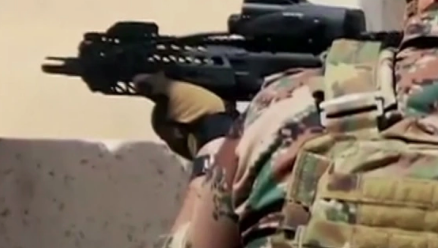
A recent video has been published by Jordanian media services showing head of state King Abdullah II in his element, conducting a training operation consisting of a dismounted sweep and clear of an enemy-held town. The King himself is a large fan of his countries Joint Special Operations Command (العمليات الخاصة المشتركة الاردنية). Between 1994 and 1999 he took command of the special operations forces, restructuring them into what they are today before taking the throne of his country in 1999, in addition to establishing KASOTC, one of the premier special forces specific training sites in the MENA region.
https://www.youtube.com/watch?v=4rExw-0ptWU&feature=youtu.be
This video shows his Highness armed with what appears to be a 12-inch barrel configuration of the Sig Sauer MCX carbine, most likely in 5.56x45mm NATO, with an Elbit Systems optical sight mounted. The remainder of his SF squad appears to have standard issue M4A1s and not MCXs as evidenced by the handguards and fixed triangular front sight posts. From the RT Arabic post-
A video released by the Jordanian Royal Court showed Jordan’s King Abdullah II, who was playing with Jordanian soldiers in a military exercise with live ammunition that appeared to be an operation against terrorists. King Abdullah appeared in full military uniform with a machine gun that appeared to be M16, in a real atmosphere of war, which received tens of thousands of views, banners and posts within an hour of publication.
أظهر فيديو نشره الديوان الملكي الأردني، العاهل الأردني الملك عبدالله الثاني وهو يشارك إلى جانب جنود أردنيين في مناورة عسكرية بالذخيرة الحية بدت أنها عملية ضد إرهابيين.
وظهر فيه الملك عبدالله بكامل عدته العسكرية مع رشاش بدا أنه M16 ، في أجواء حرب حقيقية، حظي بعشرات آلاف المشاهدات واللايكات والمشاركات خلال ساعة من نشره.

This photograph shows one of the members of the SF team with a standard issue M4A1.

The entire production appears to have been a propaganda stunt to raise support for the Kingdom by portraying the King in a positive light. Similar to earlier stunts where the King was pictured flying bombers into Syria when a Jordanian pilot was burned alive by the so-called Islamic State. The MCX rifle, however, is most likely not a part of the propaganda because the overwhelming majority of viewers watching the video clip probably will have no clue what the Sig MCX even is. The carbine could be a personal purchase or favorite of the King’s, or it could be something more serious, such as one of several T&E rifles ordered by Jordan, or even the results of a legitimate order. If we want to stretch it, there could also be a possibility that the MCXs could be in .300 BLK as well.
As per Wikipedia, the King actually has an interesting military career, even serving in the British Army-
He began his military career at Royal Military Academy Sandhurst in 1980, while he was a training officer in the Jordanian Armed Forces.[8] After Sandhurst, Abdullah was commissioned as a second lieutenant in the British Army[4] and served a year in Britain and West Germany as a troop commander in the 13th/18th Royal Hussars.[6]Abdullah was admitted to Pembroke College in 1982, where he completed a one-year special-studies course in Middle Eastern affairs.[4] He joined the Royal Jordanian Army on his return home, serving as first lieutenant and then as platoon commander and assistant commander of a company in the 40th Armored Brigade.[4] Abdullah took a free-fall parachuting course in Jordan,[9] and in 1985 he took the Armored Officer’s Advanced Course at Fort Knox.[4] He became commander of a tank company in the 91st Armored Brigade, with the rank of captain.[4]Abdullah also served with the Royal Jordanian Air Force‘s anti-tank helicopter wing, where he was trained to fly Cobra attack helicopters.[9]The prince then attended the Edmund A. Walsh School of Foreign Service at Georgetown University in Washington, D.C. in 1987, undertaking advanced study and research in international affairs.[4] He returned home to serve as assistant commander of the 17th Royal Tank Battalion in 1989, later being promoted to major.[4]Abdullah attended a staff course at the British Staff College in 1990,[9] and served the following year in the Office of the Inspector General of the Jordanian Armed Forces as the Armored Corps representative.[9] He commanded a battalion in the 2nd Armored Cavalry Regiment in 1992 and was promoted to colonel the following year, commanding the 40th Brigade.[4]In 1994 Abdullah assumed command of Jordan’s Special Forces and other elite units as brigadier general, restructuring them into the Joint Special Operations Command two years later.[9] He became a major general, attended a course in defense resources management at the American Naval Postgraduate School[9] and commanded an elite special-forces manhunt in the pursuit of outlaws in 1998.[10] The operation reportedly ended successfully, with his name chanted on the streets of Amman.[10]