Silah Report Has a New Look!

Silah Report recently undertook a massive transformation, moving servers, changing appearances, working out the new kinks. Because this website is personally run, all this had to take place between actual jobs and other commitments. But we hope you like the new appearance, it certainly is much more professional than the previous one.

We will also update the country database. Originally we intended the country database to be an all encompassing snapshot at the small arms history within a particular country. Although ideal in theory, in practice we found out that it was far too much work. Instead, what we want to do now is to maintain the individual country pages, but ONLY concentrate on small arms exported/imported in large quantities into a country, and small arms produced domestically, either under license or designed indigenously. Essentially we want to recreate what World.Guns.Ru, which is fantastically run by Maxim Popenker, but centered around small arms from the MENA and Central Asian region.

The goal of this database is to allow researchers and future writers to be able to reference back to it, so they can historically piece together how a particular small arm came into a country, or where it might have been bought from, and especially in what time period.

Analysis of Taliban Firing Positions in OEF

Due to the efforts of ISAF forces during Operation Enduring Freedom, Taliban fighters had to change their tactics constantly to stay tactically ahead of coalition efforts. Because of the reliance on fire support assets and modern armament that much of ISAF could afford, the Taliban in Helmand and Kandahar provinces couldn’t sustain a protracted fight as they could against ANA or AUP positions. Thus the insurgent force had to adapt and overcome. One of the ways in which they employed small arms against ISAF forces was through their usage of compounds and firing positions. Being in Helmand or Kandahar, firing from an open position or fields is almost certainly suicide against ISAF forces because of the lack of egress routes and being cut down. Thus, many Taliban fighters adopted the technique of utilizing “murder holes” as firing positions from compounds. Most of these compounds were taken over from the families that owned them, often threatening them with death if they spoke to coalition forces about the compound’s usage.

Compound/housing structures in rural southern Afghanistan have a number of advantages for maneuver insurgent warfare. Because the walls are made from mud, they can have holes busted through them to use as firing ports, but at the same time can be extremely resistant to incoming rounds, even up to .50 BMG. These compound walls can be anywhere from six feet to twelve feet in height and easily conceal the numerous motorcycles that the Taliban used. Motorcycles are essential for the kind of “shoot n’ scoot”maneuver warfare because of the ease of transportation and the possibility of swiftly getting away from lumbering  MRAPs and MAT-Vs along twisting narrow roads. In addition, a single PKM machine gun team could be concealed and broken up among three or five motorcycle driving Talibs. One carrying the receiver, another the barrel, another the ammunition. This way, all three could move to a new firing location discreetly, and most importantly separately.

The Taliban’s worst threat was being fixed in place and destroyed. The force knew that it could not sustain a long drawn out, small arms fight even against a single ISAF patrol. Once their position has become known, the key to surviving a protracted fight is to quickly pick up, mount up, and push to another firing position to further engage the patrol, preferably from a completely different angle than the first one. The problems thus presented to the ISAF patrol were twofold. One the one hand, it would be very difficult to determine the source of the fire, especially if it was from a PKM beyond 400-600 meters. And second, even if the Taliban location was found and positive identification was made, the patrol would have to maneuver around to get into a position to return accurate rifle and light machine gun fire, by which time the PKM position would already be broken down, and repositioned at a completely different angle to the patrol. This entire scenario is also not even taking into account the IED threat that complex ambushes would often be initiated with, thereby adding another layer of complexity to the mix of that ISAF patrol maneuvering.

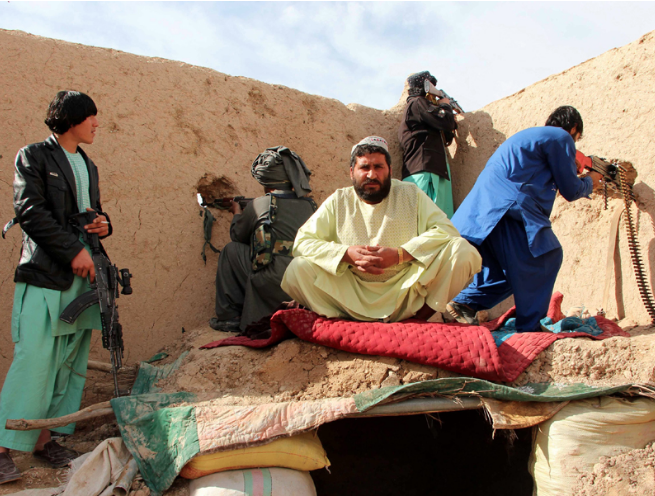
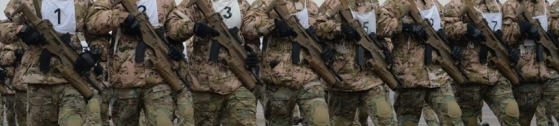
Firing positions themselves are very well thought out. As an example in the title photograph, typically Talib fighters will use a pre-existing “murder hole” or they will create one themselves as the other photograph shows. Using blankets, they will place them underneath the PKM, and then on the base of the murder hole as well. This way, the ground blanket will catch all the spent shells, and the murder hole blanket will prevent the PKM from leaving black residue on the caked mud. When the MG team leaves the position, all they have to do is wrap up the blanket with shells in it, then use the murder hole blanket to conceal the PKM parts in it and the firing position will appear to have been relatively unoccupied even if an ISAF patrol were to literally get to it after a firefight.

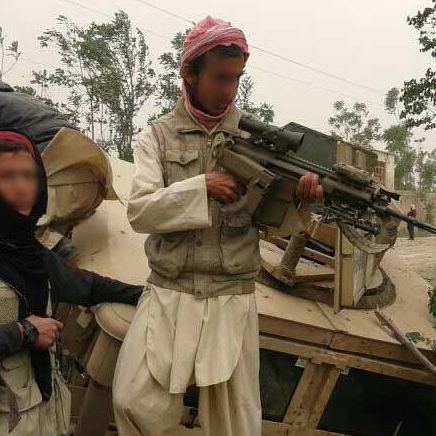
And to conclude this analysis, this a Talib fighter wearing a Marine Corps woodland digital utility jacket!

Note- The title photograph of the firing position is actually of Government ALP fighters, and not Taliban fighters. This photograph was used because it does display what the TTPs that the Taliban utilize. 
Trijicon RCO Mounted Directly to Taliban AKM

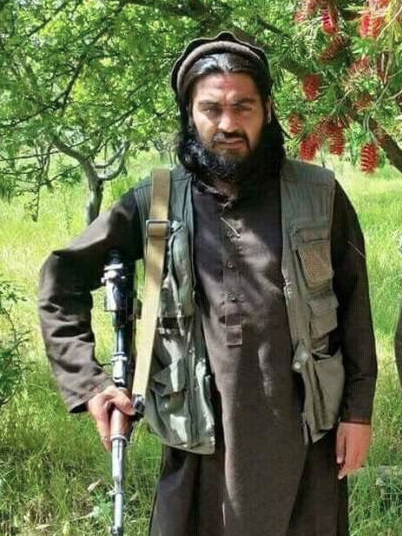
Mirwais Afghan published this on his Twitter feed earlier, of the Taliban deputy district chief for the Chaperhar district of Nangarhar province in eastern Afghanistan. He was recently killed by a U.S. airstrike.  His AKM features a Trijicon RCO with what appears to be directly mounted to the receiver cover of the rifle, possibly via a rudimentary method of welding or otherwise non-standard mounting procedure.

Of course, if this is the case, accuracy will most likely suffer greatly because of the severe vibrations of the receiver cover during the course of fire. Maintaining zero will be next to impossible. But was a status piece for a deputy district chief, it will certainly get the point across.

CZ Scorpion in use by Afghan Commandos

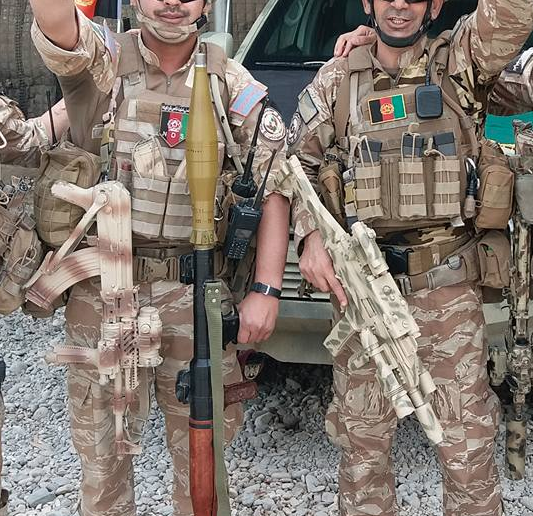
This photograph appeared very recently on Afghan social media pages, showing two ANA Commandos in desert Tiger Stripe camouflage uniforms and most interestingly a 9x19mm CZ Scorpion submachine gun with corresponding magazine pouches. The submachine gun has a number of accessories mounted to the M1913 Picatinny rails, such as the AN/PEQ-2 ATPIAL at the 12 o’clock position, what appear to be two sets of lights at the 3 o’clock and 9 o’clock positions, and what might be an Aimpoint M62 CCO red dot optic. The entire package was given a decent camouflage application that wasn’t applied to the spare magazines.

Judging from the amount of accessories, the lack of camouflaging spare magazines, and the overall presence of a submachine gun in an environment where it would not be very effective, my initial thoughts are that the ANA Commando who is armed with it, is a commander who is carrying the Scorpion as a status symbol. He isn’t actually engaging Taliban with it on combat patrols, but instead allows the weapon to signify his rank. The follow on question however, should be how it and the spare magazines got to the ANA. It would seem highly doubtful that it came through a U.S. supply line due to resources directed towards the ANA are already limited and at that are usually not afforded to such ineffective submachine guns in the battlefield that the ANA and Taliban often find themselves arranged in.

Commander Shafi’s AKSU

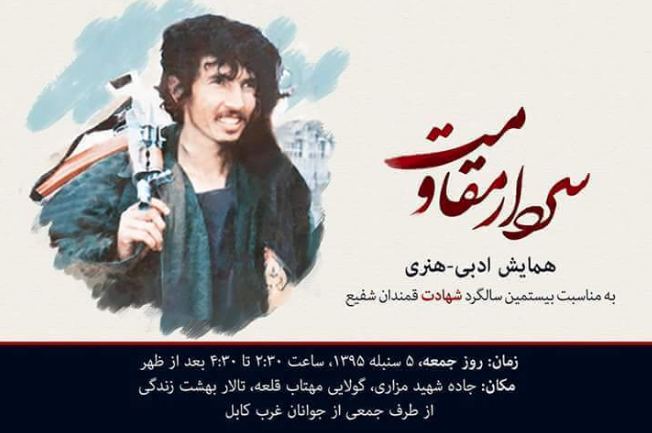
Earlier we covered the significance of the AKSU in the hands of Rashid Dustom’s security detail, and especially with one of his favored guards. In this example, we have another case of the AKSU being utilized as a status symbol. These photographs are a memorial to Hazara Commander Shafi who was commemorated and memorialized between 2:30 and 4:30 in the afternoon, Friday, Sombole 5 1395 After Hijra (subsequently after Jummah Prayer that day as well). This would be August 26, 2016 in the Gregorian year. The photo above is advertising that the venue would be in West Kabul along an address on Martyer’s Road. The occasion is that it is the 20 year anniversary of his death in what would appear to be 1996. Very little information is available on the English internet but from the date of his death in 1996, of the year of the Taliban taking over Kabul, this commander was possibly killed while fighting the Taliban. Thus, in a post-OEF setting, it would appear to make sense that Hazaras would be celebrating the life of a famous Hazara who was fighting the ideologically same Islamic Emirate of Afghanistan that exists today.

From the original Dari-

به مناسبت بیستمین سالگرد شهادت

زمان: روز جمعه، ۵ سنبله ۱۳۹۵، ساعت ۲:۳۰ تا ۴:۳۰ بعد از ظهر

مکان: جاده شهید مزاری، گولایی مهتاب قلعه، تالار بهشت زندگی از طرف جمعی از جوانان غرب کابل

Similar with Dustom and Osama bin Laden, the symbolism of the AKSU (note especially the 45 round magazine) with this commander is especially evident through the photograph chosen to represent his life at an anniversary of his death. There might be multiple photographs taken of him but yet this one, with an AKSU was chosen. We don’t know when this was taken, but we are taking a chance that it might be after the Soviet withdraw due to the fact that many of the major players fighting each other in the 1990s were lower level commanders in the 1980s with the exception of such examples of Massoud and Hekmatyar of course. Note that this commander could have just had easily carried an AKMS that fits a similar profile of the AKSU but he didn’t.


Kazakh Armed Forces Preparing for a Military Parade

Kazakhstan Army Parade 660x340.jpg

Various branches of Kazakh Armed Forces are preparing for the military parade which will be held on May 9, 2017. The parade is dedicated to the 25th anniversary of the establishment of Kazakh Armed Forces. Although there was no new firearm spotted (yet), it is still interesting to take a look at some of them in the hands of Kazakh military personnel.

Kazakhstan Army Parade.jpg

In the above picture, the special forces units carry Beretta ARX 160 rifles chambered in 7.62x39mm, which also feeds from AKM pattern magazines. They also have EOTech 512 series reflex sights and GLX160 grenade launchers mounted on the rifles.

Kazakhstan Army Parade1.jpg
On this picture, you can see the soldiers (possibly also special forces) with accessorized AK-74 rifles.


Kazakhstan Army Parade 2.jpg
Female soldiers with AKS-74U also known as “Krinkov” rifles.
Kazakhstan Army Parade 3.jpg
As in many post-Soviet countries, SKS rifles are used for the ceremonial roles in the parades and other events.
Kazakhstan Army Parade 4.jpg
Military police personnel armed with pump-action shotguns.

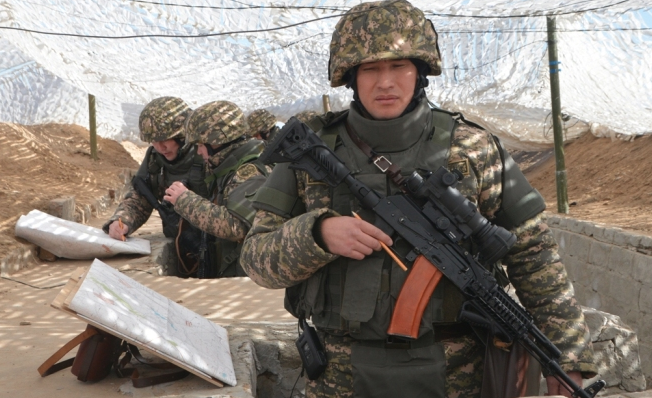
Other than mentioned firearms, the rest (majority) of the soldiers taking part in the parade are equipped with AK-74 and AK-74M rifles.

Kazakhstan Army Parade 5 (1).jpg

Kazakhstan Army Parade 5 (2).jpg

Kazakhstan Army Parade 5 (3).jpg

Kazakhstan Army Parade 5 (4).jpg

Kazakhstan Army Parade 5 (6).jpg

Kazakhstan Army Parade 5 (7).jpg

Interesting to note how the weapons from the ’70s are still capable and are the main weapons of many armies. Also, newer weapon systems find their way into the arsenals blending with existing ones. In that sense, it was a wise choice made by Beretta to not only chamber their ARX160 rifle in 7.62x39mm caliber, but also design it to take AK magazines. As you can see that configuration allows countries like Kazakistan to adopt modern rifles without any trouble concerning logistics, compatibility and interchangeability.

If anything small arms related appears during the actual parade, we’ll post about it here on Silah Report.

FNH SCAR-Hs among the Taliban

Although very few in number, several news sources have documented the usage of 7.62x51mm SCAR-Heavy rifles in use by the Taliban in Afghanistan. The most recent documentation we have in the summer of 2016 covered by Lost Weapons on Twitter, in addition to the summer of 2015 as covered by Nathaniel F. on The Firearm Blog. There is a possibility that both of these SCAR-Hs are the same rifle over the course of two years, but we can’t exclude the fact that there may be more. How it got into the hands of the Taliban is possibly by way of the Afghan Commandos who are primarily armed with M4A1s but might have been supplied a SCAR-H by their U.S. Army advisors.

e460abf1-c671-4407-be75-7198403d12eaCy0LqQJVEAIXWu7-1

Introducing our Country Database with Armenia

Although reporting recent developments and writing historical posts is the primary function of the Silah Report, we are now introducing a new feature to the website. This is our Country Database that you see in the upper left-hand corner. The intent of the database is to be able to learn as much general information about small arms usage, manufacture, and trade within any particular country within the Middle East & North Africa and Central Asian regions since 1916. Although right now our database isn’t populated, we hope to have most of it online within the next year or so. It certainly is a stretch goal and it will be continually improved upon and changed as better researchers and information is added to the pages.

Right now we have our first country profile posted and that is Armenia, written by our very own Hrachya! Please give it a look to learn some more about the current and historical small arms situation in Armenia.

AK-74s of Kazakhstan Army’s Military Exercises

Kazakh AKs 660x405.jpg

Ministry of Defense of Kazakhstan has recently posted news releases on their website concerning military exercises of high-ranking officers.

Kazakh AKs.jpg

Particularly, battalion commanders of mechanized infantry, paratrooper and marine regiments took part in mentioned exercises. The purpose of that event was to upgrade the qualification of the officers by a number of tactical and strategic classes, defensive and offensive scenario studies, as well as familiarization with new weapon systems.

img_3427_12691.jpg

During these exercises, the officers were carrying AK-74 assault rifles, which had some interesting upgrades and mods on them. Let’s take a closer look at each of them.

The railed dust cover, handguard and gas tube cover are most likely made by Russian company Zenit. The dust cover is Zenit B-33 (Зенит Б-33), the handguard is a Zenit B-10M (Б-10М) and the railed gas tube cover is a Zenit B-19 (Б-19). Here is a picture of all three accessories:

Зенит 1.jpg


The stock adapter is probably made by Israeli company FAB Defense. It is the model M4-AK P or a similar one. Some of these stock adapters differ only by the material, which is almost impossible to distinguish by only a visual reference. In any case, it is a conversion stock which allows mounting AR-15/ M-4 rifle stocks on the AK platform. It also has a built-in side folding mechanism. Here is the image of M4-AK P model:

! Kazakh stock FAB.jpg

The buttstock itself is also made by FAB Defense and it is their GLR-16 CP model with an adjustable cheek riser.

704-glr-16-cp-3d-png-Sun-Jan-6-15-34-22.jpg

The angled foregrip mounted on the handguard has the distinct shape of another FAB Defense product – PTK.

699-ptk-png-Sun-Nov-18-13-21-16.jpg


The scope is unidentified, but it is presumably a Russian made one. It is a night vision or thermal scope judging from the looks. Possibly, it is a newer version of NSPU scope. We’ll update this post as soon as we find out the exact model of the scope.

Similar exercises of squad leaders were held too and it is interesting to note that squad leaders were equipped with AK-74 rifles in stock configuration. Judging from that, the upgrades for AK-74s are available for high ranking officers only. Here is a picture of squad leader sergeants firing their AK-74s:

img_3526_13066.jpg

FYI: here is the small arms’ list of Armed Forces of Kazakhstan (from Wikipedia):

Small Arms

  • 9×18mm Makarov PM Standard issue pistol for armed forces.
  • 9×18mm PP-90M1 Submachine gun, used by special forces.
  • 5.45×39mm AK-74 Standard issue rifle of Kazakh military.
  • 5.45×39mm RPK-74
  • 7.62×39mm AKM Reserve units
  • 7.62×54mmR SVD Dragunov sniper rifle
  • 7.62×54mmR PKM machine gun
  • 7.62×54mmR PKP Pecheneg machine gun, used by special forces.
  • 7.62×39mm ARX-160 Assault rifle, used by special forces
  • 12.7mm NSV machine gun

Type 1, 2 Kalashnikovs Spotted

This photograph recently appeared on the social media account of a Kalashnikov aficionado, showing both a Type 1 and Type 2 Ak47 (not AKM) featured in the photograph. The Type 1 and Type 2 are exceedingly rare today, having been taken over by the much more produced AKM and associated variants across the world.


This was taken in Helmand province, Afghanistan by a contractor based there, probably in the Kajaki district. His testimony to this photograph is as follows-

I took that pic in Helmand Province, Afghanistan while I was there between 2012-2014. We had 7 or 8 Type I’s, 6 of which were issued to local national security force members we were mentoring. There were maybe 5-6 Type II’s including one that I estimated had less than 500 rounds through it (the underside of the trigger and disconnector still had cosmoline on it, and the auto sear and other internal parts still showed 99% blued finish with ZERO signs of wear.

The Type 1 is easily recognizable by the curved trunnion, while the Type 2 is identified by the square depression above the magazine, on the receiver. The Type II is a stamped receiver, while the AKM, Type I and Hungarian AMD65 above them are stamped.


Much Thanks to Buck T. for the input on this post!