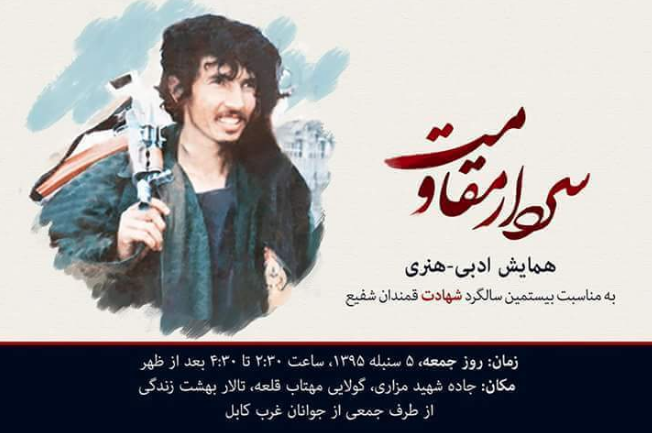
Earlier we covered the significance of the AKSU in the hands of Rashid Dustom’s security detail, and especially with one of his favored guards. In this example, we have another case of the AKSU being utilized as a status symbol. These photographs are a memorial to Hazara Commander Shafi who was commemorated and memorialized between 2:30 and 4:30 in the afternoon, Friday, Sombole 5 1395 After Hijra (subsequently after Jummah Prayer that day as well). This would be August 26, 2016 in the Gregorian year. The photo above is advertising that the venue would be in West Kabul along an address on Martyer’s Road. The occasion is that it is the 20 year anniversary of his death in what would appear to be 1996. Very little information is available on the English internet but from the date of his death in 1996, of the year of the Taliban taking over Kabul, this commander was possibly killed while fighting the Taliban. Thus, in a post-OEF setting, it would appear to make sense that Hazaras would be celebrating the life of a famous Hazara who was fighting the ideologically same Islamic Emirate of Afghanistan that exists today.
From the original Dari-
به مناسبت بیستمین سالگرد شهادت
زمان: روز جمعه، ۵ سنبله ۱۳۹۵، ساعت ۲:۳۰ تا ۴:۳۰ بعد از ظهر
مکان: جاده شهید مزاری، گولایی مهتاب قلعه، تالار بهشت زندگی از طرف جمعی از جوانان غرب کابل
Similar with Dustom and Osama bin Laden, the symbolism of the AKSU (note especially the 45 round magazine) with this commander is especially evident through the photograph chosen to represent his life at an anniversary of his death. There might be multiple photographs taken of him but yet this one, with an AKSU was chosen. We don’t know when this was taken, but we are taking a chance that it might be after the Soviet withdraw due to the fact that many of the major players fighting each other in the 1990s were lower level commanders in the 1980s with the exception of such examples of Massoud and Hekmatyar of course. Note that this commander could have just had easily carried an AKMS that fits a similar profile of the AKSU but he didn’t.