More Kalashnikov Nomenclature Charts In Arabic

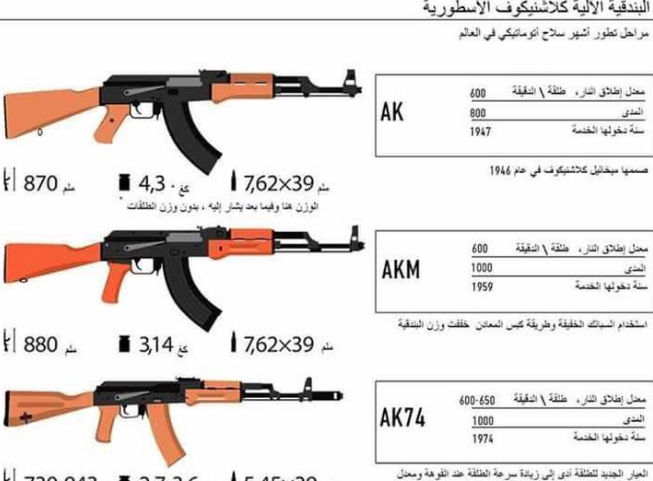
Earlier on Silah Report we showcased a number of Kalashnikov and small arms nomenclature and terminology charts in use by Iraqi small arms traders and enthusiasts. Since then we’ve gathered some more material, this time much more Kalashnikov centric. These charts continue to show perceptions of the rifles in use throughout the region and what is available. Although we have similar charts in the United States the unfortunate reality is that many of those charts are tailored to the Kalashnikov civilian market. By observing what Iraqis, Syrians, or Yemenis are concerned with identifying, we can gain a better perspective on what rifles are in the region that people want to know about.


Airsoft Accessorized to the Max!

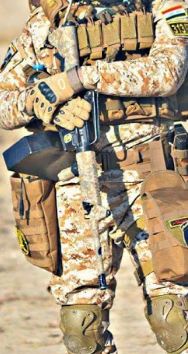
This photograph has been on the internet for awhile and appears to be depicting an Iraqi with an odd M249 SAW drum mounted around the STANAG magazine of his Airsoft M4 carbine. We doubt that this is a functioning 200 linked belt inside the drum that is being fed into the rifle and is most likely glued or taped to the magazine that is actually inserted.

Screen Shot 2017-04-22 at 9.03.19 PM.png

From the appearance of the soldier, it doesn’t look like a combatant, possibly not even an enlisted soldier in the Iraqi Army. Rather this might be an enthusiast that is “dressing up” the part. Although his equipment bears some resemblance to gear issued within the Iraqi Army, he is overloaded with equipment that isn’t standard issue. The rifle itself appears to be a U.S. civilian legal 16.5 inch barrel AR15 with a permanently attached carrying handle, he has what looks like Kalashnikov magazines in his pouches, his visor and helmet don’t look to be ballistically rated at all, and it looks like he has mounted a Kalashnikov bayonet over his right shoulder as well. Essentially, nothing matches!


UPDATE

Due to an ever watchful reader, we were able to identify several of the products pictured. The rifle is indeed an airsoft product, with an AEG magazine and an AWT Armor Warrior Tactical G4 Protection Helmet. Much thanks to Irfan!

Did Jordanian SF Purchase SIG MCXs? Or Just King Abdullah II?

A recent video has been published by Jordanian media services showing head of state King Abdullah II in his element, conducting a training operation consisting of a dismounted sweep and clear of an enemy-held town. The King himself is a large fan of his countries Joint Special Operations Command (العمليات الخاصة المشتركة الاردنية). Between 1994 and 1999 he took command of the special operations forces, restructuring them into what they are today before taking the throne of his country in 1999, in addition to establishing KASOTC, one of the premier special forces specific training sites in the MENA region.

https://www.youtube.com/watch?v=4rExw-0ptWU&feature=youtu.be

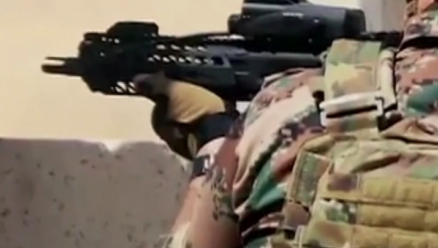
This video shows his Highness armed with what appears to be a 12-inch barrel configuration of the Sig Sauer MCX carbine, most likely in 5.56x45mm NATO, with an Elbit Systems optical sight mounted. The remainder of his SF squad appears to have standard issue M4A1s and not MCXs as evidenced by the handguards and fixed triangular front sight posts. From the RT Arabic post-

A video released by the Jordanian Royal Court showed Jordan’s King Abdullah II, who was playing with Jordanian soldiers in a military exercise with live ammunition that appeared to be an operation against terrorists. King Abdullah appeared in full military uniform with a machine gun that appeared to be M16, in a real atmosphere of war, which received tens of thousands of views, banners and posts within an hour of publication.

أظهر فيديو نشره الديوان الملكي الأردني، العاهل الأردني الملك عبدالله الثاني وهو يشارك إلى جانب جنود أردنيين في مناورة عسكرية بالذخيرة الحية بدت أنها عملية ضد إرهابيين.

وظهر فيه الملك عبدالله بكامل عدته العسكرية مع رشاش بدا أنه M16 ، في أجواء حرب حقيقية، حظي بعشرات آلاف المشاهدات واللايكات والمشاركات خلال ساعة من نشره.


This photograph shows one of the members of the SF team with a standard issue M4A1.

The entire production appears to have been a propaganda stunt to raise support for the Kingdom by portraying the King in a positive light. Similar to earlier stunts where the King was pictured flying bombers into Syria when a Jordanian pilot was burned alive by the so-called Islamic State. The MCX rifle, however, is most likely not a part of the propaganda because the overwhelming majority of viewers watching the video clip probably will have no clue what the Sig MCX even is. The carbine could be a personal purchase or favorite of the King’s, or it could be something more serious, such as one of several T&E rifles ordered by Jordan, or even the results of a legitimate order. If we want to stretch it, there could also be a possibility that the MCXs could be in .300 BLK as well.

As per Wikipedia, the King actually has an interesting military career, even serving in the British Army-

He began his military career at Royal Military Academy Sandhurst in 1980, while he was a training officer in the Jordanian Armed Forces.[8] After Sandhurst, Abdullah was commissioned as a second lieutenant in the British Army[4] and served a year in Britain and West Germany as a troop commander in the 13th/18th Royal Hussars.[6]Abdullah was admitted to Pembroke College in 1982, where he completed a one-year special-studies course in Middle Eastern affairs.[4] He joined the Royal Jordanian Army on his return home, serving as first lieutenant and then as platoon commander and assistant commander of a company in the 40th Armored Brigade.[4] Abdullah took a free-fall parachuting course in Jordan,[9] and in 1985 he took the Armored Officer’s Advanced Course at Fort Knox.[4] He became commander of a tank company in the 91st Armored Brigade, with the rank of captain.[4]Abdullah also served with the Royal Jordanian Air Force‘s anti-tank helicopter wing, where he was trained to fly Cobra attack helicopters.[9]The prince then attended the Edmund A. Walsh School of Foreign Service at Georgetown University in Washington, D.C. in 1987, undertaking advanced study and research in international affairs.[4] He returned home to serve as assistant commander of the 17th Royal Tank Battalion in 1989, later being promoted to major.[4]Abdullah attended a staff course at the British Staff College in 1990,[9] and served the following year in the Office of the Inspector General of the Jordanian Armed Forces as the Armored Corps representative.[9] He commanded a battalion in the 2nd Armored Cavalry Regiment in 1992 and was promoted to colonel the following year, commanding the 40th Brigade.[4]In 1994 Abdullah assumed command of Jordan’s Special Forces and other elite units as brigadier general, restructuring them into the Joint Special Operations Command two years later.[9] He became a major general, attended a course in defense resources management at the American Naval Postgraduate School[9] and commanded an elite special-forces manhunt in the pursuit of outlaws in 1998.[10] The operation reportedly ended successfully, with his name chanted on the streets of Amman.[10]


FNH SCAR-Hs among the Taliban

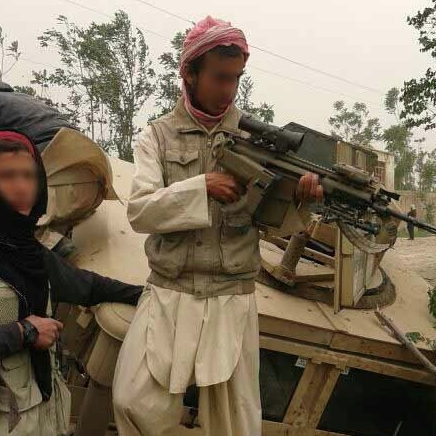
Although very few in number, several news sources have documented the usage of 7.62x51mm SCAR-Heavy rifles in use by the Taliban in Afghanistan. The most recent documentation we have in the summer of 2016 covered by Lost Weapons on Twitter, in addition to the summer of 2015 as covered by Nathaniel F. on The Firearm Blog. There is a possibility that both of these SCAR-Hs are the same rifle over the course of two years, but we can’t exclude the fact that there may be more. How it got into the hands of the Taliban is possibly by way of the Afghan Commandos who are primarily armed with M4A1s but might have been supplied a SCAR-H by their U.S. Army advisors.

e460abf1-c671-4407-be75-7198403d12eaCy0LqQJVEAIXWu7-1

How Ruger P95s and Sig P2022s Got to Iraq

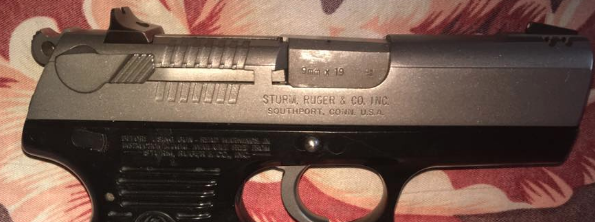
For a while now we’ve seen a number of Ruger 9x19mm NATO P95 handguns flourishing among the social media groups within Iraq. This isn’t a recent phenomena but still, the question remains over where they originated from. Daniel Watters, a noted small arms historian has provided us with some excellent context on the issue, even detailing the specific contracts that pushed 5,000 Ruger P95s, and 5,000 Sig Sauer SP2022s into Iraq.

Back in December 2004, the US Army’s Tank-Automotive & Armament Command (TACOM) posted solicitation W52H09-05-R-0067. They basically wanted 10,000 9x19mm pistols in a hurry, and were willing to place multiple contracts to fill it. Vendors were allowed to bid for as few as 100 pistols up to the full total of 10,000. The most telling portion of the solicitation was that they requested a price for the pistols to be shipped directly to Baghdad.

Before the end of the month. Ruger received contract W52H09-05-C-0058 for 5,000 P95, and SIG-Sauer received contract W52H09-05-C-0059 for 5,000 SP2022.

When outsiders saw the name Tank-Automotive & Armament Command, they assumed the pistols must be for tankers. Nothing could be further from the truth. A subordinate command of the Army Materiel Command, TACOM-Rock Island was responsible for all Army small arms procurement. It also handled orders from other US military service branches, and managed foreign military sales (FMS).
It turns out that the rush order was meant to arm Iraqi security forces ahead of the country’s first post-Saddam parliamentary elections in January 2005. Confirmation can be found in the government report “Iraqi Security Forces: Weapons Provided by the U.S. Department of Defense Using the Iraq Relief and Reconstruction Fund.

The report listed can be accessed here and lists the 5,000 P95s as being purchased for $1,271,700, and the 5,000 SP2022s being purchased for $1,756,550, both on December 12 2004. Both of these appeared to have been designated for the Ministery of Interior and the Ministery of Defense although it doesn’t specify which. We should also note that these 10,000 handguns were only a third of the 38,053 “Generic 9mm Pistols” that were on contract. What those other thirty-something thousand odd handguns were would have to take some researching.


Although very similar in appearance to a Sig Sauer handgun, our sources tell us that this is in fact a blank firing copy.

Arabic Guides to Kalashnikov and Ammunition Nomenclature

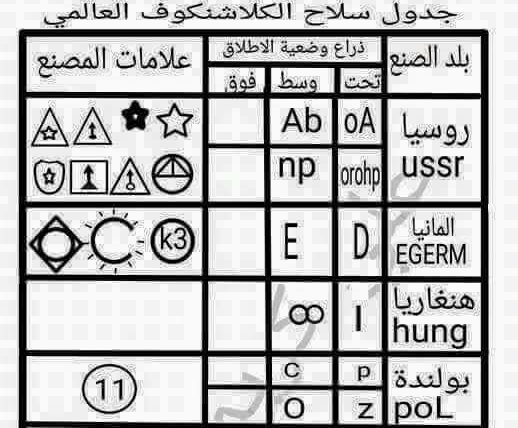
Much like in the United States Kalashnikov collector or enthusiast market, Iraqi Kalashnikov owners understand the differences in quality between AKs from different countries. The European ones take precedence over Chinese, and Russian variants when original remain supreme and commandeer a premium when it comes to cost.


These sets of markings are designating the country of origin stamps in addition to examples of serial number blocks.

While still maintaining the country origin markings, this chart explicitly shows the selector markings as well. Understanding and making sure all the markings add up is very important if a seller is to ensure the Kalashnikov he is purchasing is indeed genuine.

In addition to country of origin markings, these are guides in Arabic to ammunition markings and nomenclature. With the Iraqi flag imprinted in the graphics, the photographs appear to have been edited and translated by an Iraqi enthusiast.

Israeli “Hitchhiker” Modified M16 Magazine

(SR welcomes our first guest author, Yoel M. who will be discussing an interesting historical phenomena when it comes to the Israeli Defense Forces)

To understand the root of the IDF “hitchhiker’s magazine” we must begin with some context. Israel is a

small nation geographically, from North to South the country is only 263 miles (420Km). This same geography

that dictates military strategic plans also dictates military leave arrangements.

Because the front line are based just an hours drive from population centers, this enabled the IDF to release

soldiers for weekend vacations to return home. Not all the bases have good public

transportation options and as a result soldiers use to hitchhike on their way home and back

to base.

In the late 1980s and early 1990s, Palestinian fighters would take advantage of this situation and start to

kidnap soldiers to bargain for their comrades at Israeli prisons. These fighters

pretending to be Israelis would offer soldiers a ride. The tactic was usually to

arriving with no passengers to bus stations and offer a soldier a ride, the soldier would seat in

the front seat next to the driver, a few minutes down road the driver would stop and take in another

hitchhiker, this time the driver’s companion would sit behind the soldier and when the time

is right to attack and strangle the soldier from the rear.

IDF orders at that times were that soldiers are prohibited from moving with magazine inside the

rifle on their way to or from home. Most Israeli drivers having been IDF veterans themselves

usually also demanded the soldier to remove the magazine and cycle the

gun manually to check there is no round in the chamber before allowing the soldier in.

To counter the threat of kidnapping soldiers and against military orders, some troops would retrofit their

M-16 STANG magazines. They would saw off the magazine box and spring and weld the magazine

bottom floor plate to the new shorter box forming a magazine short enough to be totally

concealed inside the M-16 magazine housing.

There is, of course, no official data regarding the capacity of those homemade devices but it

fair to assume that 10 rounds is their maximum theoretical capacity.

Extracting the magazine was also an issue as those magazines were lighter than regular

STANG and often the welds on the floor plate brushed against the magazine housing inner

walls they often won’t drop when needed. With no exposing surface to grip to

extract the “hitchhiker magazine” some soldiers chose to shorter the magazine further and

weld or rivet small knob to the floor plate for easier magazine extraction.

The way the magazine would potentially work is that the soldier would insert it into the magazine

well and simply walk with it as a seemingly unloaded rifle to avoid any military police

checks and drivers demanding that a magazine be removed before entering the vehicle. If

the driver demands to manually cycle the bolt, the soldier will pull the charging handle while

pretending to verify that the chamber is empty only to load a round into the chamber from

the magazine.

Either way, the soldier plan to enter with his rifle loaded, only to be used in case of a hijacking

attempt. Iif the soldier is right handed when he sits in the passenger seat, the rifle would lay on his lap with the

barrel pointing towards the driver. In case of strangling from the rear the soldier could

theoretically operate the gun to shoot the driver.

The main problem with these magazines was the reliability. Those homemade fabrications

often misfed rounds, stacked in the housing and would drop or break open un-

expectantly when the welding failed.

Another problem was the increase in firing accidents the magazine caused, soldiers at home or

back at base could forget there is a magazine in the gun. More dangerous is the soldier’s

young siblings that might find the seemly unloaded gun and try to play with it.

Needless to say, the IDF didn’t take kindly to its soldiers initiative or the hitchhiking for that

matter and set to prohibit both. The military police was ordered to find and confiscate

hitchhiker’s magazines and penalties of up to a month in military prison to whom it was in

possession or those who tried hitchhiking.

Simultaneously officers were instructed to release soldiers for vacation only at days and

hours when public transportation was due. Moreover the army reluctantly spent money

paying private bus companies for transporting to and from central bus stations during the weekends.

Eventually, usage of the magazine became redundant as there was no longer a threat to IDF soldiers and the practice

went away.

As for its actual combat test and evaluation the magazine was never reportedly used in any kidnapping

attempt. One potential use I found in an online forum which I can’t verify or disprove was to

insert the magazine in the gun in what called “Peaceful Patrols” in Gaze and West Bank urban areas,

as the brass had the novel idea of “Winning Hearts and Minds” by send patrols without

magazines in the guns (only in the pockets of their vests). Some soldiers realized that their lives were worth more than

any hearts and minds campaign, and thus used these “Hitchhiker Magazines” while they were patrolling, to give them a

better chance of reacting to a threat.

Sadly there is no photos of the “Hitchhiker Magazine” online, the manufacturing of it done

against IDF orders and the magazine before social media and cell phones with

cameras appeared. In the end the concealed “Hitchhikers Magazine” achieved its goal as it still

invisible from Google’s all seeing eye.

Although not an Israeli magazine modification, this commercial five round magazine would have approximated what the “Hitchhiker’s Magazine” would have looked like in the 1980s and 1990s.

“Major League Infidel” Comes Full Circle In Iraq

16649184_216451905494784_3182529706248954656_n.jpg

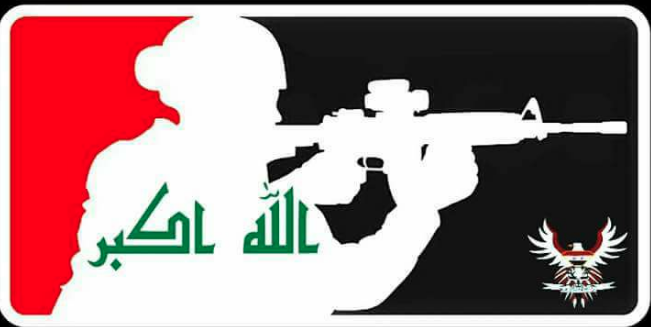
Early in the invasions of Iraq and Afghanistan, an emblem lifted from the Major League Baseball symbol was used to demonstrate the feelings of many American Soldiers and Marines deploying in support of OIF and OEF. It depicted a soldier in place of the traditional baseball hitter, against a background of red and blue, with the figure in white. Of course, the colors red, white and blue were synonymous with the American flag. The phrase “Major League Infidel” was attached at the bottom. Infidel, “Kafir”, or کافر is a popular moniker within the U.S. Military because this is the language used in propaganda videos put out by Al Qaeda, Taliban, or current Daesh groups. Soldiers and Marines hear this and take to the term as a sort of endearment as being unliked. Of course, these same Soldiers and Marines don’t realize that the word “Kafir” exists in Arabic versions of the Christian bible as used by Christian Arabs across the MENA region.


Even the extremely popular Crye Precision brand, that makes top quality camouflage clothing and patterns, has this on their website–


We created this trademarked slogan and icon to remind everyone that all “non-believers” in senseless violence are “infidels” and to celebrate the ones who actually do something about it… the Major League Infidels™

The Islamophobic rhetoric notwithstanding, the symbolism has interestingly made its way into Iraq, by way of the Iraqi ISOF forces. This time the logo is depicting the colors of the Iraqi flag; red, white, and black, with the motto found on the flag- الله اکبر, Allah Ak’bar, or translated as “God is Great”. The figure depicted is that of an Iraqi Special Operations Forces soldier with a raised Rock River Arms 14.5″ LAR-15, and Aimpoint CompM4 optic, both standard issue among ISOF forces. It is probable that the creator of this image wasn’t entirely sure of the original intent and meaning of the MLI originating from the States, but regardless he took the image and used it in a very pro-Iraqi context, which is actually anything but what the intention of the symbol was in the beginning. Thus, it has literally come full circle in the meaning, essentially changing it entirely.

In addition, it is cognisant of a much more important dynamic and that is the admiration and imitation of Iraqi and Afghan forces for U.S. forces. Copying everything from the way pouches are being set up on their plate carriers, helicopter safety lines, even attachments on their small arms to include Airsoft M203 imitations trying to replicate the look of real ones.

Below is a gathering of the original form of the meaning, to demonstrate just how clear the original intent was-

This particular logo has actually gone past the political and cultural ramifications and moved into Call of Duty. 
Homemade Anti-Materiel Rifle With Iraqi Militia

C5rKjNRWAAAvjh5.jpg

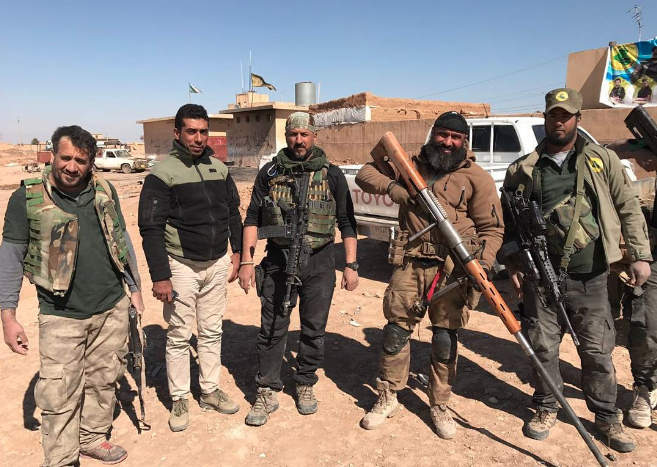
A Polish small arms magazine recently posted this to their social media page. It appears to be of a group of Iraqi militiamen from the Imam Ali Brigade, as is evidenced by the circular yellow patch with a Kalashnikov over an image of a green country profile of Iraq . The bearded militiaman is posing with a huge bolt action anti-materiel rifle. These DIY conversions had been seen multiple times during the Syrian conflict. Supposedly this gun uses either 14,5mm (from KPV or KPVT) or 23 mm (from ZU-23-2) barrel with an improvised receiver, bolt, trigger mechanism, furniture and bipod. You can also see a picatinny rail section mounted on top of the receiver for attaching a scope.

I guess they use the survived barrels from guns with damaged or destroyed mechanisms. Otherwise, it won’t be justified to take the barrel from a functional heavy machine gun or automatic cannon. Although depending on the situation it can be the case, too.

When making the new stock and forearm, the gunsmith definitely tried to make it look like an SVD/Al-Kadesiah.

Note also the other guys’ weapons: an AK, M4 Carbine and an M249 SAW LMG.

334

The Shi’a Imam Ali Brigade (Cited Source- The Observers)

The Iraqi Shiite militia known as the Imam Ali Brigades is accused of having committed multiple war crimes in the fight against the Islamic State organisation in Iraq, including summary executions and torture of captives. But its brutality isn’t the only thing fuelling the militia’s notoriety – it also has a well-oiled communications strategy.
In June 2014, Shiite leader Ayatollah Sistani made an appeal for mobilisation against the Islamic State organisation. Numerous Iraqi Shiite militias were formed after this announcement.

These new formations joined the four large, already-existing Shiite militias in Iraq: the Badr Brigade, founded in Iran in 1982; Saraya al-Salam (the “Peace Brigades”), which is directed by the radical Shiite religious cleric Moqtada al-Sadr; Asaib Ahl al-Haq (the “League of the Virtuous”); and, lastly, the Iraqi Ketaeb Hezbollah.

The Imam Ali Brigades have distinguished themselves by resorting to extreme violence. The militia, made up of combatants trained in Iran or Lebanon, has faced widening criticism since the release of a YouTube video showing men wearing the Imam Ali Brigades insignia burning a man.

WW II Small Arms in Libya

Although this these images are from a post that is several years old and on an Airsoft forum, the historical relevance is still very important to consider when examining small arms in the MENA region. These photographs came out during the massive unrest in Libya during and following the Libyan unrest otherwise known as “17 February” that overthrew long-time ruler Muammar Gaddafi. Although many of these small arms were actually used in fighting, the photographs appear to show a lull, where militia forces aren’t actually engaged but are rather conducting target practice or celebrating.

Two variants of the U.S. 1919 are shown, the first one appears to be a heavily modified 1919A4 variant, while the second one is a 1919A6. At first glance, these may appear to be 7.62x51mm NATO variants that Israel modified to use in the IDF during the 1950s and 1960s. However, a closer look at the belt of ammunition reveals the length of the rounds do appear to be .30-06 Spr and thus are most likely original manufacture 1919A4s and A6s.

libyanrebs15 libyanrebs07 libyanrebs06The photo below shows a Browning Hi Power, Sterling SMG, and a Caracano rifle in the background.
libyanrebs

The proceeding two photographs are of a Russian 7.62x54Rmm DP28 light machine gun. These might have arrived in Libya as a form of surplus support from the Soviet Union during the Cold War.

libyanrebs17
libyanrebs05

At an initial glance, this would appear to be a German 9x19mm MP40, but instead, due to the circular opening in the magazine well it is in fact, the predecessor to the MP40, the MP38.

libyanrebs10

This rifle appears to be a Mauser K98 with a broken stock that has been replaced

libyanrebs02

17 February Unrest Summary (Wikipedia)-

The first Libyan Civil War, also referred to as the Libyan Revolution[33] or 17 February Revolution,[34] was an armed conflict in 2011, in the North African country of Libya, fought between forces loyal to Colonel Muammar Gaddafi and those seeking to oust his government.[35][36] The war was preceded by protests in Zawiya on 8 August 2009, and finally ignited by protests in Benghazi beginning on Tuesday, 15 February 2011, which led to clashes with security forces that fired on the crowd.[37] The protests escalated into a rebellion that spread across the country,[38] with the forces opposing Gaddafi establishing an interim governing body, the National Transitional Council.

The United Nations Security Council passed an initial resolution on 26 February, freezing the assets of Gaddafi and his inner circle and restricting their travel, and referred the matter to the International Criminal Court for investigation.[39] In early March, Gaddafi’s forces rallied, pushed eastwards and re-took several coastal cities before reaching Benghazi. A further UN resolution authorised member states to establish and enforce a no-fly zone over Libya, and to use “all necessary measures” to prevent attacks on civilians.[40] The Gaddafi government then announced a ceasefire, but fighting continued.[41][42] Throughout the conflict, rebels rejected government offers of a ceasefire and efforts by the African Union to end the fighting because the plans set forth did not include the removal of Gaddafi.[43]