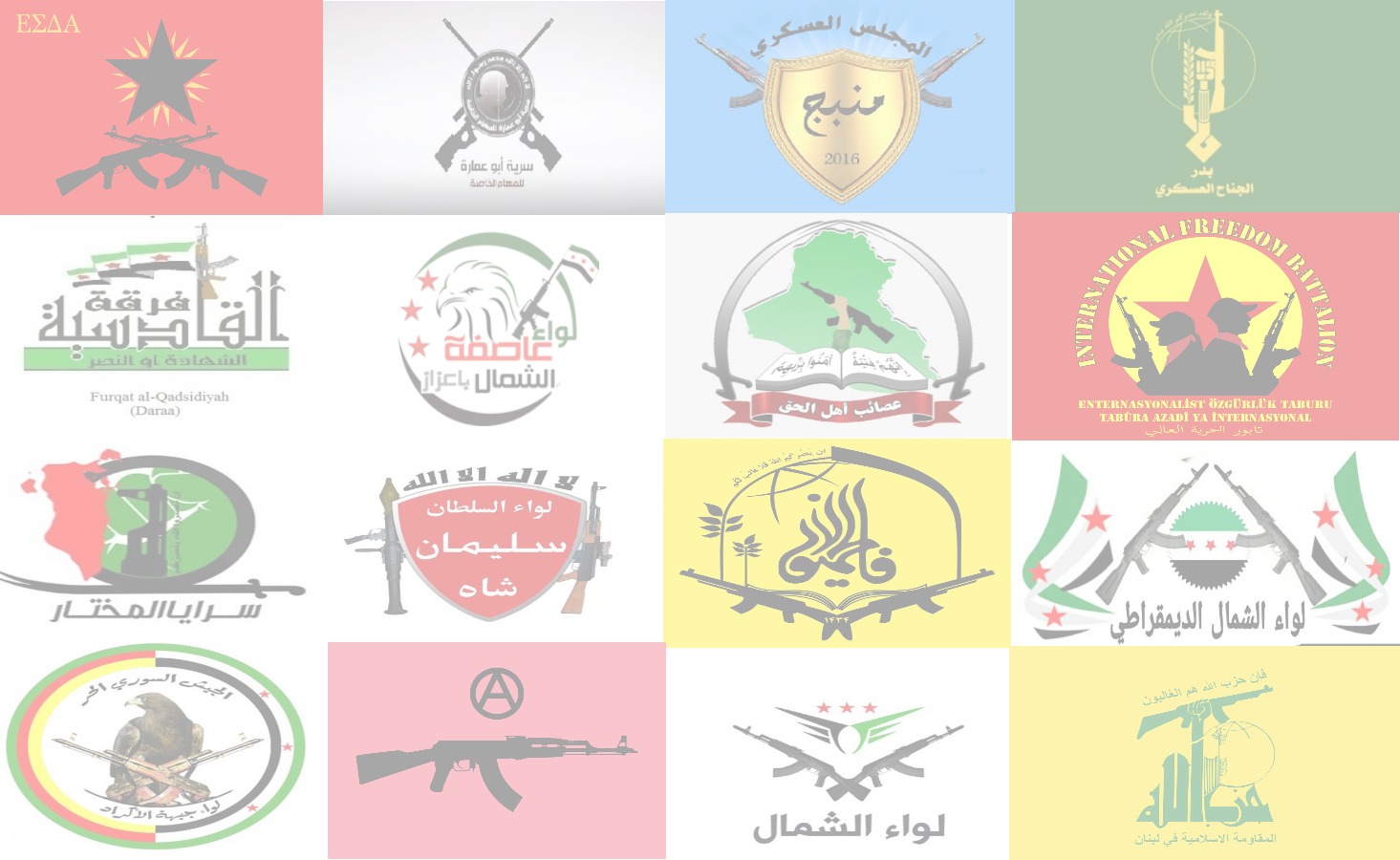
In this series we have examined Syrian armed groups from across the entire political spectrum who at one point or another during the war featured a firearm in their official crest. Our goal is to present a statistical overview of the small arms used in this military imagery and to share some interesting information I was able to deduce. You can find the first three parts of this series here, here and here. In this fourth and final part, we will make a comparative overview of all the political affiliations fighting previously focused on throughout the previous posts.
The political affiliations studied are the Syrian Opposition (48 factions featuring small arms in their crests), the Assad Regime (36 factions featuring small arms in their crests) and the SDF/Rojava (18 factions featuring small arms in their crests), giving us a total of 102 individual militant groups. Distributed across these 102 armed factions logos and iconography is a total 106 Small Arms Light Weapons (SALW) portrayed with 18 different weapon models. 67% of these 106 arms hail from the former USSR, 4.7% from Russia and 14.2% from Iran. While 12.3% are US-manufactured, 0.9% originate from the UK and 0.9% from Germany.
We learn from the chart above that the top 5 of most popular small arms being featured on the factions’ crests across all different political blocks comes down to the AK-47, the AKM, the Iranian G3A6, the M16A2 and the RPG-7, in that order. The AKM (and AKMS) and RPG-7 are widely and commonly available on the Syrian battlefield in vast numbers. The reason they appear on so many crests is more out of familiarity than association, similar to medieval coats of arms and heraldic imagery featuring a plethora of common weaponry tied to that era. As for the other three, the AK-47, G3A6 and M16A2, they aren’t nearly as common on the ground as the former two, and mainly fulfill the role of symbolic association. The sheer power and influence they exude is due to their intrinsically intertwined history with popular culture, politics and their respective nations of origin make for powerful icons conjuring a predefined image among spectators and supporters.
It is important to realize that many of these crests didn’t appear overnight but are the result of a thought process using pre-existing deep-seated social, historical and cultural symbols and images. The use of distinct color codes, specific terminology and a range of animals like the hawk, eagle, tiger and lion must be seen in this light. The use and choice of small arms models on crests comes down to the same thing, despite being less representative of ideology than the aforementioned elements. The distribution of said SALW isn’t equal across the entire political spectrum of the Syrian Civil War, however. The graph below represents this distribution of relevant small arms models among all researched affiliations.
In a very statistical representation of the survey’s results, and after comparison of the different political blocks, we can assert that the SDF/Rojava block has the highest USSR-made small arms percentage, the Opposition block has the highest US-made small arms percentage and the Regime block has the highest Iran-made small arms percentage. The USSR remains the main source of SALW on crests across all political blocks, 78.9% among the SDF/Rojava, 70% among the Opposition (a difference of 8.9%) and 57% among the Regime (21.9% less than the SDF/Rojava and 13% less than the Opposition). As far as American-made firearms go, the Opposition scores 18%, the SDF/Rojava 15.8% (a small difference of 2.2%) and the Regime only 2.7% (15.3% less than the Opposition and 13.1% less than the SDF/Rojava).
The Opposition block is the most diverse one, featuring in addition to the USSR and the USA also firearms of German, British and Russian origin. The Iranian-produced G3A6 is exclusively associated with Regime-affiliated factions, and doesn’t appear outside of that political block. The leftist elements of the SDF/Rojava political block resolutely favor USSR-made weaponry, while associated factions identifying with the FSA’s cause have been featuring Russian and American small arms as well.
In conclusion is this research useful to understand the wider militant scene across the region? I think it is, not the least because so many of Syria’s factions overlap with groups and movements outside of the country, be it in Iraq, Libya, Palestine, Lebanon or any other country with a fair amount of politically opposing militias pitted against each other. The USSR (and now Russia), USA and Iran have been the main major players shaping the Middle East since at least a few decades, and each one of them has its own zealous supporters and ardent enemies in any war-torn and conflict-ridden area. While their small arms emblematically featured don’t necessarily give away any ideological background to the group using them, their image won’t disappear any time soon as long as the entire region remains the focus of their creators. As Turkey’s role increases and extends far beyond Anatolia, we might notice an uptick of Turkish weaponry, such as older G3s and newer MPT-76 self-loading rifles, appearing on crests and emblems across the Middle East and North Africa.
For an overview of the raw data I used to create the politically affiliated sample groups, please refer to this file.
If you enjoy our work here at Silah Report please consider supporting us on Patreon!