Miles is the founder, editor, and local Khan governing Silah Report. He is quite fond of obscure languages, dangerous locales, and fascinating small arms designs and uses.
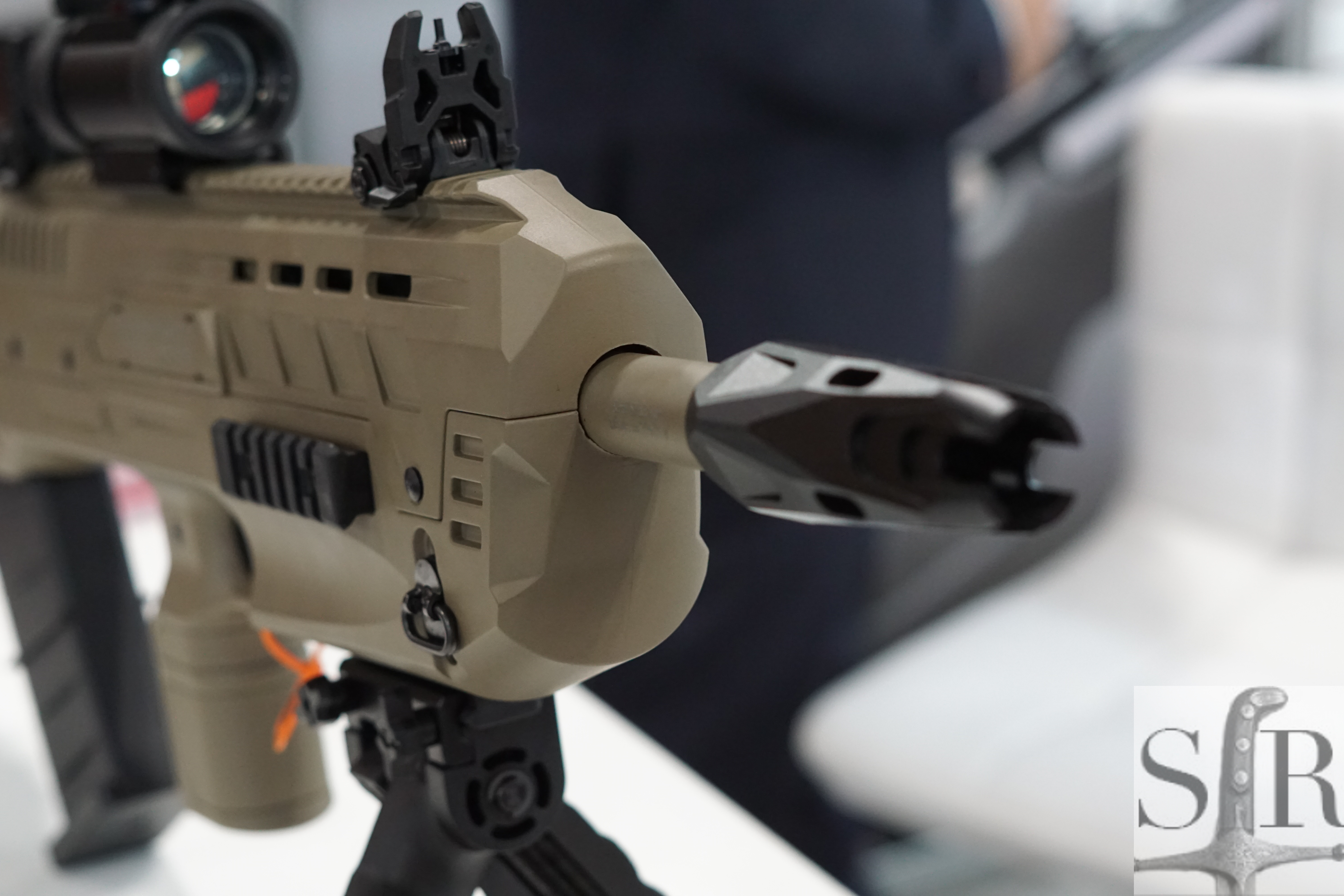
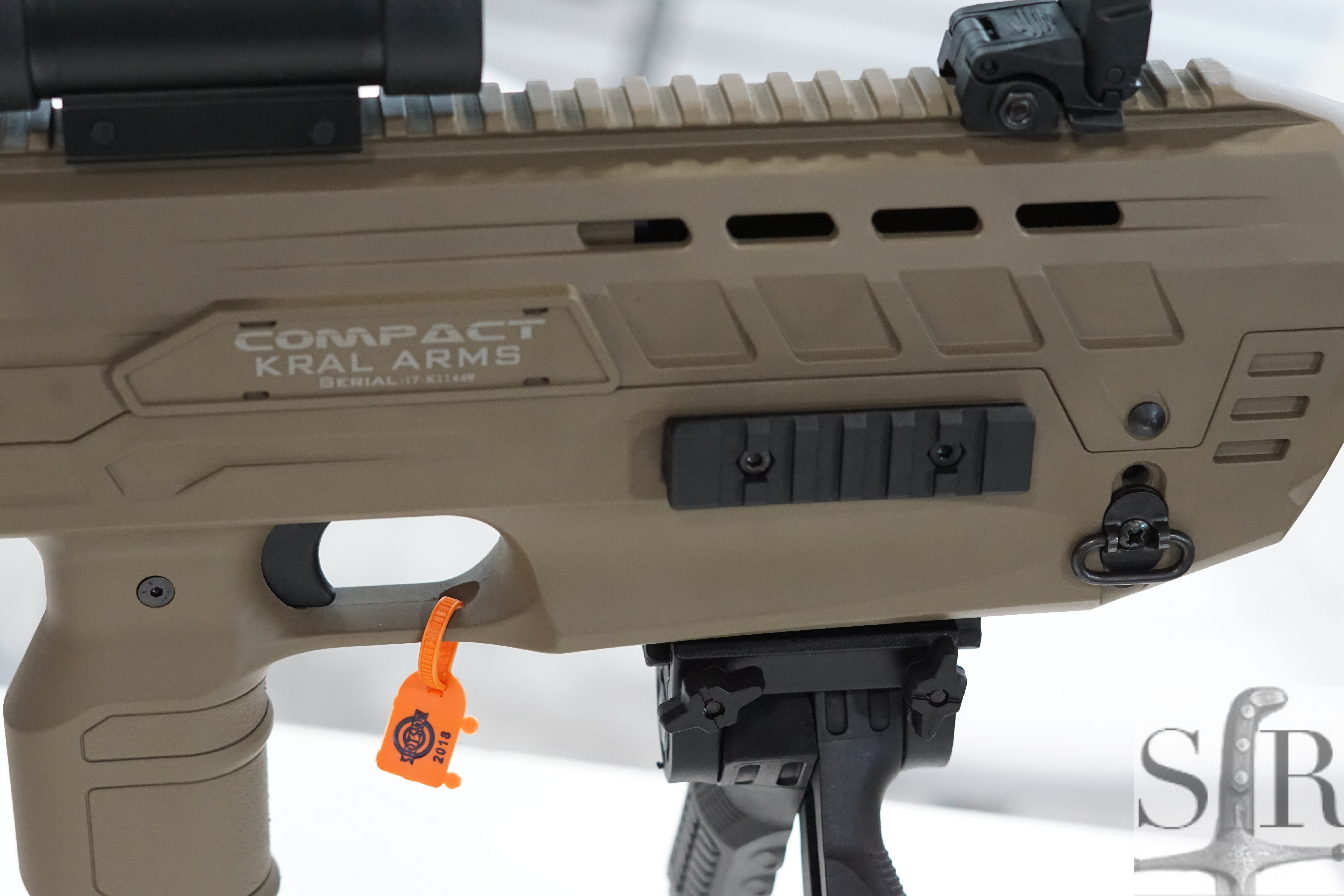
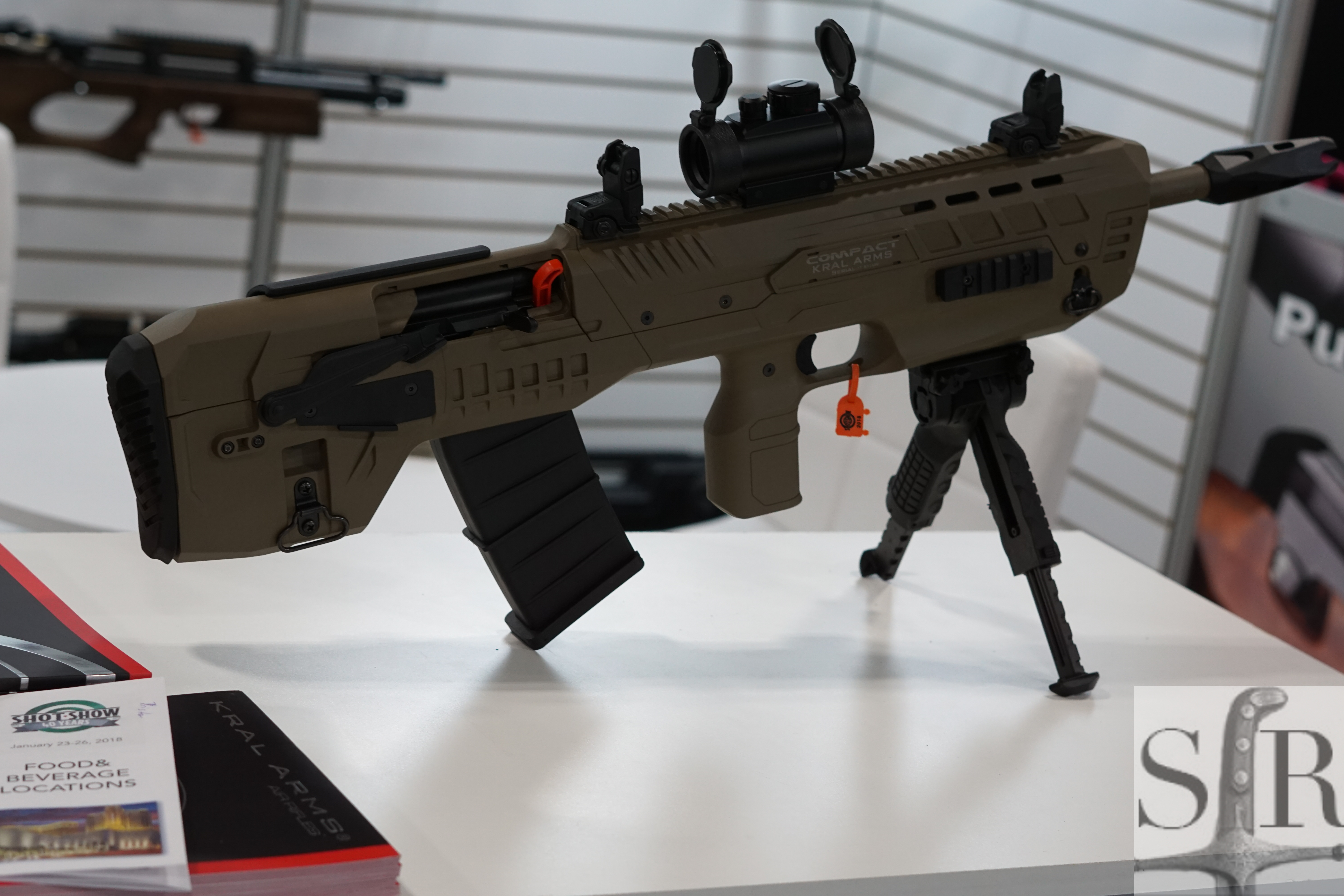
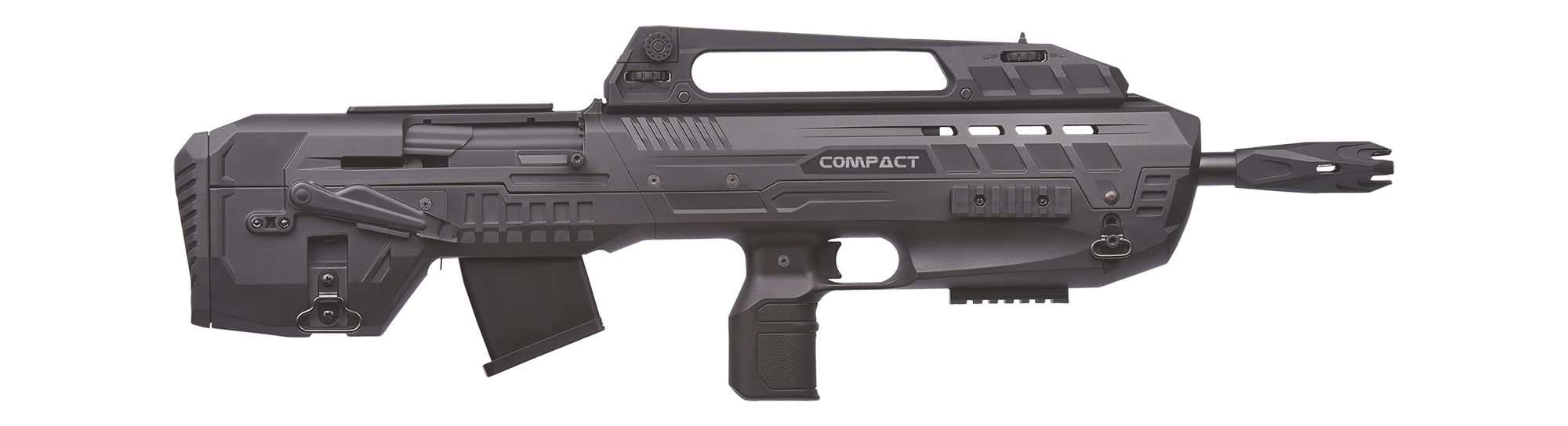
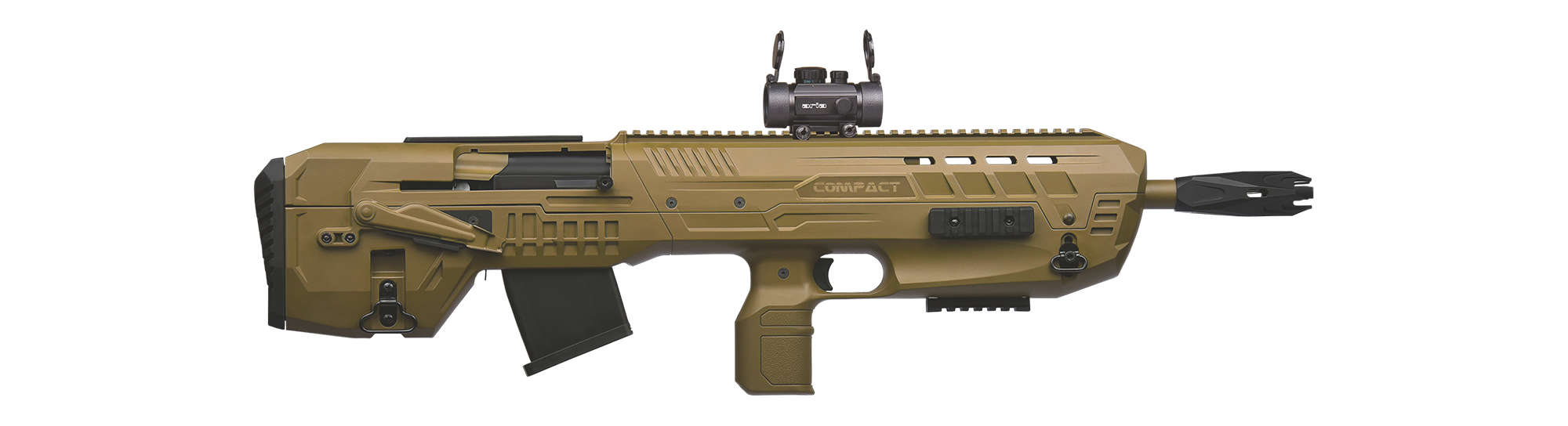
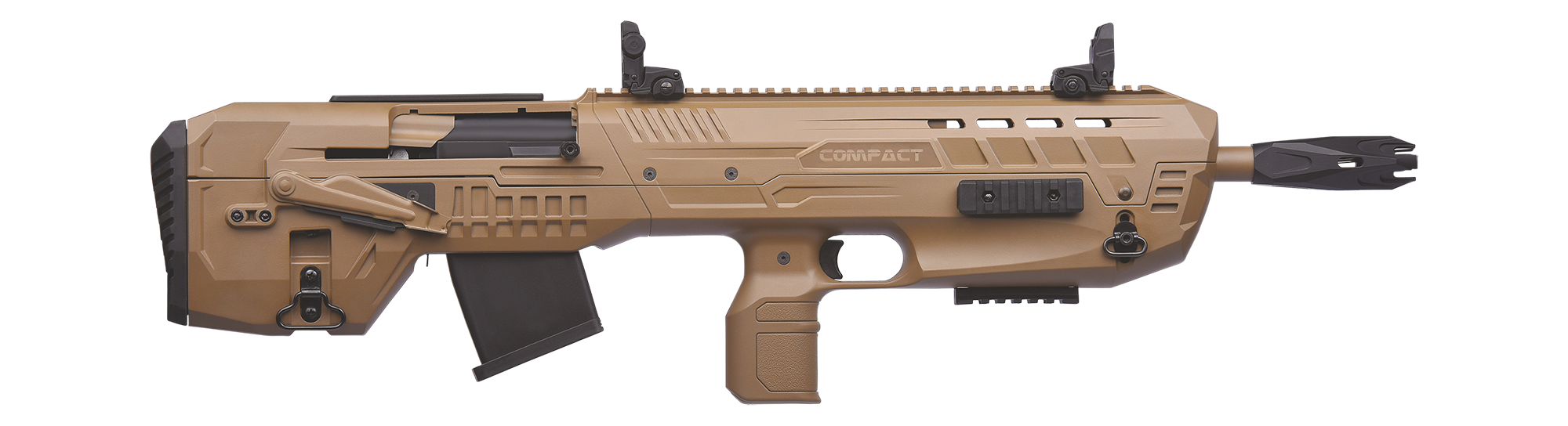
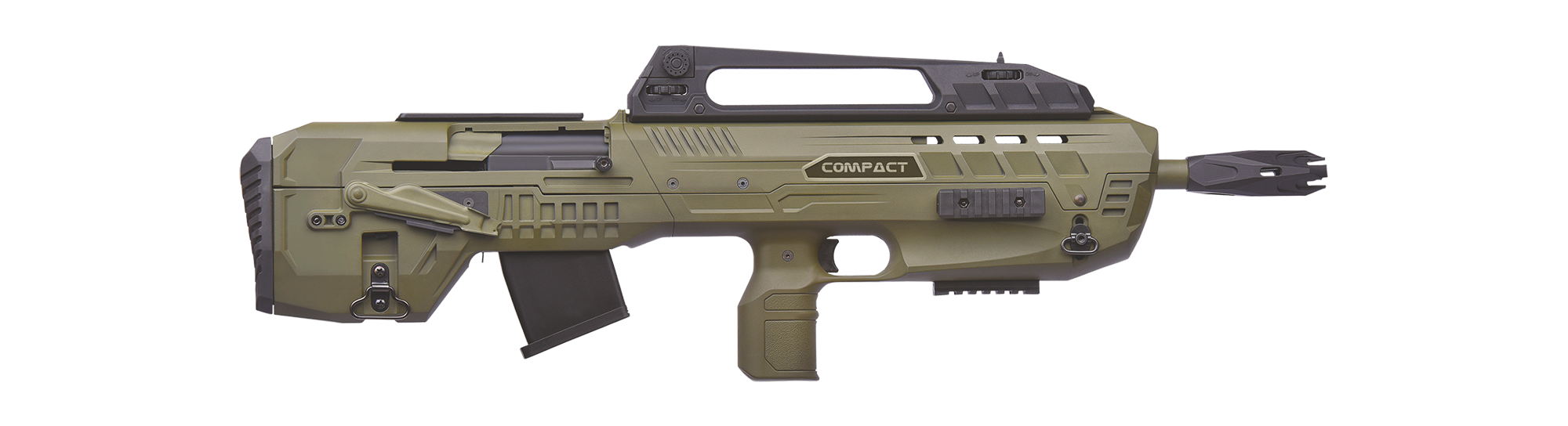
Kral Arms brought out their “Compact” 12 Gauge bullpup semiautomatic shotgun at SHOT 2018 this year. Essentially the “Compact” is the companies previous 12 Gauge XPS Kalashnikov patterned shotgun fit into the polymer frame of a bullpup. It retains the safety lever externally. There is a trigger bar that extends to the Kalashnikov trigger mechanism in the rear.
The shotguns are offered with red dot sights, plain BUIS sights, or an improvised A2 handguard that extends the entire length of the Picatinny optics rail. Magazines offered are either a 2, 5, and 8 shell configuration.
There are four available finishes: Black, Burnt Bronze Cerakoted, Dark Earth Cerakoted, and OD Green Cerakoted.
“Krinkov”, where does it come from and how have we gotten to it? There are a number of theories about it, some truer than others, but we’ll examine each one, and I will provide what I have come up with so far.
The first theory is that it is Russian. At face value, this could seem true, by simply hearing the word “Krinkov” to a non-Russian speaker, it might sound Russian. However, this is by far, not the case at all. Tim from Military Arms Channel has an excellent dialogue on this, explaining that the Russians have an entirely different nickname. I’ll take an excerpt from Maxim Popenkers site, World Guns:
Since its introduction the AKS-74U, unofficially known as a “Ksyukha” (variation of a Russian woman name) or “okurok” (cigarette stub)
In addition from Max’s book Assault Rifles, we have this entry:
Since its introduction the AKS-74U, unofficially known as a “Kysusha” (a variation of a Russian female Ksenia), “Suka” (bitch), “Suchok” (small tree branch) or “Okurok” (cigarette stub)
And this is Tim from Military Arms Channel, explaining some of that from the Russian side.
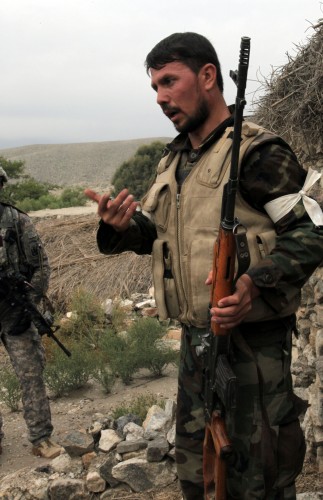
Tim is correct in his explanation of what Russians would call it, but the biggest problem I have with his explanation is that he completely dismisses the role of the Afghan Mujahaden, saying that it is a “nonsense word”. In addition, he speculates that maybe the first AKS74U taken off a Russian who was named Krinkov. The theory doesn’t hold any weight because for one, Krinkov isn’t a Russian name or in any sort of Russian vocabulary. Also, the fact that Pashtun speaking Mujahideen could speak or even read Russian is very, very rare, many of them being illiterate in their own language of Pashtu (illiteracy is an extremely large problem even in current day Afghanistan/Peshawar, and was much more so in the early 1980s). Furthermore, the circumstances of the Mujahideen capturing weapons from the Russians involved very little live prisoners. We’ll get into this in a bit as well, but for the overwhelming majority of the time, the AKS74U was issued to helicopter and armored vehicle crew members. Contrary to popular belief, the amount of Russians captured in Afghanistan during the war, and the amount of Russians fleeing to the Mujahideen side was extremely low as well. Most of the time, the only way Mujahideen could get their hands on Soviet equipment was through disabled vehicles wherein the Russian occupants would already be dead, or through the corrupt selling of Russian arms to the Mujahideen by either Russians themselves, or Afghan government troops.
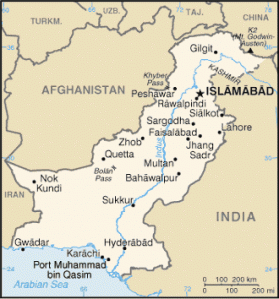
Most of the Mujahideen and Pashtun speakers that would have contributed to the name “Krinkov” would have been near Peshawar and in the eastern regions of Afghanistan.
The second theory is much more recent, but it originates from a gun shop in Naples, Florida. The shop was called “Krinks” and was run by a certain Paul Mahoney, who in the early 1990s was one of the first AK builders in the States to really take advantage of deactivated AKS74U kits, and put them together. The quality of them left much to be desired, but the fact of the matter is that the first mass producer of “Krink” kits in the United States was this guy Paul Mahoney with his gunshop “Krinks”. This might have certainly been one of the reasons why the name started to gain in popularity in the States, but it doesn’t help us at all in the actual etymology of the name.
My problem in the whole name origin is that we constantly see this theme of loosely attributing it to the Mujahideen, but yet there hasn’t been a single effort to get right to the source and really examine how that name might have even come about. Maybe it is ethnocentrism, maybe it is on account of laziness, maybe it is just accepting the status quo and not moving on. Either way, I’m going to present evidence that points to that fact that the name is actually a Pashtu word that has entered into our vocabulary, and is a testament to a twist in linguistics in the Pashtu language.
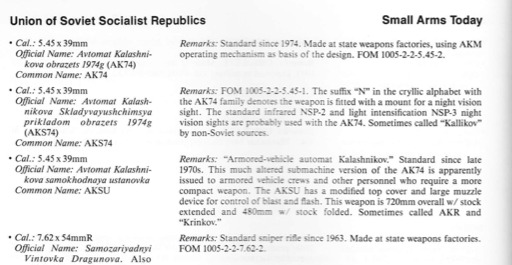
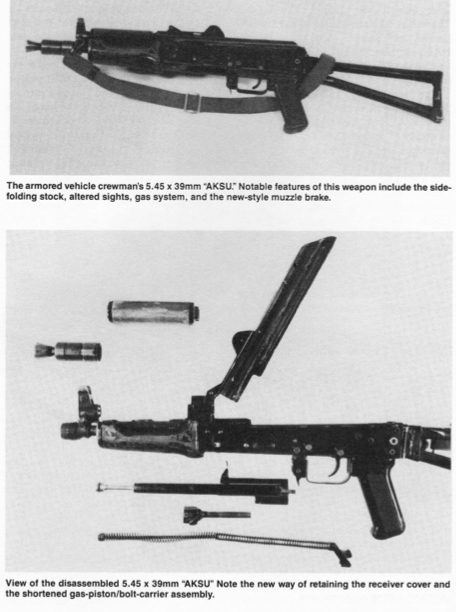
To begin with, we have to examine how the existence of this carbine became known about in the United States. I’ve often heard the claim that Soldier of Fortune magazine was the first entity to bring knowledge about the AKS74U, and even the AK74 to the West. I think this claim is more of a support for Soldier of Fortune’s reputation than any actual truth. Because just by looking at the facts, the famous Soldier of Fortune article that was run about the AK74 was in 1982, and the article about the AKS74U was in the July 1984 edition of the magazine. Looking at Jane’s Infantry Weapons from that era, and before, we see entries for the AKS74U, Sometimes labeling it as an AKSU 74, an AKSU and also as an “AKR”. This name most likely originates from Ian V. Hogg, as he was tied in with various intelligence circles at the time, that somehow came up with AKR. We still see this name in 1989, with Edward Ezell’s book, Small Arms Today.
Above is from Small Arms Today, and below is from “The AK47 Story“, both by the late Edward Ezell. Above he refers to it as the AKR/Krinkov, and below the “AKSU”. Both published in the late 1980s
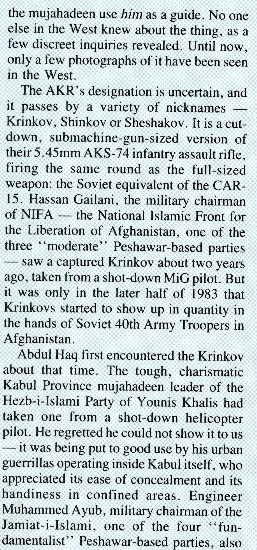
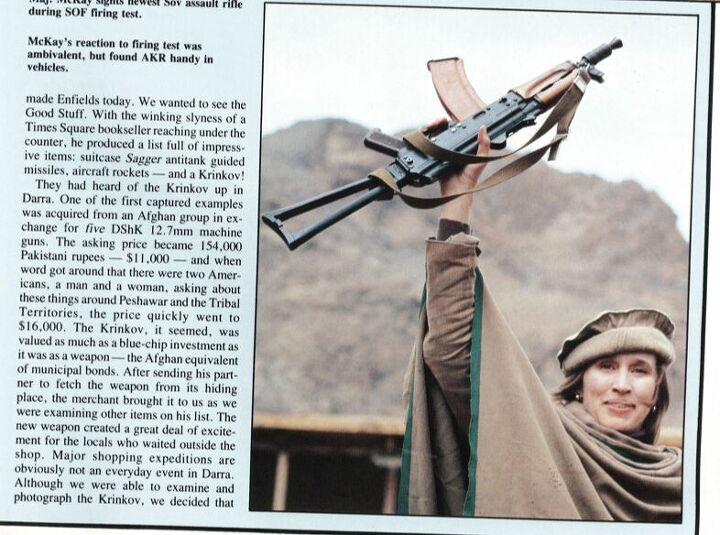
But going on to who actually deserves the credit of “discovering” the AkS74U, we have a sentence from the July 1984 edition of Soldier of Fortune, in which David Isby does an entire article about reviewing this new carbine, while he and an American Army Major are in Pakistan. He claims that initial knowledge of the carbine is from Ian Hogg, who in turn heard about it from a certain Peter Jouvenal. This guy was a video journalist, who has been in and out of Afghanistan since the late 1970s, and is extremely important because he captured one of the only video shots of Taliban leader Mullah Omar in person.
Below is the text from the Soldier of Fortune article detailing the origins and name of the AKS74U.
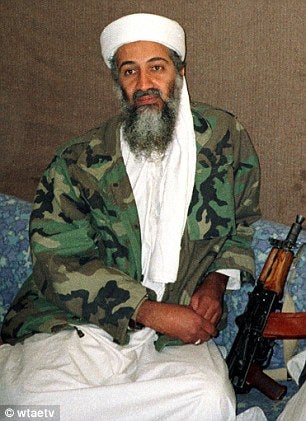
Peter Jouvenal, right, with Osama bin Laden. Probably the actual “discoverer” of the AKS74U in the West.
Within the Soldier of Fortune article, David Isby takes the name from the Afghans he was with. However, he mentions two other names “Shrinkov” and “Shesakov”. These two names are also important, but because of the linguistics involved, I’ll get to that in a second.
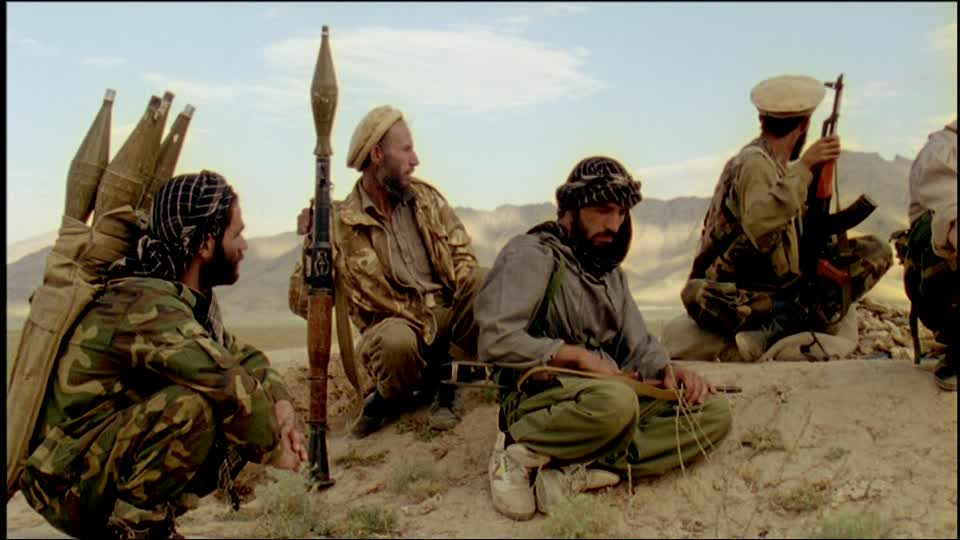
As mentioned earlier, the difference between this article, and any other article on the internet, is that I’m going to the actual source of the name, which is from the Pashtu speaking peoples of eastern Afghanistan, and Pakistan. The name is not a “nonsense” word, it is a Pashtun word. I’ll start this off by showing a clip from a movie called Son of a Lion. Quite an interesting movie, it was made by an Australian EMT on his own dime, after 9/11, going to Peshawar and filming a storyline about a young boy who works in the arms trade but really wants to go to school to become educated. The culture and language displayed in the movie are phenomenal, but from a firearms perspective, it gives us an in-depth look at the arms trade in Peshawar. Apart from a few actors, the rest of the movie is completely shot amid the markets and daily life of the North West Frontier Province of Pakistan. There aren’t any “props” or staged settings. The locations are real, and so are the small arms portrayed. But in it, we have this one scene where the main character takes a “Krinkov” out to a customer to test fire it. He also mentions the connection with Osama bin Laden.
https://youtu.be/KzN1-M37RiY?t=17m40s
Now, to understand why the reference to Osama bin Laden was even mentioned, we have to understand a little behind why the AKS74U became prominent among first the Mujahaden, and then today among families of status. As mentioned previously, the weapon was only ever issued out to crew members of helicopters and armored vehicles. Contrary to popular belief, this wasn’t a favorite of the Spetsnaz at all, although it originally started out as a proof of concept for Soviet Special Forces. It was quickly ditched for the AKS74 because the longer barrel proved to be better in the vast distances that the Spetsnaz found themselves operating in. This from an interview that I conducted with Marco Vorobiev, a Spetsnaz Veteran of the Afghan war.
Miles Vining- I noticed in some of your talks that you don’t have much love for the AKS74U?
Marco- Well its alot of fun. Lets talk about it from a far away point here. The gun is a tool in a toolbox to complete a certain job. And the job could be a regular contact fight, lets say 500-400 meters, to include maybe clearing houses or compounds. So from that regard you want something small, maybe be able to use it in close quarter combat, something really, easy to handle, easy to maintain. Well that is fine, considering if you are a police officer going through a house. It shoots 5.45 as well, so thats good for wounding. On the other hand, as a carbine, you need to be able to hit targets out to 300 meters. You can do that with an AKS74, no problem, even with an M4. But the AKSU? You might if you spray half a magazine in that particular direction. But I even have one, I shoot it for fun, I get a big old smile on my face. It’s fun to shoot, it’s just like rrrrrrrrrrp, almost like a little toy so to speak. Mikal Kalshanikov himself told me that he loved it, although he was a very anti 5.45 guy, but he was a big fan of the AKSU for some reason. But you put yourself in an actual gunfight, with people screaming everywhere, trying to get comm up, you taste the metal of adrenaline in your mouth, and now you are trying to pick out targets in the distance… it’s really hard with that gun. We were always trying to get rid of it for the AKS74.
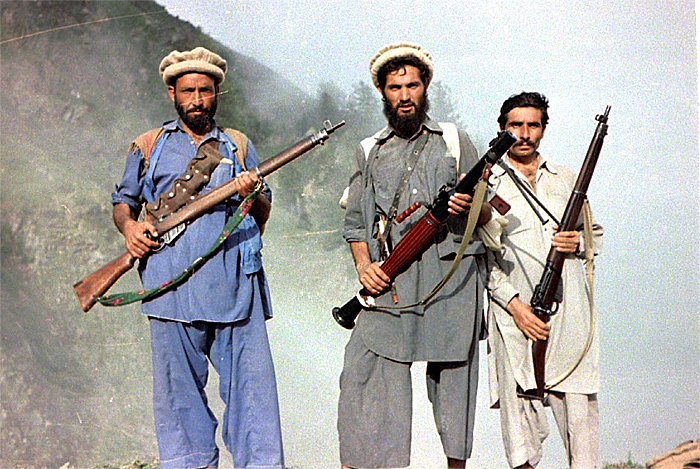
Thus, the weapon was strictly for crew members. And if we look at the context of the Soviet-Afghan War, the biggest hinderances for the Mujahideen, were the Hind attack helicopters, and the BMPs. In fact, if you look through Soviet photographs of the war, there is much evidence to attest to this, with helicopter crews even having thigh holsters carrying their AKS74Us. Thus, taking one of these monsters out of the fight would be one enormous victory for a small band of fighters, but more importantly, proving that you took one down would show everyone how brave or good you were. And what better way to prove it than to take a weapon that only these troops would have on them, an AKS74U? It not only proves that you were competent, but it also gives you something to defend yourself with. Even in the Soldier of Fortune article, we see just how rare and sought after these things were, even rising in price after word was passed around that an American was looking for one in Peshawar.
Now, Osama bin Laden claimed back to his Yemeni and Saudi buddies back home that he fought in the Soviet-Afghan War. But the actual truth of the matter is that he probably was never near any of the fighting, most likely staying in a rear echelon capacity, directing funds and supplies to the front (if he even did that). But, on his return to the area in the mid-1990s, we have a multitude of pictures of him, with an AKS74U by his side in the camera frame. This was very deliberate, to the point of the gun sellers in Peshawar even telling the customer that “This is the Osama gun”. Although Osama never took down a Soviet armored vehicle or Hind, the fact that he was carrying the carbine showed a status symbol, and he was able to identify much more easily with local Pashtuns who didn’t understand his Saudi background but absolutely understood his choice of weapon.
The placement of that AKS74U in the camera frame is entirely on purpose.
Somewhat off track, but this is important to understand how the name came to be, because even today, the AKS74U occupies a very lofty position as a status symbol in eastern Afghanistan and Peshawar.
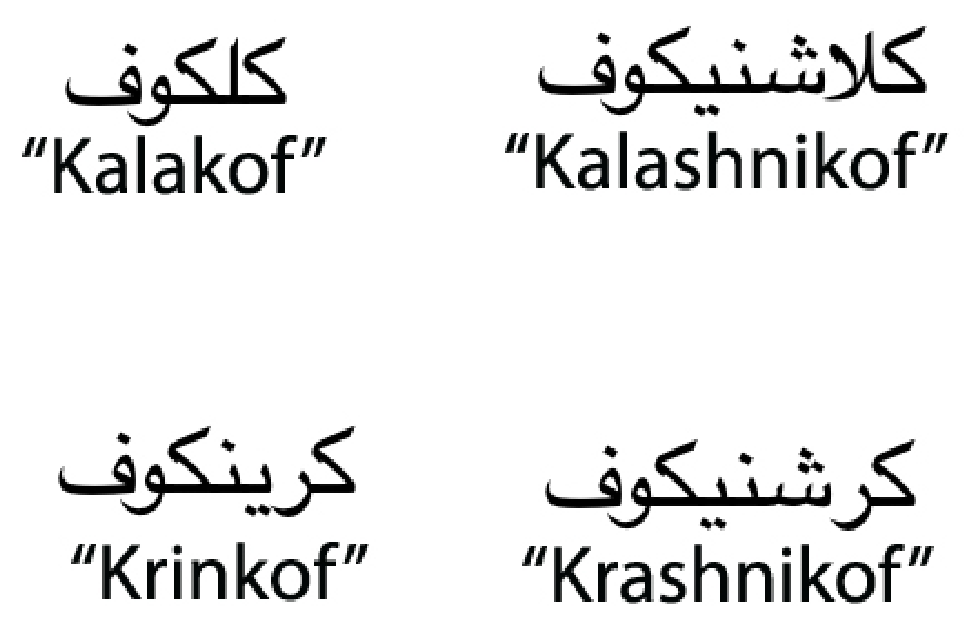
A close Afghan contact from Jalalabad mentions two names for the AKS74U, the first one which is popular in Jalalabad, is “Kalakov” and the second one is “Krinkov”. If you hear somewhat of an “F” sound at the end of the word, that is because there isn’t any “V” consonant in Pashtu, speakers instead using an “F” or a “W” sound to simulate a “V”. Now, remember what David Isby said the other names for the carbine were? “Shrinkov” and “Shesakov”? Using a little knowledge of the Pashtu language, the names pair up to be the same word. There are two dialects of Pashtu, the southern, or Kandahari, and the eastern, or the Nangahari. So looking at this words, “Krinkov” and “Shrinkov” are actually the same word, just pronounced differently, while “Kalakov” and “Shesakov” are a little more different, but dropping the “la” sound, the words are also the same.
From the full form of the word on the right, going into the nickname for the AKS74U on the left, the differences between the top and bottom are in different Pashtu areas of speaking.
But how exactly did these words come about? As my friend mentioned, adding an “ov” to any word makes it Russian-ized in Pashtu. So that explains the last part of the word, and the first part is probably a bit of vocabulary added on, to signify the importance of the AKS74U as a status symbol. Because it isn’t just any old “Kalashnikov”, its a “Krinkov”, and you know I got it from that Hind I blew out of the sky a week ago. Another tidbit that my friend brought up after the camera was off, is that for some reason, in Jalalabad, the Pashtuns refers to the Kalashnikov rifle as that, a “Kalashnikof”. However, in other parts of eastern Afghanistan, the same name is actually pronounced “Krashnikof”. And this might actually be the truest jump to “Krinkof”, as going from “Kalashnikof” to “Kalakof” is very similar, as is going from “Krashnikof” to “Krinkof”. In both cases, the “L” in the first one, and the “R” sound in the second one are maintained in their nickname for the short rifle.
I hope this was an informative article and was able to really get to the point of “Why do we call it this?”. If anything, the most important part of all of this, is that the word isn’t a made up, nonsense word, but instead has very important historical and cultural attributes and an etymology that comes from a defining moment in history. There is much evidence to point to the fact that Afghanistan might just have been the straw that broke the Soviet Unions back, and this word directly came out of that struggle. In addition, it is a Pashtun invention, and is still very much alive and well in eastern Afghanistan and Peshawar.
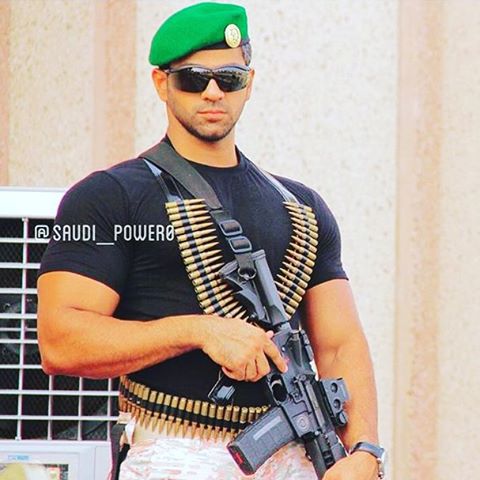
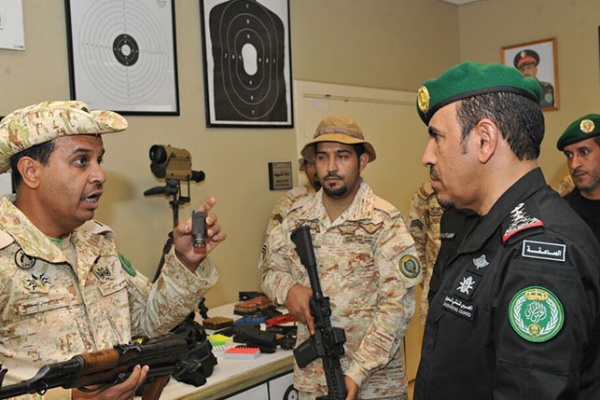
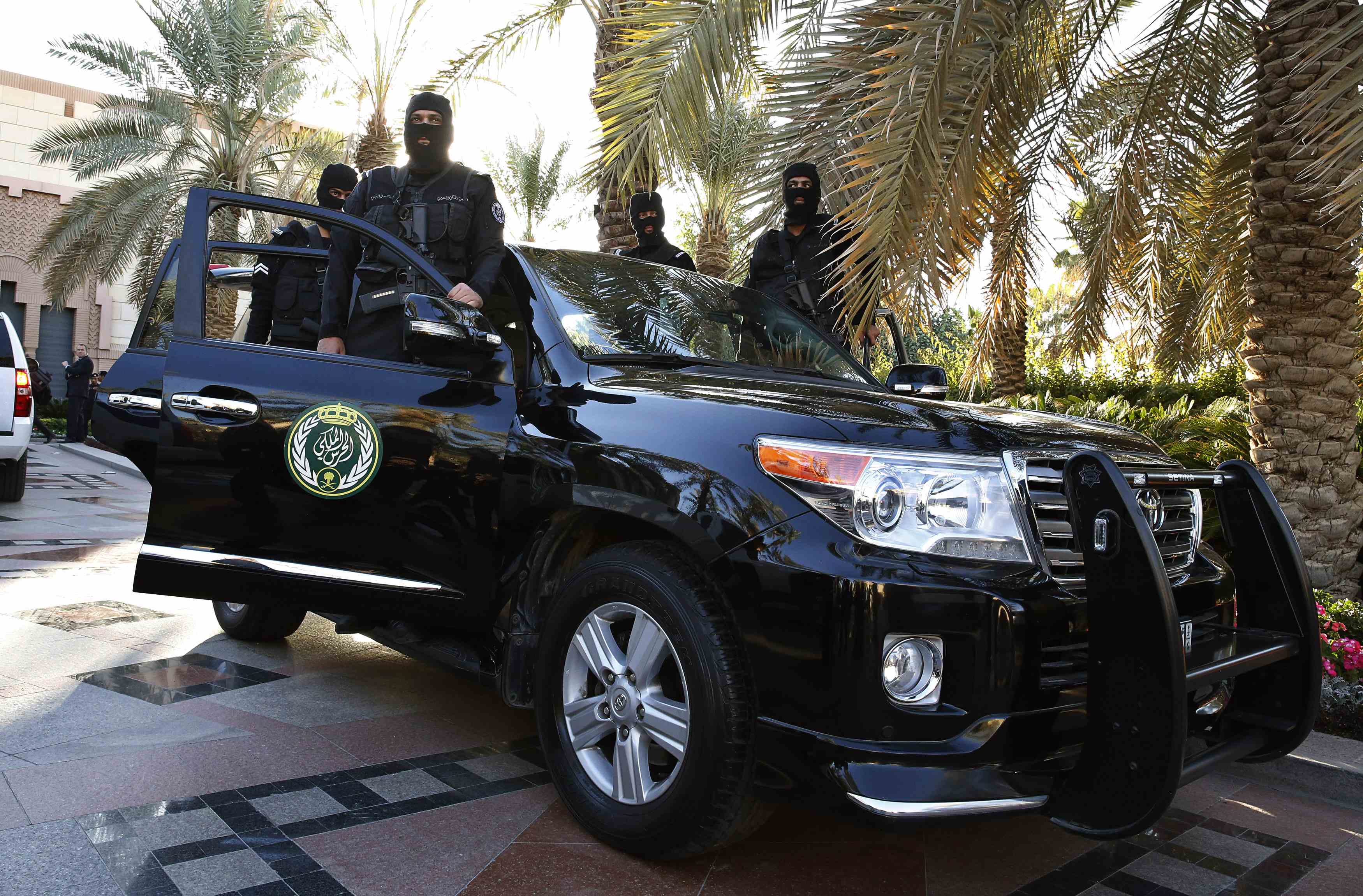
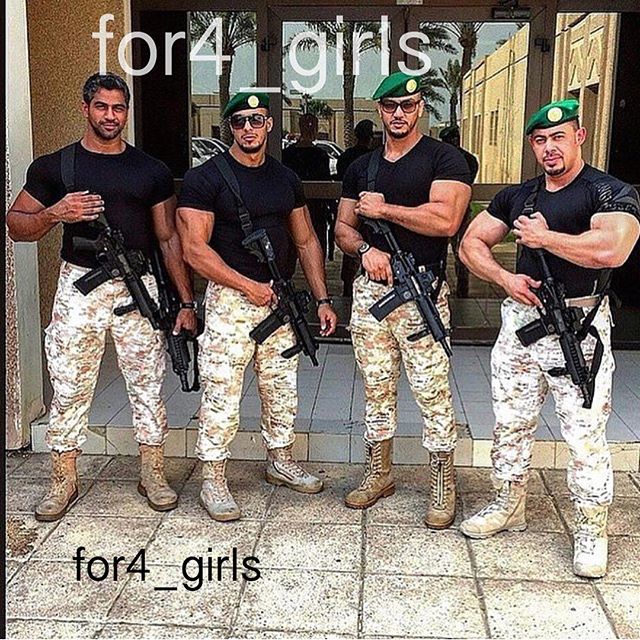
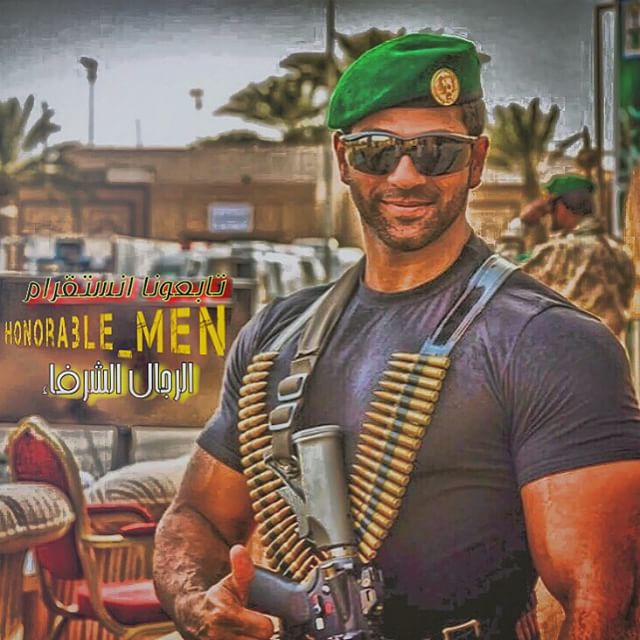
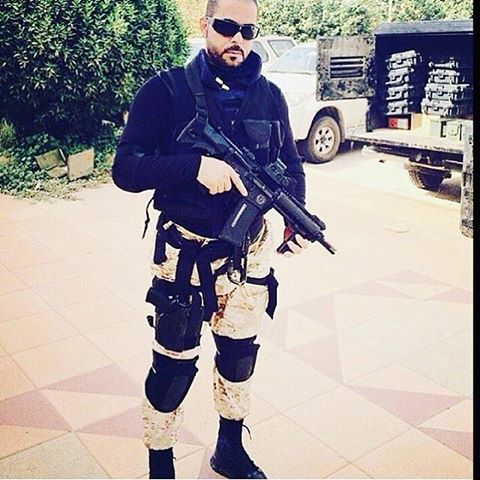
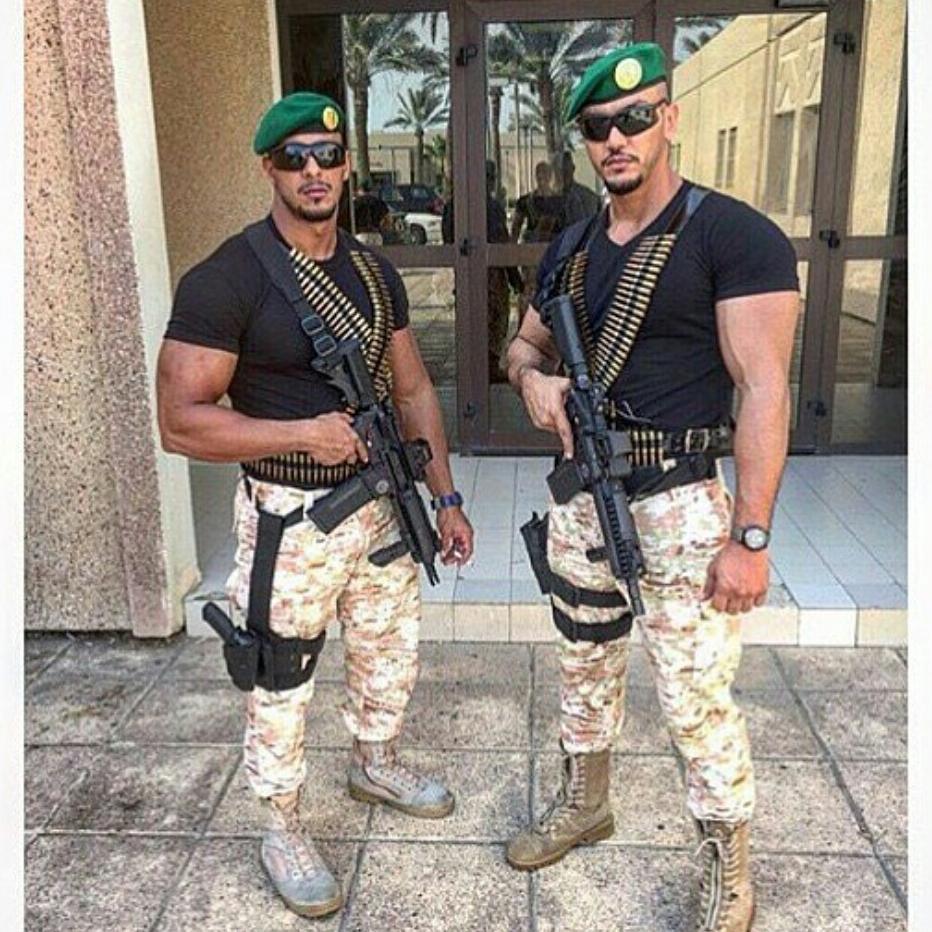
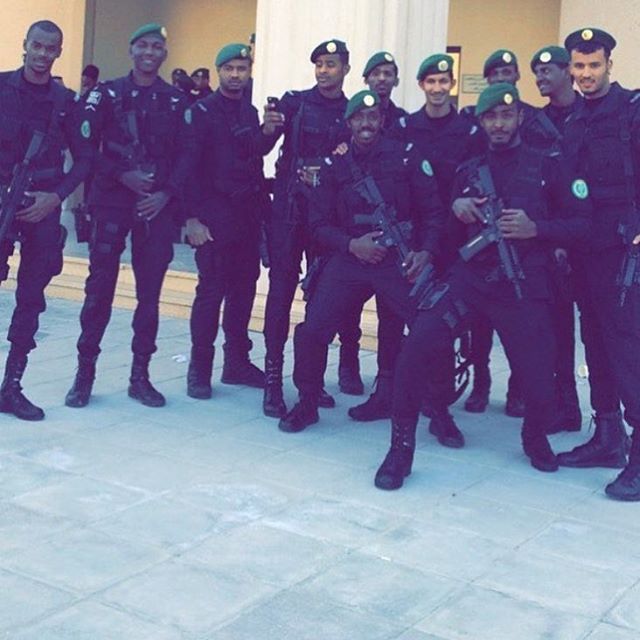
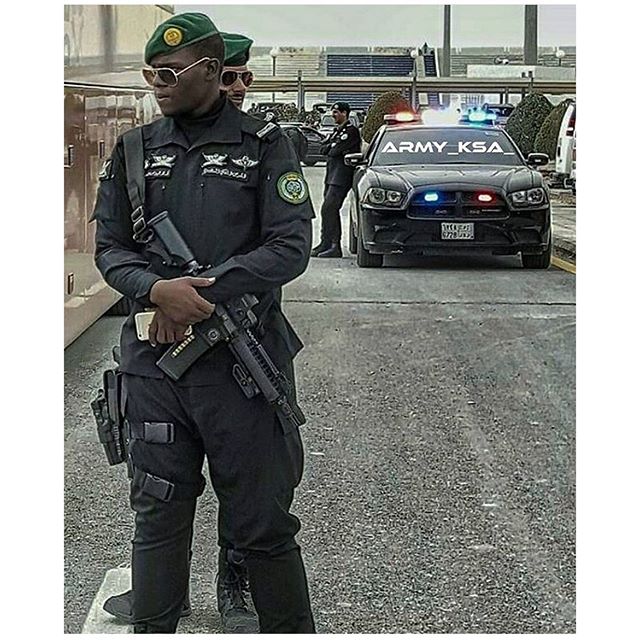
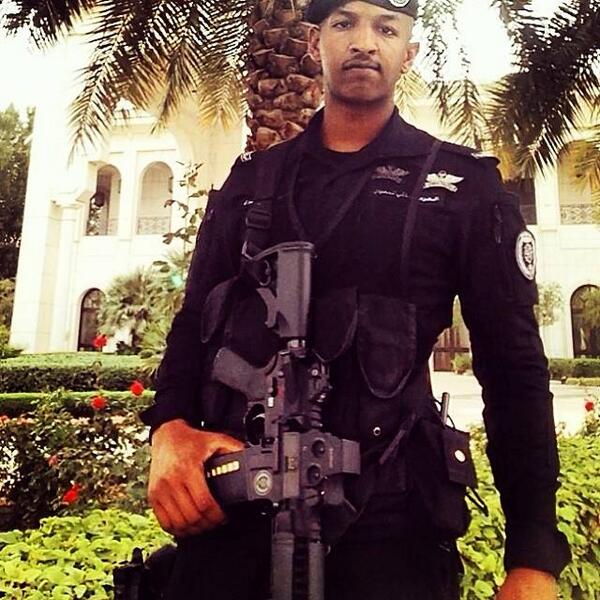
The reigning King (currently King Salman) of the Kingdom of Saudi Arabia, otherwise known as the “Custodian of the Two Holy Mosques”( خادم الحرمين الشريفين) and his enormous family has numerous lawyers of protection surrounding him due to the numerous threats upon the absolute monarch. One of these layers is known as the Saudi Royal Guard Regiment (لحرس الملكي السعودي). This unit has been profiled numerous times on social media, both in the observance of their protection duties, but also simply as casual encounters with members posting photos of themselves and their mates that eventually end up on Instagram and other social media sites. The guards are unique and identifiable in that their uniforms are black with bright green berets. However, they have been seen wearing the desert digital trousers that the Saudi Royal Army uses as well.
Notice the shape and design of the carbine on the left. It is an LWRC UWIC.
Saudi commandos guard the front of Erga Palace as U.S. President Barack Obama arrives to meet with Saudi Arabia’s King Salman in Riyadh January 27, 2015. Obama sought to cement ties with Saudi Arabia as he came to pay his respects on Tuesday after the death of King Abdullah, a trip that underscores the importance of a U.S.-Saudi alliance that extends beyond oil interests to regional security. REUTERS/Jim Bourg (SAUDI ARABIA – Tags: POLITICS MILITARY)
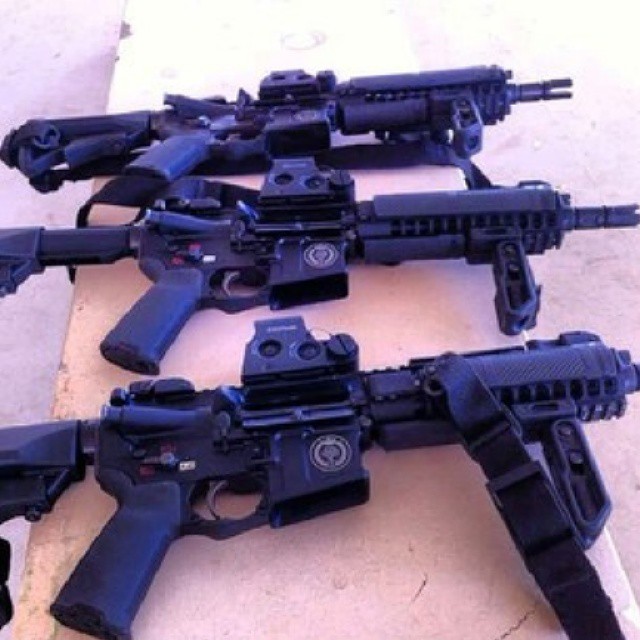
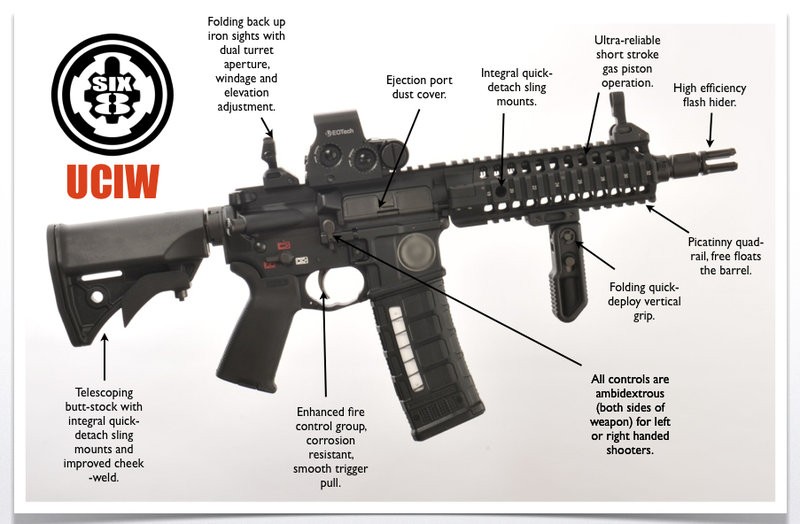
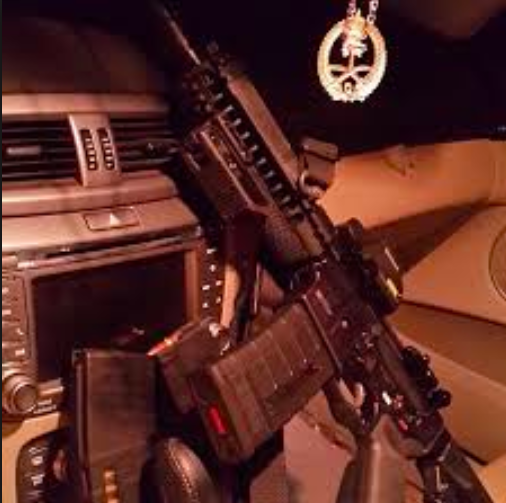
An interesting facet of this group is that it has been seen armed with LWRC UICW (Ultra-Compact Individual Weapon) carbines chambered in 6.8x43mm Remington Special Purpose Cartridge (SPC). The LWRC UICW is distinctly recognizable due to the shortened buffer tube and almost mini-SOPMOD stock. It also has an 8.5-inch barrel, making it very handy for close protection work, and moving in and out of vehicles.
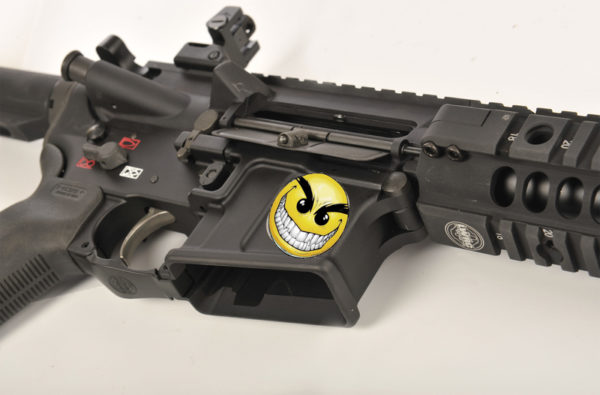
A unique point about the Saudi LWRC UICWs is that they all have the unit’s crest etched in white on the right side of the lower receiver, on the magazine well. Apart from that identifier, these carbines are outfitted with EoTech XPS2 holographic sights, Magpul pistol grips and see through 30 round magazines, Picatinny rail covers, BUIS sights, a folding vertical foregrip, and what appears to be a Vicker’s Tactical (or at least an imitation of one) two-point sling mounted on QD release points. All of the carbines have a select-fire capability. The overwhelming majority are in a black finish with matching furniture, but we do have one example so far of a green stock, with a matching green sling.
We also have this graphic that was created for the carbine as a promotional piece. Notice on the right side of the magazine well how the crest is completely blurred from view. It would appear to be that this crest was actually the Saudi Royal Guard Regiment but blurred for publication.
Very similar to the case of this one as well-
These carbines were a part of a contract with Saudi Arabia, through the U.S. State Department beginning in Feburary 2012 and ending the next year, worth $109 Million. From a statement from the LWRC Facebook page–
In Feb of 2012 LWRCI signed a $109 million dollar 18 month contract with the Government of Saudi Arabia, sanctioned by the U.S. Department of State and U.S. Congress. This is the largest direct commercial to foreign government sale of firearms in the history of the ATF Exports Branch. $109 million dollars of foreign money coming into Maryland to a company that is five years old. In these economic times, this is a story that the Department of Business and Economic Development can be very proud of. New jobs; developing a workforce; and stimulating the economy.
Specifications from Defense Review-
Caliber: 6.8mm SPC
Barrel Length: 8.5″
Weight (unloaded): 6.25lbs (8.5″ barrel)
Length (overall): 24-27.25″ (8.5″ barrel)
Rate of Fire: Semi Auto or Select Fire 700 rpm (+/- 100rpm)
Rifling: 1/10″ RH
Stock/Pistol Grip: LWRCI/Magpul MOE
Sights: LWRCI Folding BUIS Front and Rear
Magazine: Magpul 30 rd. P-Mag
Muzzle Device: LWRCI flash hider 5/8×28 TPI
Colors Available: Black”
This is a Saudi social media channel on Youtube that shows extensive footage of the Royal Guard Regiment during various training demonstrations.
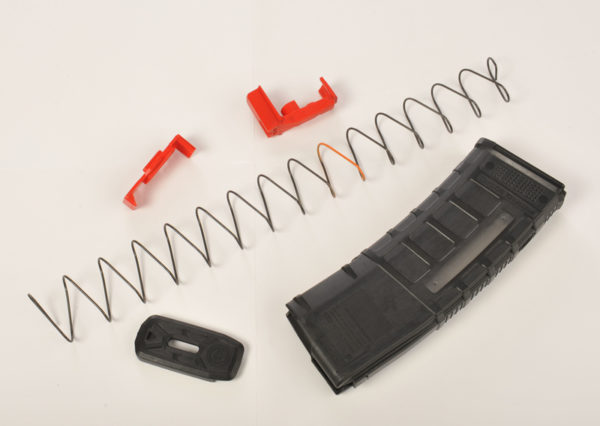
The Magpul 6.8x43mm SPC magazines that are used with the Saudi Royal Guard Regiment were actually developed in close coordination with LWRC. They are readily identifiable by the bright red follower and internal baseplate. You can still purchase them in the United States for $26.97 on Cheaper Than Dirt. From the website-
Magpul PMAG magazines are designed for the LWRC 6.8 pattern AR lower receivers. These magazines were built specifically as a result of a partnership with LWRC and Magpul industries. These magazines feature the new constant curve geometric body, anti-tilt follower and other minor improvements. The polymer magazine reduce overall magazine weight by half without sacrificing durability. Magpul 6.8 magazines are a must have if you own a compatible LWRC rifle chambered in 6.8 SPC.
Silah Report took some time to ask a native Afghan from the province of Mazar-i-Sharif to talk about various colloquial names that Afghans have for popular small arms in use by the Mujahideen and in the modern era. This interview is not verbatim and has been edited for clarification.
SR- Please explain the Dragunov?
Interviewee- So the Russian name Dragunov actually isn’t used in Dari, or in Afghanistan. Instead, we call it “Draz-nuf” (درازنف) In this case, “Draz” (دراز) Dari means long or lengthy, and that name is given to that rifle due to its overall length being longer than most small arms such the Kalashnikov, Krinkov, and Shinkov. That’s why they call it “Draz-nuf”, the “Draz” for “Lengthy” or “Long”. Likewise, with names like Krinkov, or Shinkov, these are names given to various small arms by the Mujahideen in the Soviet War. They don’t represent the actual Russian name for them.
SR- Was the “Draz-nuf”/Dragunov a special rifle among those who used it? Only choose Mujahids would use it?
Interviewee- I think so because they used it as a sniper rifle due to the optics that came with it. You can focus your target very well and then shoot it. That’s what I have seen in movies as well. But it isn’t as expensive or as sought after as the Krinkov as far as I know. Carrying a Krinkov is sort of a show-off, something a Captain, a commander, would do. Everyone would talk about how “That guy was carrying a Krinkov, or his bodyguards carry a Krinkov”. But that status symbol isn’t the same with the “Draz-nof”.
SR- What are some other names? Such as PKah, Makarov, etc…?
Interviewee- Yes, PKah, they call it by another name of “Grin-nuf”.
SR- What about the RPG?
Interviewee- This is sometimes called a “Rockeet” (راکت) or “Rockeet-Tandaz” (راکت تندز) This is because “Rockeet” is obviously the missile that is fired out of that barrel, and “Andakhtan” is the Dari verb “To Throw” (انداختن) so “Rockeet-Tandoz” is an instrument that is used to throw a “Rockeet”.
SR- What about the .303 Lee Enfield?
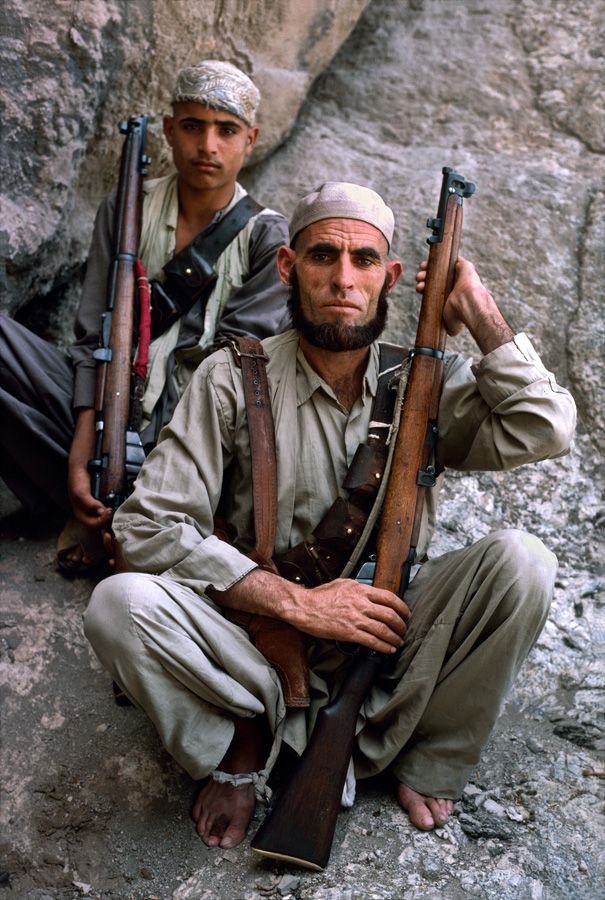
Interviewee- We call these “See-Sahd-See-Bor” ( سه صد سه بور) See-Sahd-See means three hundred and three in Dari, meaning the caliber .303, and “Bor” for the diameter of the barrel. I’ve seen these rifles in old people’s houses and people would say “My grandfather carried this”. And “Karabine”, is another kind of gun, but it isn’t a rifle, it is shorter, shooting single rounds instead of automatic fire. We also have “Dushka” for the DShK Heavy Machine Gun.
Afghan fighters hide during Soviet bombardment, Jalalabad, Nangarhar, Afghanistan, 1981
Ali Parsa is an Iranian scientist who has a lifelong passion for sailboats. He also knows a great deal about the history of the Mauser bolt action rifles that initially entered service in Iran at the turn of the 20th Century. He wrote this article examining the history of the Persian Mauser with its roots in the Czech VZ24 being license produced in arms factories outside of Tehran. This article was written almost a decade ago and he has very generously allowed Silah Report to republish it with express permission from himself. It initially appeared on the website that bears his name, Aaliparsa.com. This edition has been lightly edited.
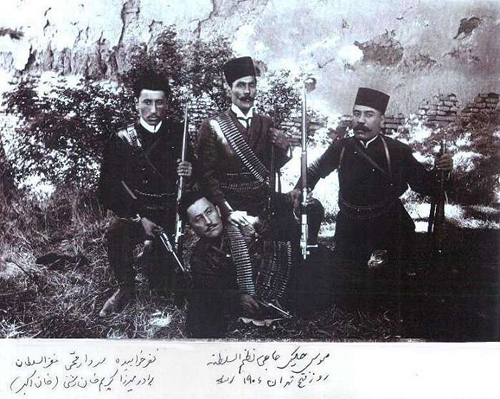
Mauser rifles first appeared in Iran before the First World War. Looking at pictures of Iran’s Constitutional Revolution era, one can spot Mauser rifles and handguns in the hands of freedom fighters of Sattar Khan and Bagher Khan, as well as other Constitutionalists in different regions of Iran.
Iranian Constitutionalists, with their Mausers, in 1906
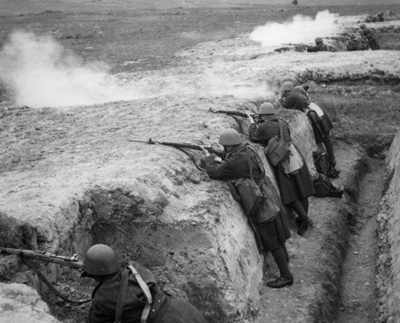
At the end of World War I, and as a result of the Versailles treaty arms ban, Germany no longer produced these rifles, but an almost exact copy was in production in Czechoslovakia. After Hitler became the German chancellor, the production was resumed in Germany.
Later, with the invasion of Czechoslovakia, the identical rifle was produced in Germany and Czechoslovakia.
Czechoslovak Army Drill, 1938
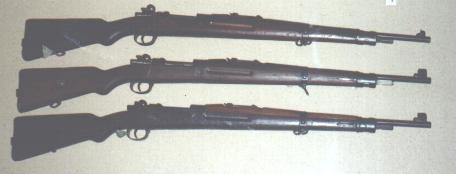
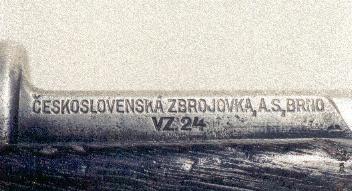
A major production center was in Brünn, or Brno, as the city is called in the Czech language. The rifles made in Brno, the Czechoslovakian model, are known as VZ24 (for Vzor24, or Model 24 in the Czech language) and had the word Brno imprinted on them.
Czechoslovakian VZ24
Markings of a VZ24
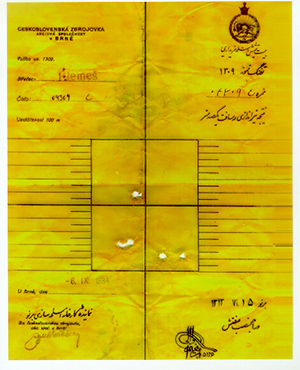
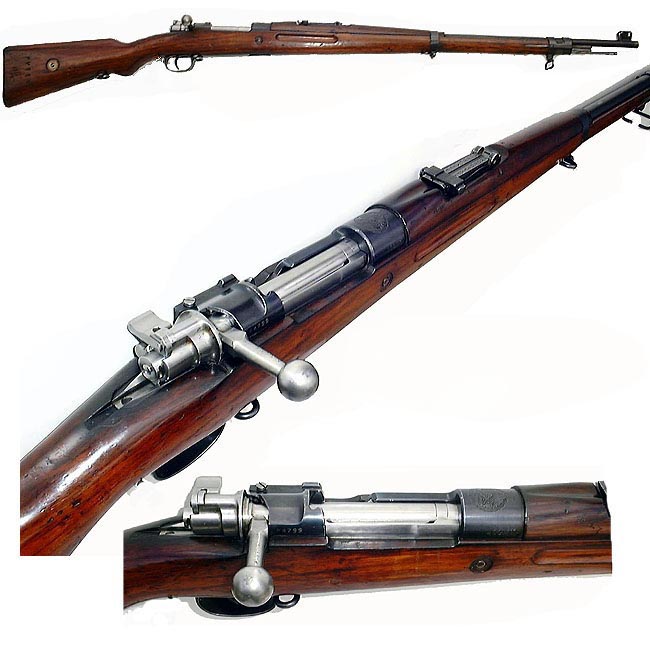
Officially, the Mauser rifle was selected for the Iranian army during Reza Shah’s time. But Iran didn’t go for the original German and ordered the identical Czechoslovakian version, the so-called Brno. The Czech firm provided Iran rifles made of many German parts. It was similar to the longer barrel version Germans designated as K98. Some official test results are available from antique arms dealers today, featuring signatures of the Brno factory representative, the Iranian in charge, and of course, satisfactory ‘grouping’ or bullet marks.
A 1934 test result document
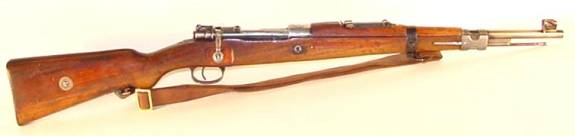
Full length ‘Brno’ with markings in Persian
At that time two other rifles were in use and very well known in Iran: the British Lee Enfield and the Russian Mosin Nagant (Noghaan, or Naaghaan, (نوغان- ناغان) in popular parlance in those days). The exact reason for preferring Brno over its rivals is not known, but one can speculate that those in charge of the Iranian army, or maybe Reza Shah himself, tried to avoid dependence of Iran to either of the two neighboring powers. Besides, the Brno and it’s Mauser original were considered to be the best military rifle of its day.
The Iranian government ordered three versions of this weapon. It was manufactured in Czechoslovakia by two firms. One was called Ceskoslovenska Zbrojovka, or CZ. These rifles are known to collectors as Persian CZ98, Persian Mauser or Persian Brno.
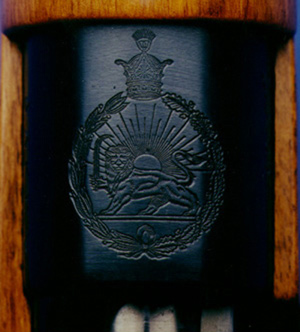
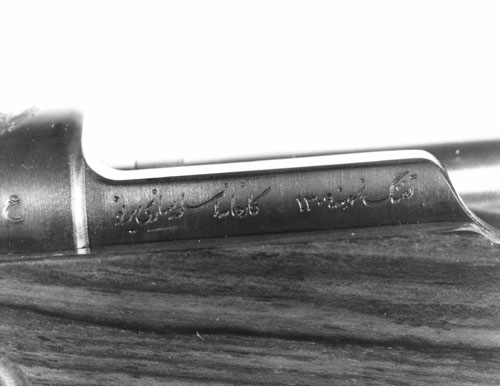
A Pahlavi crown, lion and sun crest appears near the feeding ring, as an inscription in Persian (in Nasta’liq script) on the side of its magazine giving the model and the factory name, which was in Brno. From then on the name, Brno was used by Iranians to refer to this rifle.
Lion and Sun crest of a Persian Mauser
Persian markings of a Brno made rifle
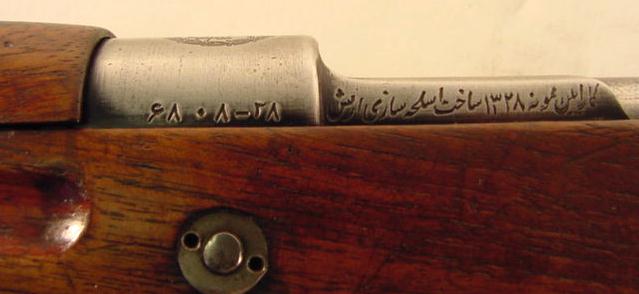
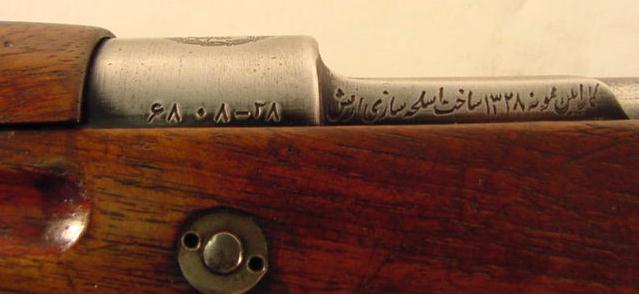
One typical such inscription read “tofang-e nemoone 1309 karkhane-ye aslahe sazi berno” (“Rifle model 1309 Made at Brno Arms factory.” The number 1309 refers to the Persian year 1309 which is the year 1930 in the Gregorian calendar).
In the late 1940s Iran’s Taslihat-e Artesh (Arms Factories of the Army), popularly known as Mosalsal-sazi (the machine-gun factory), in Tehran started production of these Brno rifles. The needed machinery and technical assistance were provided to Iran through the industrial firm Škoda, which had a long history of cooperation with Iran. Iran produced two models: the regular VZ24 rifle (similar to the German Kar98k, overall length 1110 mm) and the short version (similar to the German G30, overall length 993 mm) known as “Berno kootah” (short Brno).
Berno Kootah (short Brno)
Under a licence from CZ. The difference was only in the markings on the side of reciever: instead of naming Brno as the maker, it was written “sakht-e aslah-e sazi-e artesh” (made by the Army arms factory).
Markings on an Iran made short Brno
The products are known among the collectors as Persian Mauser and are regarded to be the best and smoothest of the Mauser family of bolt-action rifles.
For many years Brno was the standard personal weapon of the Iranian armed forces, until it was replaced by the more modern, semi-automatic, American Garand M1, and later by the German Heckler & Koch G3.
The rifle was especially cherished by Iranian tribes, who are known to be firearms aficionados and able shooters. A tribesman sharpshooter would settle for nothing less than a Brno. Tribal rebels did everything to acquire one of these rifles, and they did get their hands on these in many tribal wars during Reza Shah and Mohammad Reza Shah’s time. And probably the tribal chieftains, or Khans, did get shipments from foreign sources, to be distributed among their savars (mounted fighters). One single event, which contributed to the widespread availability of Brno rifles among the tribes in Iran, was the fall of Reza Shah following the invasion of Iran by the Allied forces in 1941. At that time the Iranian army, after a short resistance, was almost disbanded and many people, especially tribesmen, got hold of the Brnos left after the soldiers abandoned the barracks.
There are many stories of the gun’s accuracy among the tribes. When Dadshah rebelled against the shah’s government in Baluchistan in the 1950s, people said that his wife, Bibi Khatoon, who accompanied him in the mountains, at one occasion, took her Brno and shot a bullet right into the barrel of the gun of a poor gendarme who was aiming at her over a long distance. Its popularity among Iranian tribes was so much that it was mentioned in some of their songs. A version of a well-known Boyer Ahmad song has a refrain that says “Mastom, Mastom, Brno kootah be dastom” (I’m drunk and have a short Brno in my hand).
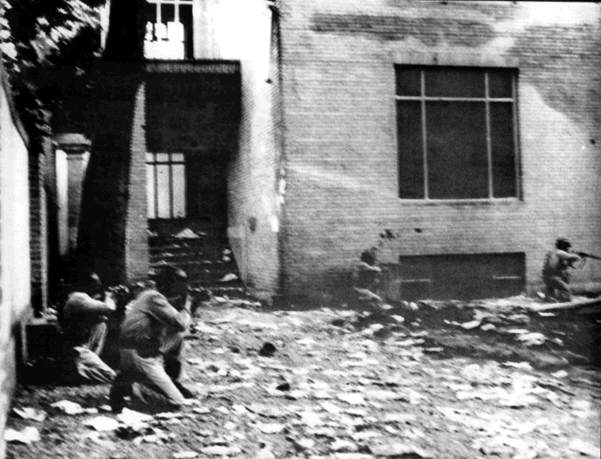
For the politically minded intellectuals of 1950s and 1960s, the rifle was a symbol of the Shah’s repressive rule. It can be seen in the pictures of soldiers attacking the house of Dr. Mossageq on the fateful day of 19 August 1953 (the infamous day of the US-British coup).
Soldiers attacking the house of Dr. Mossadiq, Aug. 1953
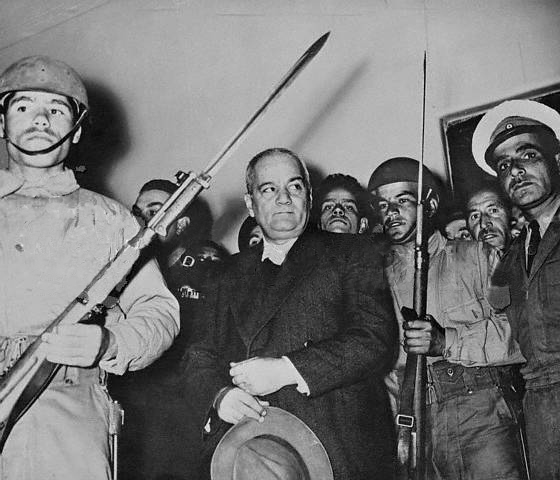
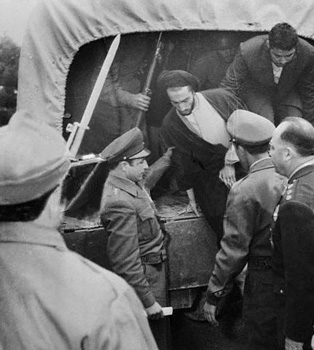
Gory pictures of executions of Tudeh party officers in the Chitgar shooting range in 1955 shows defiant young officers strapped to the stake minutes before execution, with Brnos present to do the task. When Navab-Safavi, the fundamentalist leader of Fadaiian Islam was arrested, Iranians saw his pictures being transferred to a prison under bayoneted Brnos.
Dr. Yazdi, the Tudeh party leader, after arrest in 1953, surrounded by soldiers with Brnos
Navab-Safavi, the Fadaiian-e Islam leader arrested
You can see it in pictures of 15 Khordad (June 1963) uprising in Tehran. In fact, when the Shah’s opposition cried against his “rule of the bayonet”, it was the sight of these Brnos with their bayonets attached that they were referring to.
Ordinary people usually had their first encounter with the rifle while passing a guard in the street, or when they were (willingly or otherwise) recruited for the military service.
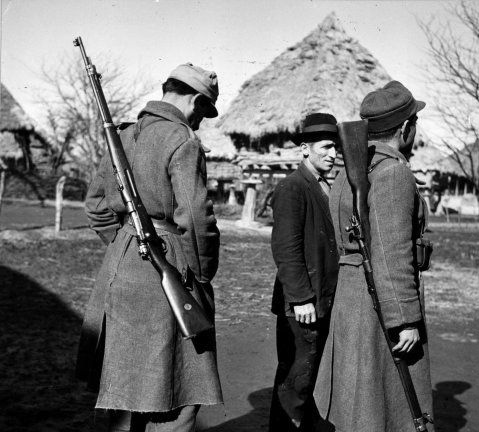
A deserter is taken to military service in a Gilan village, circa 1955
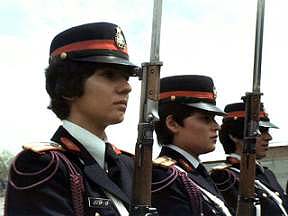
In the 1960s the semi-automatic US made M1 replaced Brno in the Iranian army, and Brno use was confined to the gendarmerie and the game wardens for a while, before it was decommissioned from active use. In the 1970s it was used mainly in ceremonial occasions.
Girl cadets of the police academy in graduation ceremony, circa 1972
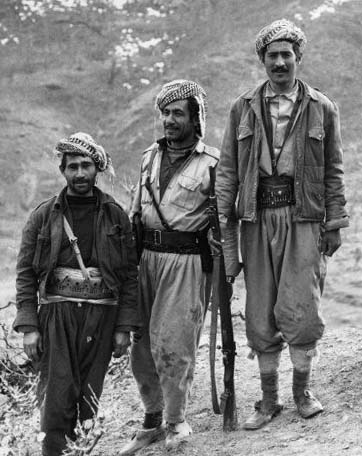
During the 1979 revolution, the gun reappeared in the hands of the revolutionaries and tribesmen, who never abandoned their Brnos. When Kurds challenged the newly established Islamic government, they used mostly modern assault rifles. But Brno still had a use: The Kurds claimed that with special cartridges that can pierce 2cm of steel, Brno can down aircraft and helicopters.
Kurdish ‘Peshmarga’s with Brno
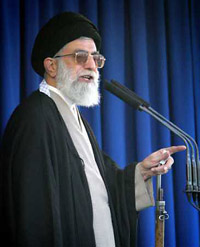
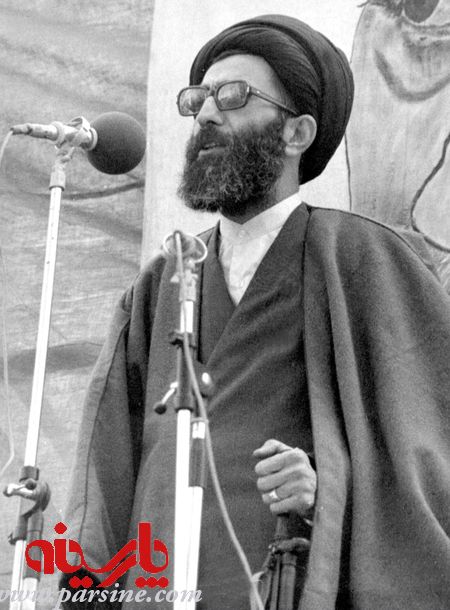
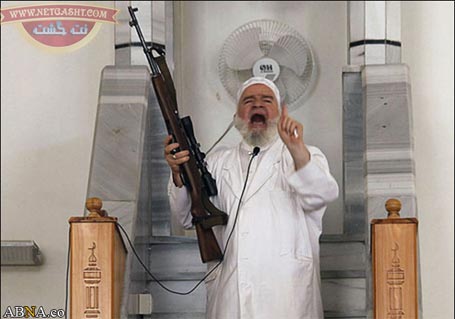
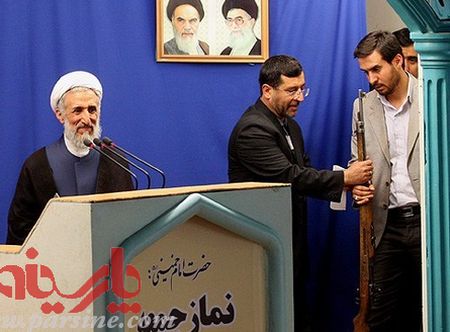
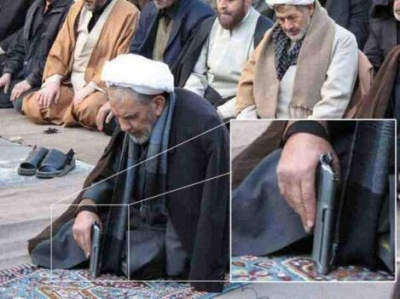
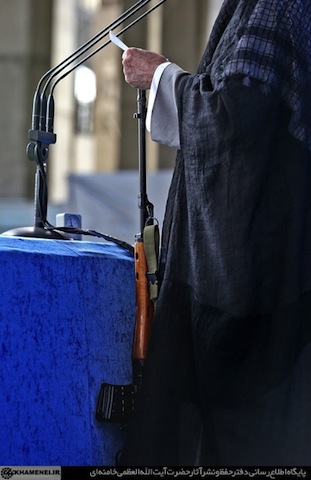
Besides the rebels, the Islamic government too had a use for Brno: It was, and is, used in official Friday prayer ceremonies. The speaker is required to have ‘the weapon of the day’ by his side, according to the tradition of the Prophet (he apparently used a sword).
A different news source, but this shows a handgun being held by an imam leading the Khutbah.Supreme leader Ayatollah Khamenei with what appears to be a Dragunov derivative. https://www.theblaze.com/news/2015/07/20/can-you-spot-what-irans-khamenei-was-holding-during-his-speech-on-the-nuclear-deal-the-mainstream-media-ignored-it
The most likely reason for its use in such ceremonies is that it is long enough for the speaker to hold it like a walking stick while he is standing and preaching. The Mauser brothers would have been happy to hear that their rifle would be considered a ‘weapon of the day’ a century later.
For people of my generation Persian Mauser, or Brno, brings back many bittersweet memories. The coup, the executions, the NoghlAli (Iranian version of GI Joe) with his Brno in a watch-cabin, the pain of being hit by its butt in street demonstrations, the greedy gendarme guy looking for a chicken to steal, the poor poacher in a remote town using the old rifle to feed his family with meat once in a while. You see it in the old newspaper pictures of battles, ceremonies, riots and executions. It is a piece of history.
Thank you Ali Parsa for contributing to Silah Report!
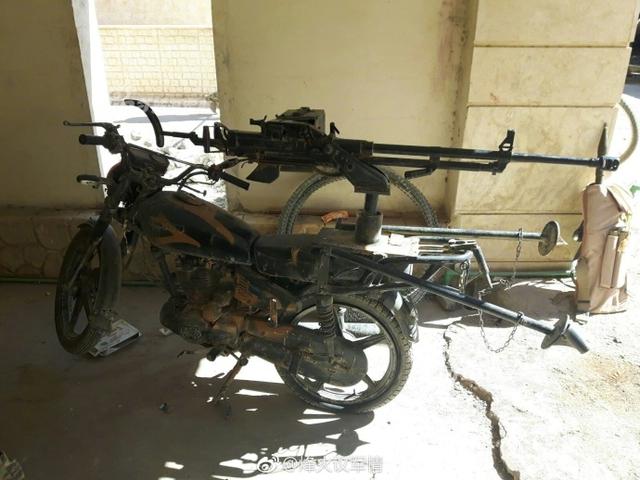
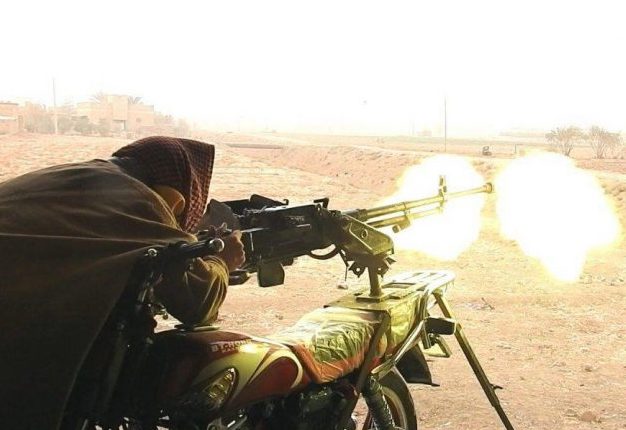
Notice how the bipod legs fold onto the back rack of the motorcycle while the Chinese 12.7x108mm Type 87 is pointed to the rear to be transported easier. Now, it would appear that any driver on the motorcycle would have to push the machine gun to the left or right while he is driving it
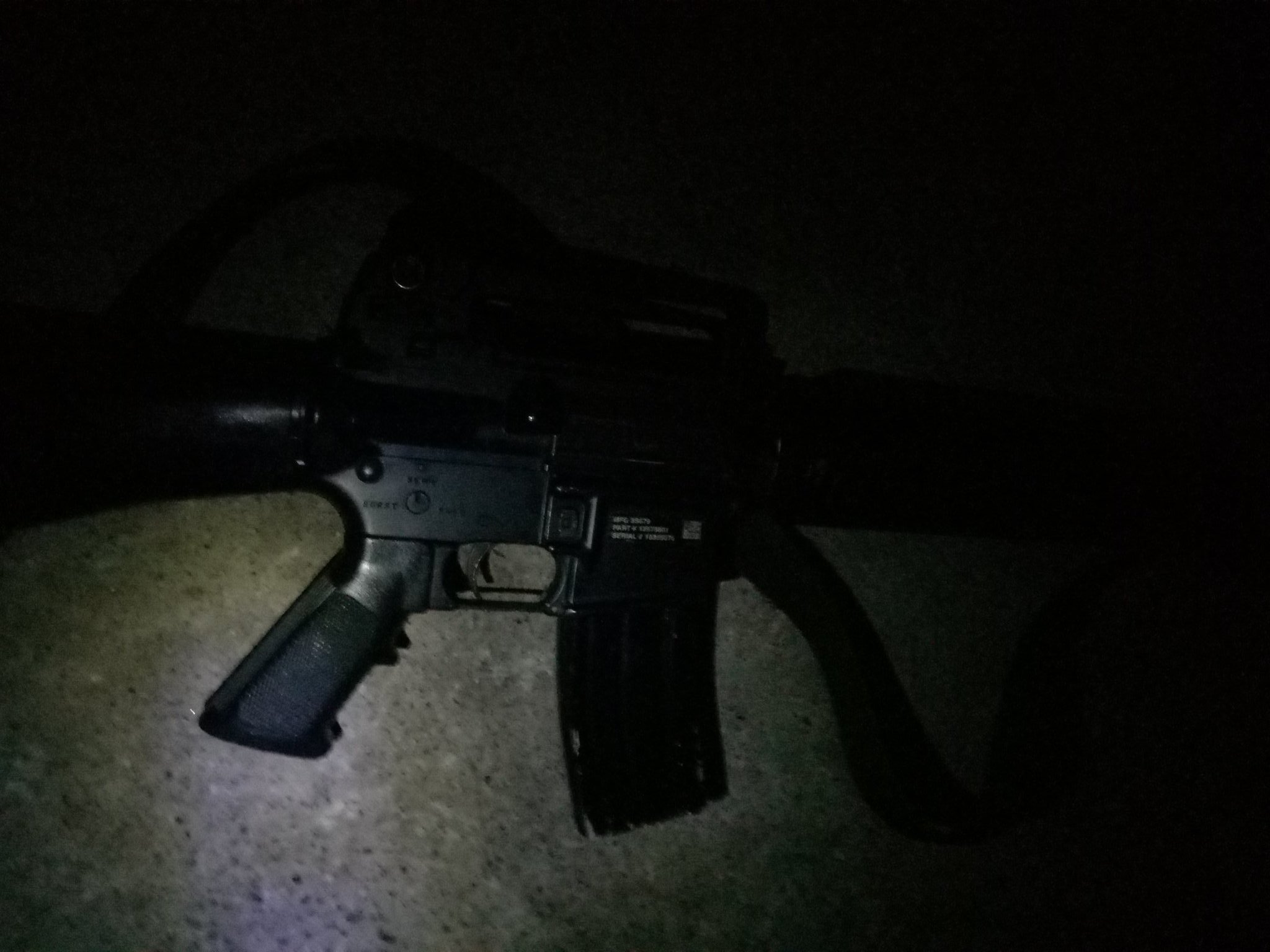
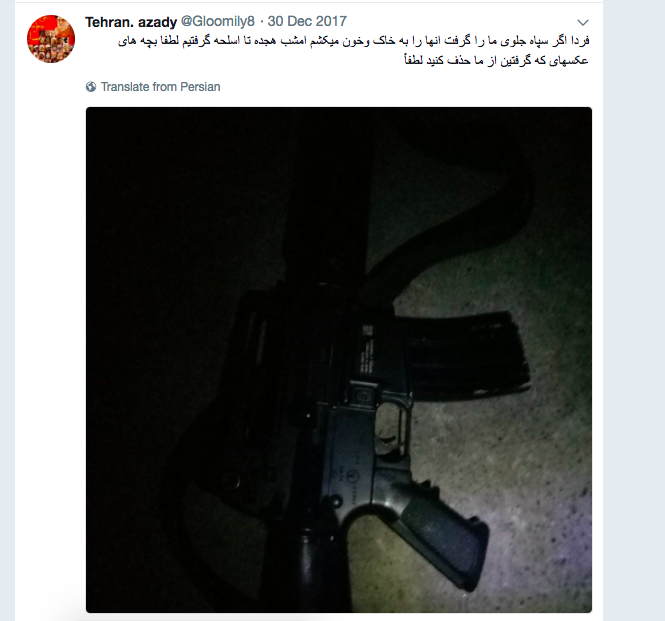
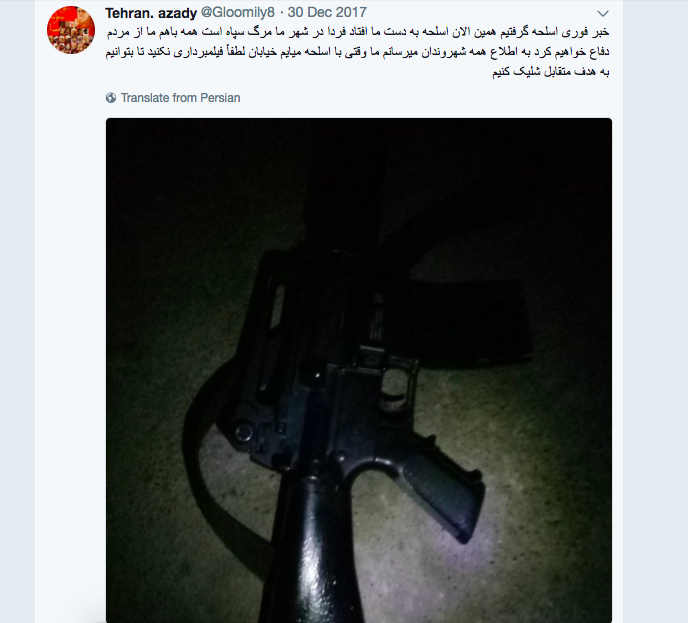
A Twitter account by the name of Tehran. azady/@Gloomily8 (Free Tehran) has posted two posts and accompanying photographs on their page depicting what appears to be an FN Herstal, former U.S. Government 5.56x45mm M16A4 Service Rifle. It is not known or confirmed if the image is actually from Tehran for that matter, but a cursory Google Image Search revealed this Twitter account appears to have been the first online poster of this particular photograph. It would also appear that these photographs are actually screenshots from a motion picture, due to the apparent movement of the light source.
Neither post makes much mention of the weapon and is more concentrated on what is going to be happening or will be planned to happen in the future in regards to the protests.
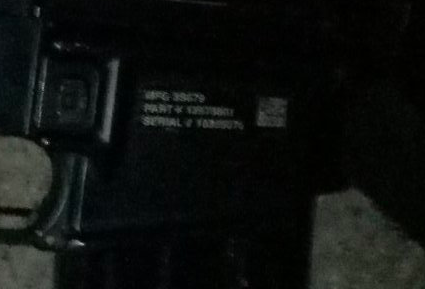
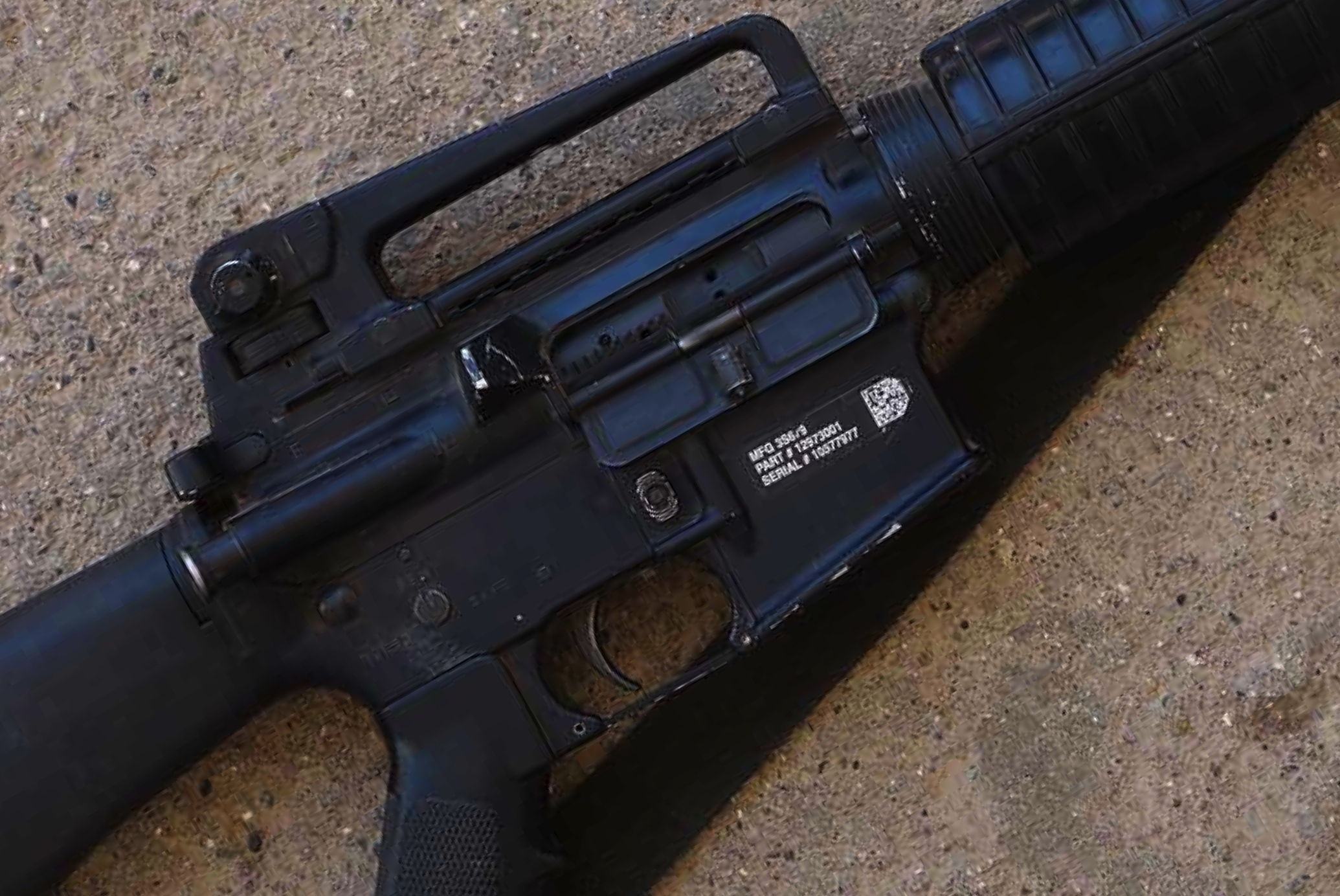
Notice the SKU imprint-
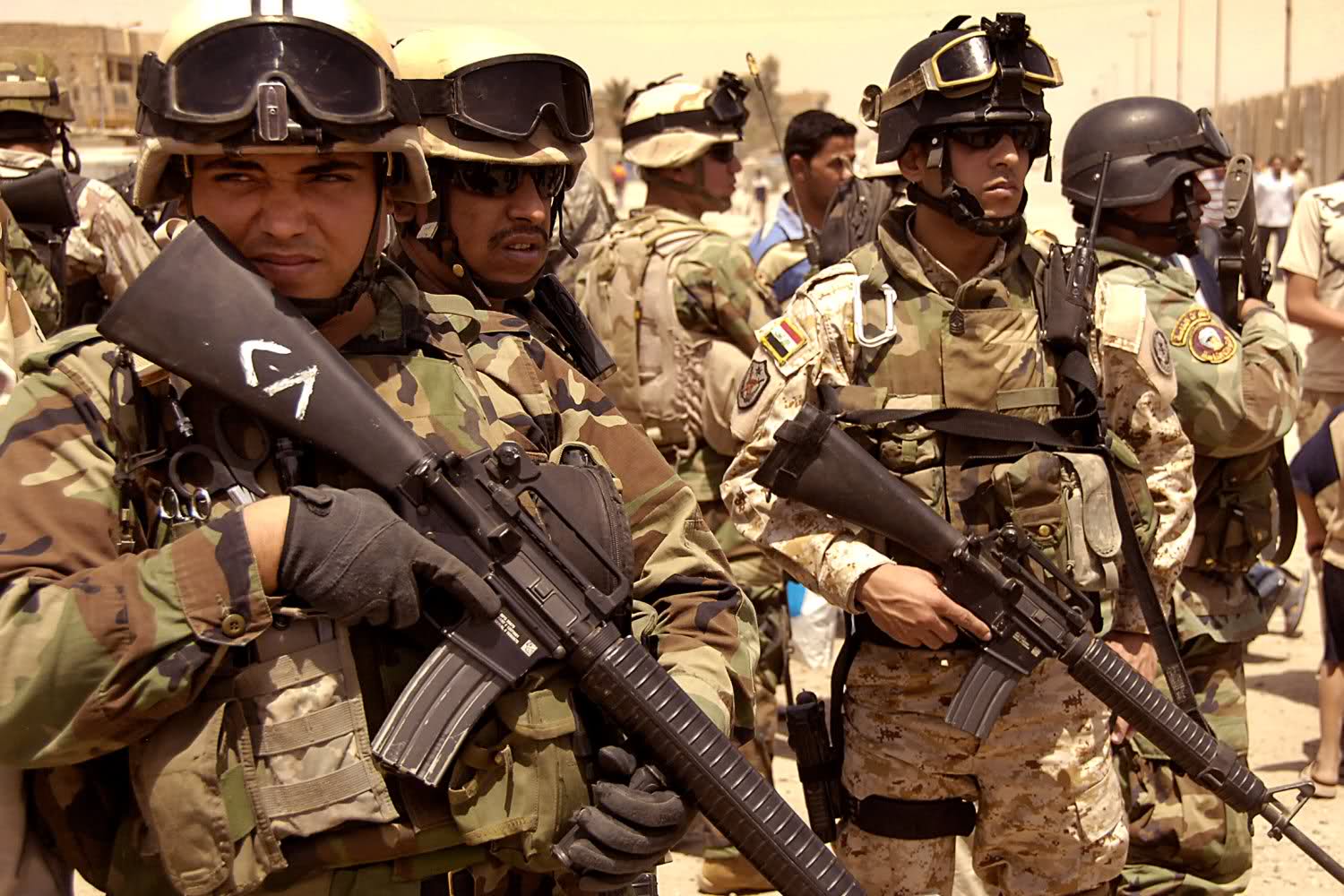
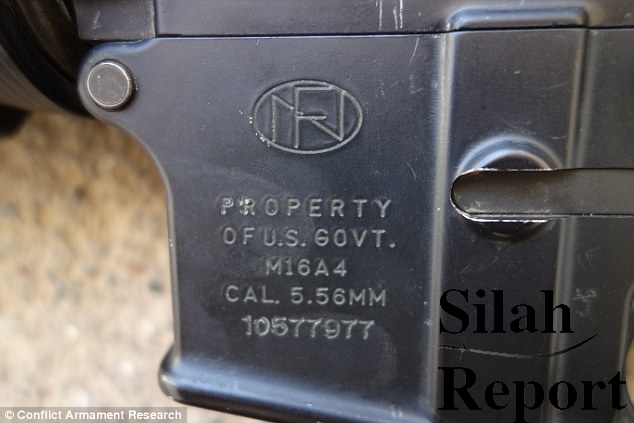
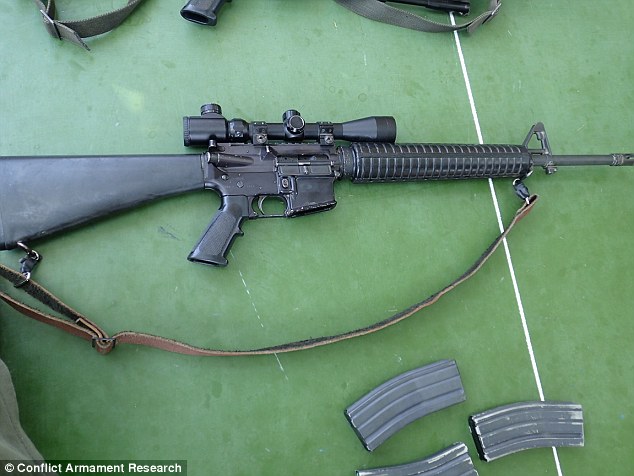
It would appear that this M16A4 is most likely diverted from U.S. Foreign Military Sales to Iraq. What could possibly confirm this is the design of the handguard. We know it is an M16A4 due to the M1913 Picatinny Rail a part of the upper receiver, of which an “A2” carrying handle is fastened to. What is being left out however, is the design of the handguard. If it is a Knight’s Armament “A4” handguard, it would be a very rare sight indeed. But most likely it is an “A2” style with the circular handguards and vertical vent ports. The “Hybrid” M16A4/A2 rifles were previously sold to the Iraqi Army-
And were subsequently seen/captured by the so-called Islamic State-
Source- Conflict Armament Research ReportSource- http://www.dailymail.co.uk/news/article-2749197/ISIS-arming-US-military-hardware-wage-jihad-Middle-East-seizing-weapons-Syrian-rebels-Iraqi-soldiers.htmlSource- http://www.dailymail.co.uk/news/article-2749197/ISIS-arming-US-military-hardware-wage-jihad-Middle-East-seizing-weapons-Syrian-rebels-Iraqi-soldiers.html
It should be noted that M16A4s are in service in Afghanistan with the Ministry of the Interior, in addition to M4/M4A1s are in service with numerous Afghan forces as well. But the amount in service in Afghanistan doesn’t seem to be proportional to the amount of M16A4s with the Iraqi Army, or circulating on the Iraqi black market.
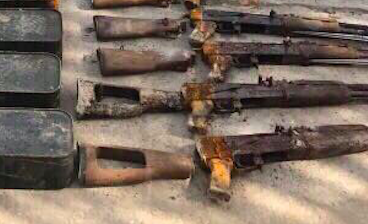
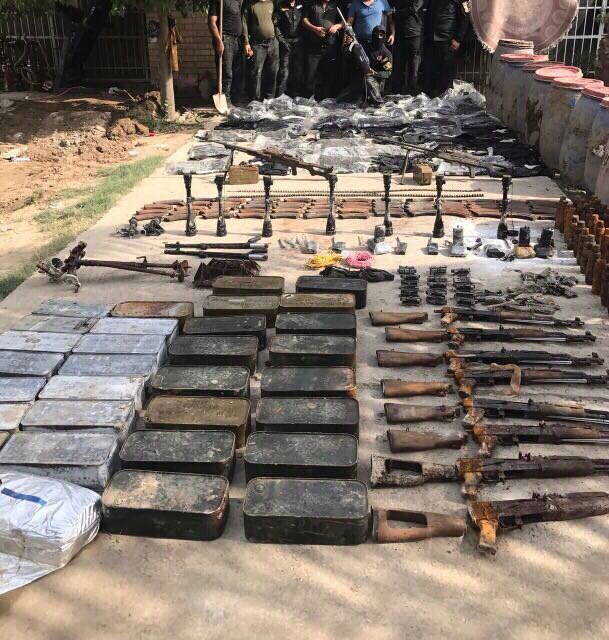
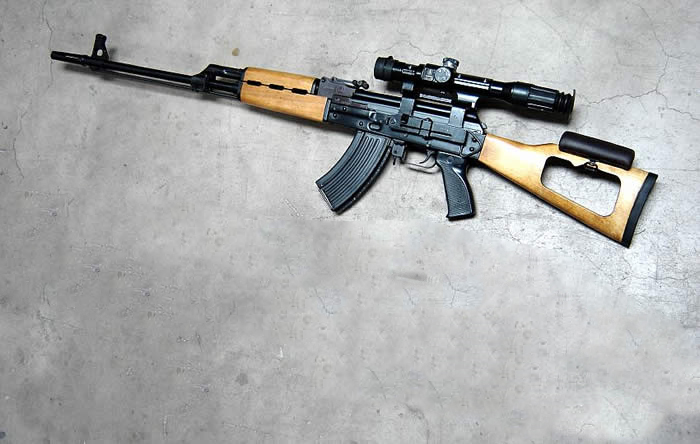
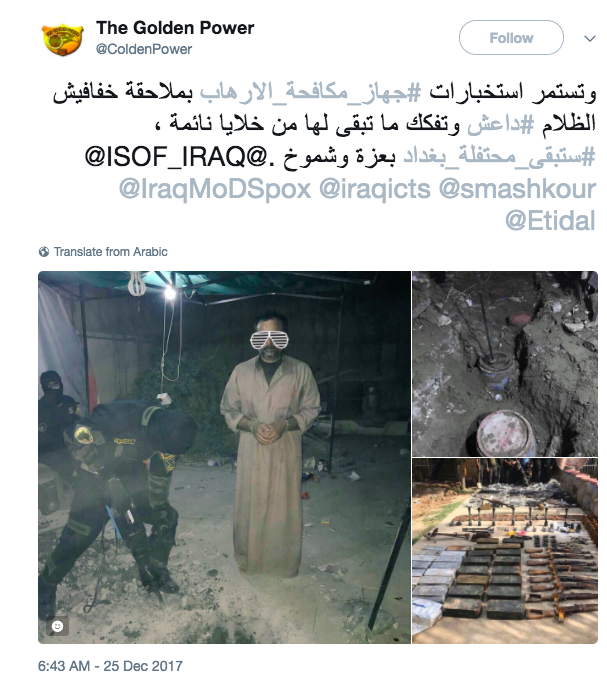
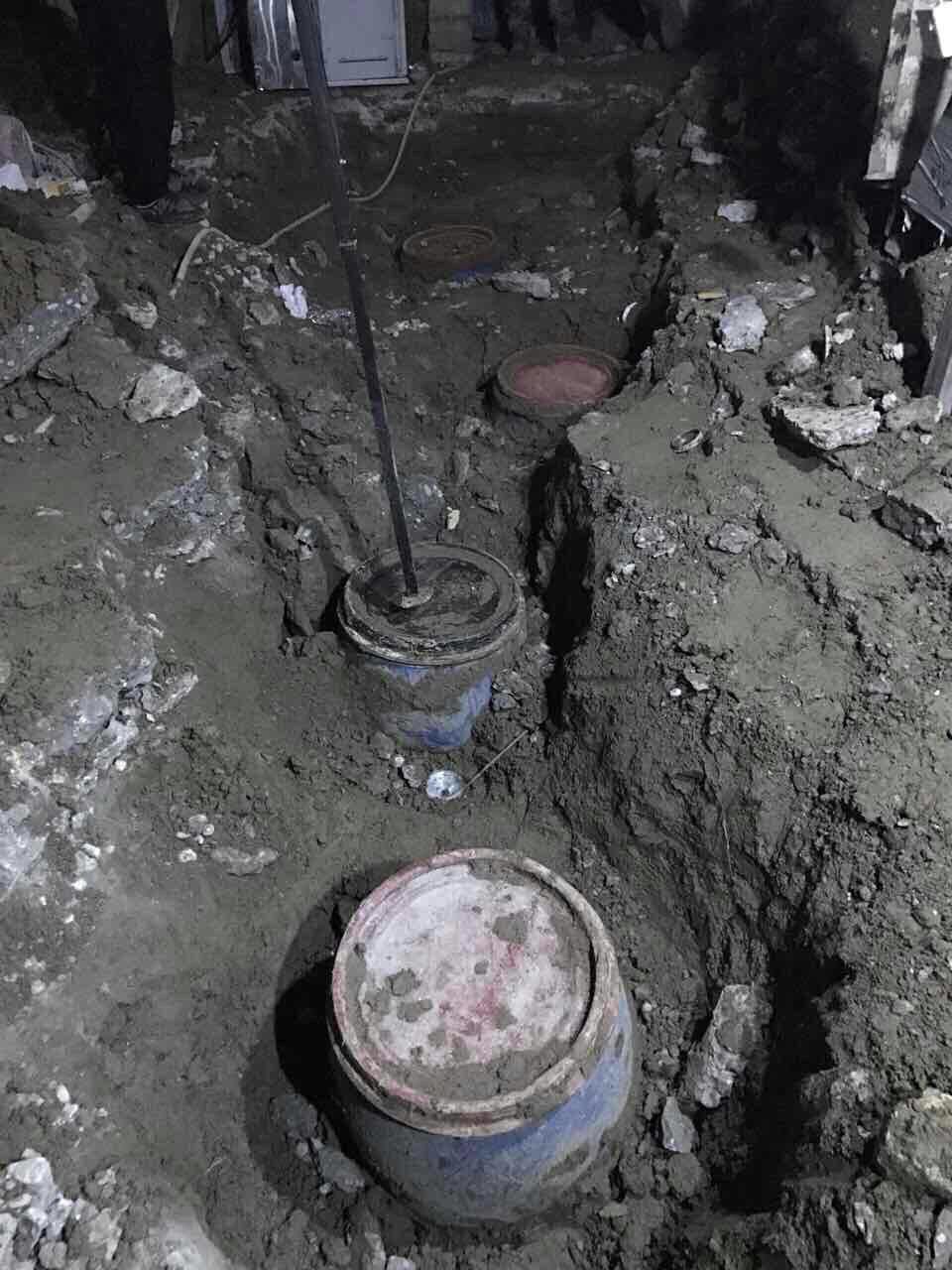
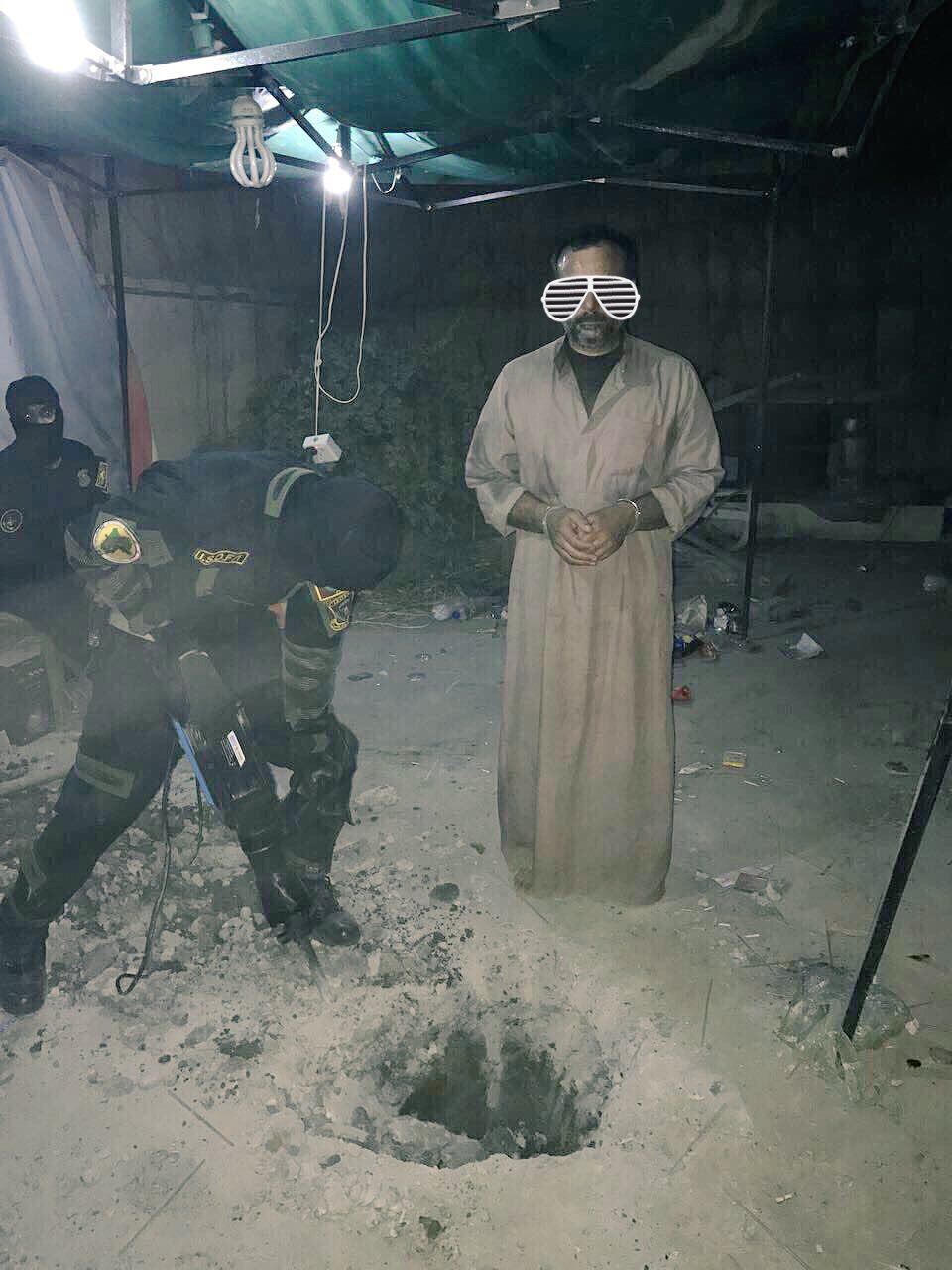
At a recent weapons cache that was turned up by Iraqi Counter-Terrorism Forces in Baghdad, what appears to be two Iraqi Tabuk Sniper rifles were among the rifles discovered in the buried cache. The Tabuk Sniper is uniquely identified by the cutout in the rear stock. Based on the Yugoslavian M70, the Tabuk sniper is a variant of the standard Tabuk rifle with full wooden stock, and the shorter version with a folding stock. It is unique among designated marksmen rifles in that it is chambered in 7.62x39mm, a round not known for its accuracy in the years it was adopted and used.
The two Tabuk Snipers in this photograph are distinguished by the aforementioned stocks and the three vents in the wooden handguard. On the above rifle there does seem to be some doubt as the receiver looks to be milled instead of stamped due to the magazine cut out portion. In addition, it is difficult to tell if the pistol grips are plastic or wooden, a key identification point about the Tabuk and M70 series. The stocks themselves are actually reversed, you are looking at the left side of the stock when it should have been the right side if aligned properly with the rifle.
Nauman Afzal is a Pakistani based writer, and writes at his own very successful blog, My Random Ramblings as well. This is his first article for Silah Report.
In our part of the world, weapons have always followed a rather strange evolutionary path, if we talk about their development only. Darra Adam Khel or as I would like to call it, “Our Wild West” is the place where one can get a copy of almost any weapon made, at a price. The evolution of weapons here has always depended on the type of ammunition being used. In other words, it was the availability of a particular caliber of ammunition that dictated its development, unlike other places. That is akin to making cars on the availability of a certain kind of fuel. So in the 1960’s and 1970’s .32 ACP and .32 S&W Long were available in wide abundance throughout Pakistan. And one could either buy a foreign made weapon, which off course was expensive (as it is still today) or a Darra made revolver, which were available and still are being produced.
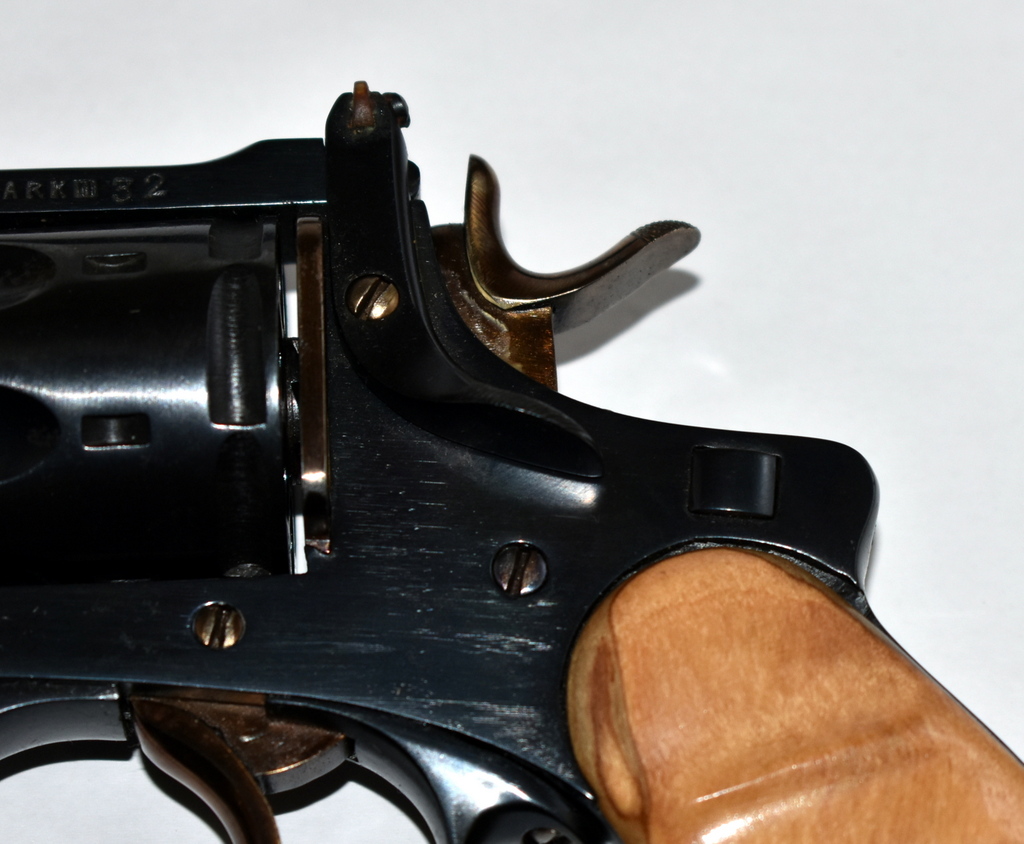
This particular piece is around 40 years old and is quite well made and kept. In those days many a “Khan” could be seen wearing this type of revolver across their chest with a dozen or more rounds inserted in the very belt holding it in place. Semiautomatic pistols were expensive and rare, so the de-facto choice was a Darra made wheeler, in .32 S&W Long, made to perfection. The local gunsmiths (who now have improved to the extent that they can and are in fact making copies of CQA the Chinese equivalent of AR15) perfected their skills to make excellent quality revolvers.
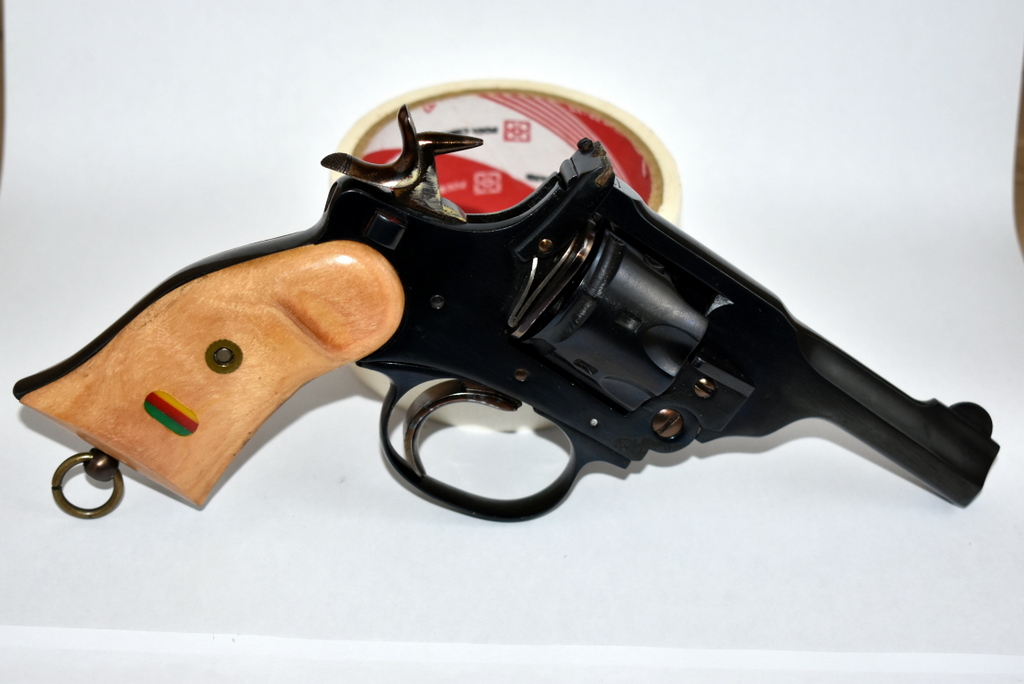
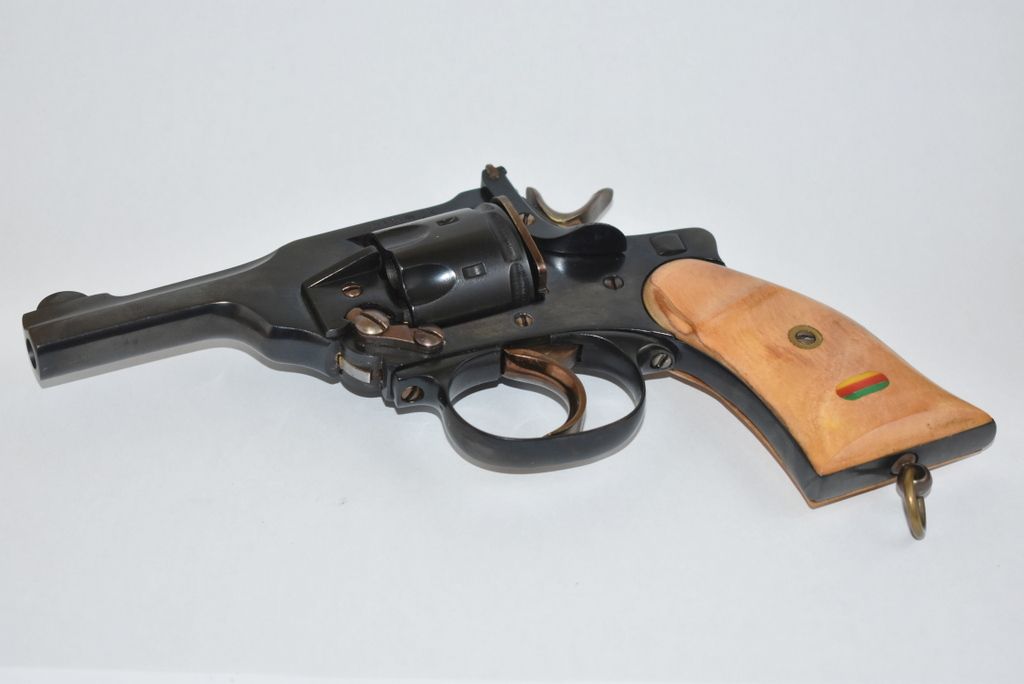
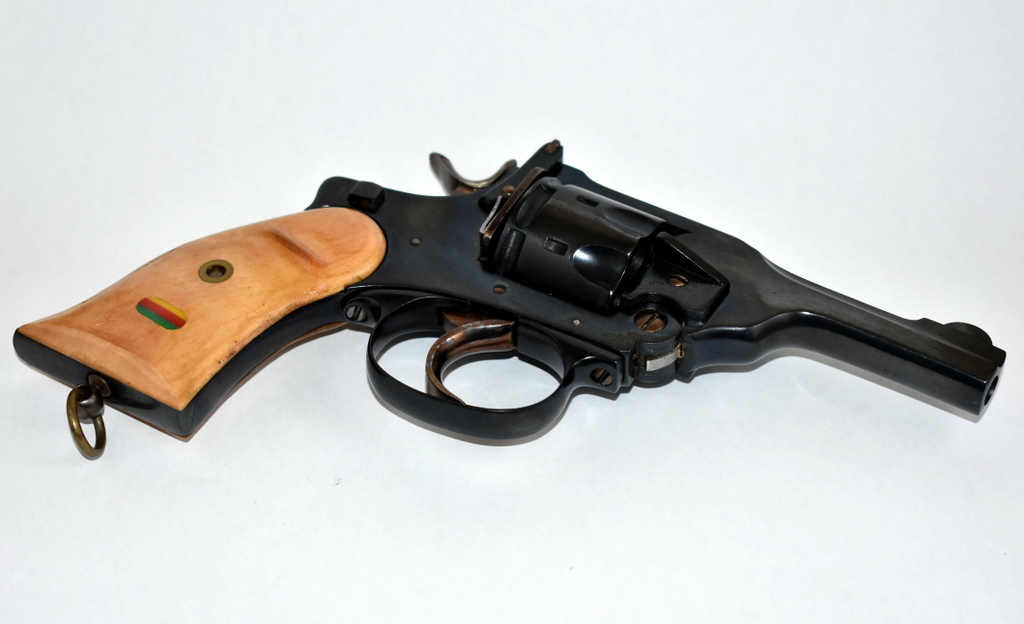
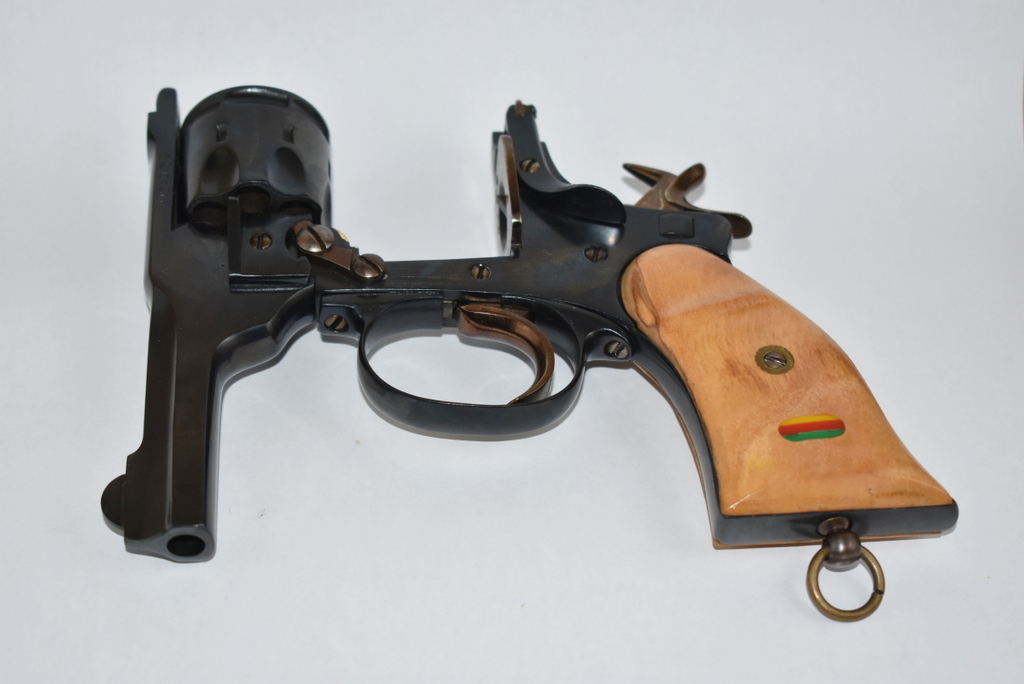
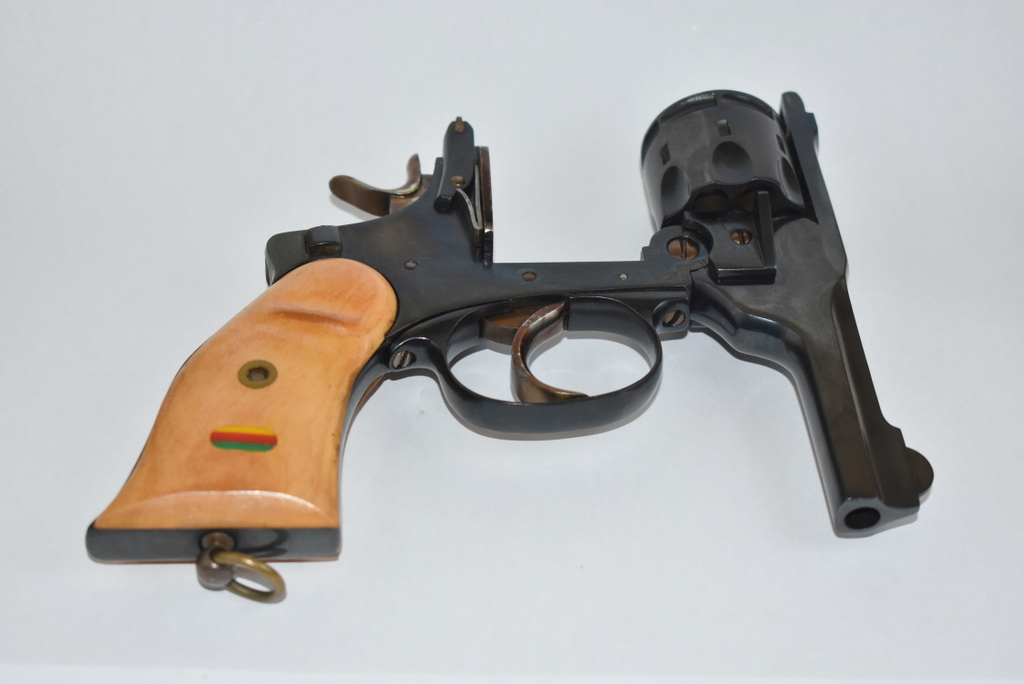
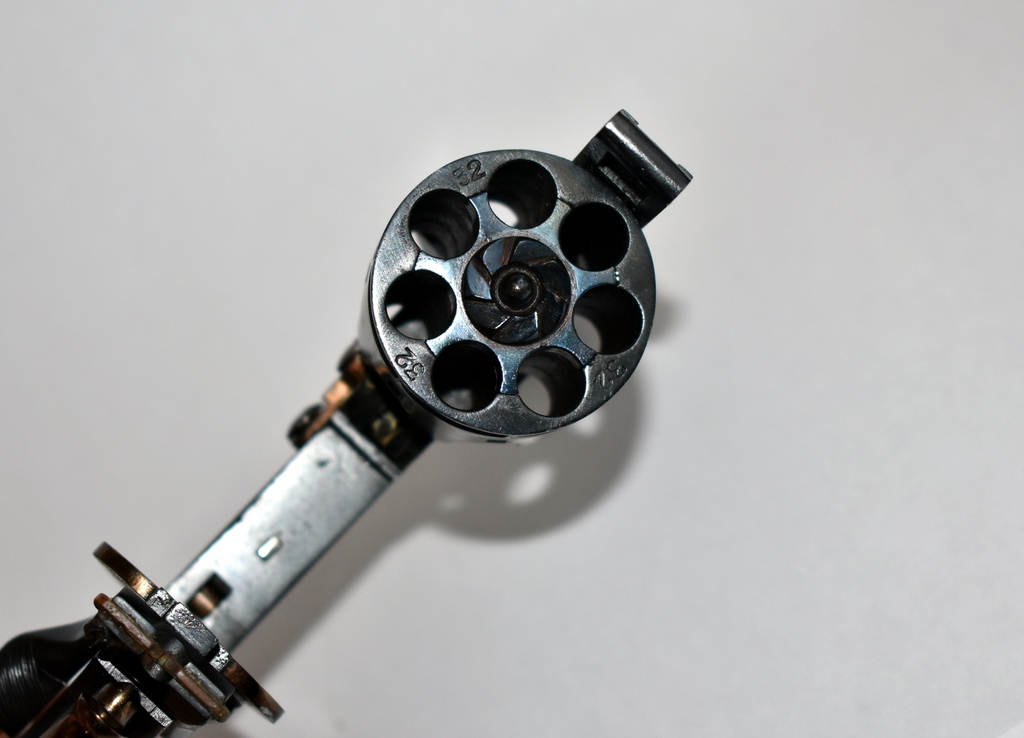
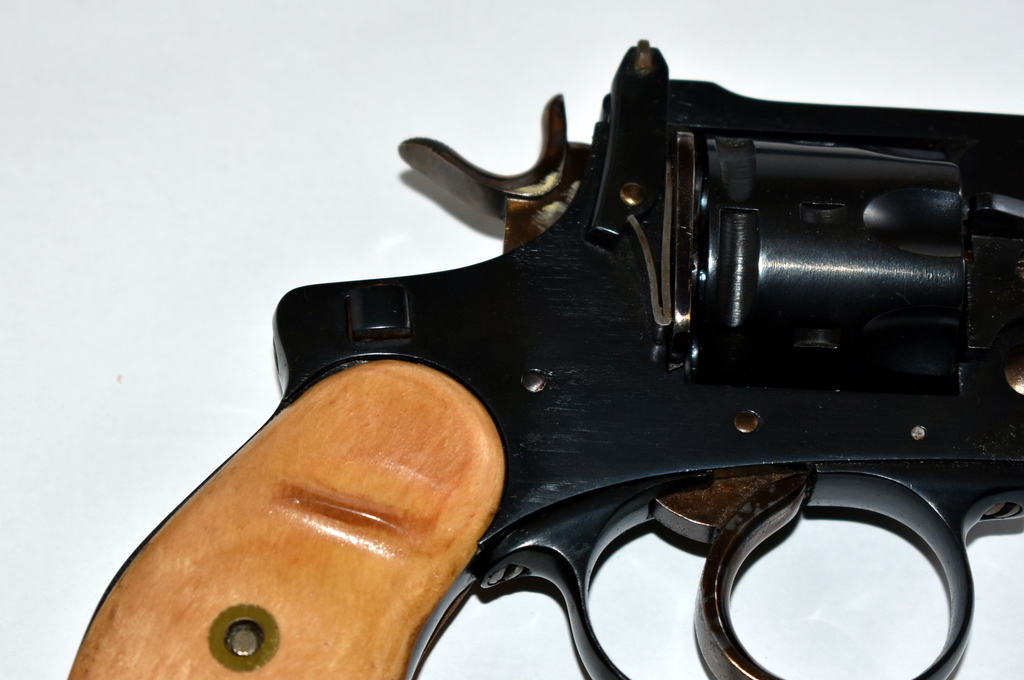
This little piece is an exact copy of the .32 Webley and Scott (Mark IV precisely), a top-break, seven shot revolver, single as well as double action brass hammer, a brass trigger and safety.
Caliber:.32 S&W Long
Weight:720 grams approx
Action:SA/DA
Cylinder Capacity: 7 shots
Barrel length:3.5”
Front and Rear Sight: Fixed
Top Break: With extractor for removing cartridges from the cylinder
Safety: Manual, Lateral Safety just behind the hammer
A dozen screws all along the body hold it in place, grips included. This revolver has its fair share of brass used in it; the hammer, trigger and the rear sight plate are made out of brass which gives it a shiny look when polished. The hammer, as well as the top-break lever, are knurled for a better grip.
Observe the Mark IV 32 marking over the left side on top of the cylinder, which is quite reminiscent of the original Webley & Scott. Other than this there are no markings or writings on the body. The hammer itself is pointed much like a nail or needle quite unlike the original Webley.
The revolver weighs 720 grams approximately, and in this size it is a good choice for a carry weapon, even nowadays. I have seen a few newer versions of this revolver selling for around Rs. 1500 that makes it around $ 15 plus or minus few today. (But off course .32 S&W Long is expensive here. ) The newer versions lack brass and hence give it a finish that appears quite dark in texture.
Frankly, I never tried disassembling one recently, but since everything is held in place by screws taking it apart is not an issue. But then there is not much point in taking apart a revolver. This particular piece has its grips changed, the original ones are made of poor quality plastic. The wooden grips were custom made for $3, both sides. Marking 32 on the inside the cylinder indicates its caliber.
These revolvers are known to stand out in reliability, a testament to the good quality workmanship in Darra. Since the advent of semi-auto pistols and the craftsmen ability to make good copies Revolvers are less in demand, still one can find them in the market. Somehow people tend to think that revolvers are inferior in performance as compared to semi-auto pistols.
This particular piece has been in my family and has passed hands from one generation to another, with no more than a hundred rounds fired through it. It now has an emotional value attached to it, and is held in much reverence amongst gun enthusiasts.
The elaborate activity known as exhibition drill within the United States is quite unique in its execution. It evolved out of a want to push the envelope when it comes to Drill and Ceremony (shortened to D&C) competitions. For many decades, militaries all over the world have held D&C competitions, even down to the academy cadet level. The United States was no different, with the tradition possibly originating from Prussian General Friedrich Wilhelm von Steuben, who is credited with teaching D&C to American troops at Valley Forge during the Revolutionary War. However, it was only within the last century that competitions took on a more flashy or exhibition flare, with both armed and unarmed portions. The reasons for this could be many, but the author speculates that it has to do with D&C becoming less important on the battlefield and more of a measure of a unit’s discipline in the rear. For example, doing exhibition drill in the 1800s would probably be met with stern disappointment, because this was still the age where actual battles were won and lost due to a unit’s ability to maneuver in formation on a battlefield.
Today exhibition drill teams exist at every level from High School JROTC programs, Collegiate level ROTC programs, Military ceremonial units such as the Marine Corps’ Silent Drill Platoon, and even professional performance teams such as New Guard America. One of their performances is shared below.
But back to origins. The general beginnings of what we now know to be called “exhibition” drill are claimed to be a cadet unit called “Pershings Rifles” still active today at a university in Nebraska. Whether or not this cadet unit performed anything near to what would be labeled as exhibition, the research isn’t very clear. But the general consensus is that modern exhibition drill really took off in the years following the Vietnam War, growing to a huge network today.
However, before the Pershing Rifles, there was Hajji Sherif/الحاج شريف (normally colloquially as Hadji Cheriff). This name was most likely a stage name or something an American audience could easily pronounce. The first part, Hadji/Hajji is indicative of this man making the Haj pilgrimage to Mecca, and the second part Cheriff/Sherif, means “Noble” in Arabic. Although Sherif might have been apart of the man’s name, it really doesn’t give us much as to his family name, what part of the MENA region he was from, etc…
This video clip that was copyrighted by Thomas Edison in 1899 (he also had another clip of Hajji Sherif performing a dance at the inventor’s studio) specifically label Sherif as the “Arabian” Gun Twirler and recorded at what is believed to be the Midway Plaisance during during the World’s Columbian Exposition of 1893, taking place in Chicago. It shows Sherif effortlessly spinning what appears to be a muzzleloading Model 1855 Springfield .58 Caliber rifle.
The only other known video (described earlier) of him is also online-
But in this short movie that would have been aired or published as a silent movie, we see exactly what goes on today on exhibition drill decks across the United States. As the drill website, The Nationals notes–
[He is performing] a basic aerial toss (two, 1-1/2 over-hand thrown from the firing hammer) and also an over the shoulder technique with a rather remarkable display of over-the-head drill (OTH), and ends right after an under the leg inverted spin.
A bearded man performs a rifle twirling act on a stage with a painted backdrop of a city street corner. He wears a white turban and a dark two-piece costume of tunic and baggy pants that narrow at the knees; perhaps the costume of an Arab infantryman. The tricks he performs include throwing the spinning rifle in the air and catching it; twirling the gun in front of him, above his head, behind his back, to the side of his torso, and under his leg; and twirling the rifle as he switches hands.From Edison films catalog: An interesting exhibit by Hadji Cheriff, of the original Midway Plaisance. Twirls his rifle over shoulder, behind back, under leg, both hands and one hand. 50 feet. $7.50.
50 feet is in reference to the overall physical length of the roll if you were to purchase it for $7.50 at the time of the short’s airing at the turn of the century in 1899.
Hadj Cheriff was both an Arabian knife juggler and an acrobat. He had little to do with filmmaking of any sort, as his debut was in the 1894 Edison short film “Hadj Cheriff” which features him performing part of his act in Edison’s Black Maria studio. Cheriff later appeared in another Edison film, “Arabian Gun Twirler” from 1899. These two shorts are apparently the only films he took part in; thus, Cheriff remained a minor part in filmmaking.
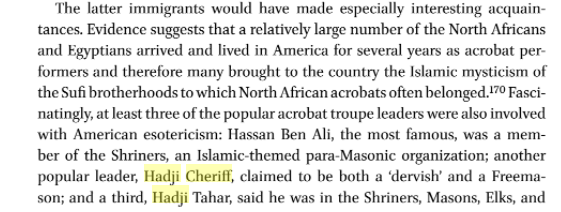
We have these references in The History of Conversion to Islam in the United States Vol II, which suggest that Sherif was a circus performer, and might have been Egyptian, and even a Sufi. Some Sufi religious orders are quite known for various practices that put them in a trance-like state, most famously the Whirling Dervishes but they number very little even in Turkey. From the book-
New York Clipper, July 19, 1890, pp. 291, 294, 295, 301, 304…. Hadji Cheriff, Arabian gun juggler
The real question that I think is important to answer as researchers is where did Hajji Sherif get the idea of twirling an unloaded rifle to entertain a crowd? One body of thought is that it might have come from his Sufi roots (if he was Sufi to begin with). Another distant train of thought is that it might be related to Yowla/اليولة, which is a traditional dance routine practiced in the Gulf Countries today, but can be traced back many years. Although not often using full-size rifles (imitation ones are used), and often using swords, there could be a connection. An important here is that traditional Yowla puts much more emphasis on the dance rather than skill with the rifle. The third option is that Sherif came up with the idea on his own of course.
Traditional Yowla performance-
https://www.youtube.com/watch?v=PUvX-1g9F7M
This is an example of Yowla with muzzleloaders today, similar to what Sherif would have had-