The Muscat Martini: Martini Pattern Rifles in Oman

This guest article is written by Christopher Cowan, an avid reader and supporter of Silah Report.

Alongside Brown Bess muskets and Lee-Enfield pattern rifles, Martini pattern rifles are perhaps one of the most iconic and ubiquitous guns of the British Empire. First fielded in the 1870s, the Martini-Henry saw service in all corners of the Empire, from the plains of the Serengeti to the peaks of the Hindu Kush.

The Martini-Henry Rifle. Photo courtesy Creative Commons.


A single shot rifle, the Martini Henry utilizes a falling block action. It is chambered in the rather burly .577/.455 Martini Henry, a .45 caliber round-nosed slug fitted into a necked-down .577 Snider casing. The Martini Metford and Martini Enfield were the natural progression of the platform. Both firearms utilize the same falling block action, merely rechambered and/or rebarreled in .303 British. By the time they were fielded in the mid 1880s, they were of little practical use to frontline combat units given the adoption of the magazine-fed Lee-Metford (1).

That said, both the Martini Metford and Martini Enfield saw continued use among local colonial forces, as well as by civilians as sporting rifles (2). Perhaps owing to its proliferation, reliability, and simplicity, Martini-pattern rifles existed long past their official retirement as a service rifle. Widely manufactured and traded across the Middle East and South Asia for a good deal of the 20t h century, these rifles saw usage among irregular fighters as late as the Soviet invasion of Afghanistan. While likely the last time Martini-pattern rifles saw any serious usage in armed conflict, examples continue to turn up on occasion (3).

The proliferation of Martini-pattern rifles throughout South Asia is a subject for another article if not a book. Beyond Afghanistan and Pakistan, Martini-pattern rifles have remained prolific in the Sultanate of Oman. Martinis are as common a sight in souvenir shops in Muscat’s Sooq Mutrah as they are for sale alongside other assumedly functional firearms in Nizwa Sooq.

Martin-pattern rifles for sale alongside other firearms in Nizwa Sooq, Nizwa, Oman. Note modifications to the rifle in all three photos, including the polished receiver and refinished stock and handguard of the latter example. Photos by author.

Given Oman’s history, the widespread presence of the Martini-pattern rifles is understandable. Oman has historically occupied a major crossroads of Indian Ocean trade; at one point the Omani Empire itself stretched from Zanzibar off the coast of modern-day Tanzania to Gwadar, modern-day Pakistan. At the center of this empire was Muscat. Even following decline in imperial power and prestige, Muscat remained an important center for trade well into the early 20t h Century. Trade in all manner of goods, including weapons, was largely unrestricted; Muscat subsequently grew into a major regional hub for arms trading at the turn of the century (4).

While the early Twentieth Century marked a high-point in the proliferation of Martini-pattern rifles in the Arabian Peninsula as well as South Asia, Martinis remained popular weapons in Oman until rather recently. There are cases of them being used to hunt the now-protected Arabian Oryx in the 1960s, as well as documented cases of their use by irregular fighters in the Dhofar War during the 1960s and 1970s (5).

Al Wahibi Bedu man with his Martini-pattern rifle. Note the ornate barrel bands as well as the khanjar – or dagger – affixed to his belt. From “Bedouin: Nomads of the Desert” by Alan Keohane.

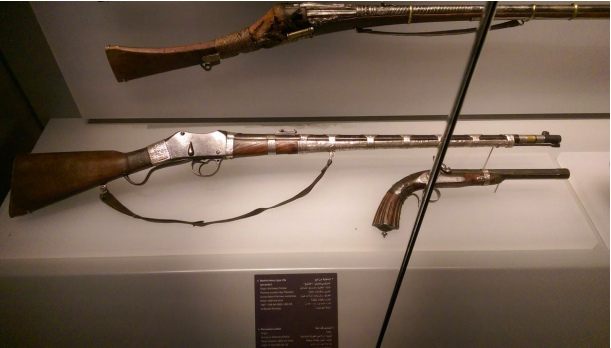
To this day, it is possible to occasionally see Martini-pattern rifles toted for ceremonial as well as practical purposes. In Dhofar, for example, shepherds can be observed carrying Martini-pattern rifles to protect their animals from predators. As a ceremonial piece ornately decorated Martinis are a commonplace, as are their accompanying cartridge belts. Both are often highly decorated, and frequently observed for sale to tourists. Good examples of both can also be observed in the National Museum in Muscat.

Examples of Martini-pattern rifles and cartridge belts at the National Museum in Muscat, Oman. Photos by author.

Despite being outdated by modern firearms technological and doctrinal standards, the Martini-pattern rifle has persisted long past its official military retirement in both a practical and cultural capacity. There just as much to be said of the simple elegance of the design as there is the skill required to use one effectively. Likewise, the continued prominence of the Martini-pattern rifle in Arabian firearms-culture alongside other weapons speaks to the eminence of the rifle.
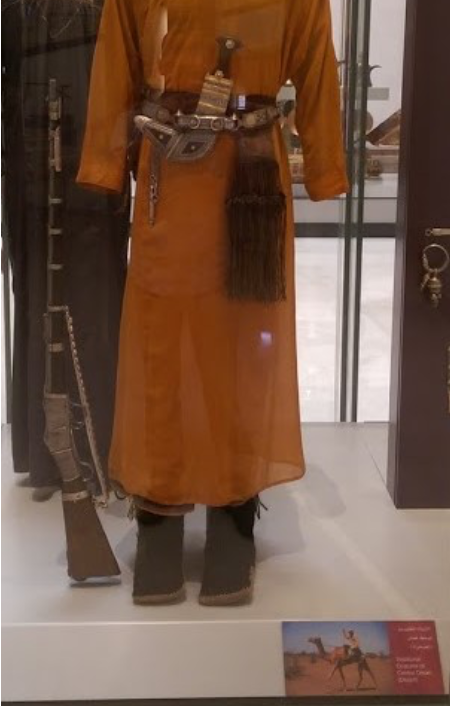
Various examples of Martini-pattern rifles and cartridge belts at the National Museum in Muscat – including alongside the traditional garb of central Oman. Photos by author.

Sources

(1) Rifles and Machine Guns
(2) Rifles and Machine Guns
(3) https://atwar.blogs.nytimes.com/2010/12/10/rifles-of-advanced-age-remain-in-use-in-afghanistan/

(4) R.M. Burrell 10; Arming the Periphery 116 5 Oryx Martini; 9781780969053

Works Cited

Burrell, Robert M. “Arms and Afghans in Makrān: an episode in Anglo-Persian relations 1905–1912.” Bulletin of the school of oriental and African Studies 49, no. 1 (1986): 8-24.

Cashner, Bob. The FN FAL Battle Rifle. Botley, Oxford: Osprey Publishing, 2013.

Chew, Emrys. “3: The Arms Trade in the Western Indian Ocean.” In Arming the Periphery: The Arms Trade in the Indian Ocean during the Age of Global Empire, 98-159. Basingstoke (GB): Palgrave Macmillan, 2012.

Chivers, C.J. “One Way to Retire an Old Rifle.” The New York Times. December 10, 2010. Accessed June 02, 2018.

https://atwar.blogs.nytimes.com/2010/12/10/rifles-of-advanced-age-remain-in-use-in-afg hanistan/.

F, Nathaniel. “Jumping The Gun (Literally): Saudis Dancing With Guns.” The Firearm Blog. August 12, 2015. Accessed June 02, 2018. http://www.thefirearmblog.com/blog/2015/08/12/jumping-the-gun-literally-saudis-dancin g-with-guns/.

Fowler, Will, and Patrick Sweeney. The World Encyclopedia of Rifles and Machine Guns. London: Anness Publishing, 2007.

Keohane, Alan. Bedouin: nomads of the desert. Trafalgar Square, 1994.

Leung, Canice. “Jumping the Gun | Pictures.” Reuters. August 11, 2015. Accessed June 02, 2018. https://uk.reuters.com/news/picture/jumping-the-gun-idUKRTX1NTN7.

Loyd, M. “The Arabian oryx jn Muscat and Oman.” African Journal of Ecology 3, no. 1 (1965): 124-127.
The Voice of the Gun in Central Asia

This guest post was written by Marcello Fantoni, an avid reader and supporter of Silah Report.

“The question is not about the weapon, but the spirit in which you use it.”(1)

For those raised within the dichotomous paradigm of Westphalian war and peace, war is the end of sociability, the exhaustion of every social recourse. Likewise, when that war is over, and sociability is said to return the memories of fracture become encased in temporal and Cartesian distinctions, the material culture of conflict sequestered to the appropriate sterile cases in the vaults of armouries and museums. Yet, conflict is inherently and inescapably sociological (2). It is the birth of a new form of sociability, on the level of both the individual and the collective, and this is a relationship in which the material culture of conflict retains an agency beyond the moment of fighting itself. It is not a relic but becomes the assurance against repeat and symbolic of the new addition to the cultural history and citrisis of a society. We have seen time, and again that material culture is good for thinking, feeling and expression, even eating and drinking (3), but we must, however, remember that it is also for fighting.

Conflict and the conceptualising, organisation and negotiation of it are shaped by the society which engages in it, and the community itself in is turn influenced by it. Conflict and its material culture become inexorable parts of the society’s post-conflict identity, having a fundamental impact on the ordering of the post-conflict reality (4). In this change, the material culture which provided the means to act for the individual attains a symbolic position. It may bestow both a new social life and physical death. Through the analysis of how specific weapons have come to be identified with cultures and the role of conflict in that culture, we shall see that those weapons are far more than the nefarious amalgamations of elements, but intrinsic parts in the development, manipulation and organisation of a society from both the emic and etic perspective. The thick sociological (5) description of the tools which both create and destroy sociability. The voice of the gun.

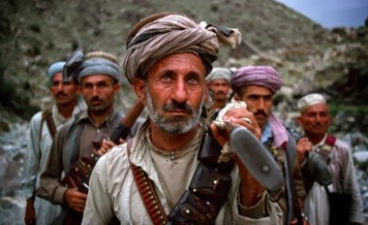
In Central Asia and the Caucuses, firearms have become ingrained in the identity of societies, for many as a response to the years of oppression under successive regimes, but also as part of customary law and social differentiation. But, the adoption of these weapons also reflects the rebirth of an often constructed martial tradition and ideology which often idealises of a fictive golden historical age as a central rallying point for future conflicts. Military traditions are written deep into their histories, and those histories are contained in the weapons which come to symbolise them. In Chechnya and Dagestan, the APS Stechkin machine-pistol has replaced the Shalt Kama traditional dagger and is illustrative of the independence movements of the 1990s and early 2000s as a high-status prestige item linked to the presidential guard of Dudayev and Maskhadov. But, its concealability also reflects the banditry which was born of those same conflicts. For the ethnocultural group of the Cossacks, the traditional Nagaika whip now serves side by side the AK-74M as their identity as an irregular military force is becoming ever more tied to their exploitation as the Russian State’s ready supply of disposable mercenaries and the new Tsar’s enforcers (6). For the cultures of the Northwest Frontier, the AK-74SU and Glock pistols as prestige pieces have usurped the venerable Enfields and Jezails, reflecting both the recent history of the region since 1979 and the preferences of FATA’s ever more discerning customers. Yet, constants remain, the Kukri of the Gurkha and the Kirpan of the Sikhs. Though, for both the colonial manipulation of the, as a “martial race” was born of their use of the 1856 Enfield rifle, which set them apart from the bulk of the British Indian Army who revolted in 1857 over the rumour that the bullets were lubricated with the fat of pigs and cows. Abhorrent to Muslims and high-caste Hindus, but not to the Gurkha and Sikhs.

Through the analysis of the social function and conceptualisation of weapons and those who use them within Central Asian and Caucasian societies, we shall see how they have become inexorably linked to both the past and present of a culture and how it is viewed internally and externally.

Marcello Fantoni can be reached at Marcello.p.a.fantoni@gmail.com

Sources

______________________

(1) Thoreau, H. D. 1860. The Echos of Harper’s Ferry.

(2) Richards, P. 2005  (ed) No Peace, No War: An Anthropology of Contemporary Armed Conflicts. Oxford: James Currey.

(3) Douglas, M. and Isherwood, M. 1979. ‘the world of goods’. London: Allen Lane.

(4) Hallpike, C. R. 1973 Functionalist interpretations of primitive warfare, Man (n.s.) 8/3, 451-70

(5) Geertz, C. 1973. ‘The interpretation of cultures’. New York: Basic Books.

(6) RFE/RL. 2018. Cossack Fighter Laments Russian ‘Utilization’ Of Mercenaries In Syria. https://www.rferl.org/a/syria-Russian-mercenaries-cossack-shabayev–interview/29056934.html. Retrieved 03/05/18.

Suggested Readings.

•    Jersild, A. 2002. Orientalism and empire, North Caucasus Mountain Peoples and the Georgian Frontier, 1845-1917.  McGill-Queen’s University Press.
•    Bourgois, P & Scheper-Hughes, N (2004) ‘Introduction: Making Sense of Violence.’ In Scheper-Hughes, N & Bourgois, P (eds) Violence in War and Peace: An Anthology. (Oxford, Blackwell, 2004)

•    Lee. E. W. 20110. Warfare and culture in world history. New York University Press.

A German DWM Luger in Helmand Province

This guest post was written by Jeffrey Reardon, an avid reader and supporter of Silah Report. 

In the past one hundred and eighty years, Afghanistan has been the target of multiple foreign invasions. From the British, (1839-1842, 1878-1880 and 1919) Soviet (1979-1989) and United States (2001-Present) involvement in Afghanistan. As such, we have a unique opportunity to see the small arms of yesterday back in action. Let’s look at one such example today. 

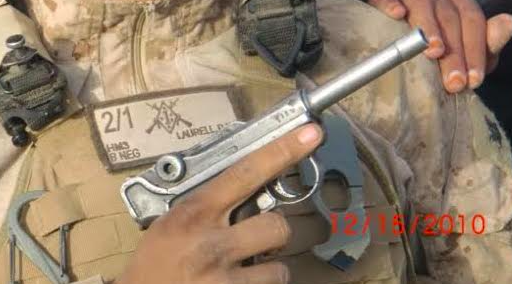
An American Marine of personal acquaintance was assigned to a Police Mentor Team (PMT) apart of 2nd Battalion, 1st Marines. These units were responsible for mentoring and training the Afghan National Police (ANP). The PMT duty consisted of patrolling to different ANP checkpoints. The PMT would spend a few days at each checkpoint then move on to thier next scheduled checkpoint. This Marine also happened to be an avid military surplus collector. This assignment would give him many opportunities to meet new people and see a myriad of Curio and Relics (C&R) in Afghanistan. In 2010, while in Garmsir, Helmand Province, Afghanistan, that’s exactly what happened to this Marine.

While on patrol with the ANP unit, this Marine noticed the unmistakable silhouette, of a Luger pistol that one of the ANP members was carrying. Naturally, the Marine was curious and just had to have a look at this interesting piece of military history.

In this picture, we can clearly make out the DWM rollstamp. The Deutsche Waffen- and Munitionsfabriken (German weapons and ammunition factories) was created in 1896 by, Ludwig Loewe & Company. They combined their weapons and ammunition facilities under one company. Simultaneously, Loewe transferred all shares it owned in other weapons producing companies to the newly formed DWM. These included, lesser know production facilities along with the Waffenfabrik Mauser and Fabrique National(FN). This pistols date is a little obscure in the picture. However, I was told this example is dated 1916. Just during WWI, from 1914-1918, there were approximately 2,000,000 Luger pistols made.

In this picture, another Marine poses with Luger. Here, we can see clearly see the front sight is missing. We can only guess as to what happened and how long it’s been missing. This goes along with my theory that this particular Luger is more if a badge of honour and sign if rank. Although, it would certainty get the job done in close quarters. Not having a front sight at all will put you at a disadvantage for the Marine Corps 25 meter pistol qualification.

As evident by the pictures, there is absolutely nothing left of the original finish. Which would have been a very beautiful and high gloss blue oxide on the major components. With small pieces such as the trigger and takedown lever being strawed. This process turns the metal a soft, golden colour which closely matches that of dried hay or, “straw.” In all actuality, this is exactly what one would expect. After all, it is almost a century old. Very easily a veteran of two world wars and countless other conflicts. It’s current location in southern Afghanistan, with its frequent sand storms, certainly does not help.

The Marine function tested the pistol. On a Luger, this is accomplished by grabbing the top of the toggle link and pulling up. With an empty magazine in place,  the slide will stay fully locked back in then open position. I was assured that it is in operable condition. Although, the Marine did not test fire it. 

There are, by this point, more than a few things I’m curious about. One question I would love to know the answer to is, to know if the ANP had the holster and spare magazine? If he didn’t, what was he using for a holster? If he wasn’t in possession of the spare magazine, was he worried about the lack of capacity? 

I was told that the ANP officer was very proud of his pistol. He made it known that he was not at all interested in selling it. I often wonder, by what route did that pistol get to Afghanistan? How did that ANP officer acquire it? 

Sadly, we will never know the answers to these questions.  We can only be happy that our beloved military surplus small arms are still serviceable after all this time.

*Special thanks and photo credit to Timothy Arndt

Pakistani SSG’s Rifles Function as “Prayer Barrier”

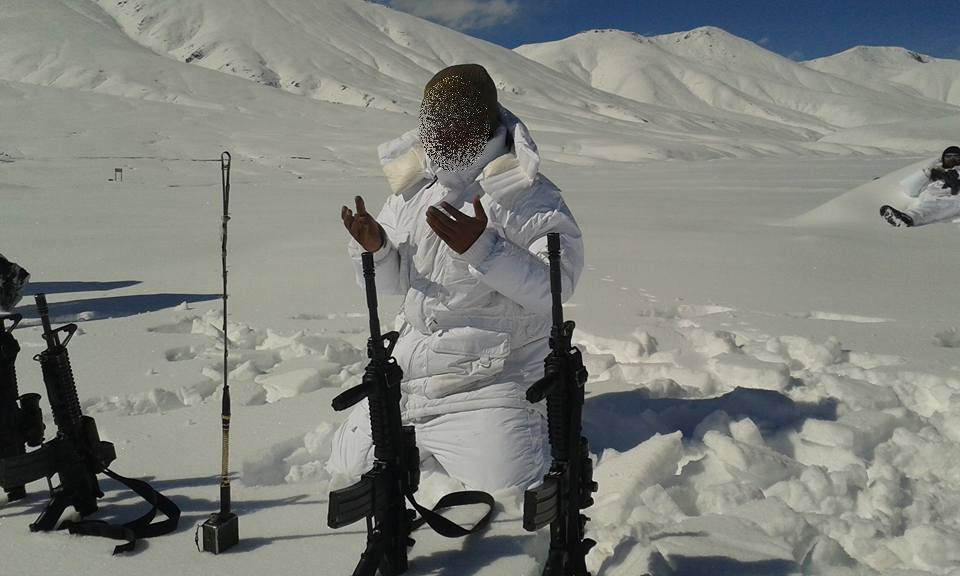
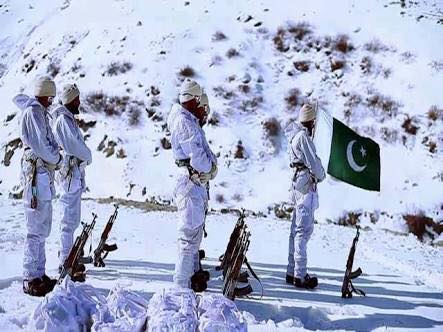
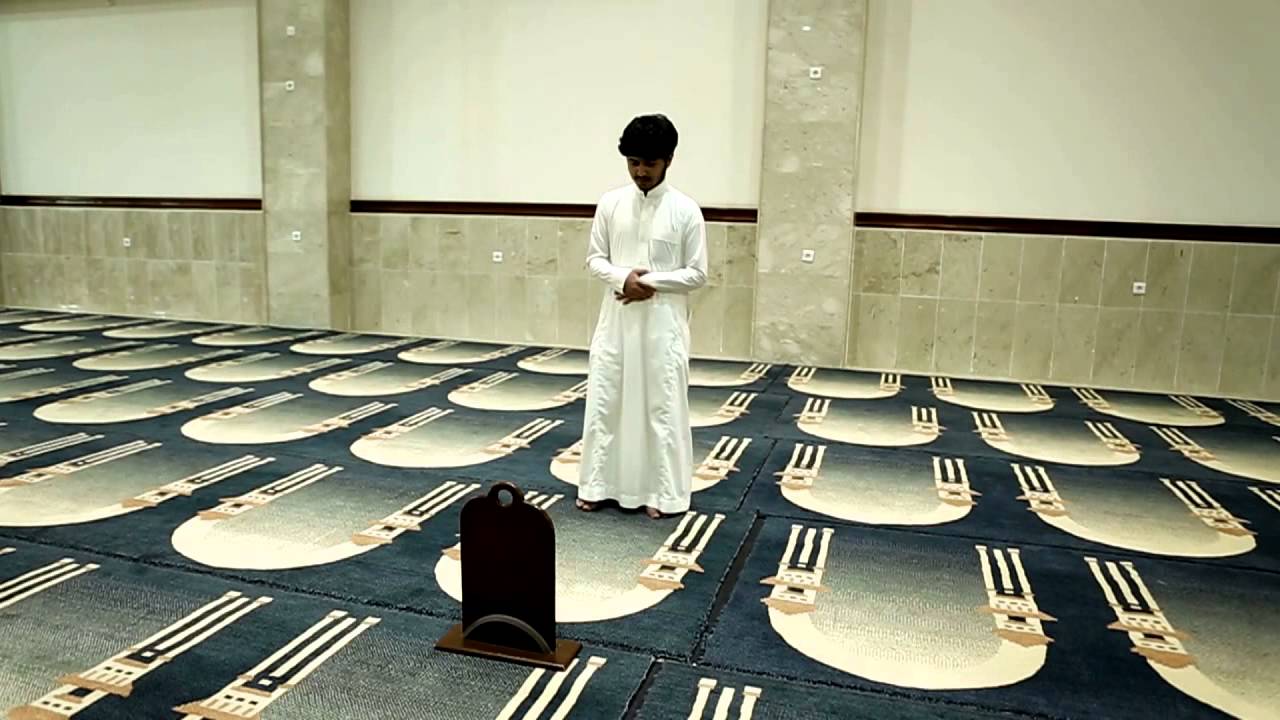
Recent photographs of Pakistan’s Special Service Group have surfaced in which members of the group are conducting mountain warfare training in the snow. Of particular interest is of the group conducting their Salat, or daily prayers. The prayers themselves aren’t so much as interesting as is what the soldiers are doing with their weapons. The M4s and in another picture, Kalashnikov patterned self-loading rifles are stuck into the snow in front of the soldiers praying, butt first.

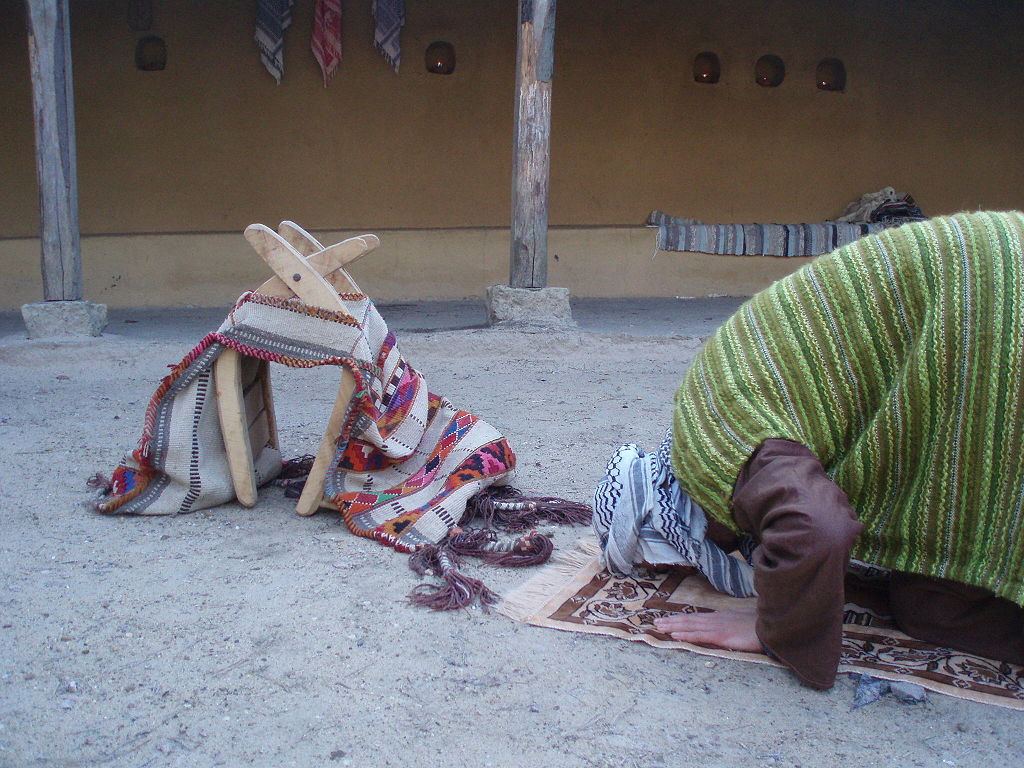
Although not really utilized today throughout the Islamic world, the practice dates back to the early Islamic period where one would place an object in front of them so other people would know not to walk in front of them during their salat. Specifically, it is called a Sutrah, or سترة in Arabic, meaning screen, or cover. There are some Hadiths on the topic but again it isn’t in wide use today.

Wikipedia lists two Hadiths in particular–

Sahl ibn Abu Hathmah narrated: إذا صلى أحدكم إلى سترة فليدن منها لا يقطع الشيطان عليه صلاته The Prophet said: When one of you prays facing a sutrah he should keep close to it, and not let the devil interrupt his prayer.

The Messenger of Allah said: لا تصل إلا إلى سترة، ولا تدع أحداً يمر بين يديك، فإن أبى فلتقاتله؛ فإن معه القرين Pray facing a sutrah, and let no one cross in front of you while praying. If he insists, then prevent him by force because he is accompanied by shaitan.

Another resource on the topic is listed here for those fluent in Arabic.

70 Firearms Stolen from Kabul Police Station

A report on Television One has revealed that 70 firearms and a number of cameras capable of operating at night (possibly meaning infrared capabilities) have been stolen from a central Police armory in Kabul. The article inferred that the firearms were possibly being smuggled to Pakistan but this isn’t known as of yet.

From Television One–

منابع خبرداده اند که هفتاد میل جنگ افزار از یک ذخیرگاه مهمات پولیس در کابل دزدی شده است.

منابع امنیتی که نخواستند نام شان فاش شود از دزدی شدن هفتاد میل جنگ افزار و سه دوربین در ذخیرگاه های مهمات پولیس در کابل خبر داده اند.

این جنگ افزارها شامل تفنگچه ها و دوربین های شب بین بوده که از یک بخش حمایوی پولیس در کابل دزدی شده است.

بر بنیاد گفته های منابع، چندین تن از سوی وزارت داخله در پیوند به این رویداد بازداشت شده اند.

با وجود تلاش های زیاد وزارت امور داخله نخواست در این باره ابراز نظر کند، اما یک مقام وزارت داخله به تلویزیون یک این موضوع را تایید کرده گفت، بررسی ها درباره این موضوع جریان دارد.

Firearms being stolen from a central police repository is somewhat alarming, especially that observing that it has happened the day before Now-Ruz, or the Persian New Year. There is the possibility that maybe the theft was to supply a possible attack in the upcoming festivities but this is most likely not the case as the firearms stolen were mostly handguns. This is most likely a case of lax regulations right before the holiday and an insider taking advantage of them. Similar to many other attacks and thefts within the Afghan government, this was most likely an inside job possibly helped by a corrupt official.

Guest Post: Iraqi Contract Sterling MK 4 in Syria

Mathew Moss comes to us as a highly esteemed writer from The Firearm Blog, but he also founded his own fascinating historical small arms research source, The Armourers Bench, in addition to runs his Twitter feed at Historical Firearms. This is his first work for Silah Report, and we hope it won’t be the last!

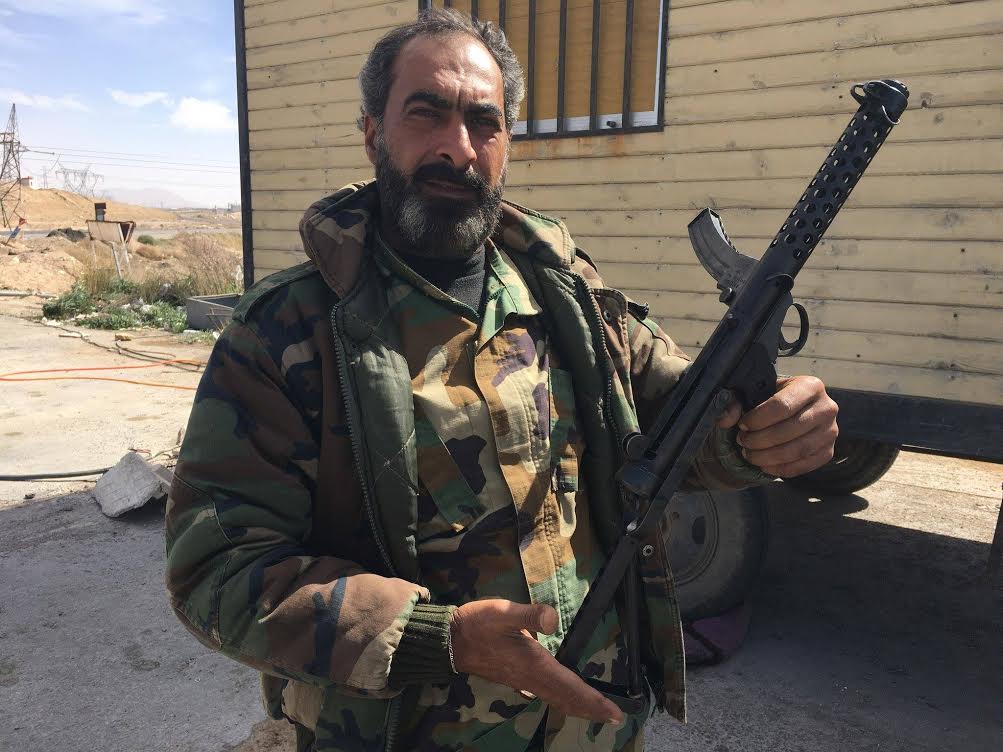
On the 10th March, Broń. Milmag, the Polish defense magazine, posted an intriguing photograph on their facebook page. The photograph had the short caption, which once translated, reads: “Syria Ad2018. 9-MM MACHINE GUN STERLING MK 4 / l2a3 used by a government soldier.”

Plenty of surplus World War Two weapons including the StG-44, MG42, Mosin-Nagant, K98ks and even French MAS-36s have been sighted in Iraq and Syria during the regions current multi-sided conflict. Sightings of the Cold War era- Sterling submachine gun, however, have been few and far between.

The Sterling submachine gun was developed by George Patchett at the Sterling Arms Company during the latter half of World War Two. Following extensive testing in the late 1940s and early 1950s the British Army adopted Patchett’s submachine gun to replace the Sten gun. It entered British service as the L2A1 in 1953, evolving quickly to its final form the L2A3. The L2A3 was produced commercially by Sterling at their plant in Dagenham, UK from 1956 until 1988 with an estimated 211,000 produced.

The Sterling was subsequently sold commercially and licensed for overseas production in both Canada (leading to the C1 Submachine Gun) and India (leading to the 1A Machine Carbine). Sterling successfully marketed the commercial version of the L2A3, the Mk4, to over a dozen countries around the world from Malaysia, to Libya, to Iraq.

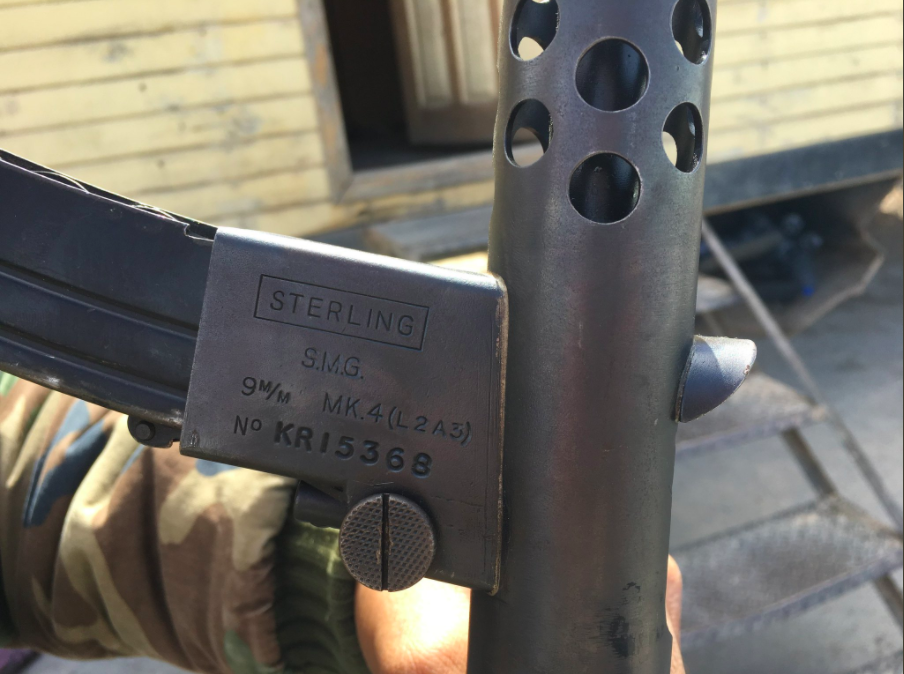
The weapon featured in the photograph appears to be in remarkably good condition. Following some digging I was able to find what I believe to be the original posting of the photograph online. Posted on Twitter by @Edward_Sn0wden on the 9th March. The twitter post includes a second photograph showing the Sterling’s magazine housing and markings. The photographs are credited to Alexander Kharchenko but sadly no location is mentioned. The caption suggests that the weapon might be a captured trophy.

From the available photographs the weapon appears to have a matte, rather than crackle paint, finish – this is either an original contract choice or a later armory refurbishment. The weapon is also fitted with an original Sterling produced commercial production 34-round curved double stack, double feed magazine – one of the most reliable submachine gun magazines ever developed.

We are lucky enough to have a second photograph showing the weapon’s markings in full: ‘STERLING SMG 9m/m MK4 (L2A3) KR15368’. The serial number, beginning with ‘KR’ dates the gun as a pre-1972 Sterling and refers to Kenton Redgrave, the Sterling company’s long-time director. The serial number dates the weapon, according to the serial number ranges, listed in The Guns of Dagenham (1996) by Peter Laidler, to 1957. This date would fit with the 1956-63 Iraqi contract which supplied 13,241 Mk4s to Iraq, first to King Faisal II’s military, and then to the Iraqi Republic, following a coup that deposed Faisal in 1958. The Iraqi Sterlings later saw action during the Iran-Iraq War and to a limited degree during both the Gulf War and during the 2003 Iraq War. 

While rare the Sterling has been spotted in the region before, three years ago CJ Chivers, the New York Times investigative conflict journalist and author of The Gun, shared a photograph of a Mk4 with a straight Sten magazine in use by the Mahdi Army in Sadr City, Iraq.

While investigating the photograph above, an Iraqi fighter came forward and told me about his ‘heirloom’ Sterling Mk4 which had belonged to his father, an Iraqi soldier killed during the Iran-Iraq war. Interestingly, this Iraqi heirloom Mk4 dated from June 1964, suggesting that the Iraq contract may have extended beyond the 1963 end date indicated by Laidler.

The Iraqi gentleman also advised that the Sterling was known to him, and possibly regionally as the ‘غداره مصريه’, which translates to ‘Egyptian Contract’ or Egyptian Submachine Gun. It seems that the Sterling has come to be confused with, or at least associated with an Egyptian submachine gun. While the Egyptian Army did purchase a number of commercial Mk3 Sterlings in 1954-5, Egypt never produced a copy of the Sterling, instead opting to copy the Carl Gustav m/45 to create to the Port Said, produced by Al Maadi.

How a Syrian government soldier might have come into possession of what is likely an Iraqi Sterling submachine gun is one of war’s intriguing mysteries. Regardless of how he acquired it appears to be in excellent condition for a 50 year old weapon.

Images:

Milmag post:

https://www.facebook.com/TheMilMag2/photos/a.871586039536290.1073741828.871547992873428/1980952581932958/?type=3&theater

Possible original source on twitter:

https://twitter.com/Edward_Sn0wden/status/972075403971055616

Rock Island Auctions photo of commercial Mk4 Sterling for Reference:

https://www.rockislandauction.com/detail/70/2504/sterling-mk-4l2a3-full-auto-sales-sample-smg-with-bayonet#detail

Taliban Raid on Afghan Militia Post Reveals Modern Small Arms Inventory

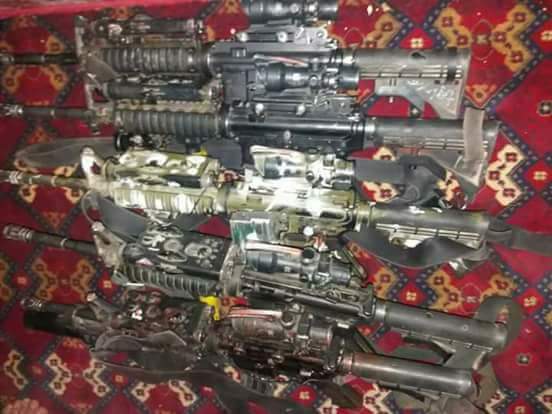
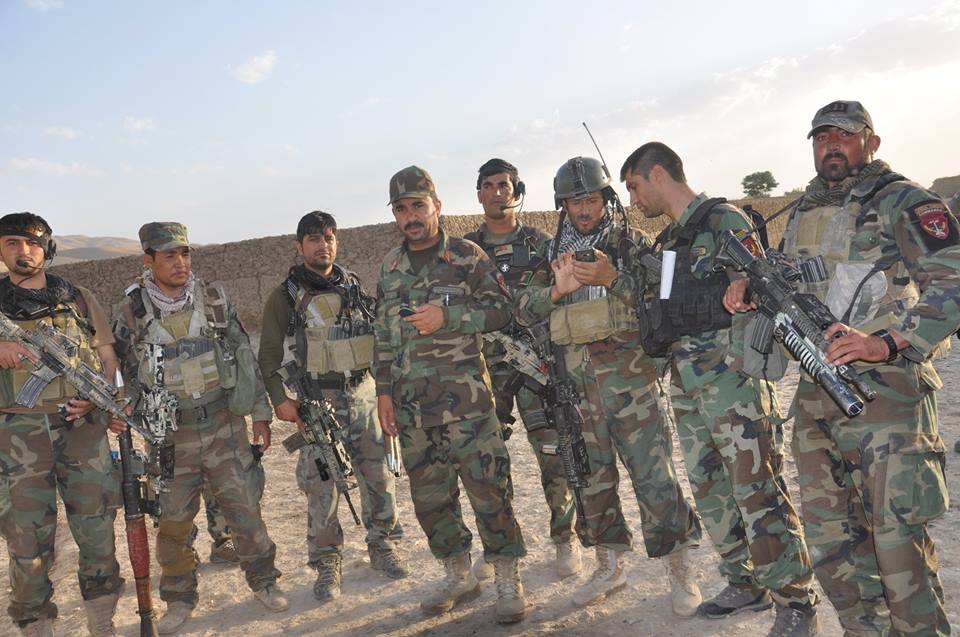
Recently disclosed photographs supplied to Silah Report have suggested that the local GoIRA supported militias are armed with more than the standard Kalashnikov self-loading rifles often seen throughout the country. One example of these forces is the Afghan Local Police, or ALP. Although these forces are seen as cost-effective, many local Afghans compare them to the days of the War Lords that roamed the country in the Civil War.

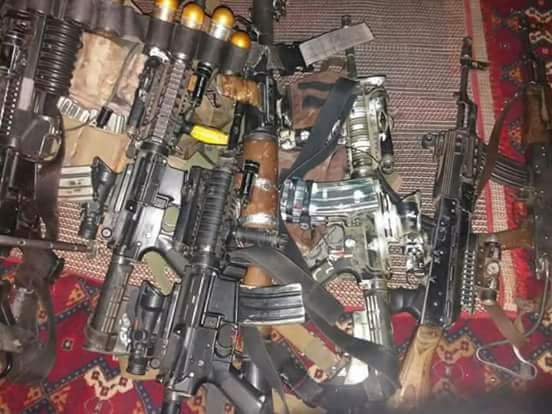
The photograph below depicts five 5.56x45mm NATO M4-patterned carbines in configurations that are identical to that of the ANA Commandos. This includes the AN/PEQ-2 TPIAL mounted at the 12 o’clock position on the Picatinny rail, the Trijicon 4x RCO day optic, the MaTech BUIS, and even the spray painted rifle in the center. Also present is a 40x46mm NATO M203 UBGL mounted to the carbine at the bottom. Notice on the painted carbine the coupled STANAG magazine inverted from a usual “rounds up” position.

As indicated by this photograph, a small arms inventory such as this is consistent with what the ANSF Commandos are generally issued.

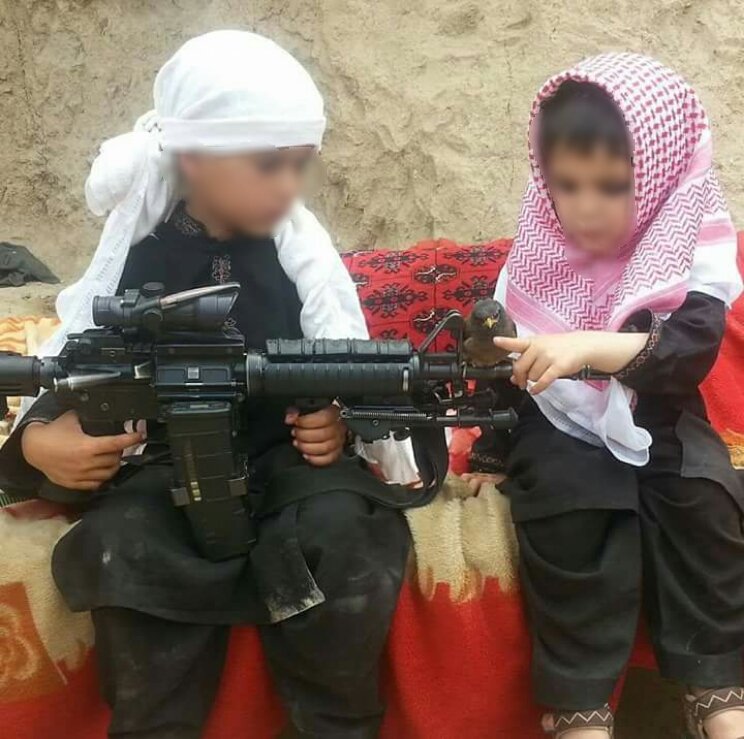
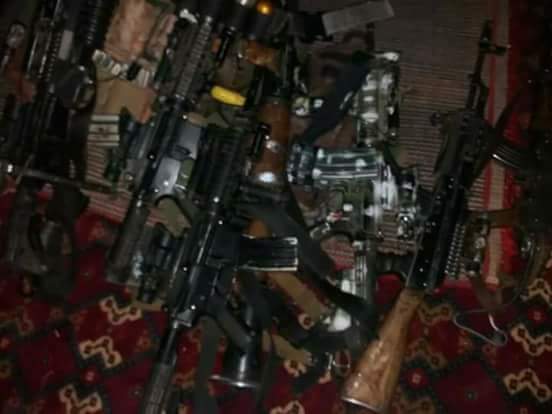
This photograph was provided by the same source and features a similar magazine coupling technique as illustrated above. What appear to be UTG rail covers and what is most likely a Harris bipod copy appear to be third party modifications from the standard issue. Myna Bird perched on the 6-inch barrel comes unissued.

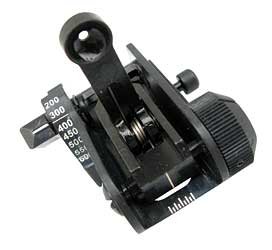
MaTech BUIS as in use.

However in this angle present are Streamlight TLR Picatinny mounted weapon lights, in addition to Kalashnikov patterned rifles, which are rarely in use by ANSF Commandos, if at all. Although rare, there are some TLRs that have been spotted among the group.

Although contextual information about the photographs are scare, a source has suggested that the militia checkpoints are perhaps funded by a shadow entity with a large supply budget. Such as the “Kandahar Strike Force” that was indeed set up by the CIA. In Afghanistan, this is immediately assumed to be the “CIA”, but until we have further information, we cannot venture more into the origins of these carbines.

Palestinian Authority “Returns” Israeli CAR15 (Sans Bolt) after Patrol Attacked in West Bank

An Isreali Defense Forces patrol was attacked with several members severely beaten before an armed Palestinian Authority element came to their aid in the vicinity of Jenin, West Bank. From the Alemeiner-

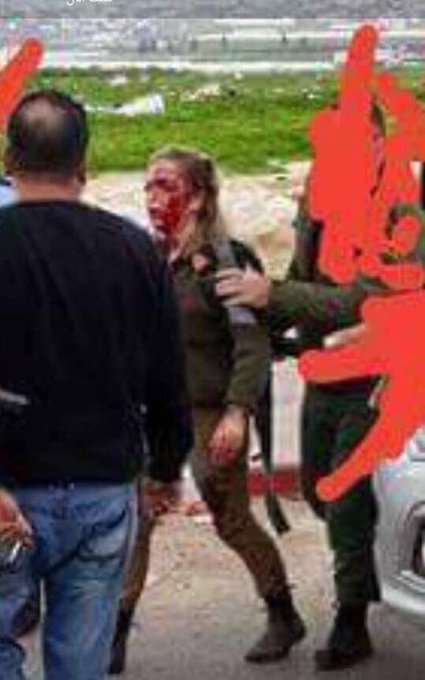
The two soldiers, a man and a woman, were lightly to moderately injured. Images of the female soldier’s bloody face circulated on social media after she was injured by shattered windshield glass. She was evacuated to a hospital in Afula.

Video from the attack shows the mob haranguing and attacking the soldiers as they cried out.

An initial investigation found that the soldiers had been misdirected to the Palestinian city by the Waze navigation app on their journey from Shavei Shomron in Samaria to Afula in the Jezreel Valley.

A Palestinian Authority policeman intervened to protect the Israeli soldiers, ultimately firing into the air to disperse the crowd. Over 100 members of the PA security forces were called out to escort the soldiers to safety and return their jeep to Israel, according to a PA security official interviewed by the Jerusalem Post, who also said that the effort was made both to protect human life and prevent Israeli reprisals against Jenin.

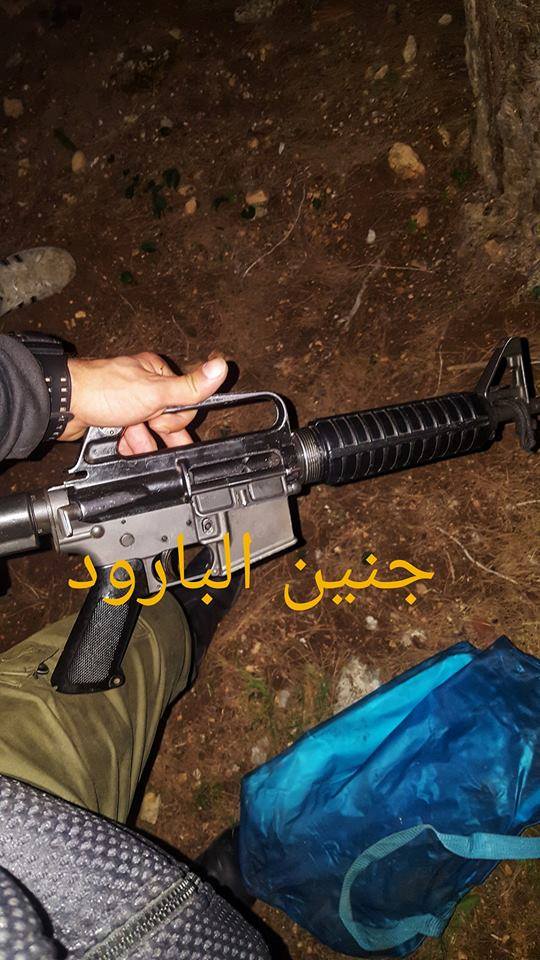
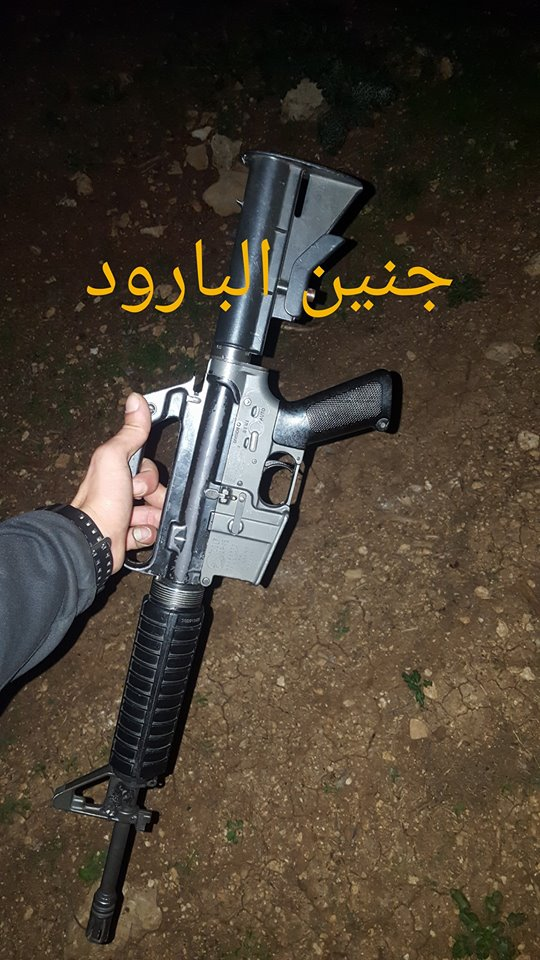
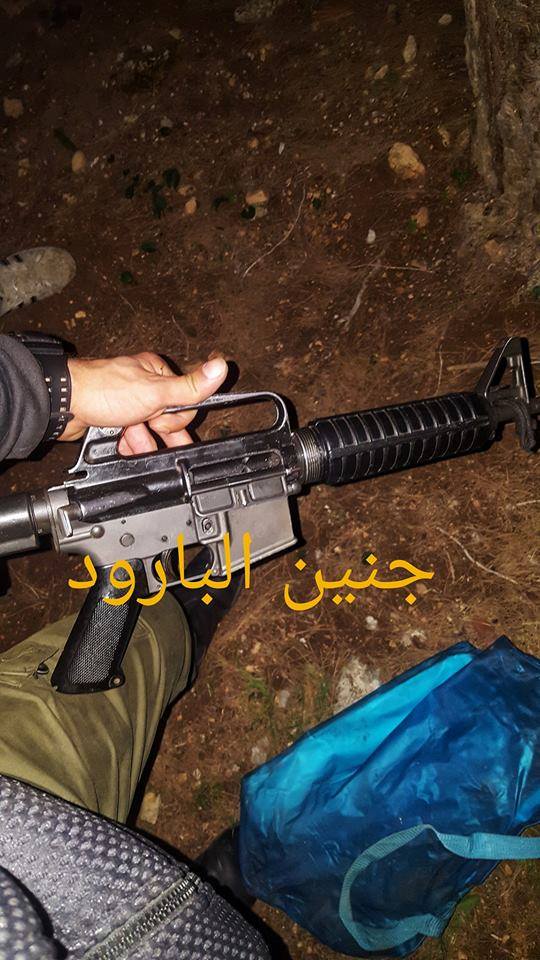
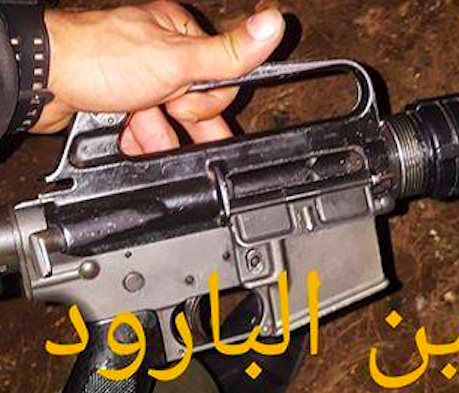
Various Palestinian social media outlets have released images of a Colt CAR15 that appeared to have been returned to IDF forces after the encounter. The IDF has made extensive use of U.S. CAR15s, M16A1s, M16A2s, and even M4s for a number of decades, currently supplementing the IWI Tavor now in service with frontline troops.

From Gaza Now, a Palestinian social media account–

بعد محاصرة الشاب الفلسطيني الذي استولى و تمكن من إغتنام سلاح مجندين جيش الاحتلال .

#عاجل : أجهزة أمن السلطة الفلسطينية تسلم الاحتلال الإسرائيلي السلاح الذي استولى عليه الفلسطينيين في مدينة #جنين اليوم .

#صور: مسربة للسلاح قبل تسليمه لجيش الاحتلال

Notice the earlier A1 forward assist and A1 rotary dial rear sight. In addition, notice the shorter telescoping stock which is signatory of the CAR15 series. Also note that the upper and the lower receiver don’t match, possibly indicating that the two parts were interchanged throughout the life of the rifle.

But more interesting than the rifle is the fact that the bolt and charging handle appears to be missing from it. This could have been intentional on the part of the Palestinians who captured the rifle.

The Israeli soldiers appear to have taken a beating but fortunately are still alive. They probably could do with a remedial land navigation course, and not rely on Waze to get from one tactical objective to another.

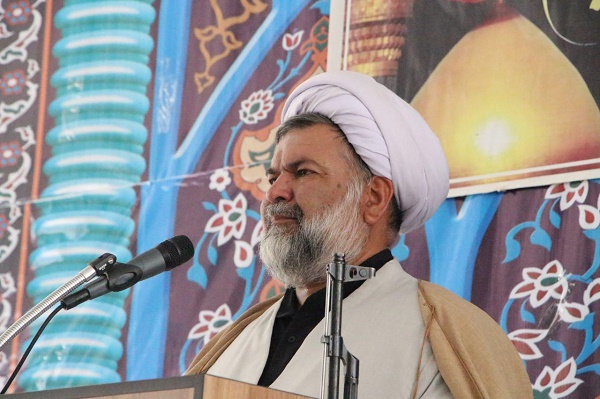
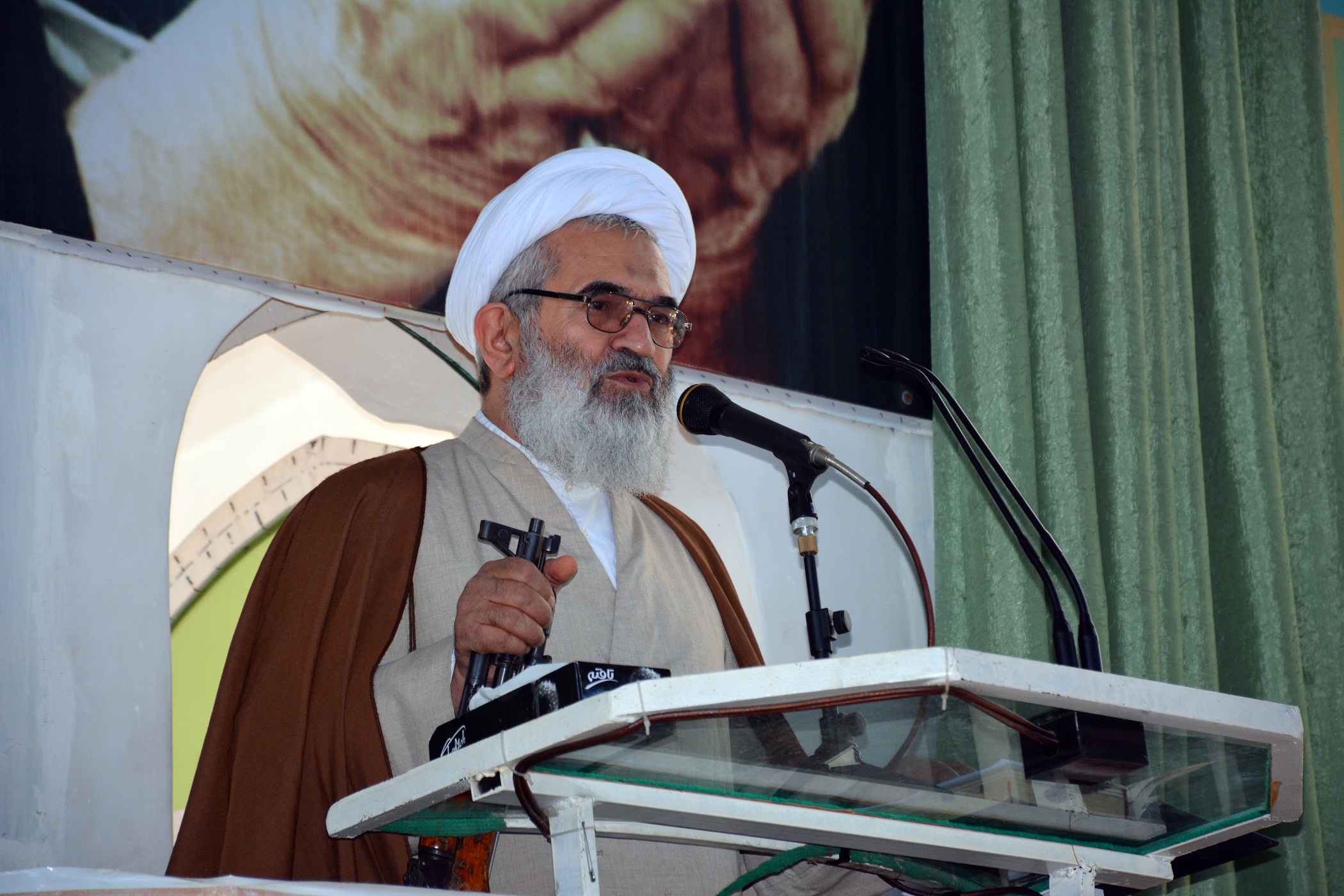
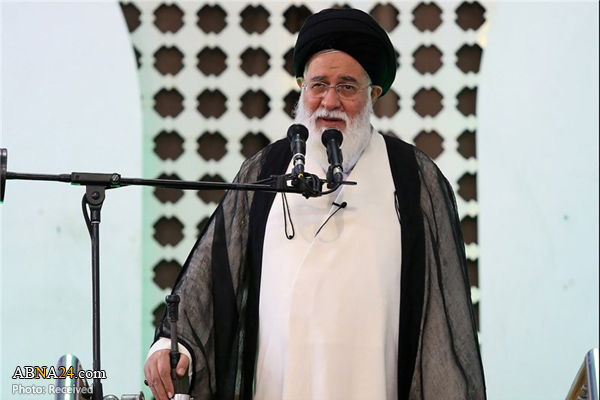
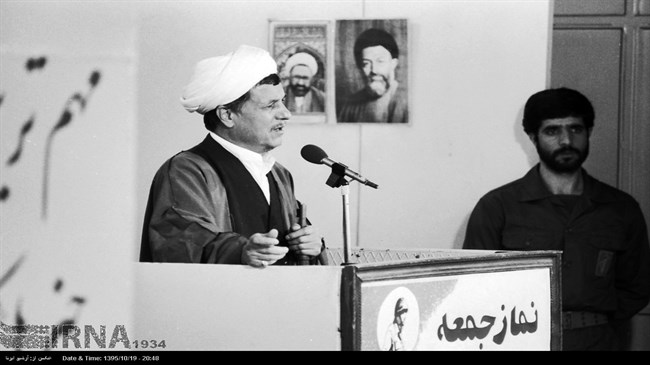
The Odd Case of Iranian Imams Holding the “Weapon of the Day” During Khutbah Prayer Sermons

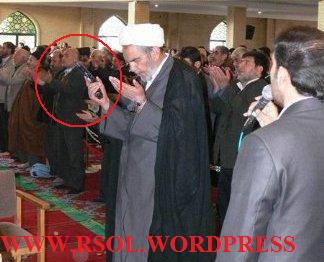
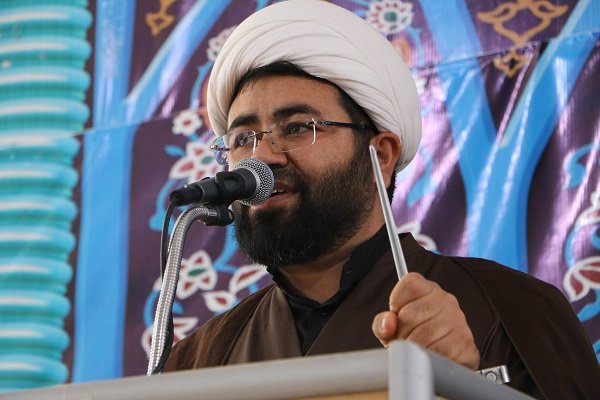
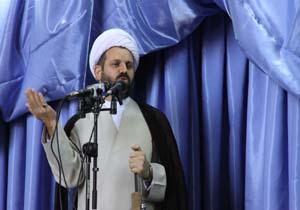
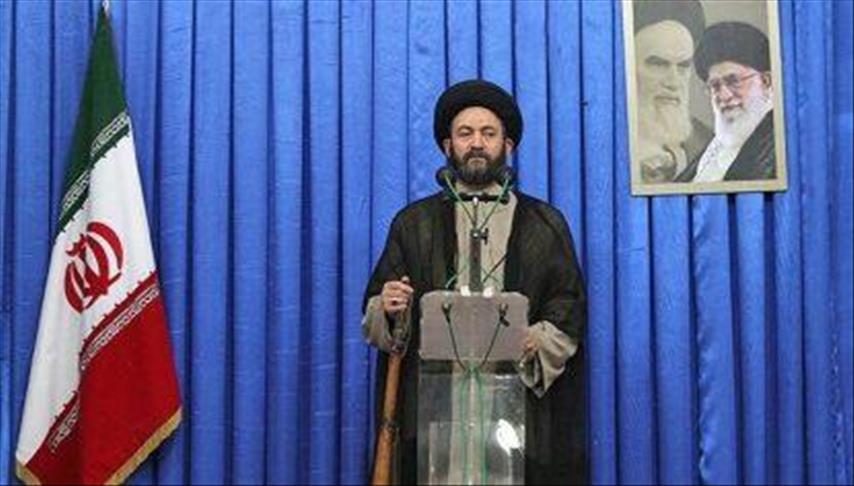
In a previous article on Silah Report authored by Ali Parsa and generously donated by him from his website Aliparsa.com, Ali specifically mentioned an interesting practice done by Iranian Shi’a Imams during Friday Khutbah Prayer services. Imam’s in Iran are known to hold on to various rifles while giving their Khutbah sermons. Ali mentions that this comes from a Sunnah of the Prophet Muhammad (ﷺ) where it mentions that the Prophet always held the “Weapon of the Day” while giving his own sermons. Going into a little searching I found this paragraph on Islam QA that gives some background behind this-

In a tradition recorded by Imam Abu Dawood, it is narrated that the companion, Hakam bin Hazn Al Kulfi (RA) said, ‘We witnessed Juma with the Prophet (SA), and while standing (to deliver the khutba), he was leaning on a staff or bow. (Abu Dawwood – Chapter of a person who delivers a khutba and leans on a bow). Based on this narration, scholars have stated that holding the staff while delivering the khutba is commendable, as it was a practice of the Prophet (SA). In this regard, the great jurist, Allama Shami recorded the following: – ‘Certainly taking the staff is a Sunnah just as standing’. (Raddul Mukhtar).

Now, I’m not nearly as versed in the Sunnah as Iranian Shi’a clerics, but in this instance it makes no mention of a “Weapon of the Day”, which Imams in Iran appear to interpret as meaning whatever primary weapon is issued that is used to defend the Islamic Republic of Iran. That is certainly one interpretation of “Weapon of the Day”, perhaps similar how a “Uniform of the Day” is in many armed forces regulations around the world informing troops what uniform to wear. The explanation above refers to a “Staff”, which the Prophet appears to simply mean something to lean on, gain physical support from, and show to emit a sense of authority in front of a congregation. We have similar examples of Prophet Moses’s staff and there are other religious texts that reference a staff as well.

A key note to mention here is that this practice is only adhered to in the Islamic Republic when it comes to gripping actual firearms during the Khutbah sermons. It doesn’t appear to even exist in other Shi’a dominated countries or countries under Iranian influence to the extent that it does in Iran.

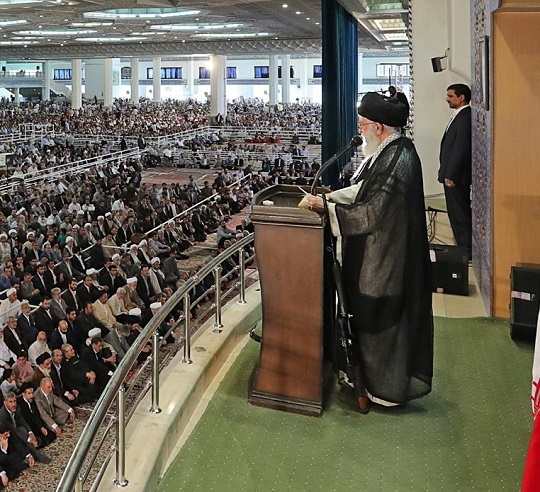
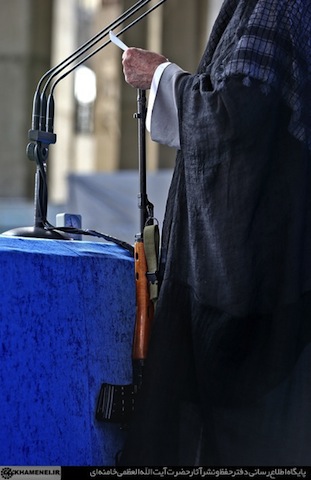
Now, going back to sort of the entire reason why Silah Report exists (apart from general small arms & light weapons analysis), is that we serve to make sense of these cultural phenomena when it comes to the intersection of small arms and the regions we are interested in. A prime example is this Blaze post in 2015 that is entitled “Can You Spot What Iran’s Khamenei Was Holding During His Speech on the Nuclear Deal? The Mainstream Media Ignored It”.

The post goes to great length to try and psychoanalyze the geopolitical ramifications of Imam-i-Khamenei gripping what is most likely a Chinese export copy of the 7.62x54r mm SVD Dragunov marksman rifle.

The article mentions that-

To drive home the point, the supreme leader’s official website posted a close up photo captured from beside the podium of the gun which even showed the magazine jutting out

…

But the most potent sign of all reflecting his message – the gun balanced under his left hand holding his speech notes – was left unmentioned.

It’s unlikely that if the speech had been given by an American or any Western politician that this scene setting detail would have been overlooked, especially given the hotly debated issue of guns.

The AP’s website had this photo of Khamenei holding the gun, but it was not mentioned in the copy in the accompanying article

By now, I hope readers of this article will realize the odd stance that The Blaze is taking on this Dragunov. Of course the Iranian media didn’t mention it because this is in fact actually a completely routine practice done by Imams at every organizational level throughout the religious hierarchy in Iran. Should the Iranian media have thoroughly mentioned the microphone in front of Imam-i-Khamenei’s face as well?

Now, this post isn’t to slander a conservative news outlet for getting something wrong. Any viewpoint from any source at all that is worthy of correcting in a cultural, historical, or social light will be equally scrutinized. This one just so happened to stand out as a prime reason why we at Silah Report are dedicated to our jobs at hand, to fill this void of historical and cultural knowledge by analyzing the technical with the cultural.

For more information on other Imams holding small arms during sermons, check out this Farsi language post on the topic, literally discussing what certain Imams prefer to hold during their Khutbahs.

From the post, in Farsi-

به گزارش پارسینه، برکف گرفتن سلاح توسط امام جمعه، سنتی است اسلامی که ریشه در صدراسلام دارد، نمادی از آمادگی دفاعی در برابر دشمنان اسلام حتی در محراب و محل نماز، بعد از پیروزی انقلاب اسلامی، مرحوم آیت الله طالقانی که با حکم امام خمینی، احیاگر سنت نماز جمعه بود، بار دیگر این سنت اسلامی را زنده کرد. آیت الله طالقانی در برابر پیشنهاد برخی از انقلابیون که به وی پیشنهاد کردند از شمشیر به عنوان سلاح خطیب امام جمعه استفاده کند، این پیشنهاد را رد کرد و “سلاح روزآمد و مدرن” را به دست گرفت.

در اوایل انقلاب اسلامی، سلاح ژ-3 تفنگی بود که امامان جمعه تهران و شهرستانها در حین ایراد خطبه جمعه به دست می گرفتند که در سالهای بعد، اسلحه از رده خارج “برنو” جای ژ3 را گرفت.

در میان ائمه جمعه، آیت الله حسنی امام جمعه ارومیه به داشتن سلاح های متعدد از جمله کلت و گرینوف در نماز جمعه شهرت دارد و معمولا بر خلاف ائمه جمعه دیگر از سلاح کلاشینکف در محراب نماز جمعه استفاده می کند.

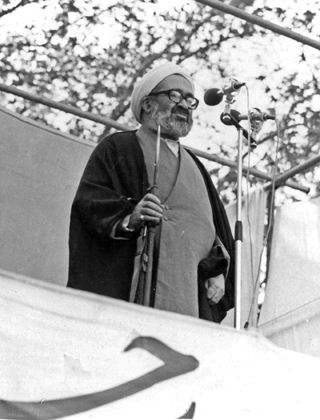
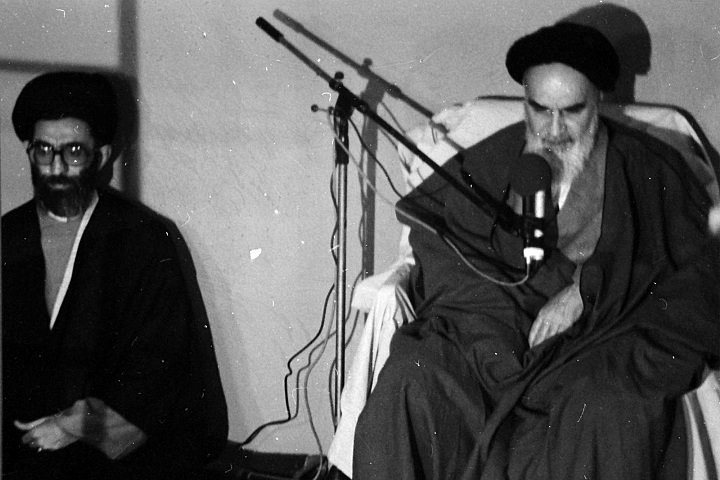
As a quick sidenote by scanning photographs online, it doesn’t appear that the initial Supreme Leader of Iran, Imam-i-Khomeni adhered to the practice. Although it should be noted that senior Imams during his time did partake in it, as evidenced in the black and white photographs above.

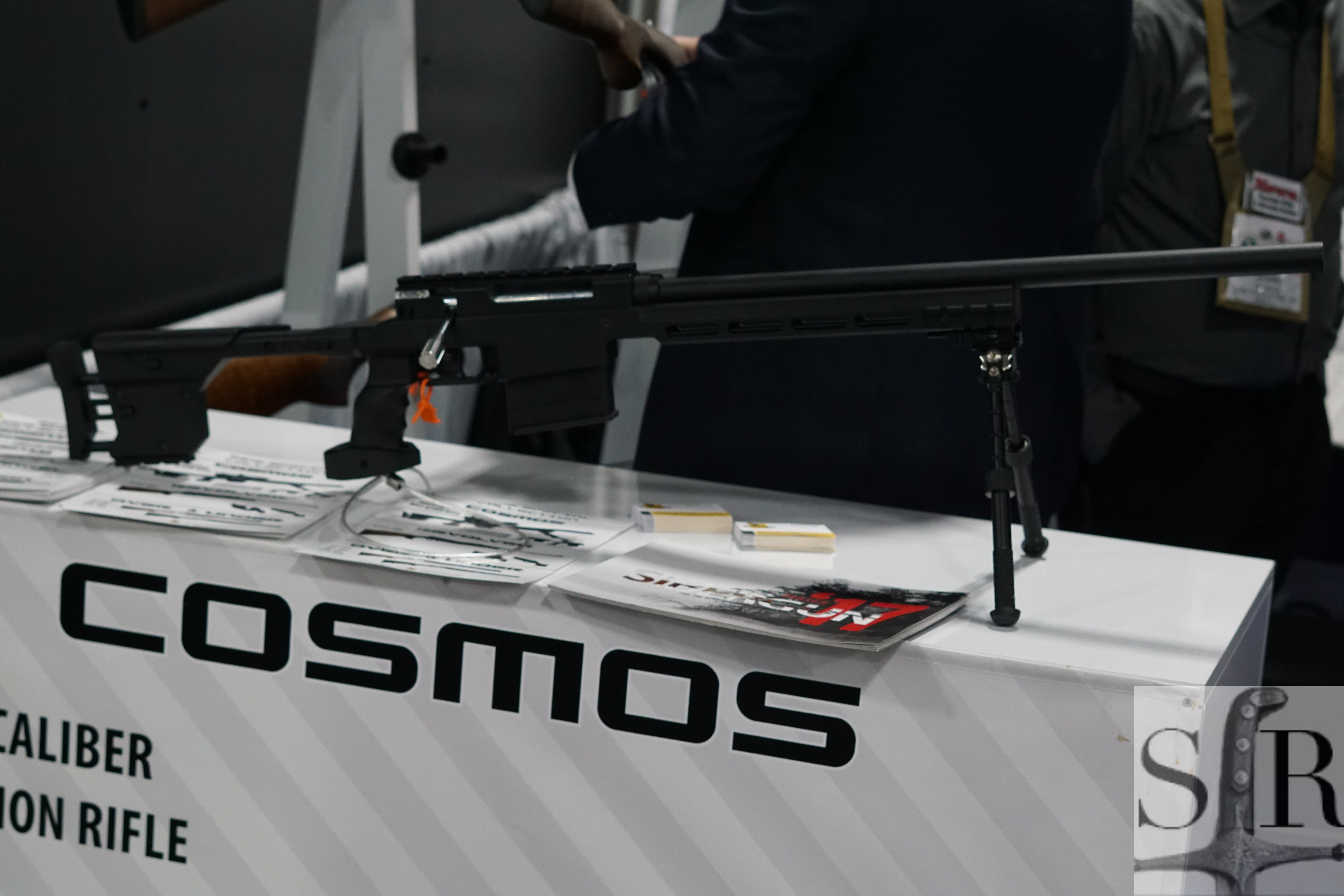
Yazicilarav’s Cosmos Bolt Action Rifle at SHOT 2018

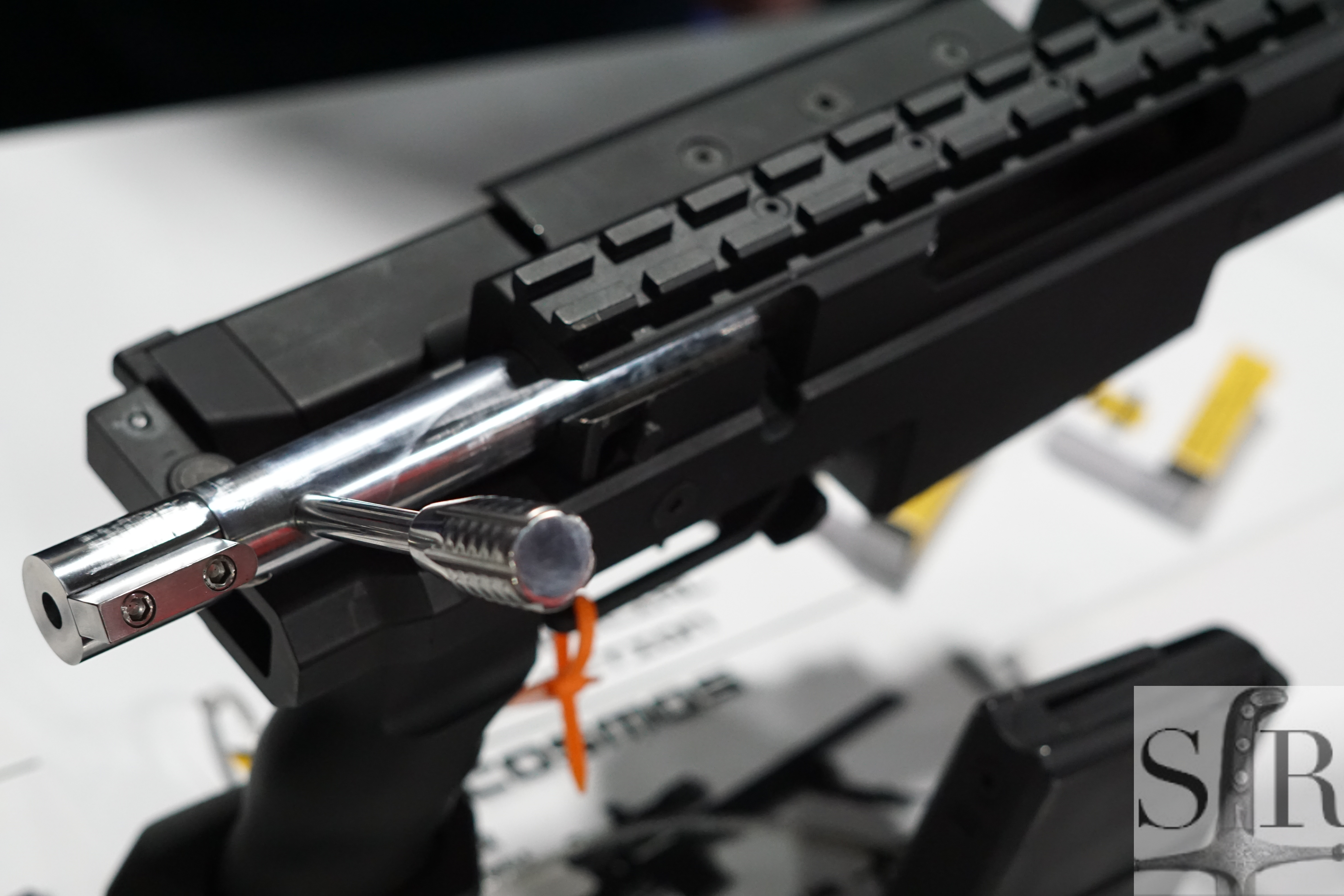
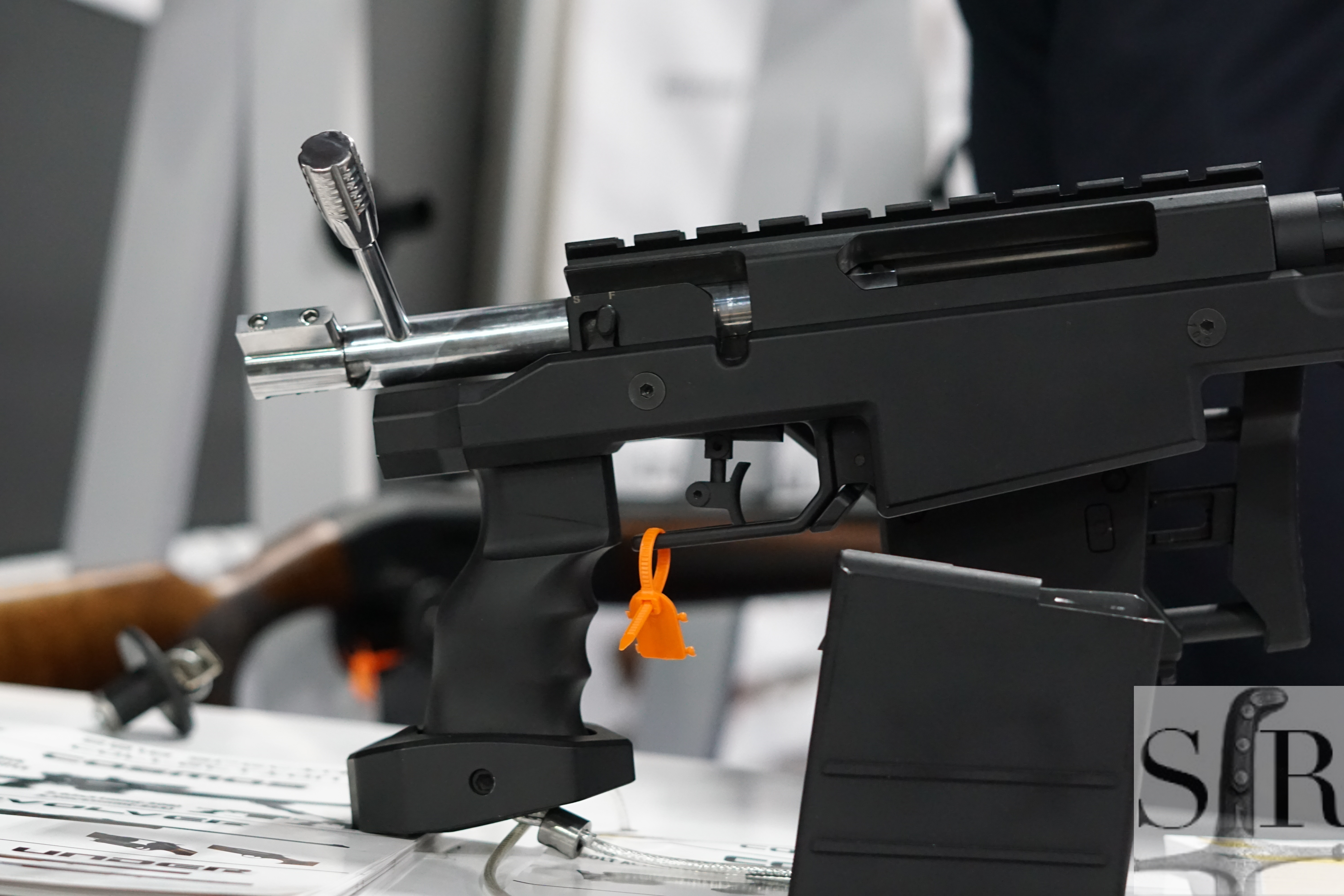
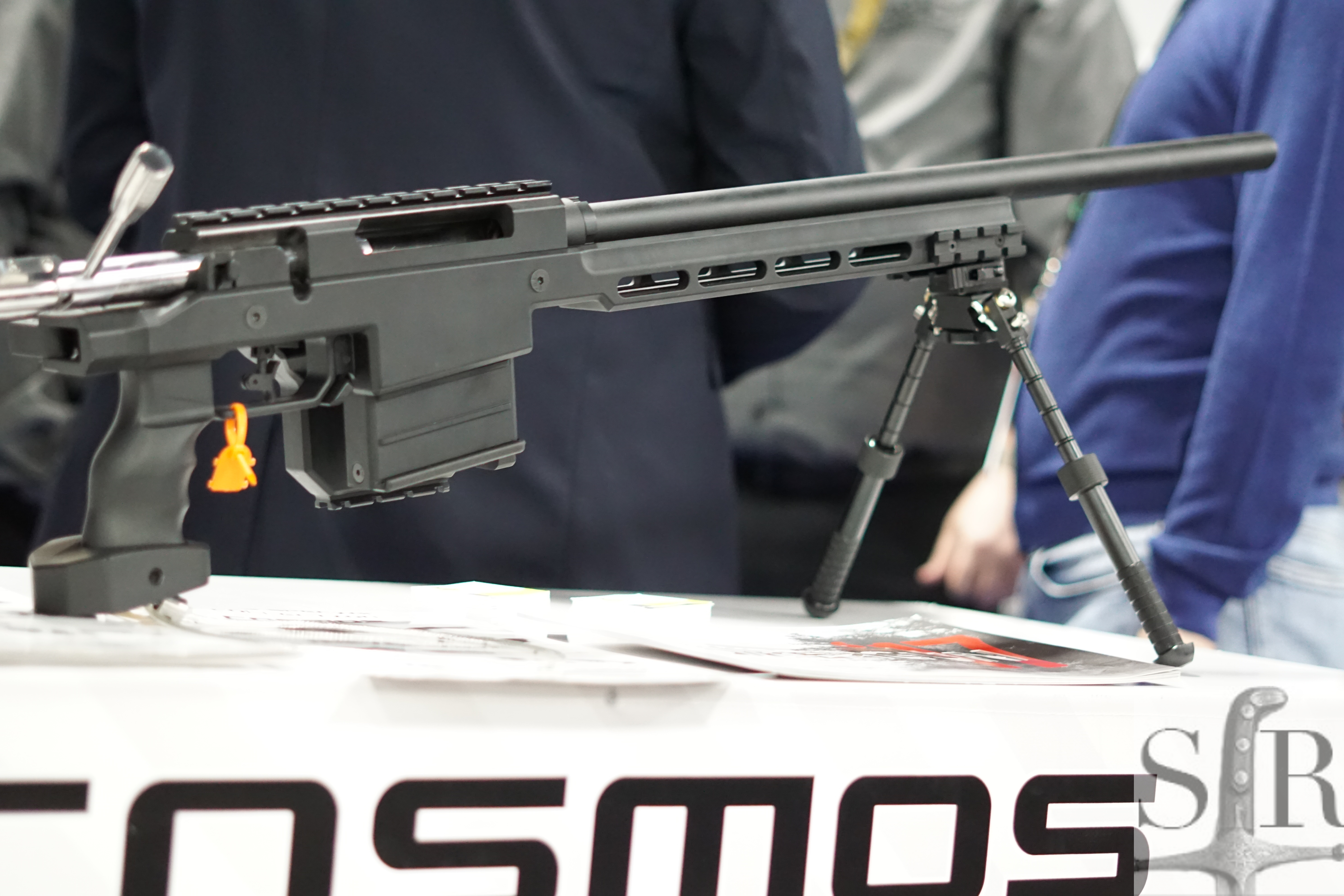
The relatively small Turkish company Yazicilarav brought out their Cosmos bolt action rifle to SHOT 2018 this year. The commercial rifle is chambered in .308 Win and .223 Rem. It also comes in a “Camo”, “NATO Green”, or “Black” finish. Although it is marketed as “Multi-Caliber”, this only appears to be in product offerings instead of a true multi-caliber interchangeable barrel. The operating mechanism is very simple, appearing to be a Mauser action, utilizing front bolt lugs to lock the action in place.

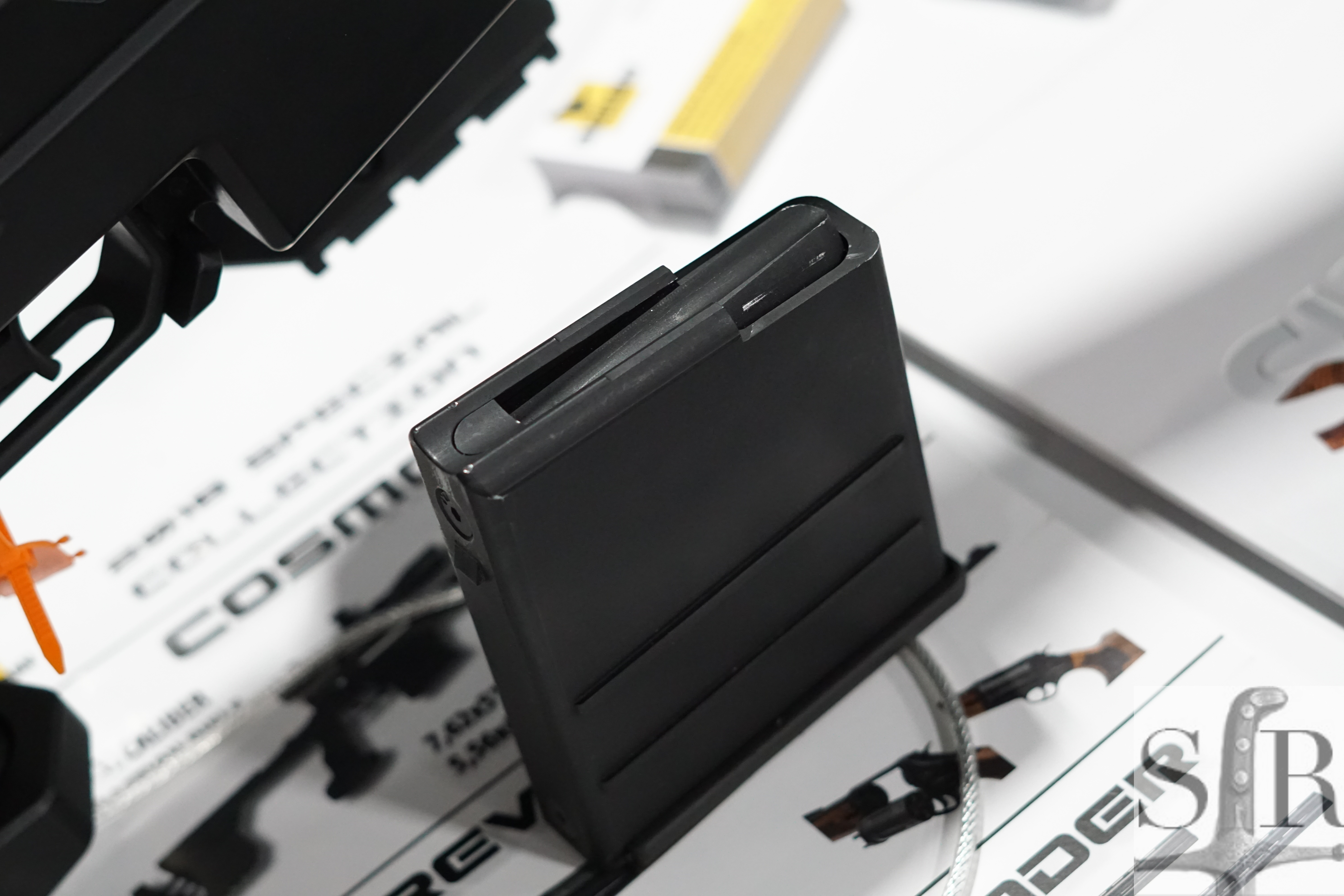
The detachable magazine has a polymer body and uses an ambidextrous magazine release.

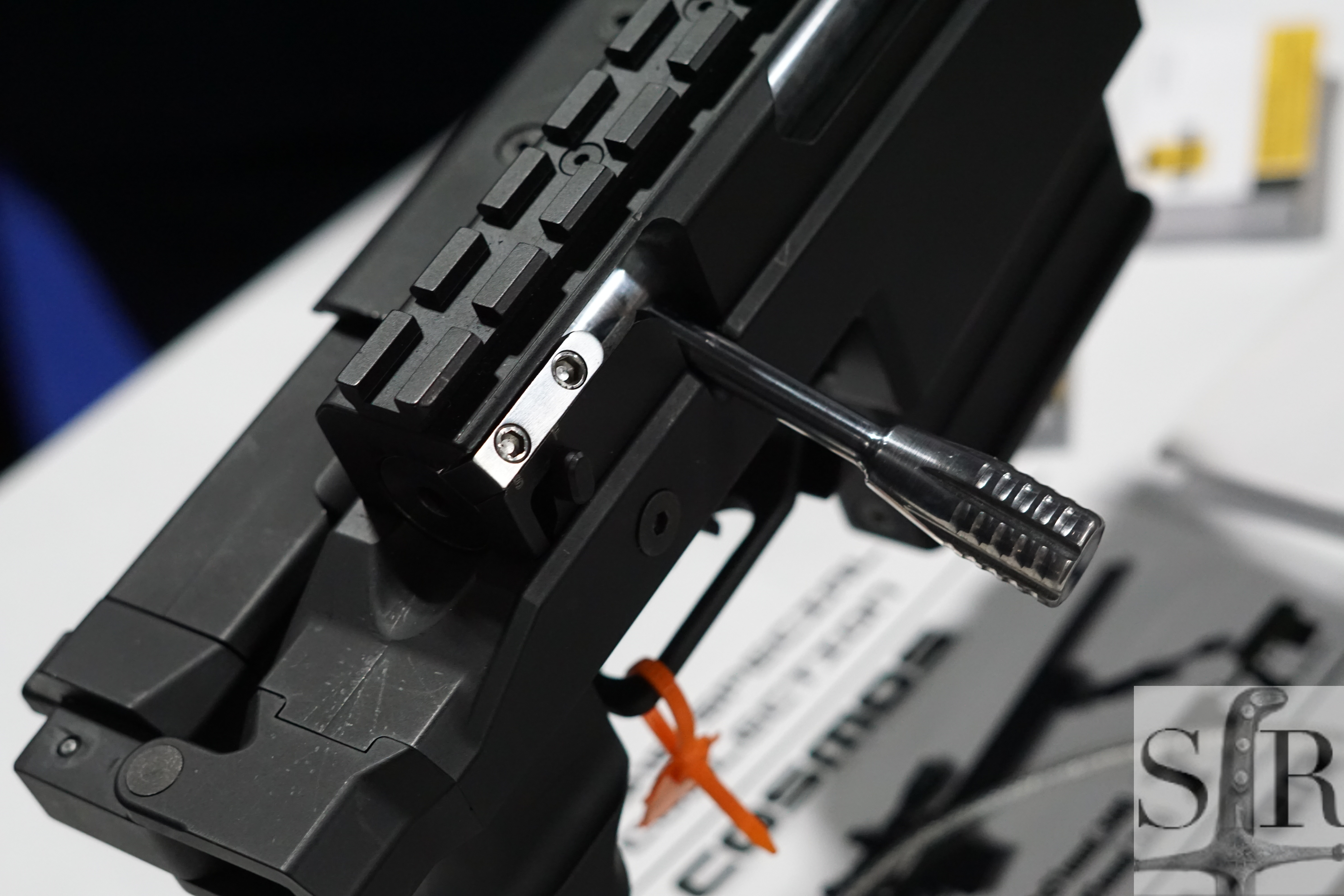
The bolt has a 90-degree throw, has a knurled handle, and is highly polished. The stock can collapse to the left side of the rifle.

Note the adjustable trigger shoe and the safety. Also note the PSG-1-esque pistol grip.

Notice what appear to be M-Lok similar or possibly compatible rail inserts on the handguard, and the Atlas bipods attached to the rifle.