Yassin RPG – The Underground RPG of Gaza

Due to the Arab-Israeli conflict in Palestine, Hamas with its military wing al-Qassam brigades has developed their own tools of war in order to preserve self-sufficiency in order to not be affected by the blockade made on Gaza strip.

This article will spotlight on one of the more interesting craft produced rocket launchers in Gaza , which is literally underground since their production facilities are protected in underground bunkers from IDF air raids and artillery strikes.
It is designed and manufactured by Hamas, but they distribute the launchers to other resistance troops working in Gaza, including Fatah and the PFLP (Popular Front for Liberating Palestine).

History

The weapon is named after Sheikh Ahmed Yassin, the founder and the spiritual leader of Hamas who was assassinated by Hellfire missiles shot from an Israeli AH-64 Apache Helicopter gunship on March 22, 2004, at the age of 67.

It was designed by Adnan al-Ghoul who was also assassinated by an Israeli air strike on October 21st, 2004.
Characteristics

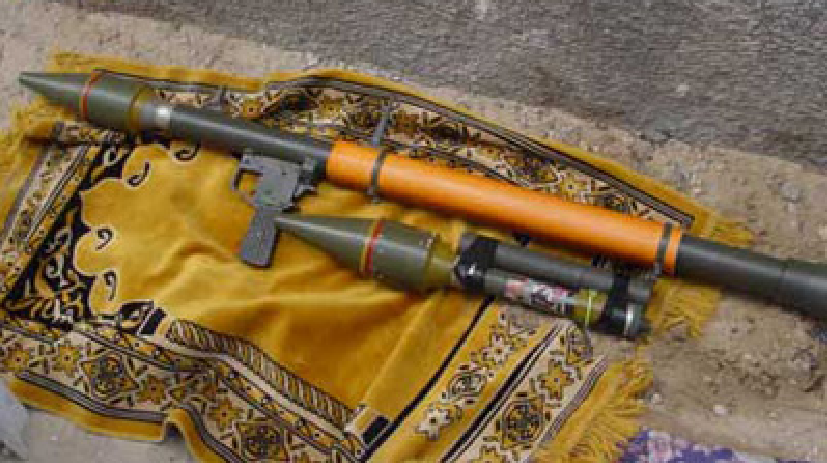
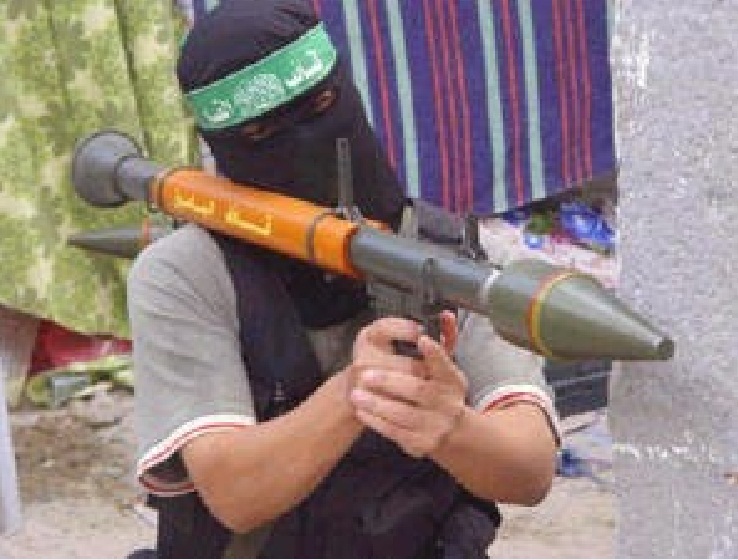
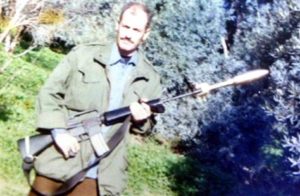
The Yassin RPG is a unique design that resembles the RPG-2 combined with RPG-7 with some improvised design features, From RPG-2 it took the launching tube design and the warhead external shape and the rocket motor which are very simple, but to improve the performance they added some features from the RPG-7 such as the nozzle at the launcher’s rear to deflect recoil generated by launching the rocket, they also added a rocket booster to be attached to the propelled grenade to extend it’s range, and the internal shaped charge of the warhead is enhanced as well.

The manufacturing process occurs in underground workshops using ordinary shop tools, but the conception and engineering of the weapon seem to have a high degree of sophistication and professionalism given the lack of technology of the design.

In Action
According to the continuous improvements of armor in Israeli armored vehicles, the RPG is believed to be not effective against them. However, Saladin brigades (the military wing of the Popular Resistance Committee in Gaza) claimed to destroy a Merkava Mk.3 MBT by targeting a weak point of the tank. Yet, the weapon is very effective against brick fortifications and soft-skinned armor as it can penetrate a 21 cm steel plate from 150 meters.

Specifications 

Model : Yassin RPG

Designer : Adnan al-Ghoul

Type : Anti-Tank, Anti-Personnel

Place of Origin : Gaza, Palestine

Manufacturer: al-Qassam brigades, R&D unit

In Service: 2004 – Current

Weight : 7 kg (15 lbs)

Length : 95 cm (37″)

Caliber: 40 mm rocket engine ; 85 mm warhead

Muzzle velocity: 295 m/s

Effective range: 300 m

Sights: Iron sights

Differences between RPG-2 (top) and RPG-7 (bottom)
Yassin RPG featuring the combination of RPG-2 and RPG-7

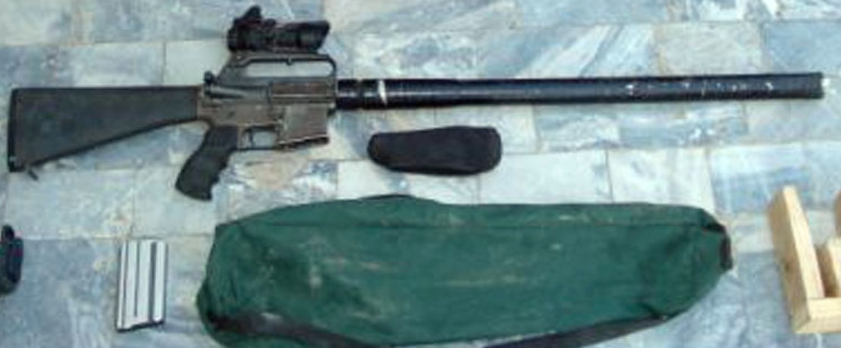
Iraqi Insurgent Improvised M16A1 suppressor (OIF)

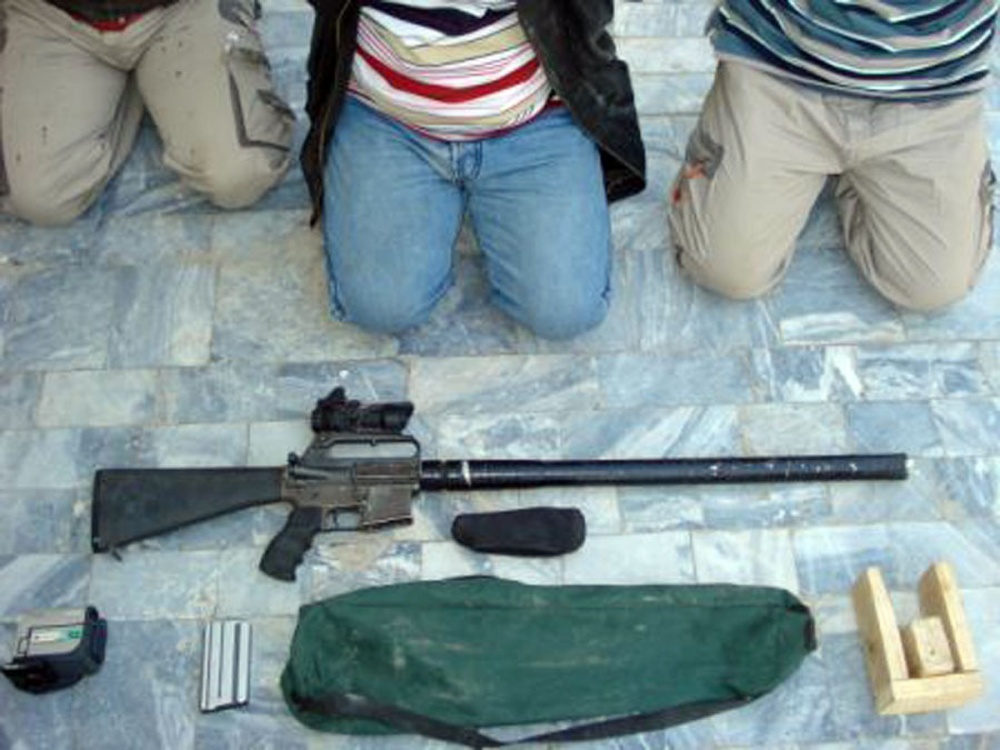
This photograph was posted on the U.S. Department of Defense Media Activity’s public domain website DVIDS along with another one that will be featured on Silah Report. Both depict improvised suppressors captured by U.S. Infantrymen while on operations in Iraq.

From the photograph description-

The confiscated items lay on the ground in front of three men arrested as a suspected sniper team in the northeast Baghdad neighborhood of Haay Ur, Jan. 17. The men were arrested by the 3rd Battalion, 4th Brigade, 1st National Police Division and the 3rd Battalion, 42nd Brigade, 11th Iraqi Army Division as the men attempted to carry out an attack on American forces in the area.

This first photograph depicts what appears to be a 5.56x45mm NATO M16A1 self-loading rifle due to the lack of a rear sight as a separate unit although the photograph is a little blurry to confirm this. The improvised suppressor appears to be some sort of muffling material wrapped around the standard 18 inch barrel of the M16A1, and then continues past the standard muzzle for about a foot of length. From the bulge just past the chamber, it appears that the standard barrel nut has been retained, and one can notice the taper of the barrel and gas tube in the shape of the suppressor. Mounted atop the carrying handle is a Trijicon 4×32 RCO. The grip is not a standard A2 grip and is most likely of commercial after market manufacture.

If the self-loading rifle is indeed an M16A1, the rifle might be a black-market trade from Lebanon or Israel where the M16A1 has seen extensive use by multiple armed entities. The presence of the pistol grip would support this assertion, as it could have been added along the way. It certainly isn’t from a captured U.S rifle. The chances of a Soldier or Marine mounting an after-market accessory such as a grip are extremely slim, and the chances of it being captured are even slimmer. In addition, the 20 round “Vietnam Era” magazine is further indicative that the rifle was initially fielded in Lebanon or Israel due to the amount of surplus equipment being sold to those countries.  It probably isn’t from a private military company either as M16A1s are rarely seen in use among these entities, 14 or 16 inch barrel length M4s being the preferred AR variant.  The Trijicon however would certainly appear to be a U.S capture or otherwise lost piece of gear, with the scope neoprene cover indicating that it was most likely newly issued or rarely used when acquired.

Construction of the improvised suppressor is harder to identify. It would appear that it is some sort of muffling or noise absorbing material stuffed inside a pipe( possibly metallic) the length of the entire suppressor. There appears to be another pipe, one of larger diameter than the main one, that connects both the main pipe and the barrel nut, thus enabling the contraption to stay in place. The entire pipe further appears to be wrapped in black tape of some sort, possibly to prevent any shine from a position of concealment. Whether or not the suppressor actually works, or how long it can adequately suppress is unknown at this point.

Sealing the deal on this capture is the video camera present, showing that the insurgents captured here were probably using the camera to film their shots on U.S troops for propaganda value, eerily  to the “Jubba” sniper videos that plagued troops based in Baghdad. Unconfirmed rumors about the “Jubba” sniper have stated that the actual shooter was using a Remington 700 shooting out of a loophole of a taxicab. A set up such as this suppressed M16A1 could just have been used in the very same way.

The “Carlo” of Palestine

A fatal stoning attack against a civilian car and its driver at the Jewish New Year eve, September 13th 2015, marked the semiofficial beginning of the “Third Intifada”, also known as the “Knife Intifada” or “Stabbing Intifada” or as more accurately could be could the “Individuals’ Intifada”. Unlike previous rounds of violence led by major terror groups like Hamas or militia groups associated with the Palestinian Authority, the “Individuals’ Intifada” attacks are almost exclusively done by lone wolfs or at most pairs of attackers, unlinked to any political or armed group. Mostly those attacks committed by young men and women are motived by social media networks.

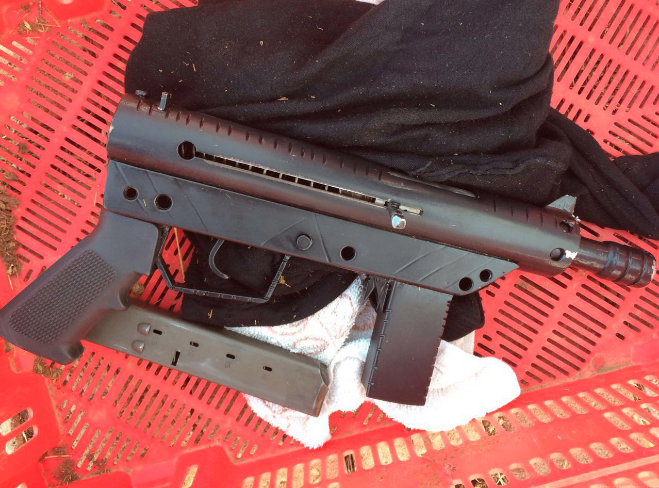
The tools of those attacks are opportunistic by nature: knives, stones, vehicle-ramming attack etc. One of those tools is the subject of this article, the Carlo sub-machinegun. The Carlo (كارلو) is a homemade sub-machine gun slightly modeled and resembling the Swedish Carl Gustav M/45 (كارلوجستاف) – a well-known sub-machinegun in the Arab world with licensed produced by Egypt under the name ‘Port-Said’ and later under ‘Akaba’ & ‘Kara’ as the simplified versions.

As a sidenote the similarity in names and appearance between the real Carl Gustav M/45 and its watered down copy create great confusion among Israeli news organizations commonly mistakably identify and report a Carlo as factory made M/45. One news outlet even reported that the Sarona-market attack terrorist’s weapon of choice was a ‘recoilless rifle’! Clearly, the reporter copy-pasted from the first item Google had to offer when searching ‘Carl Gustav’ and came up with one of the recoilless rifles under the name of ‘Carl Gustav’.       

History

Israeli police first encountered the gun at the beginning of the 2000’s in the hands of Arabs criminals in the West Bank as a self-defense gun and for celebratory gunfire. The gun, its manufacturing, and usage weren’t on the police high priority list as the phenomena seemed contained within the West Bank and as an inner Arab problem. Police operations at the West Bank also fall in the thick border line between the civilian police and the Israel Security Agency (‘Shin Bet’) areas of jurisdiction. Up until the latest Intifada, there was a minimal effort of both organizations to cooperate.

Several shooting attacks, the most notable is the June 8th 2016 attack at the Tel Aviv Sarona market where two gunmen armed with Carlos murdered four diners proved the guns efficiency at very short range attacks against unarmored people despite being inaccurate and unreliable (one of the shooters at the Sarona market attack was even caught on camera angrily throwing his Carlo after it jammed after only a few rounds).

Characteristics   

The common feature all known Carlos share is the ammunition, all known guns are chambered in 9×19mm Parabellum, which is the by far the most common pistol cartridge in Israel and used by all branches of the military, law enforce agencies, government institutions, security, private security companies and private gun owners.

The magazines used are mostly Uzi 25 rounds magazines, inserted to a magazine well in front of the pistol grip. Pistols grips appear to be high quality factory made durable plastic M16 pistol grips as well as some M16 telescopic buttstocks when the guns are stocked. The barrels are smoothbore, usually very short, barrels which are not much more than regular steel pipes.

All Carlos are full auto only fired from an open bolt, ejection port is locate on the top side of the gun and a short charging handle is locate at the gun’s right side and it reciprocating when firing. The question of why have a right side charging handle for a gun mostly used as a machine pistol? A right-handed charging port will gain no value of a charging handle at the right side he can’t easily charge with or clearing jams without buttstock and handgrip.

Since the gun’s ejection port on top a charging handle and its slot cutout could easily place left side enabling the shooter reciprocate the bolt with left hand while holding the gun right-handed. No clear answer, the first option is by trying to leech of the M/45 popularity the makers of the Carlo also copied the location of the handle scarifies functionality in order to resemble the recognized M/45.

Second option is that machine pistol concealed under a coat is best placed left of the body in order to pull it quickly (by a right-handed), having a left side handle will poke the user side so right side handle is preferable. Another source of speculations is what appear to be sort of rectangular upper hunch on the top rear part of the gun which is quite common for the higher end Carlos. Its purpose is unknown, it raised a bit the rear sight but noting that required such large protrusion. It maybe housing of some sort of crude delayed blowback mechanism, probably leaf spring, used to lower the fire rate of fire and make it more controllable gun.

Yoel M. is a contributing writer for Silah Report, and is a firearms enthusiast based out of Israel. His first report on S.R. was about the Israeli “Hitchhiker” magazine.


If you enjoy our work here at Silah Report please consider supporting us on Patreon!

Barrel Rifling Device from Darra Adam Khel

As you may know, Darra Adam Khel is a town in Pakistan which is famous for its indigenous firearms manufacturing. Many people living in this area are busy making guns and loading ammunition. There are some rough firearm clones made in Darra Adam Khel, but there are also really impressive ones both in terms of design and execution. Sometimes it is really unbelievable how these people manage to make firearms using only basic tools.

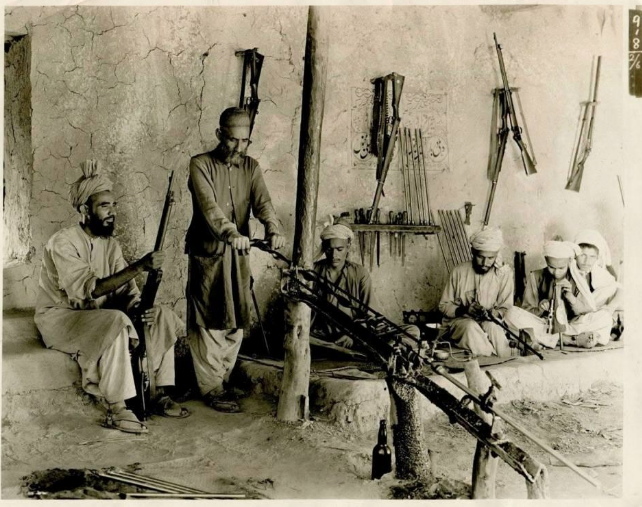
The top image of this article shows a local gunsmith operating a barrel rifling device. Although it is not confirmed, some sources say the picture is taken in 1902.

Note the barrel secured in the lower portion of the device and the gunsmith holding the handles of the cutting tool. The cutting tool itself has a spirally shaped shaft, which I assume runs on a guide pin so that when worked back and forth the cutting tool will do a spiral motion thus cutting the rifling at a certain twist rate.

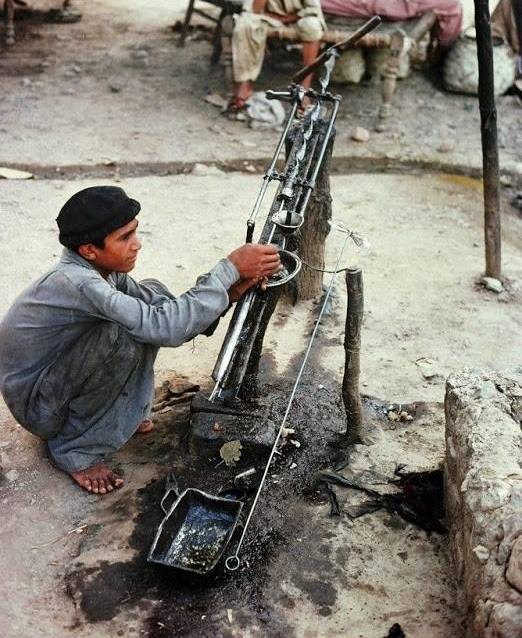
What is even more interesting is that there are newer images from Darra Adam Khel showing an exactly identical device. So even if it is a homemade rifling tool, it should be working great to be used until modern days.


How Ruger P95s and Sig P2022s Got to Iraq

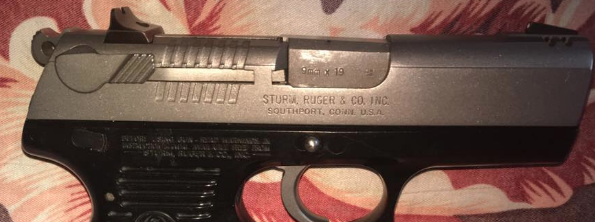
For a while now we’ve seen a number of Ruger 9x19mm NATO P95 handguns flourishing among the social media groups within Iraq. This isn’t a recent phenomena but still, the question remains over where they originated from. Daniel Watters, a noted small arms historian has provided us with some excellent context on the issue, even detailing the specific contracts that pushed 5,000 Ruger P95s, and 5,000 Sig Sauer SP2022s into Iraq.

Back in December 2004, the US Army’s Tank-Automotive & Armament Command (TACOM) posted solicitation W52H09-05-R-0067. They basically wanted 10,000 9x19mm pistols in a hurry, and were willing to place multiple contracts to fill it. Vendors were allowed to bid for as few as 100 pistols up to the full total of 10,000. The most telling portion of the solicitation was that they requested a price for the pistols to be shipped directly to Baghdad.

Before the end of the month. Ruger received contract W52H09-05-C-0058 for 5,000 P95, and SIG-Sauer received contract W52H09-05-C-0059 for 5,000 SP2022.

When outsiders saw the name Tank-Automotive & Armament Command, they assumed the pistols must be for tankers. Nothing could be further from the truth. A subordinate command of the Army Materiel Command, TACOM-Rock Island was responsible for all Army small arms procurement. It also handled orders from other US military service branches, and managed foreign military sales (FMS).
It turns out that the rush order was meant to arm Iraqi security forces ahead of the country’s first post-Saddam parliamentary elections in January 2005. Confirmation can be found in the government report “Iraqi Security Forces: Weapons Provided by the U.S. Department of Defense Using the Iraq Relief and Reconstruction Fund.

The report listed can be accessed here and lists the 5,000 P95s as being purchased for $1,271,700, and the 5,000 SP2022s being purchased for $1,756,550, both on December 12 2004. Both of these appeared to have been designated for the Ministery of Interior and the Ministery of Defense although it doesn’t specify which. We should also note that these 10,000 handguns were only a third of the 38,053 “Generic 9mm Pistols” that were on contract. What those other thirty-something thousand odd handguns were would have to take some researching.


Although very similar in appearance to a Sig Sauer handgun, our sources tell us that this is in fact a blank firing copy.

Iraq Spotlight: STG44 & MP40 Pair

Recently coming out of Baghdad are these images of a very well worn down German STG44 and what comparatively appears to be a less used 9x19mm MP40 submachine gun. There were not any close up photographs of the internals of the small arms so it is hard to ascertain what year in WWII either was made in.

16640661_1307580419322630_6634988205963306852_n 16649575_1307580435989295_4333584821653400111_n 16681784_1307580485989290_8186590511940828433_n 16807711_1307580285989310_6590856711305527722_n

STG44s have been reported in abundance in neighboring Syria, often arming Daesh troops in Raqqa. There is even an inside report on these rifles by a source in Syria from TFB. The largest issue with them is that 7.62x33mm Kurz is extremely hard to come by, although the rifles themselves are very plentiful and in like new condition.

Notice on the MP40 the grip sleeve. These are used on a number of handguns in Iraq and is actually an Airsoft import from China. They come in a number of colors, from green to tan, to black.

16830653_1307580562655949_2649343178168701307_n 16830913_1307580519322620_5621271676205644916_n

AR70s in Iraq

Images gained from Iraqi social media groups have indicated the transfer and usage of 5.56x45mm NATO Beretta AR70s. Specifically there has been one rifle spotted with the Shi’a Al-Abbas Brigade. The Al-Abbas Brigade was originally formed in Syria in 2012 but after heavy losses with Daesh moved to Iraq in 2014.

c4jfmovuoaa-ofj

Some of these AR70s appear to have been modified with Airsoft picatinny rail handgun systems to provide a picatinny interface. The Italian rifle never received an upgrade to a picatinny system having been replaced by Beretta’s ARX-160 instead. The rail in the title photograph looks to be a very common AR Airsoft rail coming out of China with the oval vents, very similar to many handguards from UTG. However the example below might be one of the Daniel Defense fakes with the 12 o’clock gas tube vents actually installed at the 6 o’clock position. Both examples show an M16A4 handguard mounted to a rail section that covers the top portion of the rifle, leading S.R. to believe that they might originate from the same source or small arms market.

c0gmajoviaebsn9