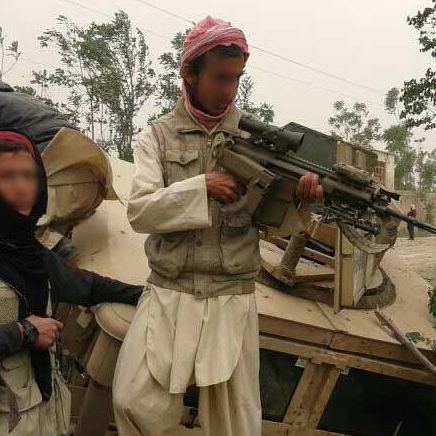
FNH SCAR-Hs among the Taliban

Although very few in number, several news sources have documented the usage of 7.62x51mm SCAR-Heavy rifles in use by the Taliban in Afghanistan. The most recent documentation we have in the summer of 2016 covered by Lost Weapons on Twitter, in addition to the summer of 2015 as covered by Nathaniel F. on The Firearm Blog. There is a possibility that both of these SCAR-Hs are the same rifle over the course of two years, but we can’t exclude the fact that there may be more. How it got into the hands of the Taliban is possibly by way of the Afghan Commandos who are primarily armed with M4A1s but might have been supplied a SCAR-H by their U.S. Army advisors.

e460abf1-c671-4407-be75-7198403d12eaCy0LqQJVEAIXWu7-1

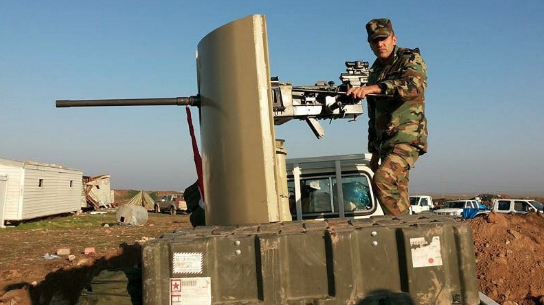
SUSAT On Peshmerga M2

A photograph has recently come out showing a Peshmerga fighter with what appears to be a SUSAT mounted on his M2 .50 BMG Heavy Machine Gun. The mount that the machine gun is cradled in also appears to be a of British design, formerly seen in use on British armored vehicles. SR’s suspicion is that the entire contraption is supplied by British forces to the Peshmerga as defensive material. However, it would also appear that the SUSAT isn’t calibrated to the trajectory of the .50 BMG cartridge, nor is it very well suited for a heavy machine gun in the first place, being designed for a 5.56x45mm rifle.

WW II Small Arms in Libya

Although this these images are from a post that is several years old and on an Airsoft forum, the historical relevance is still very important to consider when examining small arms in the MENA region. These photographs came out during the massive unrest in Libya during and following the Libyan unrest otherwise known as “17 February” that overthrew long-time ruler Muammar Gaddafi. Although many of these small arms were actually used in fighting, the photographs appear to show a lull, where militia forces aren’t actually engaged but are rather conducting target practice or celebrating.

Two variants of the U.S. 1919 are shown, the first one appears to be a heavily modified 1919A4 variant, while the second one is a 1919A6. At first glance, these may appear to be 7.62x51mm NATO variants that Israel modified to use in the IDF during the 1950s and 1960s. However, a closer look at the belt of ammunition reveals the length of the rounds do appear to be .30-06 Spr and thus are most likely original manufacture 1919A4s and A6s.

libyanrebs15 libyanrebs07 libyanrebs06The photo below shows a Browning Hi Power, Sterling SMG, and a Caracano rifle in the background.
libyanrebs

The proceeding two photographs are of a Russian 7.62x54Rmm DP28 light machine gun. These might have arrived in Libya as a form of surplus support from the Soviet Union during the Cold War.

libyanrebs17
libyanrebs05

At an initial glance, this would appear to be a German 9x19mm MP40, but instead, due to the circular opening in the magazine well it is in fact, the predecessor to the MP40, the MP38.

libyanrebs10

This rifle appears to be a Mauser K98 with a broken stock that has been replaced

libyanrebs02

17 February Unrest Summary (Wikipedia)-

The first Libyan Civil War, also referred to as the Libyan Revolution[33] or 17 February Revolution,[34] was an armed conflict in 2011, in the North African country of Libya, fought between forces loyal to Colonel Muammar Gaddafi and those seeking to oust his government.[35][36] The war was preceded by protests in Zawiya on 8 August 2009, and finally ignited by protests in Benghazi beginning on Tuesday, 15 February 2011, which led to clashes with security forces that fired on the crowd.[37] The protests escalated into a rebellion that spread across the country,[38] with the forces opposing Gaddafi establishing an interim governing body, the National Transitional Council.

The United Nations Security Council passed an initial resolution on 26 February, freezing the assets of Gaddafi and his inner circle and restricting their travel, and referred the matter to the International Criminal Court for investigation.[39] In early March, Gaddafi’s forces rallied, pushed eastwards and re-took several coastal cities before reaching Benghazi. A further UN resolution authorised member states to establish and enforce a no-fly zone over Libya, and to use “all necessary measures” to prevent attacks on civilians.[40] The Gaddafi government then announced a ceasefire, but fighting continued.[41][42] Throughout the conflict, rebels rejected government offers of a ceasefire and efforts by the African Union to end the fighting because the plans set forth did not include the removal of Gaddafi.[43]
AR70s in Iraq

Images gained from Iraqi social media groups have indicated the transfer and usage of 5.56x45mm NATO Beretta AR70s. Specifically there has been one rifle spotted with the Shi’a Al-Abbas Brigade. The Al-Abbas Brigade was originally formed in Syria in 2012 but after heavy losses with Daesh moved to Iraq in 2014.

c4jfmovuoaa-ofj

Some of these AR70s appear to have been modified with Airsoft picatinny rail handgun systems to provide a picatinny interface. The Italian rifle never received an upgrade to a picatinny system having been replaced by Beretta’s ARX-160 instead. The rail in the title photograph looks to be a very common AR Airsoft rail coming out of China with the oval vents, very similar to many handguards from UTG. However the example below might be one of the Daniel Defense fakes with the 12 o’clock gas tube vents actually installed at the 6 o’clock position. Both examples show an M16A4 handguard mounted to a rail section that covers the top portion of the rifle, leading S.R. to believe that they might originate from the same source or small arms market.

c0gmajoviaebsn9

Safir AR Magazines in use by Peshmerga, Iran

Safir Arms is a Turkish firearms company that primarily produces .410 AR clones. However, the company debuted a 5.56x45mm NATO AR magazine in 2014 along with a bullpup rifle under the name T-14 that shared a number of AR components. The rifle never seemed to have advanced past a prototype stage, but the magazine design included was turned into a manufacturing run. Currently it is listed on the company’s website and in the catalog. The listed magazine and bullpup rifle appear below along with a modular adaption of an AR rifle.

t1816730509_959895579865_6921342533509956338_n screen-shot-2017-02-13-at-10-28-04-pm

Unlike similar polymer magazines such as Magpul’s Pmag and ProMag’s signature polymer magazine, the Safir Arms version has four columns along the side of the magazine, in addition to a ribbed portion that sits below the magazine well of an AR when inserted. Observe the differences in the photographs of the Magpul and Promag-

cola18-1-large images

However, recently the same magazine design has appeared in usage with certain Peshmerga forces, specifically security forces armed with NEA Arms PDWs in Kurdistan. In addition it also appeared in a recent Iranian defense weapons exposition in Tehran. Whether or not the magazine has been copied by the Iranians and being manufactured locally is unknown at this point in time.

With the Peshmerga in the ARES post-

7

And at the Iranian exposition-

screen-shot-2017-02-13-at-5-12-39-pm 991098-1000

FP’s Take on Malhama Tactical

Malhama Tactical has been covered through numerous defense and small arms websites recently but this is the first time the print magazine Foreign Policy has ran an article on its unique guns for hire status. The group is led by an Uzbek fighter, who appears to have had some previous military training at an enlisted level.

Screen Shot 2017-02-10 at 7.14.56 PM.png

From FP-

The group’s leader is a 24-year-old from Uzbekistan who goes by the name Abu Rofiq (an Arabic pseudonym that means father of Rofiq). Little is known about him other than that he cycles through personal social media accounts rapidly, using fake names and false information to throw off surveillance efforts. In virtually every video and photo posted online, he wears a scarf or balaclava to cover his face from the nose down, leaving visible only his narrow dark eyes and long, somewhat tangled, pitch-black hair. He speaks fluent Russian, but with a slight Uzbek accent.

Since launching in May 2016, Malhama has grown to do brisk business in Syria, having been contracted to fight, and provide training and other battlefield consulting, alongside groups like the al Qaeda-affiliated Jabhat Fateh al-Sham (formerly known as the Nusra Front) and the Turkistan Islamic Party, a Uighur extremist group from China’s restive Xinjiang province. And despite recent rebel setbacks in Syria, including the loss of Aleppo, demand for Malhama Tactical’s services in the country is as strong as ever, Abu Rofiq told Foreign Policy in an interview conducted over the messaging app Telegram.

But he is also beginning to think about expanding elsewhere. His group is willing to take work, Abu Rofiq says, wherever Sunni Muslims are oppressed. He cites China and Myanmar as places that would benefit from jihad. He also suggests that Malhama Tactical might go back to its roots, returning to fight in the North Caucasus against the Russian government.

The group’s videos do show a certain degree of tactical proficiency, but lack the finesse that comes with being an NCO, such as this video covering casualty aid under fire. The casualty is assessed and treated, but there is very little respect to security being provided.

https://www.youtube.com/watch?v=4OxLah2rgMM