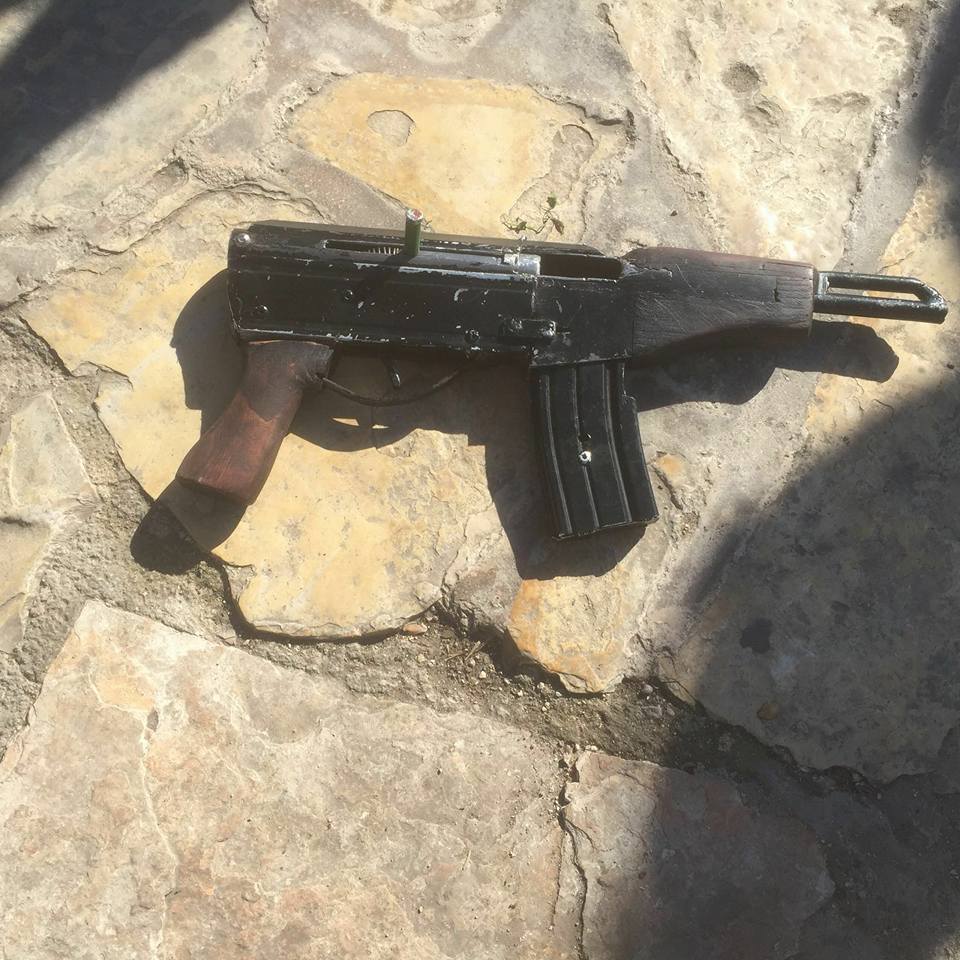
Improvised Replica Firearms from the West Bank

In my previous article, we examined the Palestinian homemade Carlo submachine gun in use in the West Bank.

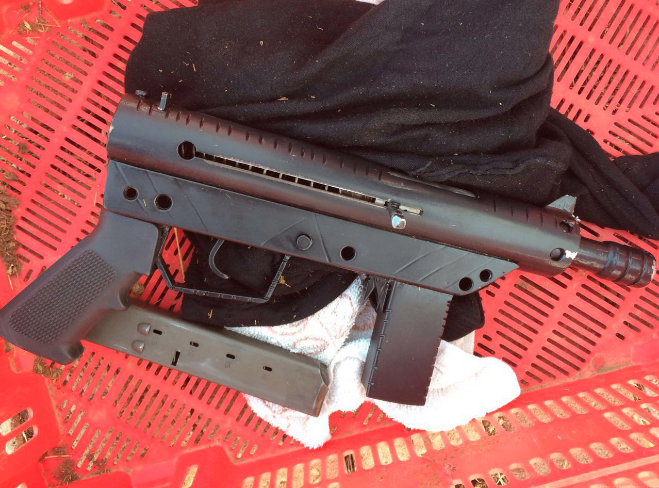
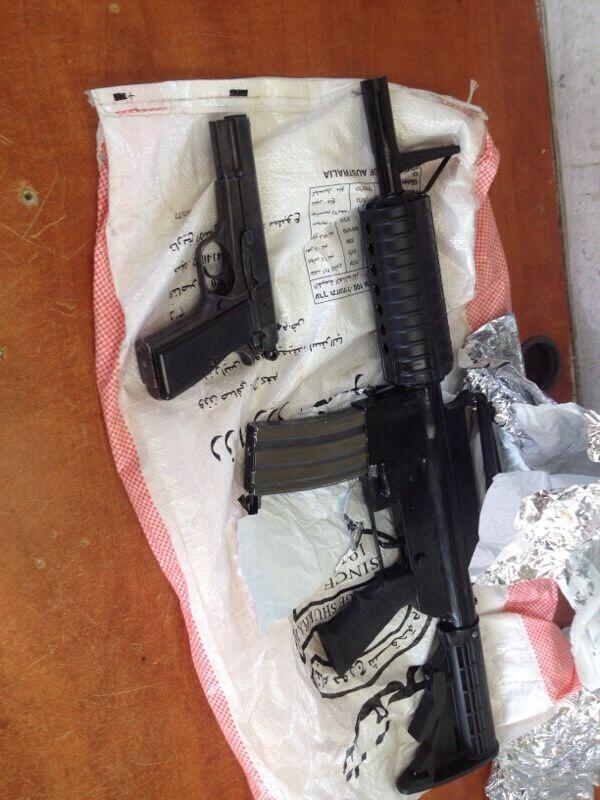
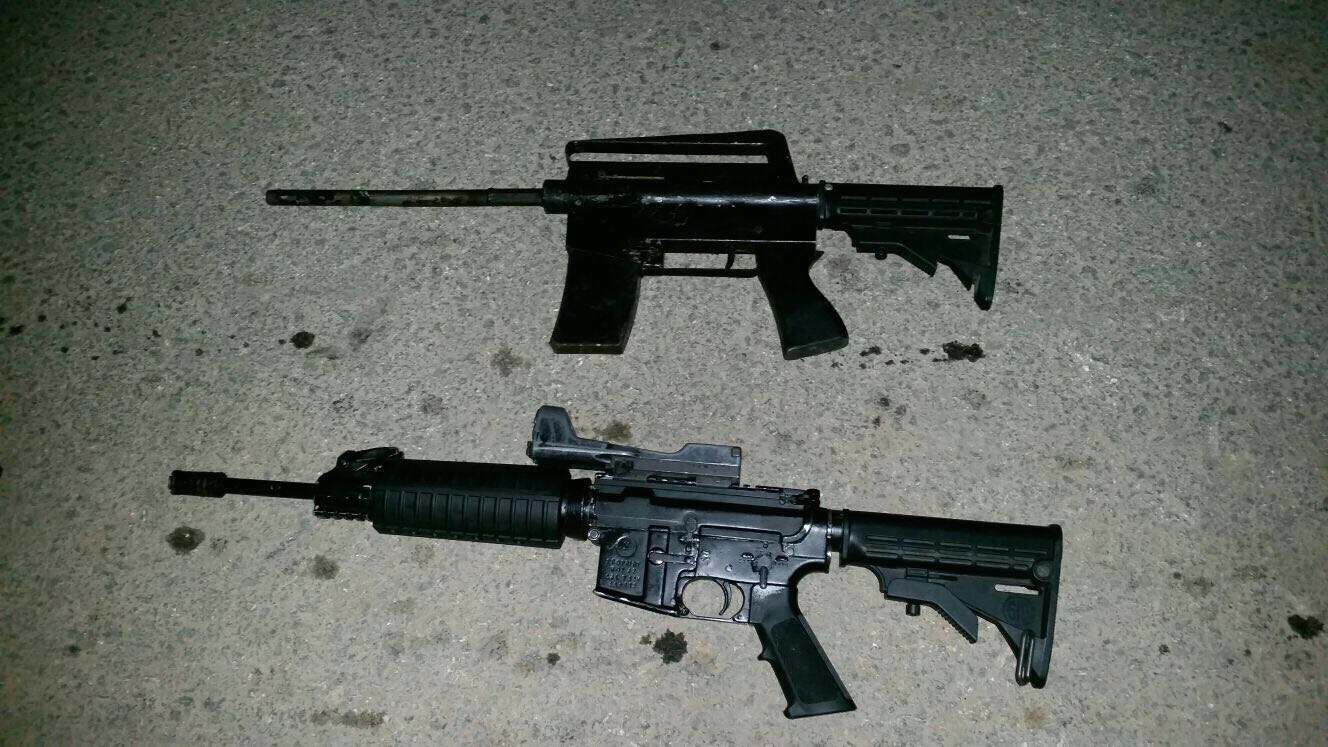
This article will examine the design and use of improvised firearms among Palestinians in the West Bank, that are otherwise known as “Replica” Carlo’s due to their similarity in appearance to the M4s and M16 rifles in use throughout Isreal that the designs are replicating. The majority of these weapons are 9x19mm NATO, fully automatic only, magazine fed, open bolt designs that are improvised from underground manufacturers that use machinery and materials purchased on the black market or outright stolen. Due to the variance in production and origins, there is no set standard of appearance for these weapons. Rather there is a general consensus that the appearance is identical to an M4 or M16 from afar, but that there are significant differences between individual models.

Motives for Producing Replicas and the Cultural Context
Availability

The prime reason to manufacture the Carlo is to resemble as closely as possible an M-16 or M-4 is the availability of furniture and magazines in Israel and the West Bank. Both guns were and still are a major part of the Israeli armament, used by the IDF, police, civil guard etc… Because of this availability of parts, Armalite based designs are favored when theft becomes an option.

From a manufacturing point of view, it makes sense to design your gun to match the existing furniture and magazines already available than to manufacture them along with the gun.
Status and Prestige

Guns have a significant role in the Arab tradition, centuries of existence in lawless regions made it essential to own weapons for self-defense and as a deterrence against other tribes who were also armed themselves with whatever they could get their hands on.

Although civilian gun ownership is largely restricted and banned by both Israel and the Palestinian Authority many Arab families in the West Bank and Israel are determined to keep their arsenals and enlarge them as much as possible.

Alongside the practicality of owning a gun the guns are symbols of status and wealth. A family or an individual that can afford high-end weapons rather than a homemade one enjoy prestige over those who compromise with the local workshop products.

Acquiring a real military grade firearm might be expensive and the common garden variety Carlos are too widespread. The Carlo replicas are a way to bridge that gap, have a more expensive and awe-inducing gun without the cost of acquiring the M4 that the replica is based on.
Imitating Popular Palestinian Figures

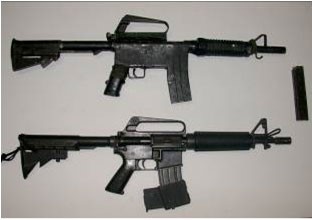
Many in the Arab population view the terror organizations and terrorists as freedom fighters and role models, naturally, there are those who want to imitate these heroes and want to have their guns be as identical to those who they admire. If the genuine guns and ammo are out of reach then the replicas become the alternative, relatively cheap and available supplies of ammunition to practice and show off. It is then easy to understand why some workshops making the replicas make great efforts to produce almost identical copies.
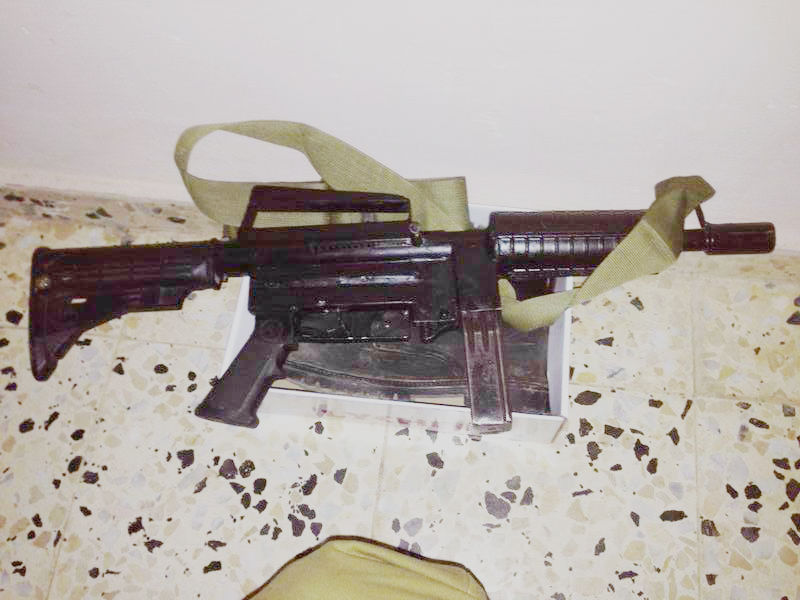
Infiltration

It has been speculated that the M4 replicas could be used for terror attacks against Israeli civilians or IDF soldiers. Due to the apparent shape of the replicas being similar to the M16 service rifle used by the IDF. This will confuse soldiers and security guards, mistaking the identity of terrorists as IDF soldiers, making them hesitate to shoot.

A fair theory, however, none of the individuals caught with these replicas has ever been caught with an IDF uniform to match the gun. Currently, the records show that after numerous attacks done by Carlo wielding terrorists none were carrying any replicas. All of the photos released by IDF and police spokesmen show a regular Carlos.
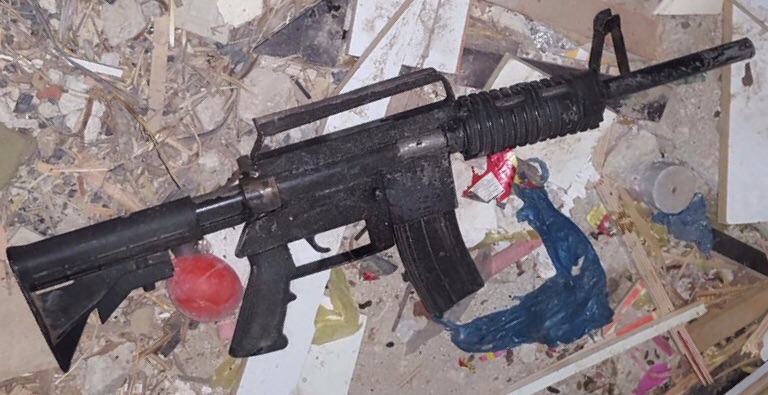
Stolen or Lost Weapons and Magazines

An obvious source for both guns and their magazines are various stocks of small arms already existing in Israel. IDF, police, border guards, private security, armed civilians and many other groups are armed with M16s and M4s. This creates an abundance of stock from which guns and magazines can be acquired, by searching IDF training areas or breaking into a police officer’s home for example.

Commercial market

Several Israeli companies, such as FAB and CAA, known in the U.S. commercial gun market for their products, are also producing and selling M16 and M4 furniture in Israel. Many IDF soldiers individually choose to upgrade their weapons at their own expense. Such equipment is sold regularly and without any background checks and it stands to reason that some of the replicas are using such legally purchased furniture.

Paintball and Airsoft Replicas

There were some on Israeli gun web forums who speculate that paintball and airsoft replicas could be the source for the Carlos replicas’ receivers.

Indeed such guns could be cannibalized to provide the Carlo replica receivers.

The 9x19mm NATO ammunition produces less pressure than intermedium cartridges do so the light structure of the paintball and airsoft might withstand the additional pressure.

However, thought technical plausible, photos taken of captured Carlos or those surface in the Arab social media don’t indicate that paintball and airsoft are used.

The replicas’ ‘receivers’ all appear to be workshop made with all the typical welding seams, rivets and out of proportions dimensions.

Embedded Magazine

Curious readers might wonder how open bolt 9x19mm submachine guns are fed with 5.56x45mm NATO STANAG magazines.

The answer is simple, the craftsmen making the guns mimic the real guns embed pistol or Uzi 9x19mm magazine inside the real STANG magazines.
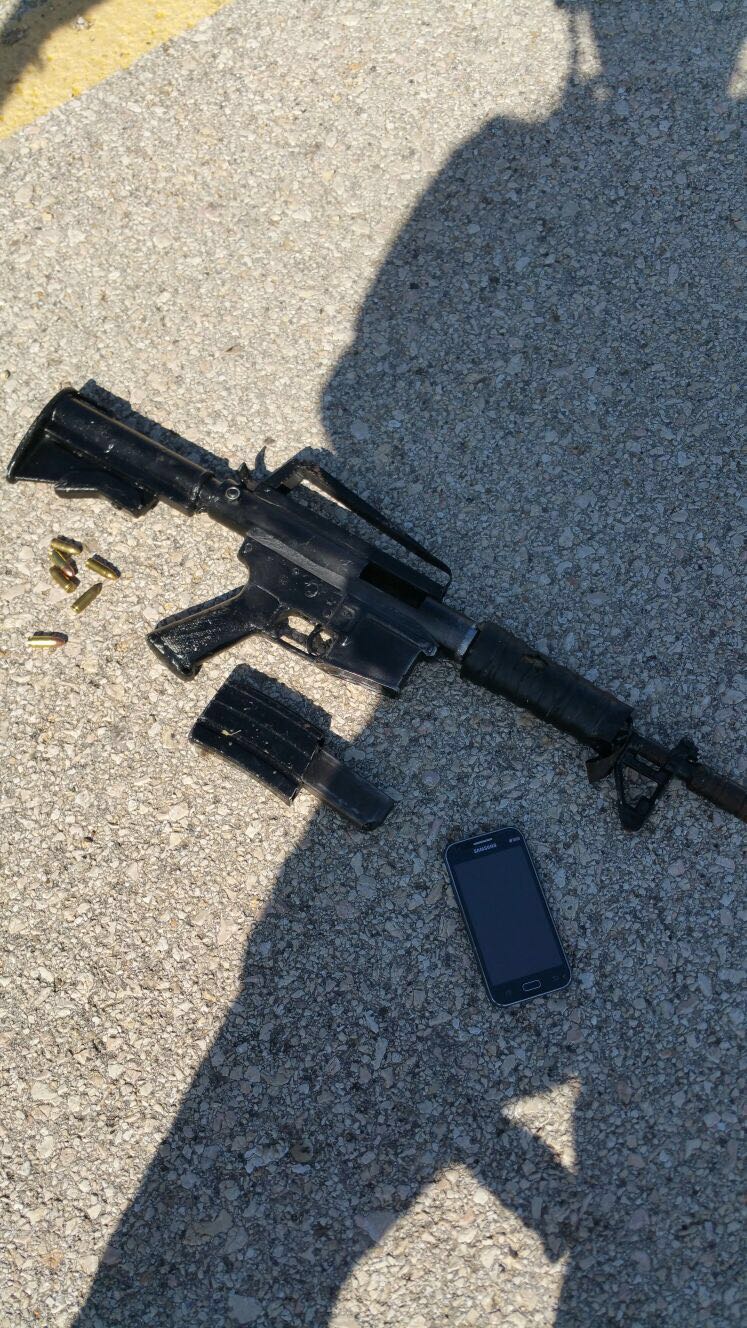
Similar to Matryoshka dolls, these magazines are inside of the weapon with few exterior modifications to the STANG magazine.
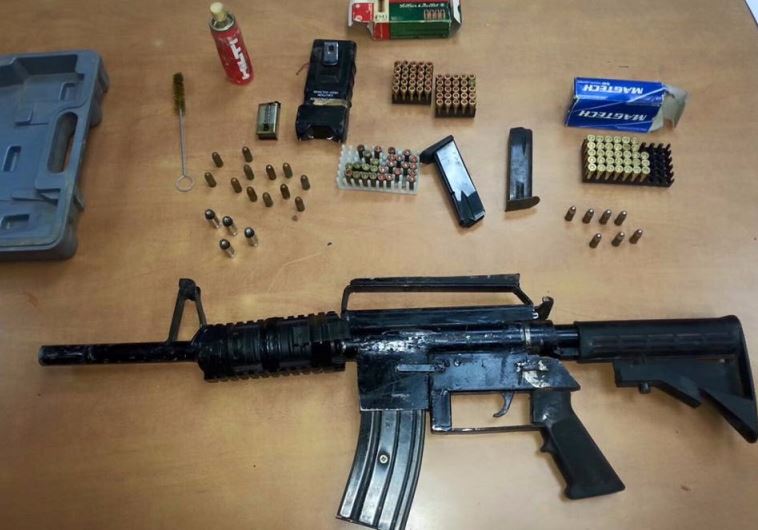
Those rivets hold the inner magazine in place.

Outside of the weapon the inner magazine is revealed protruding out of the STANAG housing magazine.
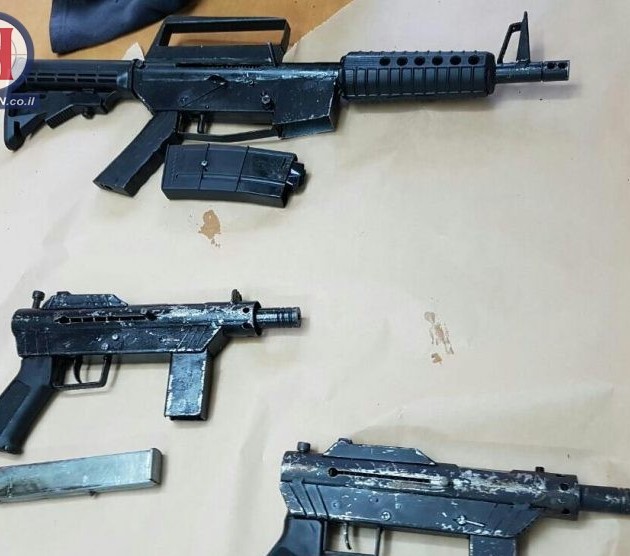
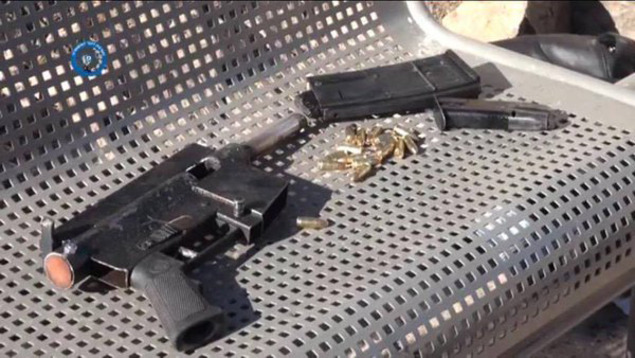
Such arrangement of small caliber magazine housed inside bigger caliber magazine shell is unusual but not unique, for example, the Philippines Armscor M16 22 is a 22LR semi-auto rifle dressed as an M16A1 with a matching STANAG size magazines containing 22LR magazines inside
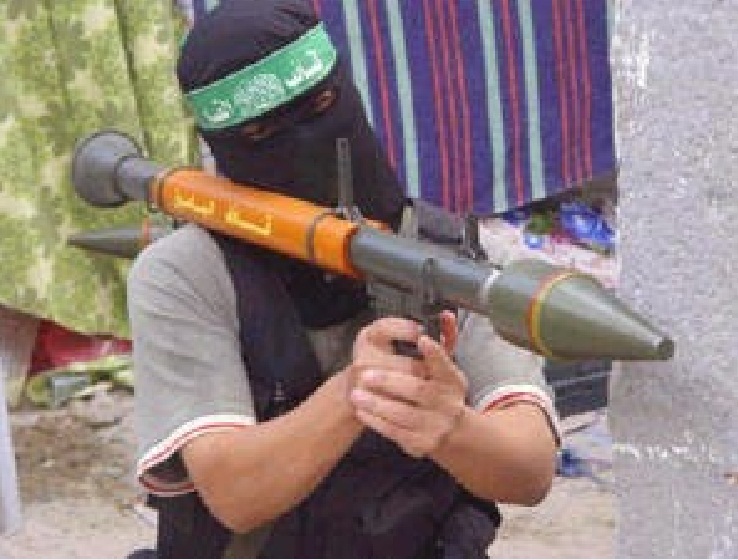
Yassin RPG – The Underground RPG of Gaza

Due to the Arab-Israeli conflict in Palestine, Hamas with its military wing al-Qassam brigades has developed their own tools of war in order to preserve self-sufficiency in order to not be affected by the blockade made on Gaza strip.

This article will spotlight on one of the more interesting craft produced rocket launchers in Gaza , which is literally underground since their production facilities are protected in underground bunkers from IDF air raids and artillery strikes.
It is designed and manufactured by Hamas, but they distribute the launchers to other resistance troops working in Gaza, including Fatah and the PFLP (Popular Front for Liberating Palestine).

History

The weapon is named after Sheikh Ahmed Yassin, the founder and the spiritual leader of Hamas who was assassinated by Hellfire missiles shot from an Israeli AH-64 Apache Helicopter gunship on March 22, 2004, at the age of 67.

It was designed by Adnan al-Ghoul who was also assassinated by an Israeli air strike on October 21st, 2004.

Characteristics

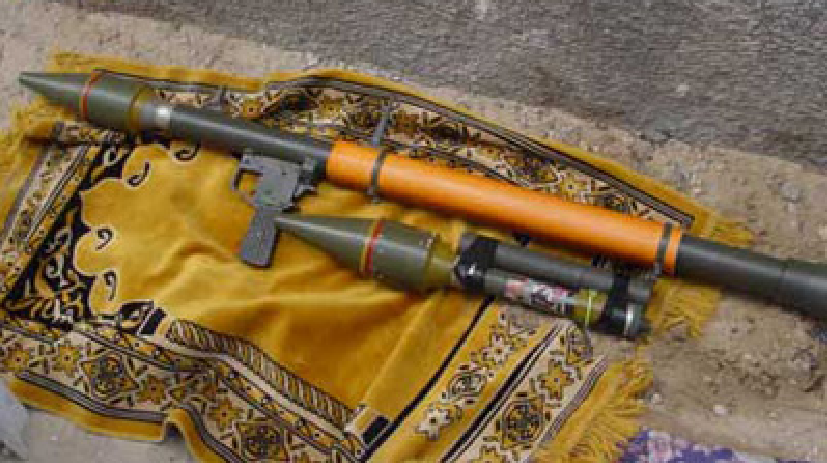
The Yassin RPG is a unique design that resembles the RPG-2 combined with RPG-7 with some improvised design features, From RPG-2 it took the launching tube design and the warhead external shape and the rocket motor which are very simple, but to improve the performance they added some features from the RPG-7 such as the nozzle at the launcher’s rear to deflect recoil generated by launching the rocket, they also added a rocket booster to be attached to the propelled grenade to extend it’s range, and the internal shaped charge of the warhead is enhanced as well.

The manufacturing process occurs in underground workshops using ordinary shop tools, but the conception and engineering of the weapon seem to have a high degree of sophistication and professionalism given the lack of technology of the design.

In Action
According to the continuous improvements of armor in Israeli armored vehicles, the RPG is believed to be not effective against them. However, Saladin brigades (the military wing of the Popular Resistance Committee in Gaza) claimed to destroy a Merkava Mk.3 MBT by targeting a weak point of the tank. Yet, the weapon is very effective against brick fortifications and soft-skinned armor as it can penetrate a 21 cm steel plate from 150 meters.

Specifications 

Model : Yassin RPG

Designer : Adnan al-Ghoul

Type : Anti-Tank, Anti-Personnel

Place of Origin : Gaza, Palestine

Manufacturer: al-Qassam brigades, R&D unit

In Service: 2004 – Current

Weight : 7 kg (15 lbs)

Length : 95 cm (37″)

Caliber: 40 mm rocket engine ; 85 mm warhead

Muzzle velocity: 295 m/s

Effective range: 300 m

Sights: Iron sights

Differences between RPG-2 (top) and RPG-7 (bottom)
Yassin RPG featuring the combination of RPG-2 and RPG-7

Book Review: The Afghan Way of War

Although former British Army officer Robert Johnson wrote his book, “The Afghan War of War” in 2011, his conclusions and observations are just as valuable, if not more valuable today than ever. The premise of his book is that very few authors, officers, or politicians have throughly studied the Afghan side of many of the conflicts that have taken place in Afghanistan, whether it be Afghans against foreign invaders/occupiers, or civil war within the country such as during the 1990s. What I especially liked about the book was a number of very useful points that Johnson raises, that I honestly had not thought of before. I’ll summarize some of these points below, as these were my key takeaways from the book.

A Nation of a Thousand Tribes

Johnson goes to great lengths to make the point that Western observers have seen Afghans as “unchanging”, the “Graveyard of Empires”, and “fierce tribal fighters”, and this has stereotyped impressions of the Afghans since the first Anglo-Afghan War in the 1840s. Throughout the book we have countless counter-examples where this doesn’t seem to be the case. Where Afghan tactics have changed, altered, and have been reactive to the threats faced, in addition to being proactive and forcing Western troops to be constantly on the defensive.

But there is one constant that hasn’t changed, and that is the tribal and group dynamics that have existed for several hundred years. What we see is that instead of seeing Afghanistan as a single entity, or even an ethnic group as an entity, what is really going on is hundreds of individual tribes, sub-tribes, clans, and families that are essentially looking out for the best option for their individual group. Whether they ally with the British, or with the King, whether the Mullahs decide to go to war at all, whether peace is on the table, etc… Any of these decisions are made for the benefit of the particular group (tribe, clan, village, etc…). And these often change. What is beneficial for a village one month, may be detrimental for it the next. This means that to the British, Soviets, or Americans, it can be increasingly frustrating trying to maintain alliances and agreements.

Something that Johnson doesn’t mention, but a personal observation that I’ve made is how economy plays into these decisions. The lack of a stable exportation or cultivation of any natural resource (other than crops and opium) has been a limiting detractor throughout the countries history and still affects national security today. But when local tribes and villages can’t rely on natural resources like oil, mining, etc… the need to fight tooth and nail for alliances, positions, and funds becomes even more apparent.

Foreign Invaders Unify Afghans

In the example of every invading or occupying force, one of the constant themes is that one of the only forces that has ever truly united Afghans of different ethnic origins in some fashion has been the need to expel a foreign one. Johnson doesn’t point this out explicitly but this is evident in his descriptions of the country before several conflicts. The state of the country under the King appeared to be on the brink of falling apart on numerous occasions, when senior leadership pushed for further hostilities against the British or during the time of communism, against the Soviets. Even under the Taliban during OEF, the need to unite under an Islamic banner instead of an Afghan, or Pashtun one was strategically necessary to be able to sweep tribal differences aside.

Differences in Technology

The first Anglo-Afghan War saw the widespread use of muzzleloading rifles and muskets on both sides of the conflict, with the British armed with the Brown Bess, and the Afghans with the Jezail muzzle loading rifle. Apart from the British cannon and cavalry, the two forces were somewhat equal in terms of actual hardware.

However in the second Anglo-Afghan War this dynamic dramatically changed with the introduction of breech-loading rifles that could not only be reloaded quicker, fired faster, but also more accurately and further. This changed the way Afghan tribesmen attacked British columns. They had to close in faster, not allowing the British to use their artillery, and often attacked at night.

Similarly, in the war against the Soviets, the use of Stinger MANPODS was brought up. The popular misconception is that Stingers helped win the war. Although they did strike fear among Soviet helicopter pilots, especially the Hind attack helicopters, their introduction was too late to make a difference in 1986, when the Soviet Union had already decided to being fighting a delaying action instead of an all-out offensive. In addition, by altering their flying practices to fly at higher altitudes, the Soviets realized they could go outside of the Stinger’s capabilities and lessen the risk.

In Operation Enduring Freedom, the prevalence of IEDs took precedence over light Infantry attacks that the Taliban initially tried to use against the British in Helmand, but suffered costly casualties due to the artillery and air assets. IEDs used by the Taliban deserve to be studied much more in detail due to the complex escalation’s and counter escalation’s executed on each other throughout the entire campaign.

Operation Enduring Freedom/Operation Herrick Observations

One point I think the book could have been improved on is the OEF/Op Herrick. In retrospect, this isn’t really Johnson’s fault because the war is still ongoing, and he can’t have access to many of the after action reports, or even just the massive amount of experience associated with the current operations from hundreds of thousands of veterans and currently serving troops. He picks out specific situations and TTPs that are usually from the British perspective, that doesn’t typify what other forces might have faced in their fight against the Pashtun lead Taliban insurgency.

His conclusion though is flawless in that he identifies that any considerable gains going forward will have to be an Afghan solution to an Afghan problem. Personally I think this has to have enormous emphasis on the countries economy, and being able to become prosperous on exporting natural resources already present in order to actually provide some capitol for a government entirely propped up on international aid money.

The Afghan Way of War is available on Amazon for $35.95.

Improvised Mauser Suppressor (OIF)

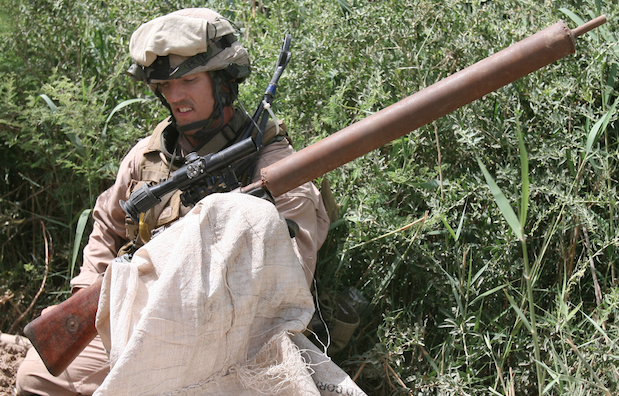
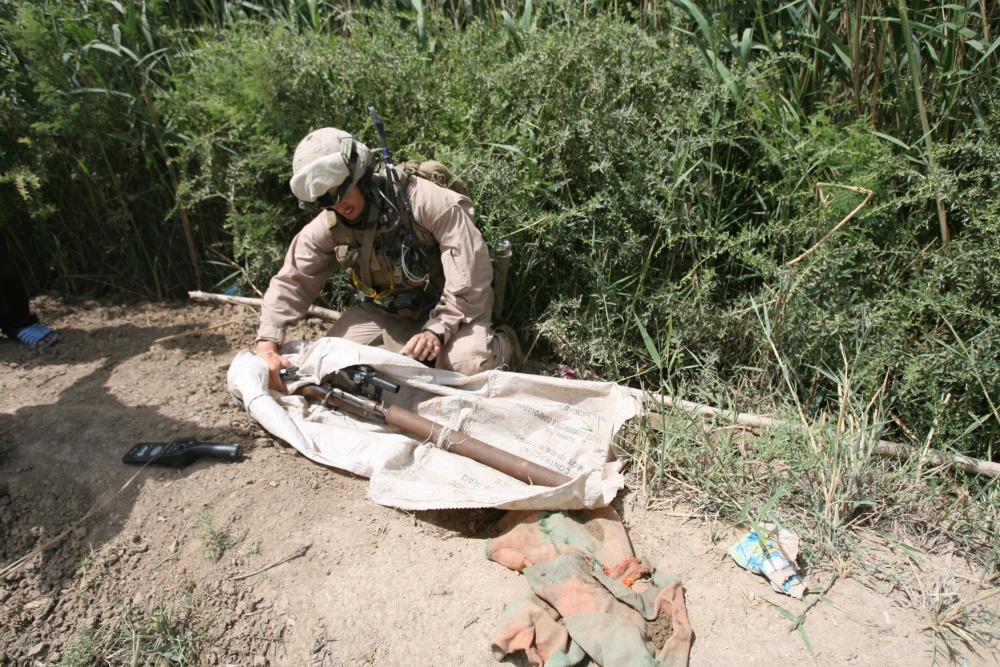
This photographs was posted on the U.S. Department of Defense Media Activity’s public domain website DVIDS along with another one featured on Silah Report. Both depict improvised suppressors captured by U.S. Infantrymen while on operations in Iraq.

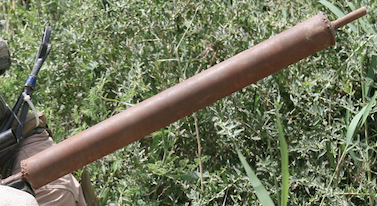
The rifle appears to be a Mauser 98K with the stock sawed off just past the chamber. Because of the proximity to Iran and the incredible amount of Iranian surplus found in Iraq, it would appear from conjecture that this rifle is a Persian Mauser, manufactured in the time of the Shah in the 1940s-50s, later being replaced by the M1 Garand through U.S. Foreign Military Sales programs in the 1960s. Unlike the previous M16A1 rifle we posted about, this improvised suppressor appears to have involved much more work, with a much larger diameter pipe being welded around the actual barrel of the rifle at both the front and rear of the pipe. There is a section of much smaller diameter pipe protruding from the main one, but this doesn’t appear to be the barrel.

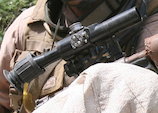
The scope mounted on this rifle is a Cold War era PSO-1 optic designed to mount on the optics rails usually riveted to the left side of a Kalashnikov or Dragunov receiver. It is unclear how this is mounted to the Mauser’s wood stock, unless an actual Warsaw Pact rail were somehow screwed into the wood stock itself.

Iraqi Insurgent Improvised M16A1 suppressor (OIF)

This photograph was posted on the U.S. Department of Defense Media Activity’s public domain website DVIDS along with another one that will be featured on Silah Report. Both depict improvised suppressors captured by U.S. Infantrymen while on operations in Iraq.

From the photograph description-

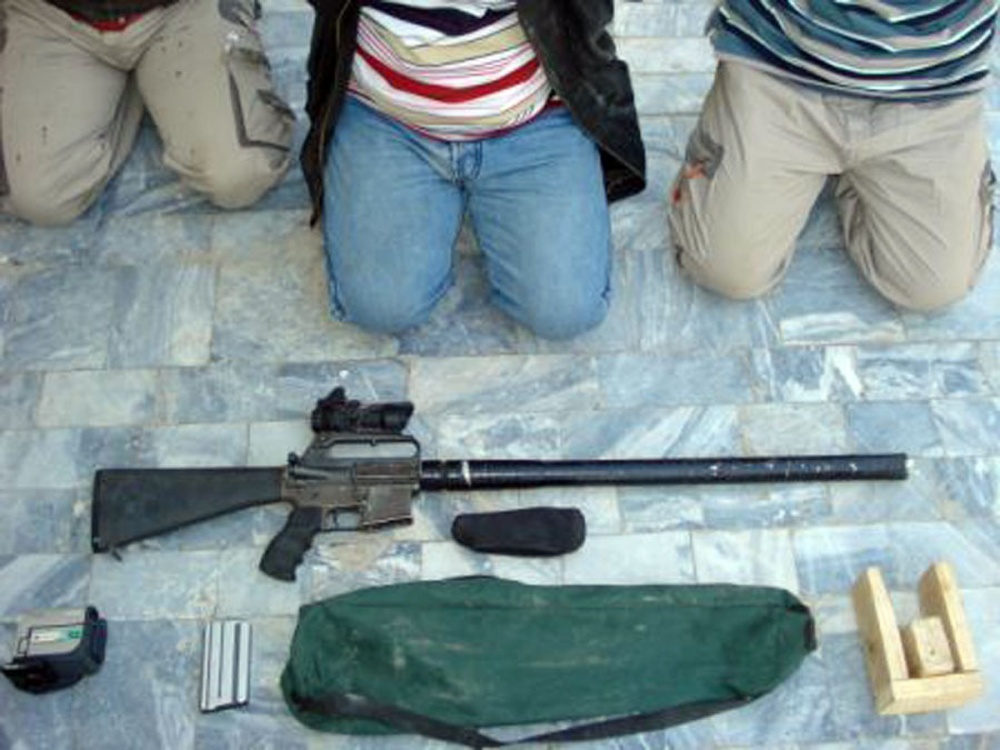
The confiscated items lay on the ground in front of three men arrested as a suspected sniper team in the northeast Baghdad neighborhood of Haay Ur, Jan. 17. The men were arrested by the 3rd Battalion, 4th Brigade, 1st National Police Division and the 3rd Battalion, 42nd Brigade, 11th Iraqi Army Division as the men attempted to carry out an attack on American forces in the area.

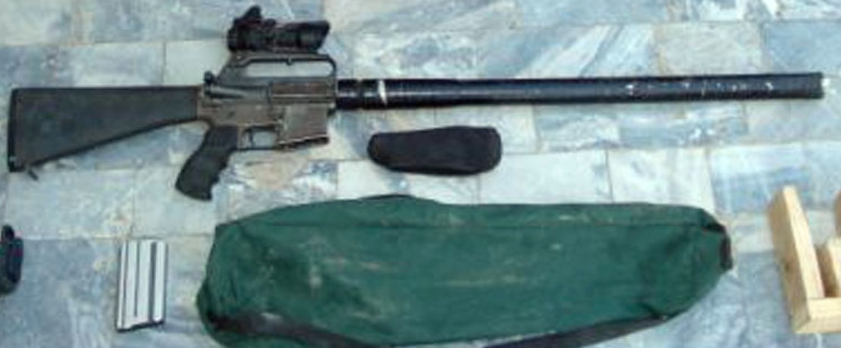
This first photograph depicts what appears to be a 5.56x45mm NATO M16A1 self-loading rifle due to the lack of a rear sight as a separate unit although the photograph is a little blurry to confirm this. The improvised suppressor appears to be some sort of muffling material wrapped around the standard 18 inch barrel of the M16A1, and then continues past the standard muzzle for about a foot of length. From the bulge just past the chamber, it appears that the standard barrel nut has been retained, and one can notice the taper of the barrel and gas tube in the shape of the suppressor. Mounted atop the carrying handle is a Trijicon 4×32 RCO. The grip is not a standard A2 grip and is most likely of commercial after market manufacture.

If the self-loading rifle is indeed an M16A1, the rifle might be a black-market trade from Lebanon or Israel where the M16A1 has seen extensive use by multiple armed entities. The presence of the pistol grip would support this assertion, as it could have been added along the way. It certainly isn’t from a captured U.S rifle. The chances of a Soldier or Marine mounting an after-market accessory such as a grip are extremely slim, and the chances of it being captured are even slimmer. In addition, the 20 round “Vietnam Era” magazine is further indicative that the rifle was initially fielded in Lebanon or Israel due to the amount of surplus equipment being sold to those countries.  It probably isn’t from a private military company either as M16A1s are rarely seen in use among these entities, 14 or 16 inch barrel length M4s being the preferred AR variant.  The Trijicon however would certainly appear to be a U.S capture or otherwise lost piece of gear, with the scope neoprene cover indicating that it was most likely newly issued or rarely used when acquired.

Construction of the improvised suppressor is harder to identify. It would appear that it is some sort of muffling or noise absorbing material stuffed inside a pipe( possibly metallic) the length of the entire suppressor. There appears to be another pipe, one of larger diameter than the main one, that connects both the main pipe and the barrel nut, thus enabling the contraption to stay in place. The entire pipe further appears to be wrapped in black tape of some sort, possibly to prevent any shine from a position of concealment. Whether or not the suppressor actually works, or how long it can adequately suppress is unknown at this point.

Sealing the deal on this capture is the video camera present, showing that the insurgents captured here were probably using the camera to film their shots on U.S troops for propaganda value, eerily  to the “Jubba” sniper videos that plagued troops based in Baghdad. Unconfirmed rumors about the “Jubba” sniper have stated that the actual shooter was using a Remington 700 shooting out of a loophole of a taxicab. A set up such as this suppressed M16A1 could just have been used in the very same way.

The “Carlo” of Palestine

A fatal stoning attack against a civilian car and its driver at the Jewish New Year eve, September 13th 2015, marked the semiofficial beginning of the “Third Intifada”, also known as the “Knife Intifada” or “Stabbing Intifada” or as more accurately could be could the “Individuals’ Intifada”. Unlike previous rounds of violence led by major terror groups like Hamas or militia groups associated with the Palestinian Authority, the “Individuals’ Intifada” attacks are almost exclusively done by lone wolfs or at most pairs of attackers, unlinked to any political or armed group. Mostly those attacks committed by young men and women are motived by social media networks.

The tools of those attacks are opportunistic by nature: knives, stones, vehicle-ramming attack etc. One of those tools is the subject of this article, the Carlo sub-machinegun. The Carlo (كارلو) is a homemade sub-machine gun slightly modeled and resembling the Swedish Carl Gustav M/45 (كارلوجستاف) – a well-known sub-machinegun in the Arab world with licensed produced by Egypt under the name ‘Port-Said’ and later under ‘Akaba’ & ‘Kara’ as the simplified versions.

As a sidenote the similarity in names and appearance between the real Carl Gustav M/45 and its watered down copy create great confusion among Israeli news organizations commonly mistakably identify and report a Carlo as factory made M/45. One news outlet even reported that the Sarona-market attack terrorist’s weapon of choice was a ‘recoilless rifle’! Clearly, the reporter copy-pasted from the first item Google had to offer when searching ‘Carl Gustav’ and came up with one of the recoilless rifles under the name of ‘Carl Gustav’.       

History

Israeli police first encountered the gun at the beginning of the 2000’s in the hands of Arabs criminals in the West Bank as a self-defense gun and for celebratory gunfire. The gun, its manufacturing, and usage weren’t on the police high priority list as the phenomena seemed contained within the West Bank and as an inner Arab problem. Police operations at the West Bank also fall in the thick border line between the civilian police and the Israel Security Agency (‘Shin Bet’) areas of jurisdiction. Up until the latest Intifada, there was a minimal effort of both organizations to cooperate.

Several shooting attacks, the most notable is the June 8th 2016 attack at the Tel Aviv Sarona market where two gunmen armed with Carlos murdered four diners proved the guns efficiency at very short range attacks against unarmored people despite being inaccurate and unreliable (one of the shooters at the Sarona market attack was even caught on camera angrily throwing his Carlo after it jammed after only a few rounds).

Characteristics   

The common feature all known Carlos share is the ammunition, all known guns are chambered in 9×19mm Parabellum, which is the by far the most common pistol cartridge in Israel and used by all branches of the military, law enforce agencies, government institutions, security, private security companies and private gun owners.

The magazines used are mostly Uzi 25 rounds magazines, inserted to a magazine well in front of the pistol grip. Pistols grips appear to be high quality factory made durable plastic M16 pistol grips as well as some M16 telescopic buttstocks when the guns are stocked. The barrels are smoothbore, usually very short, barrels which are not much more than regular steel pipes.

All Carlos are full auto only fired from an open bolt, ejection port is locate on the top side of the gun and a short charging handle is locate at the gun’s right side and it reciprocating when firing. The question of why have a right side charging handle for a gun mostly used as a machine pistol? A right-handed charging port will gain no value of a charging handle at the right side he can’t easily charge with or clearing jams without buttstock and handgrip.

Since the gun’s ejection port on top a charging handle and its slot cutout could easily place left side enabling the shooter reciprocate the bolt with left hand while holding the gun right-handed. No clear answer, the first option is by trying to leech of the M/45 popularity the makers of the Carlo also copied the location of the handle scarifies functionality in order to resemble the recognized M/45.

Second option is that machine pistol concealed under a coat is best placed left of the body in order to pull it quickly (by a right-handed), having a left side handle will poke the user side so right side handle is preferable. Another source of speculations is what appear to be sort of rectangular upper hunch on the top rear part of the gun which is quite common for the higher end Carlos. Its purpose is unknown, it raised a bit the rear sight but noting that required such large protrusion. It maybe housing of some sort of crude delayed blowback mechanism, probably leaf spring, used to lower the fire rate of fire and make it more controllable gun.

Yoel M. is a contributing writer for Silah Report, and is a firearms enthusiast based out of Israel. His first report on S.R. was about the Israeli “Hitchhiker” magazine.


If you enjoy our work here at Silah Report please consider supporting us on Patreon!

Analysis of Taliban Firing Positions in OEF

Due to the efforts of ISAF forces during Operation Enduring Freedom, Taliban fighters had to change their tactics constantly to stay tactically ahead of coalition efforts. Because of the reliance on fire support assets and modern armament that much of ISAF could afford, the Taliban in Helmand and Kandahar provinces couldn’t sustain a protracted fight as they could against ANA or AUP positions. Thus the insurgent force had to adapt and overcome. One of the ways in which they employed small arms against ISAF forces was through their usage of compounds and firing positions. Being in Helmand or Kandahar, firing from an open position or fields is almost certainly suicide against ISAF forces because of the lack of egress routes and being cut down. Thus, many Taliban fighters adopted the technique of utilizing “murder holes” as firing positions from compounds. Most of these compounds were taken over from the families that owned them, often threatening them with death if they spoke to coalition forces about the compound’s usage.

Compound/housing structures in rural southern Afghanistan have a number of advantages for maneuver insurgent warfare. Because the walls are made from mud, they can have holes busted through them to use as firing ports, but at the same time can be extremely resistant to incoming rounds, even up to .50 BMG. These compound walls can be anywhere from six feet to twelve feet in height and easily conceal the numerous motorcycles that the Taliban used. Motorcycles are essential for the kind of “shoot n’ scoot”maneuver warfare because of the ease of transportation and the possibility of swiftly getting away from lumbering  MRAPs and MAT-Vs along twisting narrow roads. In addition, a single PKM machine gun team could be concealed and broken up among three or five motorcycle driving Talibs. One carrying the receiver, another the barrel, another the ammunition. This way, all three could move to a new firing location discreetly, and most importantly separately.

The Taliban’s worst threat was being fixed in place and destroyed. The force knew that it could not sustain a long drawn out, small arms fight even against a single ISAF patrol. Once their position has become known, the key to surviving a protracted fight is to quickly pick up, mount up, and push to another firing position to further engage the patrol, preferably from a completely different angle than the first one. The problems thus presented to the ISAF patrol were twofold. One the one hand, it would be very difficult to determine the source of the fire, especially if it was from a PKM beyond 400-600 meters. And second, even if the Taliban location was found and positive identification was made, the patrol would have to maneuver around to get into a position to return accurate rifle and light machine gun fire, by which time the PKM position would already be broken down, and repositioned at a completely different angle to the patrol. This entire scenario is also not even taking into account the IED threat that complex ambushes would often be initiated with, thereby adding another layer of complexity to the mix of that ISAF patrol maneuvering.

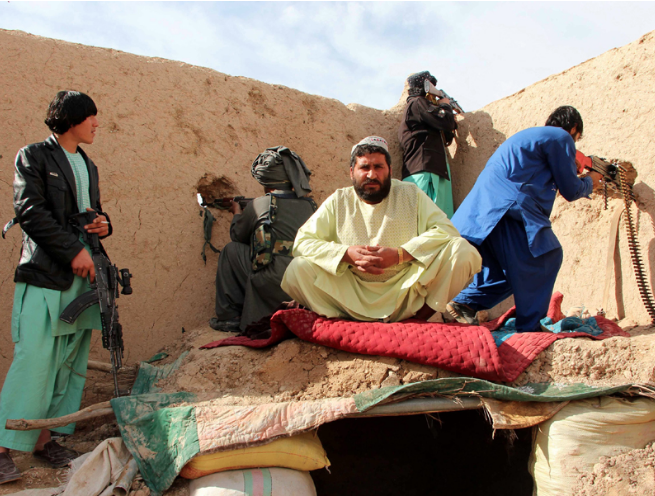
Firing positions themselves are very well thought out. As an example in the title photograph, typically Talib fighters will use a pre-existing “murder hole” or they will create one themselves as the other photograph shows. Using blankets, they will place them underneath the PKM, and then on the base of the murder hole as well. This way, the ground blanket will catch all the spent shells, and the murder hole blanket will prevent the PKM from leaving black residue on the caked mud. When the MG team leaves the position, all they have to do is wrap up the blanket with shells in it, then use the murder hole blanket to conceal the PKM parts in it and the firing position will appear to have been relatively unoccupied even if an ISAF patrol were to literally get to it after a firefight.

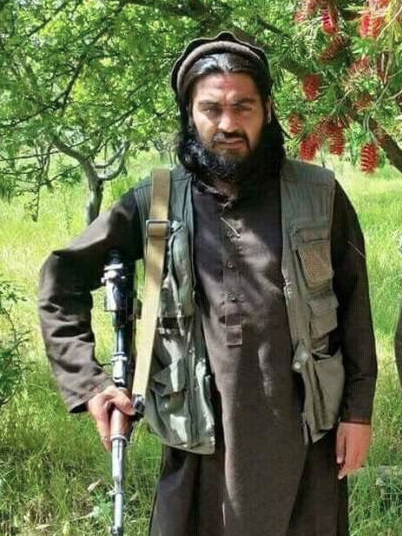
And to conclude this analysis, this a Talib fighter wearing a Marine Corps woodland digital utility jacket!

Note- The title photograph of the firing position is actually of Government ALP fighters, and not Taliban fighters. This photograph was used because it does display what the TTPs that the Taliban utilize. 

Trijicon RCO Mounted Directly to Taliban AKM

Mirwais Afghan published this on his Twitter feed earlier, of the Taliban deputy district chief for the Chaperhar district of Nangarhar province in eastern Afghanistan. He was recently killed by a U.S. airstrike.  His AKM features a Trijicon RCO with what appears to be directly mounted to the receiver cover of the rifle, possibly via a rudimentary method of welding or otherwise non-standard mounting procedure.

Of course, if this is the case, accuracy will most likely suffer greatly because of the severe vibrations of the receiver cover during the course of fire. Maintaining zero will be next to impossible. But was a status piece for a deputy district chief, it will certainly get the point across.

Sudanese AR10 in the wild, Yemen edition

This photograph was recently found on social media and features a local Yemeni man posing with an 7.62x51mm NATO AR10 next to his friend with what appears to be a modified 7.62x39mm RPK (due to the compensator) mounted with a 45 round magazine. The AR10 in question appears to be one of the largest contracts that Armlite produced of AR10s, which was the Sudanese contract of approximately 2500 rifles in the 1950s. This inference is taken from the proximity of Sudan to Yemen, so it must be stated that this is only a guess as to it’s origins and not a complete conclusion. If we could have seen the rear sight, that would remove all doubt, depending on whether or not the graduations are in Arabic numerals.

This is a little bit about it from Wikipedia-

Firearms historians have separated AR-10 production under the A.I. license into at least three basic identifiable versions, along with various sporting, carbine, and other experimental designs and calibers. The three main variants have been termed the Sudanese model, the Transitional, and the Portuguese model AR-10. A.I. built all of these rifles, beginning with the Sudanese model AR-10. The Sudanese version derives its name from the sale of approximately 2,500 AR-10 rifles of to the government of Sudan in 1958. The Sudanese model was equipped with a very lightweight, fluted steel barrel fitted with a trim, prong-style flash suppressor, a bayonet lug, lightweight fiberglass furniture, and sight graduations in Arabic.[21][22] The Sudanese model weighed only 3.3 kg (7.3 lb) with an empty magazine.[21] The price, including cleaning kit and four magazines, was US $225 per rifle.[23] All AR-10s, whether produced by ArmaLite or by A.I., used the same Stoner-designed 20-round lightweight aluminum ‘waffle’ magazine with pressed-in, corrugated sides, intended to be discarded in combat once emptied.[24]

This particular rifle appears to be in excellent condition considering that it is most likely 60 years old and has existed in a very rough part of the world when it comes to firearms care and maintenance. The young man looks to have affixed a canvas sling to the rifle, in addition to embedding a circular metal piece in the stock, also wrapping something around the buttstock by the rear sight and charging handle.

Weight 3.29–4.05 kg (7.25–8.9 lb) w/o magazine
Length 1,050 mm (41.3 in)
Barrel length 528 mm (20.8 in)

Cartridge 7.62×51mm NATO

.308 Winchester

Action Gas-operated, rotating bolt
Rate of fire 700 rounds/min
Muzzle velocity 820 m/s (2,690 ft/s)
Effective firing range 600m/656yd (ca 700m/765 1/2yds with A.I. 3.6× telescopic sight)
Feed system 20-round detachable box magazine
Sights Adjustable aperture rear sight, fixed post front sight


Commander Shafi’s AKSU

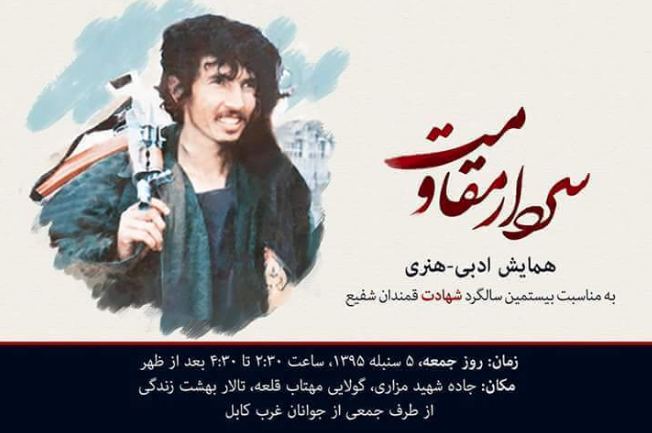
Earlier we covered the significance of the AKSU in the hands of Rashid Dustom’s security detail, and especially with one of his favored guards. In this example, we have another case of the AKSU being utilized as a status symbol. These photographs are a memorial to Hazara Commander Shafi who was commemorated and memorialized between 2:30 and 4:30 in the afternoon, Friday, Sombole 5 1395 After Hijra (subsequently after Jummah Prayer that day as well). This would be August 26, 2016 in the Gregorian year. The photo above is advertising that the venue would be in West Kabul along an address on Martyer’s Road. The occasion is that it is the 20 year anniversary of his death in what would appear to be 1996. Very little information is available on the English internet but from the date of his death in 1996, of the year of the Taliban taking over Kabul, this commander was possibly killed while fighting the Taliban. Thus, in a post-OEF setting, it would appear to make sense that Hazaras would be celebrating the life of a famous Hazara who was fighting the ideologically same Islamic Emirate of Afghanistan that exists today.

From the original Dari-

به مناسبت بیستمین سالگرد شهادت

زمان: روز جمعه، ۵ سنبله ۱۳۹۵، ساعت ۲:۳۰ تا ۴:۳۰ بعد از ظهر

مکان: جاده شهید مزاری، گولایی مهتاب قلعه، تالار بهشت زندگی از طرف جمعی از جوانان غرب کابل

Similar with Dustom and Osama bin Laden, the symbolism of the AKSU (note especially the 45 round magazine) with this commander is especially evident through the photograph chosen to represent his life at an anniversary of his death. There might be multiple photographs taken of him but yet this one, with an AKSU was chosen. We don’t know when this was taken, but we are taking a chance that it might be after the Soviet withdraw due to the fact that many of the major players fighting each other in the 1990s were lower level commanders in the 1980s with the exception of such examples of Massoud and Hekmatyar of course. Note that this commander could have just had easily carried an AKMS that fits a similar profile of the AKSU but he didn’t.