Keeping it Quiet Part 4: Conclusions

Keeping it Quiet is a series of articles by the Twitter account Everest65. First published on the webpage Calibre Obscura, he has been extremely generous in allowing Silah Report to republish his findings here. Content has been lightly edited. This is the concluding article. 

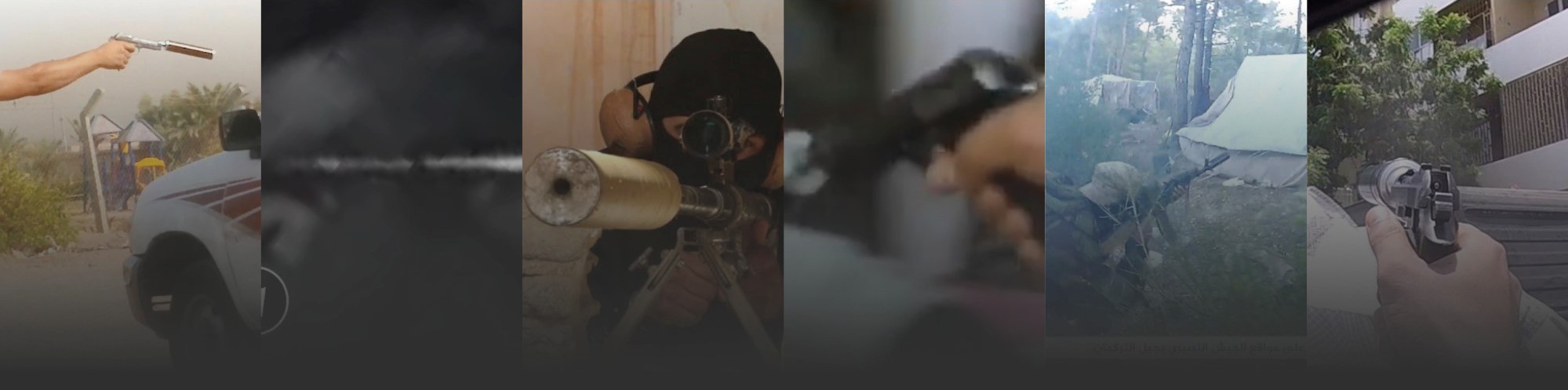
The use of suppressors by various actors should be viewed not through the technical lense of their attributes and calibers, but rather the broader strategic realities that lead to suppressors being of use to non-state groups, and their particular needs. As ISIS returns to destabilization and chaos-inducing efforts with its loss of ground and numbers, the use of attacks such as these will increase, as well as the use of suppressed weapons in them. This is also reflected in the YPG’s recent operations against Turkish/FSA forces in Afrin and surrounding areas- attempts to degrade the operational control of their opponents. This trend may be down to observe of ISIS’ successful use of this model of operation, but either way looks to be effective. Suppressed Pistols and IEDs look to be a large part of both of these campaigns, with ISIS in particular reverting to this tactic against multiple foes, HTS most recently, alongside more conventional attacks. The YPG has also shown suppressed medium range “sniper” operations, though in the western sense this looks closer to DMR use. It’ll be interesting to observe these trends when the coming Idlib battle(s) happen- will Rebel and Islamist groups revert to more insurgent-style tactics such as these? If so, we can expect to see more suppressors in use and a greater insight into their design and capabilities.

The uses of a suppressor (Typically in pistol calibers) when in the hands of insurgent or militant hands are multiple; a suppressor obviously reduces sound signature, which will reduce the speed and accuracy of any potential interdiction or counter-operation, and means that an operation using firearms can remain covert. If removing outposts, isolated small groups or sentries is the goal of the operation, then use of suppressors means that the chance of detection is lower. Another use is very close range, such as the executions indoors we see ISIS carry out. Suppressors also greatly remove muzzle flash and make militants harder to see in low light conditions, again meaning night time or evening operations can more effectively use the element of surprise and remain undetected.

A forum participant nicknamed “Obaid al-Baghdadi” recounted an attack by two jihadis on an Iraqi military barracks in the al-Saidia district of Baghdad where silenced weapons were used prior to an unnoticed withdrawal. “They perpetrated the operation quietly. The [other Iraqi soldiers] didn’t find out the two were shot until lunchtime. May God grant the two jihadis heaven and beautiful virgins,” says al-Baghdadi.

Jamestown.org, 2008

If the physical advantages of suppressor use in covert operations are clear, then there is another important factor- morale-wise. The idea of suppressors being a “James Bond” type of device remains very strong across the world- it’s commonly believed the continuing restrictions on their purchase in the United States (Remaining an NFA item) are at least partially down to the image of them being a whisper-silent assassination device.

The thought of a silent assassin stealthily picking off lone or isolated outposts cannot be discounted as a useful attribute for these groups, particularly when attempting to gradually erode the territorial and societal control of a state over an area (Who are probably using conscripts), cannot be discounted, even if the actual reality is that suppressors merely make pistol shots less detectable not whisper-silent. A covert operation using multiple pistol caliber weapons (Such as the MP5, and Pistols) follows a similar approach to those carried out by Western SOF, and is sure to mean an increased response time from the adversary, be it a state or a rival group.

The use of suppressors in the case of their use on the Battlefield is different to their use in a covert fashion, but their benefits are just as evident, if not more so.

“There are virtually no instances where an ambushed unit actually sees the enemy,” Scales, a Vietnam War veteran, said. “Both sides shoot at flashes and sounds.”And most firefights are at night.
If a soldier’s weapon is quieter than the enemy’s, and the enemy can’t see the muzzle flash, the soldier has the advantage, Scales said.

This quote is from this great article from the Military Times in the context of the United States Marine Corps and Army expanding the use of suppressors, but it does apply to their use by irregular forces too.

It later touches on the use of communication, too. The use of suppressors greatly enhances the ability to communicate coherently without raising the voice dramatically- if the attackers are carrying out covert assassinations, then this certainly assists with interrogation and coordinating the operation. I have yet to find any reliable source on the exact amount that improvised suppressors can actually reduce the sound signature, but assuming a similar Db reduction to commercial suppressors (Indeed, observing ISIS’ manufacturing process, this seems entirely possible) of 20-35 Db, they would certainly be effective for this. The video first touched on in 2012 shows this clearly. Firing an unsuppressed weapon indoors can cause permanent hearing damage. Sound waves rebound in the close confines of buildings, sending them directly back and onto the eardrum. These very close circumstances can be an ideal application for a suppressor to keep this to a minimum. However, I believe this is a minimal application in our context, as unsuppressed weapons are used very very commonly by all actors in Syria, Iraq and similar theatres. Overall, suppressors merely add a higher time for the opponent to detect, respond to and neutralize, especially if they are badly or barely trained, such as the SyAA.

An important question is the implications for the West and other Counter-Terror organizations and the capabilities of actors they are likely to face. Urban Battlefields like those seen in Raqqa, Mosul and so on pose challenges that are decidedly different to the slower-paced, longer range combat that western forces have enjoyed recently, with the technology gap now closer than before, though most combat remains at range. How Western troops deal with multiple high-intensity Raqqa-style battles is outside of the purview of the author, but the use of common, effective suppressors in kill holes and CQB simply add another difficult angle to targeting irregular opponents. The use of suppressed rifles in fast assassinations such as those shown by HTS against the Assad Regime in Latakia show an effective and rapid ability to cause costly damage and to erode overall perceived control of an area. Though we are yet to see this kind of tactic and equipment in wide use against Western forces, and Western forces are likely to have superior perimeter control and procedures, this tactic will only become more defined over time.

Credits:

Assistance: @JakeHanrahan, @ShakiraSecurity, @HKamaan, @AbraxasSpa, @iBRABO_com

Translation: @Mortis_Banned, @AlMasalim13

I am very new to this, having been inspired by many on the OSINT/Weapon ID/etc scene on Twitter. Many thanks to all of you- (Too many to list!) for providing such useful information and a real window into so many conflicts and peoples across the world.

Sources:

Please @ or message me on Twitter for sources/urls for screenshots/events etc.
Keeping it Quiet Part 1: Suppressor Use by ISIS, Al Qaeda in Iraq

Keeping it Quiet is a series of articles by the Twitter account Everest65. First published on the webpage Calibre Obscura, he has been extremely generous in allowing Silah Report to republish his findings here. Content has been lightly edited. Be sure to look for the rest of the series as it becomes published.

Amongst various militant groups in the Middle East there is a sporadic yet noteworthy use of suppressors used on firearms. I’ve been tracking this and have found that suppressors, also known as silencers or moderators, have been used by Hayat Tahir al-Sham (HTS), Islamic State (ISIS), People’s Protection Units (YPG), and some other groups. This has lead to some interesting conclusions from my observations. Whilst there doesn’t seem to be a great dearth of video or still imagery of suppressor use by any major rebel group in Syria, in this article I’ll be looking at analyzing some of them.

ISIS & AQ in Iraq

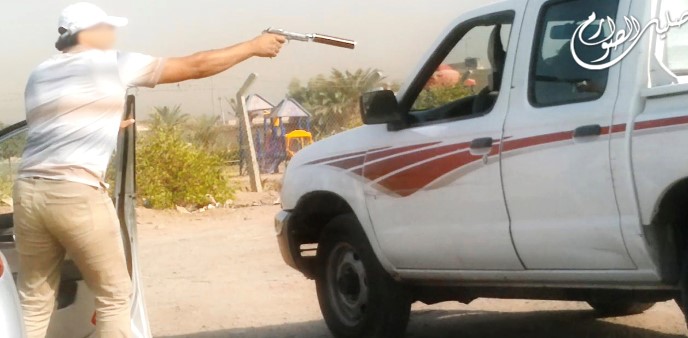
One of the most shocking videos of AQ in Iraq in the Summer of 2012 was a disguised night-time raid, which Long War Journal details:

The al Qaeda fighters are then issued uniforms that are worn by SWAT teams in the Iraqi National Police. Later that night, the militants, disguised as police commandos, get in the pickup trucks, some which have heavy machine guns mounted in the bed. Lights flashing, the al Qaeda fighters cruise the desert highways before they hit their targets: police barracks, checkpoints, and two senior Iraqi police commanders.

The Iraqi policemen appear to be stunned by the raids and comply with the al Qaeda operatives, clearly believing them to be INP commandos. The al Qaeda fighters flex-cuff the policemen, drag them outside of their positions, and line them up on the ground. The insurgents then walk down the line, and coldly shoot the policemen in the head with silenced pistols.

Whereas this raid did stand out to me because it was published online, there is evidence to suggest that this insurgent tactic was used much earlier- an article from The Guardian mentions waves of bomb and “silenced pistol” attacks across Baghdad, taking advantage of the disarray caused by the widespread issues in the 2010 election. A Senior Iraqi officer, Brigadier General Abdel-Hussein al-Kadhoumi, was killed by gunmen with suppressed pistols in May 2009. We know this tactic generally isn’t rare-with Canadian Artillery Engineer Gerald Bull being killed by suspected Iraqi or Israeli Hit Team with 5 .32 ACP bullets shot into his neck and back by a suppressed weapon- most likely to be a Beretta Model 70- another example being the unfortunate case of Laurence Foley, an American Diplomat killed in Jordan by men working on behalf of AQ in Iraq using a suppressed .32 ACP pistol in 2002. Without going over the history of use of small calibre suppressed pistols by intelligence agencies over time (Hint: It’s out of the scope of this article), it’s safe to say that this tactic is a common and oft-used one, the events quoted above being nowhere near rare. This is touched on in this excellent 2008 post from the Jamestown Foundation on Insurgent use of suppressed pistols. It refers to “7mm Pistols” which we can assume refers to 7.65mm Browning, or 32 ACP.

Here’s a two (cropped) images from the video that show the suppressed pistols in use:

2012_1

1: A pistol in use.

2:The same pistol, having failed to cycle, having the slide pulled back to re-cock

The size of these handguns appears to show a steel-framed pistol that seems to resemble a Walther PPK or derivative, of which cheap Interarms Clones are apparently popular. This video also gives an estimation of the volume reduction offered by a commercial suppressor- the Stealth Engineering Group “Jefferson”. In this case, this pistol could be chambered in .22lr, .32ACP or .380, all of which can be successfully suppressed:

Below are some examples of suppressed handguns in the hands of ISIS, ISIS derivatives and others being used for covert ops and assassinations, a task for which a suppressor, rudimentary & homemade it may be, would certainly assist with the destabilization of the security situation of the state the group is fighting. Also included are ones for sale, captured etc.

yemen_aug16
yemen_aug16_cycling(ISIS, Yemen, August 2016, Assassination of a Yemeni Colonel in Aden. This shows the pistol cycling)

ISIS_nov_2012-2(November 2012, then ISI, Now ISIS. Note chromed pistol- possible officer or ceremonial model- and civilian dress with lack of beard)

Desu_Dogg(ISIS, Syria, April 2015. .32 ACP Walther PPK.)

ISIS_North_Bagdad_2016-17(2017, ISIS, North Bagdad. Note successful cycling of pistol. I have obscured victim’s faces.)

Glock_19_Early(2012-13, ISIS, Iraq. Glock 19 is in use. Green laser is attached to M16, off-screen)

ISIS_Aleppo_2014(ISIS, Aleppo, Syria. Feb 2014. Pistol is PPK clone in .380 ACP or 32 ACP with Interarms import/export markings on it.)

ISIS employs rifle suppressors in seemingly a more limited role, as opposed to their common use on pistols mentioned above. The group appears, as part of its strategy of using long/accurate 5.56mm platforms in the DMR Role, to embrace suppressors to assist in the concealability and survivability of its close range and urban sniper squads. POI Shift (The shift of the bullet when a suppressor is installed) would be naturally less of an issue at shorter ranges.

M16_Iraq(Iraq, December 2016. M16A4 used in close fighting)

ISIS_Fallujah_June2016(Fallujah, Iraq, June 2016. Short Suppressor on AK type rifle. Direct Thread Mount. This shorter type would naturally be louder.)

Dragunov(Raqqa, Syria. July/Aug 2017. Rifle is SVD Dragunov used in DMR role, notice painted/sprayed camo and spotter)

ISIS_Raqqa_2017_Urban_1

ISIS_Raqqa_2017_Urban_2

ISIS_Raqqa_2017_Urban_3(In the midst of Urban Fighting against SDF, Raqqa, 2017. Note Steyr AUG used in close range role, Glock 19 as sidearm, and tape-wrapped M16A4 on spotter.)

It’s interesting to note that the Chechen sniper is using a suppressor wrap very similar to a product such as a SilencerCo Suppressor Cover:

SilencerCo_Suppressor_Cover

This wrap has a variety of uses- concealment/camouflage, ease of quick removal (Protects against burns), and also mitigating the “mirage affect” from repeated firing- as the rifle is used, the suppressor gathers a lot of heat. This heat begins to rise off of the suppressor and creates a mirage- this mirage can obstruct the users’ view making it almost impossible to see the target. In the hot conditions of Iraq and Syria this would be made worse.

Below is an interesting case-an improvised 12.7mm or 14.5mm anti-material rifle in use by ISIS (A fairly common phenomenon), but with a very large suppressor:

12.7_ISIS(Raqqa, Syria. July/Aug 2017)
The “Female” Variant of the Galil


The integration of female soldiers in IDF combat roles is a much-debated topic in Israel the last decade or so. Today we will ride on the wayback machine to a time when the place of women in military service was very different.

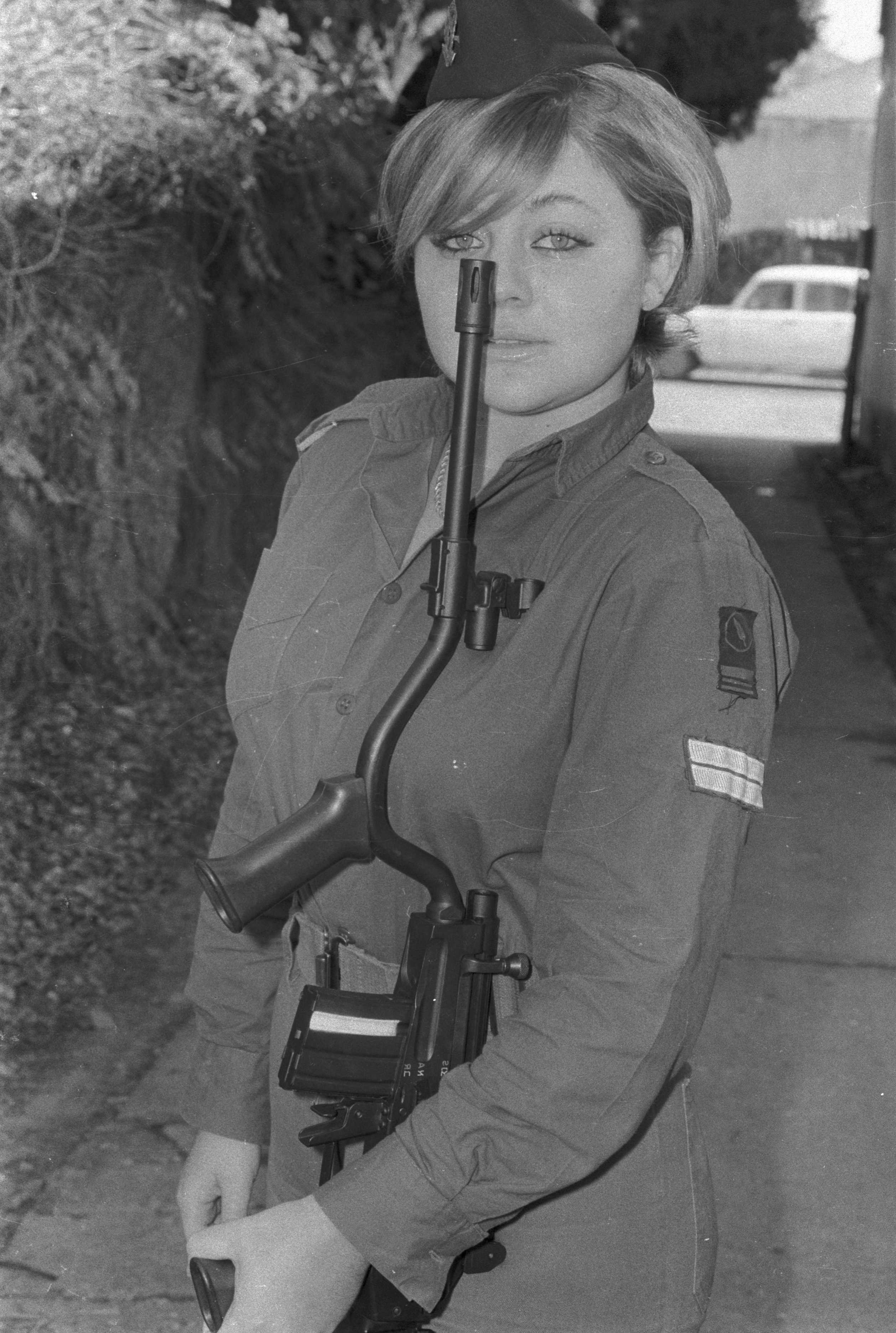
In the December 8 1982 issue of the IDF weekly magazine, Bamahane,  a short news piece was published with bold letters titled: “The end of discrimination! A major victory to the women’s liberation movement; a Galil assault rifle developed especially for female soldiers!”

The paper includes several pictures taken of an IDF female soldier ‘modeling’ a bent barrel Galil AR and further explanation states that the most problematic issue with designing a feminine rifle is that regular rifles keep colliding in the soldier’s breast whenever it was carried and practice in foot drills.

According to the news piece the development of the gun took two years and was tested by 350 female soldiers that were “carefully selected for their outstanding physical characteristics”

That ‘news piece’, as you might guess by now, wasn’t a real news report. It was the weekly satiric column called ‘על הגבול’ which literally means ‘On The Border’ but the more accurate translation means ‘Borderline’.


The prop gun was manufactured by none other than Yisrael Galil , the inventor of the Galil, for the satiric column.

The gun was a modified Galil AR with an absurdly bent barrel and vertical foregrip attached instead of the regular foregrip. The bolt carrier lacks a gas piston and there was no gas tube. All removed to achieve the described breast clearance. In one of the photos, the rifle is lacking a buttstock.

The gun was issued with a 12 round magazine, presumably to lighten the load on those top-heavy girls in uniform. The magazine is in fact a blank magazine used to propel rifle grenade.

The column summarized that since the rifles were introduced into military service they already proofed their value and the developer is flooded with purchase orders.


This article made possible by the courtesy of IDF & Defense Establishment Archives.

The photographer was Reuven Yehudai.

Guest Post: Iraqi Contract Sterling MK 4 in Syria

Mathew Moss comes to us as a highly esteemed writer from The Firearm Blog, but he also founded his own fascinating historical small arms research source, The Armourers Bench, in addition to runs his Twitter feed at Historical Firearms. This is his first work for Silah Report, and we hope it won’t be the last!

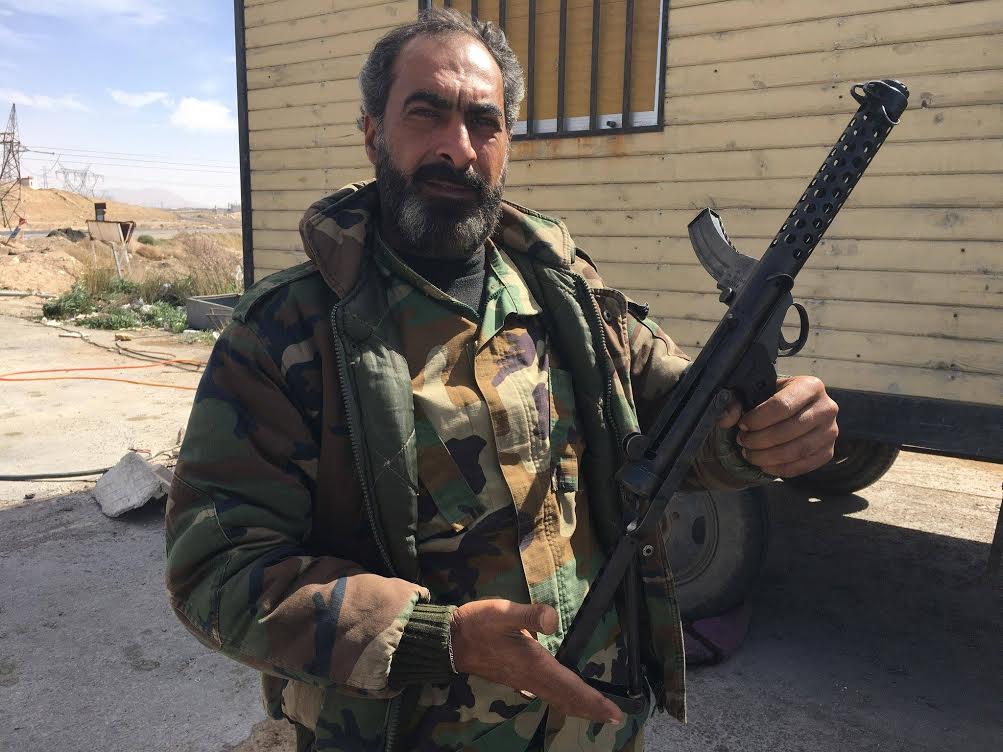
On the 10th March, Broń. Milmag, the Polish defense magazine, posted an intriguing photograph on their facebook page. The photograph had the short caption, which once translated, reads: “Syria Ad2018. 9-MM MACHINE GUN STERLING MK 4 / l2a3 used by a government soldier.”

Plenty of surplus World War Two weapons including the StG-44, MG42, Mosin-Nagant, K98ks and even French MAS-36s have been sighted in Iraq and Syria during the regions current multi-sided conflict. Sightings of the Cold War era- Sterling submachine gun, however, have been few and far between.

The Sterling submachine gun was developed by George Patchett at the Sterling Arms Company during the latter half of World War Two. Following extensive testing in the late 1940s and early 1950s the British Army adopted Patchett’s submachine gun to replace the Sten gun. It entered British service as the L2A1 in 1953, evolving quickly to its final form the L2A3. The L2A3 was produced commercially by Sterling at their plant in Dagenham, UK from 1956 until 1988 with an estimated 211,000 produced.

The Sterling was subsequently sold commercially and licensed for overseas production in both Canada (leading to the C1 Submachine Gun) and India (leading to the 1A Machine Carbine). Sterling successfully marketed the commercial version of the L2A3, the Mk4, to over a dozen countries around the world from Malaysia, to Libya, to Iraq.
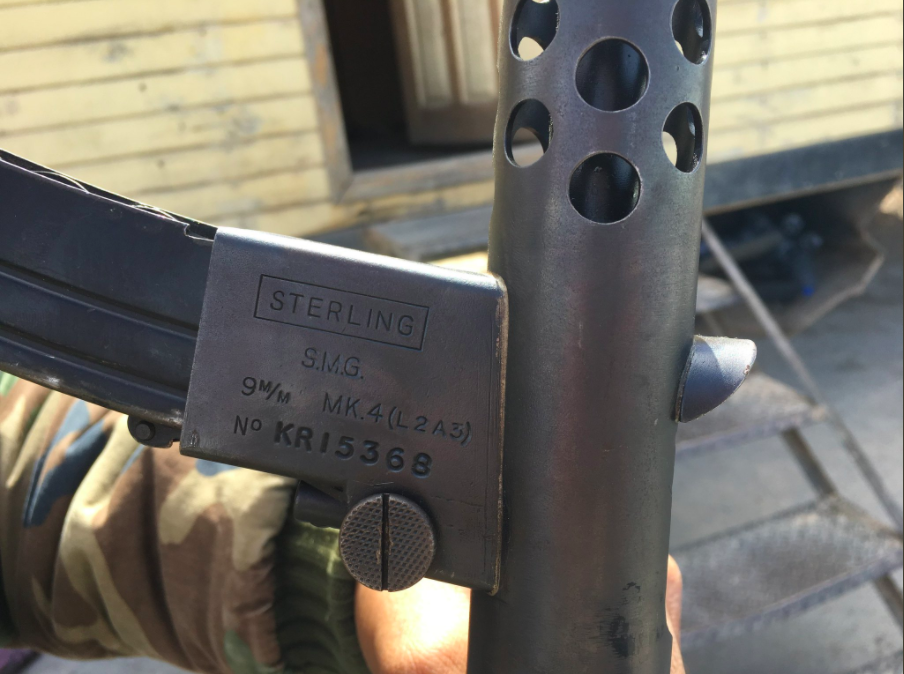
The weapon featured in the photograph appears to be in remarkably good condition. Following some digging I was able to find what I believe to be the original posting of the photograph online. Posted on Twitter by @Edward_Sn0wden on the 9th March. The twitter post includes a second photograph showing the Sterling’s magazine housing and markings. The photographs are credited to Alexander Kharchenko but sadly no location is mentioned. The caption suggests that the weapon might be a captured trophy.

From the available photographs the weapon appears to have a matte, rather than crackle paint, finish – this is either an original contract choice or a later armory refurbishment. The weapon is also fitted with an original Sterling produced commercial production 34-round curved double stack, double feed magazine – one of the most reliable submachine gun magazines ever developed.

We are lucky enough to have a second photograph showing the weapon’s markings in full: ‘STERLING SMG 9m/m MK4 (L2A3) KR15368’. The serial number, beginning with ‘KR’ dates the gun as a pre-1972 Sterling and refers to Kenton Redgrave, the Sterling company’s long-time director. The serial number dates the weapon, according to the serial number ranges, listed in The Guns of Dagenham (1996) by Peter Laidler, to 1957. This date would fit with the 1956-63 Iraqi contract which supplied 13,241 Mk4s to Iraq, first to King Faisal II’s military, and then to the Iraqi Republic, following a coup that deposed Faisal in 1958. The Iraqi Sterlings later saw action during the Iran-Iraq War and to a limited degree during both the Gulf War and during the 2003 Iraq War. 

While rare the Sterling has been spotted in the region before, three years ago CJ Chivers, the New York Times investigative conflict journalist and author of The Gun, shared a photograph of a Mk4 with a straight Sten magazine in use by the Mahdi Army in Sadr City, Iraq.

While investigating the photograph above, an Iraqi fighter came forward and told me about his ‘heirloom’ Sterling Mk4 which had belonged to his father, an Iraqi soldier killed during the Iran-Iraq war. Interestingly, this Iraqi heirloom Mk4 dated from June 1964, suggesting that the Iraq contract may have extended beyond the 1963 end date indicated by Laidler.

The Iraqi gentleman also advised that the Sterling was known to him, and possibly regionally as the ‘غداره مصريه’, which translates to ‘Egyptian Contract’ or Egyptian Submachine Gun. It seems that the Sterling has come to be confused with, or at least associated with an Egyptian submachine gun. While the Egyptian Army did purchase a number of commercial Mk3 Sterlings in 1954-5, Egypt never produced a copy of the Sterling, instead opting to copy the Carl Gustav m/45 to create to the Port Said, produced by Al Maadi.

How a Syrian government soldier might have come into possession of what is likely an Iraqi Sterling submachine gun is one of war’s intriguing mysteries. Regardless of how he acquired it appears to be in excellent condition for a 50 year old weapon.

Images:

Milmag post:

https://www.facebook.com/TheMilMag2/photos/a.871586039536290.1073741828.871547992873428/1980952581932958/?type=3&theater

Possible original source on twitter:

https://twitter.com/Edward_Sn0wden/status/972075403971055616

Rock Island Auctions photo of commercial Mk4 Sterling for Reference:

https://www.rockislandauction.com/detail/70/2504/sterling-mk-4l2a3-full-auto-sales-sample-smg-with-bayonet#detail

Taliban Raid on Afghan Militia Post Reveals Modern Small Arms Inventory

Recently disclosed photographs supplied to Silah Report have suggested that the local GoIRA supported militias are armed with more than the standard Kalashnikov self-loading rifles often seen throughout the country. One example of these forces is the Afghan Local Police, or ALP. Although these forces are seen as cost-effective, many local Afghans compare them to the days of the War Lords that roamed the country in the Civil War.

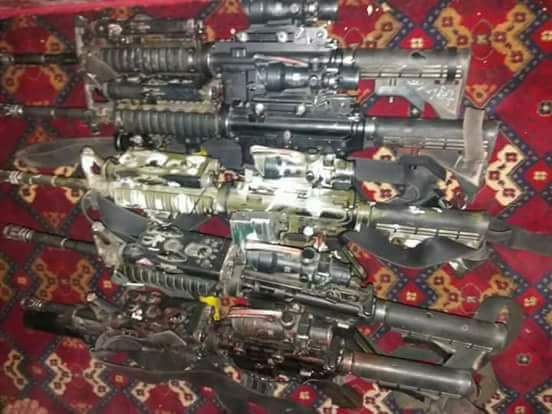
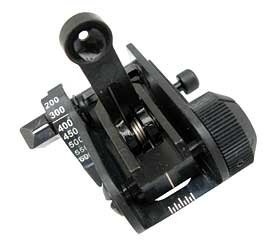
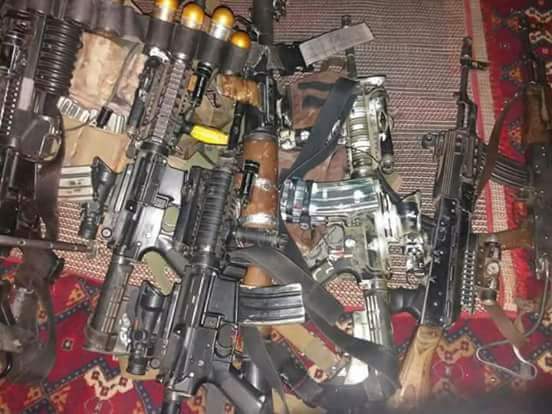
The photograph below depicts five 5.56x45mm NATO M4-patterned carbines in configurations that are identical to that of the ANA Commandos. This includes the AN/PEQ-2 TPIAL mounted at the 12 o’clock position on the Picatinny rail, the Trijicon 4x RCO day optic, the MaTech BUIS, and even the spray painted rifle in the center. Also present is a 40x46mm NATO M203 UBGL mounted to the carbine at the bottom. Notice on the painted carbine the coupled STANAG magazine inverted from a usual “rounds up” position.

As indicated by this photograph, a small arms inventory such as this is consistent with what the ANSF Commandos are generally issued.

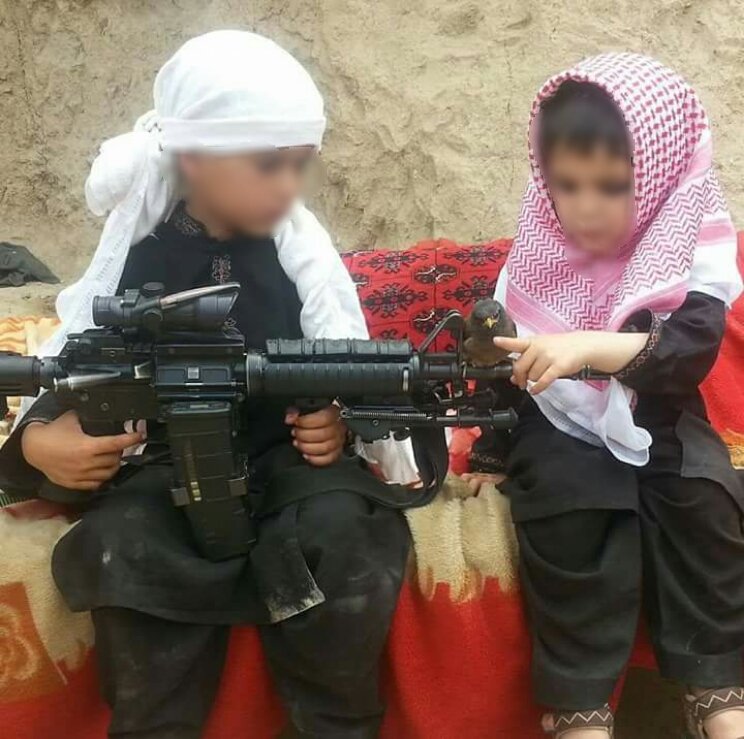
This photograph was provided by the same source and features a similar magazine coupling technique as illustrated above. What appear to be UTG rail covers and what is most likely a Harris bipod copy appear to be third party modifications from the standard issue. Myna Bird perched on the 6-inch barrel comes unissued.

MaTech BUIS as in use.

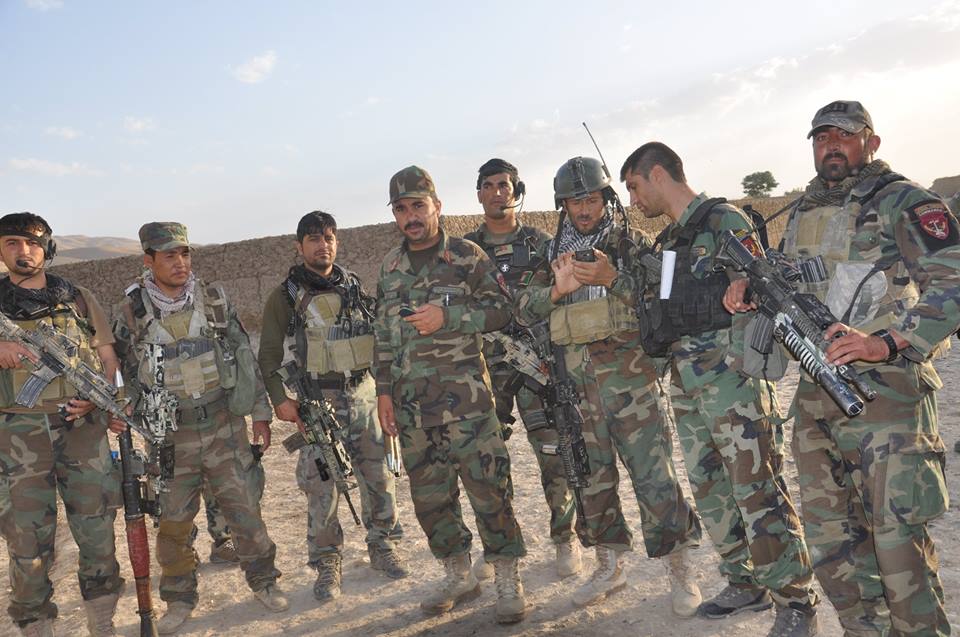
However in this angle present are Streamlight TLR Picatinny mounted weapon lights, in addition to Kalashnikov patterned rifles, which are rarely in use by ANSF Commandos, if at all. Although rare, there are some TLRs that have been spotted among the group.

Although contextual information about the photographs are scare, a source has suggested that the militia checkpoints are perhaps funded by a shadow entity with a large supply budget. Such as the “Kandahar Strike Force” that was indeed set up by the CIA. In Afghanistan, this is immediately assumed to be the “CIA”, but until we have further information, we cannot venture more into the origins of these carbines.

Krinkov: A Pashtu origin

This article was first published with The Firearm Blog on January 18th, 2016. It has been republished on Silah Report with permission of the author.

“Krinkov”, where does it come from and how have we gotten to it? There are a number of theories about it, some truer than others, but we’ll examine each one, and I will provide what I have come up with so far.

The first theory is that it is Russian. At face value, this could seem true, by simply hearing the word “Krinkov” to a non-Russian speaker, it might sound Russian. However, this is by far, not the case at all. Tim from Military Arms Channel has an excellent dialogue on this, explaining that the Russians have an entirely different nickname. I’ll take an excerpt from Maxim Popenkers site, World Guns:

 Since its introduction the AKS-74U, unofficially known as a “Ksyukha” (variation of a Russian woman name) or “okurok” (cigarette stub)

In addition from Max’s book Assault Rifles, we have this entry:

Since its introduction the AKS-74U, unofficially known as a “Kysusha” (a variation of a Russian female Ksenia), “Suka” (bitch), “Suchok” (small tree branch) or “Okurok” (cigarette stub)

And this is Tim from Military Arms Channel, explaining some of that from the Russian side.

Tim is correct in his explanation of what Russians would call it, but the biggest problem I have with his explanation is that he completely dismisses the role of the Afghan Mujahaden, saying that it is a “nonsense word”. In addition, he speculates that maybe the first AKS74U taken off a Russian who was named Krinkov. The theory doesn’t hold any weight because for one, Krinkov isn’t a Russian name or in any sort of Russian vocabulary. Also, the fact that Pashtun speaking Mujahideen could speak or even read Russian is very, very rare, many of them being illiterate in their own language of Pashtu (illiteracy is an extremely large problem even in current day Afghanistan/Peshawar, and was much more so in the early 1980s). Furthermore, the circumstances of the Mujahideen capturing weapons from the Russians involved very little live prisoners. We’ll get into this in a bit as well, but for the overwhelming majority of the time, the AKS74U was issued to helicopter and armored vehicle crew members. Contrary to popular belief, the amount of Russians captured in Afghanistan during the war, and the amount of Russians fleeing to the Mujahideen side was extremely low as well. Most of the time, the only way Mujahideen could get their hands on Soviet equipment was through disabled vehicles wherein the Russian occupants would already be dead, or through the corrupt selling of Russian arms to the Mujahideen by either Russians themselves, or Afghan government troops.

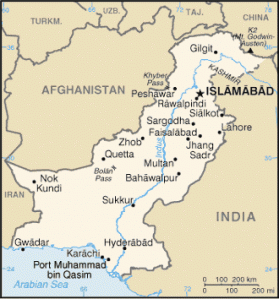
Most of the Mujahideen and Pashtun speakers that would have contributed to the name "Krinkov" would have been near Peshawar, and in the eastern regions of Afghanistan.
Most of the Mujahideen and Pashtun speakers that would have contributed to the name “Krinkov” would have been near Peshawar and in the eastern regions of Afghanistan.

The second theory is much more recent, but it originates from a gun shop in Naples, Florida. The shop was called “Krinks” and was run by a certain Paul Mahoney, who in the early 1990s was one of the first AK builders in the States to really take advantage of deactivated AKS74U kits, and put them together. The quality of them left much to be desired, but the fact of the matter is that the first mass producer of “Krink” kits in the United States was this guy Paul Mahoney with his gunshop “Krinks”. This might have certainly been one of the reasons why the name started to gain in popularity in the States, but it doesn’t help us at all in the actual etymology of the name.

My problem in the whole name origin is that we constantly see this theme of loosely attributing it to the Mujahideen, but yet there hasn’t been a single effort to get right to the source and really examine how that name might have even come about. Maybe it is ethnocentrism, maybe it is on account of laziness, maybe it is just accepting the status quo and not moving on. Either way, I’m going to present evidence that points to that fact that the name is actually a Pashtu word that has entered into our vocabulary, and is a testament to a twist in linguistics in the Pashtu language.

To begin with, we have to examine how the existence of this carbine became known about in the United States. I’ve often heard the claim that Soldier of Fortune magazine was the first entity to bring knowledge about the AKS74U, and even the AK74 to the West. I think this claim is more of a support for Soldier of Fortune’s reputation than any actual truth. Because just by looking at the facts, the famous Soldier of Fortune article that was run about the AK74 was in 1982, and the article about the AKS74U was in the July 1984 edition of the magazine. Looking at Jane’s Infantry Weapons from that era, and before, we see entries for the AKS74U, Sometimes labeling it as an AKSU 74, an AKSU and also as an “AKR”. This name most likely originates from Ian V. Hogg, as he was tied in with various intelligence circles at the time, that somehow came up with AKR. We still see this name in 1989, with Edward Ezell’s book, Small Arms Today.

Screen shot 2016-01-14 at 1.55.10 PM
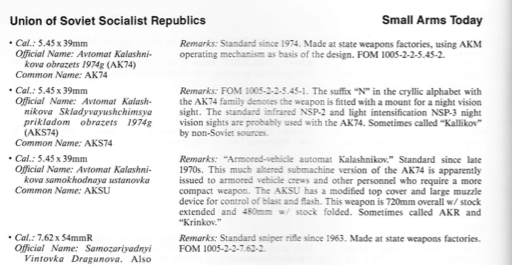
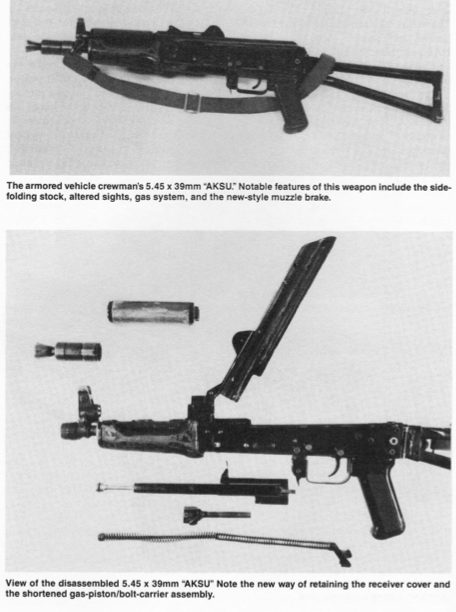
Above is from Small Arms Today, and below is from “The AK47 Story“, both by the late Edward Ezell. Above he refers to it as the AKR/Krinkov, and below the “AKSU”. Both published in the late 1980s

Screen shot 2016-01-14 at 1.56.16 PM

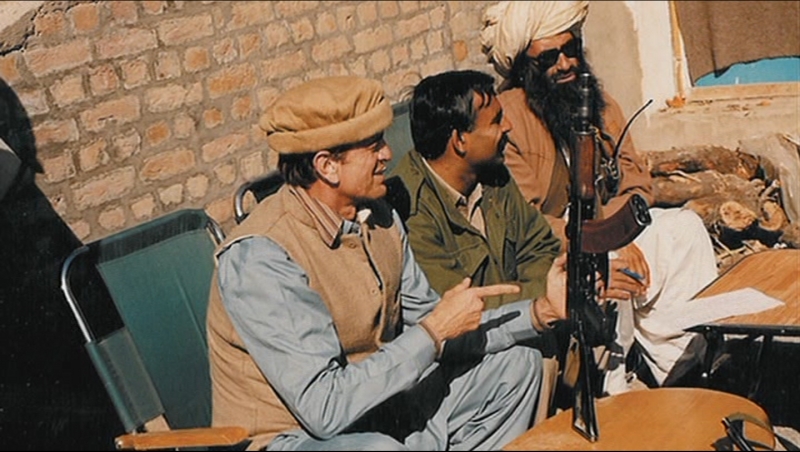
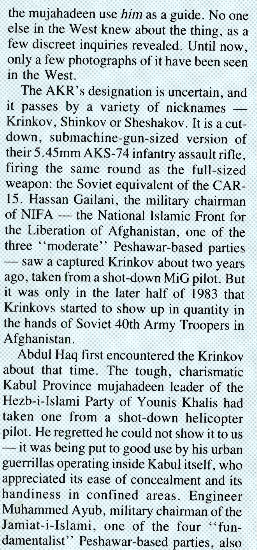
But going on to who actually deserves the credit of “discovering” the AkS74U, we have a sentence from the July 1984 edition of Soldier of Fortune, in which David Isby does an entire article about reviewing this new carbine, while he and an American Army Major are in Pakistan. He claims that initial knowledge of the carbine is from Ian Hogg, who in turn heard about it from a certain Peter Jouvenal. This guy was a video journalist, who has been in and out of Afghanistan since the late 1970s, and is extremely important because he captured one of the only video shots of Taliban leader Mullah Omar in person.

Below is the text from the Soldier of Fortune article detailing the origins and name of the AKS74U.

Screen shot 2016-01-14 at 2.03.17 PMScreen shot 2016-01-14 at 2.03.29 PM

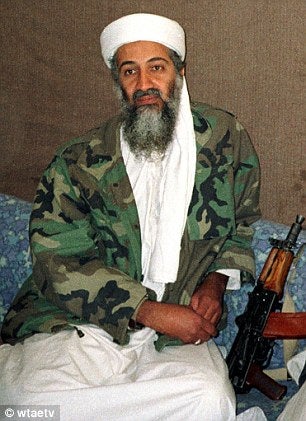
Peter Jouvenal, right, with Osama bin Laden.
Peter Jouvenal, right, with Osama bin Laden. Probably the actual “discoverer” of the AKS74U in the West.

Within the Soldier of Fortune article, David Isby takes the name from the Afghans he was with. However, he mentions two other names “Shrinkov” and “Shesakov”. These two names are also important, but because of the linguistics involved, I’ll get to that in a second.

As mentioned earlier, the difference between this article, and any other article on the internet, is that I’m going to the actual source of the name, which is from the Pashtu speaking peoples of eastern Afghanistan, and Pakistan. The name is not a “nonsense” word, it is a Pashtun word. I’ll start this off by showing a clip from a movie called Son of a Lion. Quite an interesting movie, it was made by an Australian EMT on his own dime, after 9/11, going to Peshawar and filming a storyline about a young boy who works in the arms trade but really wants to go to school to become educated. The culture and language displayed in the movie are phenomenal, but from a firearms perspective, it gives us an in-depth look at the arms trade in Peshawar. Apart from a few actors, the rest of the movie is completely shot amid the markets and daily life of the North West Frontier Province of Pakistan. There aren’t any “props” or staged settings. The locations are real, and so are the small arms portrayed. But in it, we have this one scene where the main character takes a “Krinkov” out to a customer to test fire it. He also mentions the connection with Osama bin Laden.

https://youtu.be/KzN1-M37RiY?t=17m40s

Now, to understand why the reference to Osama bin Laden was even mentioned, we have to understand a little behind why the AKS74U became prominent among first the Mujahaden, and then today among families of status. As mentioned previously, the weapon was only ever issued out to crew members of helicopters and armored vehicles. Contrary to popular belief, this wasn’t a favorite of the Spetsnaz at all, although it originally started out as a proof of concept for Soviet Special Forces. It was quickly ditched for the AKS74 because the longer barrel proved to be better in the vast distances that the Spetsnaz found themselves operating in. This from an interview that I conducted with Marco Vorobiev, a Spetsnaz Veteran of the Afghan war.

Miles Vining- I noticed in some of your talks that you don’t have much love for the AKS74U?

Marco- Well its alot of fun. Lets talk about it from a far away point here. The gun is a tool in a toolbox to complete a certain job. And the job could be a regular contact fight, lets say 500-400 meters, to include maybe clearing houses or compounds. So from that regard you want something small, maybe be able to use it in close quarter combat, something really, easy to handle, easy to maintain. Well that is fine, considering if you are a police officer going through a house. It shoots 5.45 as well, so thats good for wounding. On the other hand, as a carbine, you need to be able to hit targets out to 300 meters. You can do that with an AKS74, no problem, even with an M4. But the AKSU? You might if you spray half a magazine in that particular direction. But I even have one, I shoot it for fun, I get a big old smile on my face. It’s fun to shoot, it’s just like rrrrrrrrrrp, almost like a little toy so to speak. Mikal Kalshanikov himself told me that he loved it, although he was a very anti 5.45 guy, but he was a big fan of the AKSU for some reason. But you put yourself in an actual gunfight, with people screaming everywhere, trying to get comm up, you taste the metal of adrenaline in your mouth, and now you are trying to pick out targets in the distance… it’s really hard with that gun. We were always trying to get rid of it for the AKS74.

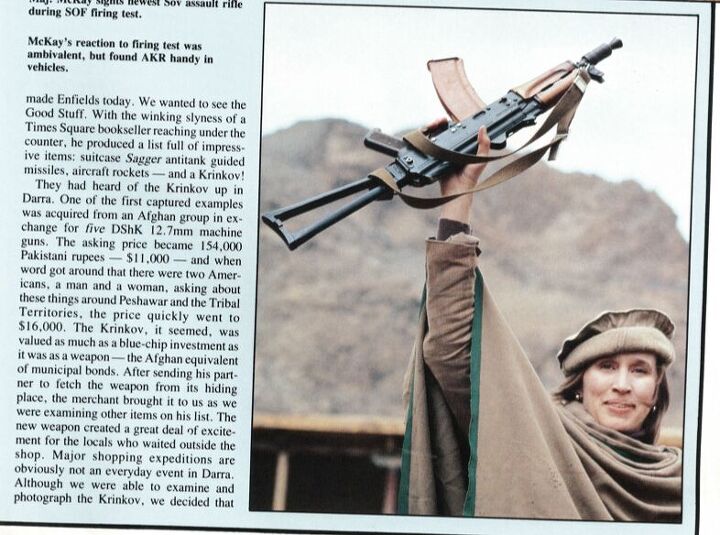
Thus, the weapon was strictly for crew members. And if we look at the context of the Soviet-Afghan War, the biggest hinderances for the Mujahideen, were the Hind attack helicopters, and the BMPs. In fact, if you look through Soviet photographs of the war, there is much evidence to attest to this, with helicopter crews even having thigh holsters carrying their AKS74Us. Thus, taking one of these monsters out of the fight would be one enormous victory for a small band of fighters, but more importantly, proving that you took one down would show everyone how brave or good you were. And what better way to prove it than to take a weapon that only these troops would have on them, an AKS74U? It not only proves that you were competent, but it also gives you something to defend yourself with. Even in the Soldier of Fortune article, we see just how rare and sought after these things were, even rising in price after word was passed around that an American was looking for one in Peshawar.

Screen shot 2016-01-14 at 2.31.47 PM

Now, Osama bin Laden claimed back to his Yemeni and Saudi buddies back home that he fought in the Soviet-Afghan War. But the actual truth of the matter is that he probably was never near any of the fighting, most likely staying in a rear echelon capacity, directing funds and supplies to the front (if he even did that). But, on his return to the area in the mid-1990s, we have a multitude of pictures of him, with an AKS74U by his side in the camera frame. This was very deliberate, to the point of the gun sellers in Peshawar even telling the customer that “This is the Osama gun”. Although Osama never took down a Soviet armored vehicle or Hind, the fact that he was carrying the carbine showed a status symbol, and he was able to identify much more easily with local Pashtuns who didn’t understand his Saudi background but absolutely understood his choice of weapon.

The placement of that AKS74U in the camera frame, is entirely on purpose.
The placement of that AKS74U in the camera frame is entirely on purpose.

Somewhat off track, but this is important to understand how the name came to be, because even today, the AKS74U occupies a very lofty position as a status symbol in eastern Afghanistan and Peshawar.

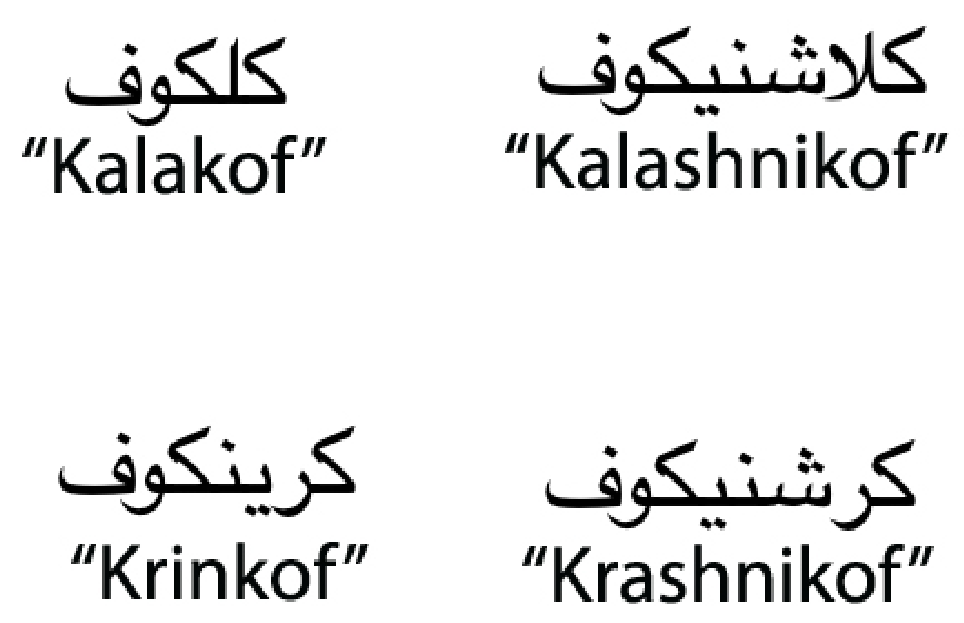
A close Afghan contact from Jalalabad mentions two names for the AKS74U, the first one which is popular in Jalalabad, is “Kalakov” and the second one is “Krinkov”. If you hear somewhat of an “F” sound at the end of the word, that is because there isn’t any “V” consonant in Pashtu, speakers instead using an “F” or a “W” sound to simulate a “V”. Now, remember what David Isby said the other names for the carbine were? “Shrinkov” and “Shesakov”? Using a little knowledge of the Pashtu language, the names pair up to be the same word. There are two dialects of Pashtu, the southern, or Kandahari, and the eastern, or the Nangahari.  So looking at this words, “Krinkov” and “Shrinkov” are actually the same word, just pronounced differently, while “Kalakov” and “Shesakov” are a little more different, but dropping the “la” sound, the words are also the same.

Screen shot 2016-01-16 at 6.05.48 PM
From the full form of the word on the right, going into the nickname for the AKS74U on the left, the differences between the top and bottom are in different Pashtu areas of speaking.

But how exactly did these words come about? As my friend mentioned, adding an “ov” to any word makes it Russian-ized in Pashtu. So that explains the last part of the word, and the first part is probably a bit of vocabulary added on, to signify the importance of the AKS74U as a status symbol. Because it isn’t just any old “Kalashnikov”, its a “Krinkov”, and you know I got it from that Hind I blew out of the sky a week ago. Another tidbit that my friend brought up after the camera was off, is that for some reason, in Jalalabad, the Pashtuns refers to the Kalashnikov rifle as that, a “Kalashnikof”. However, in other parts of eastern Afghanistan, the same name is actually pronounced “Krashnikof”. And this might actually be the truest jump to “Krinkof”, as going from “Kalashnikof” to “Kalakof” is very similar, as is going from “Krashnikof” to “Krinkof”. In both cases, the “L” in the first one, and the “R” sound in the second one are maintained in their nickname for the short rifle.

I hope this was an informative article and was able to really get to the point of “Why do we call it this?”. If anything, the most important part of all of this, is that the word isn’t a made up, nonsense word, but instead has very important historical and cultural attributes and an etymology that comes from a defining moment in history. There is much evidence to point to the fact that Afghanistan might just have been the straw that broke the Soviet Unions back, and this word directly came out of that struggle. In addition, it is a Pashtun invention, and is still very much alive and well in eastern Afghanistan and Peshawar.

“Brno”, the Persian Mauser

Ali Parsa is an Iranian scientist who has a lifelong passion for sailboats. He also knows a great deal about the history of the Mauser bolt action rifles that initially entered service in Iran at the turn of the 20th Century. He wrote this article examining the history of the Persian Mauser with its roots in the Czech VZ24 being license produced in arms factories outside of Tehran. This article was written almost a decade ago and he has very generously allowed Silah Report to republish it with express permission from himself. It initially appeared on the website that bears his name, Aaliparsa.com. This edition has been lightly edited.

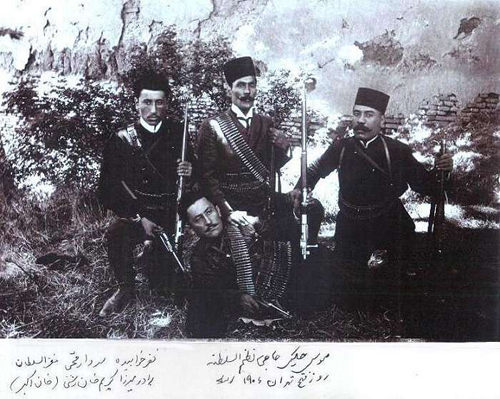
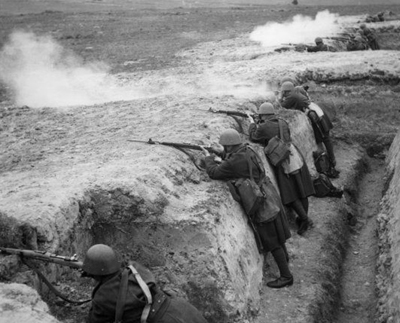
Mauser rifles first appeared in Iran before the First World War. Looking at pictures of Iran’s Constitutional Revolution era, one can spot Mauser rifles and handguns in the hands of freedom fighters of Sattar Khan and Bagher Khan, as well as other Constitutionalists in different regions of Iran.


Iranian Constitutionalists, with their Mausers, in 1906

At the end of World War I, and as a result of the Versailles treaty arms ban, Germany no longer produced these rifles, but an almost exact copy was in production in Czechoslovakia. After Hitler became the German chancellor, the production was resumed in Germany.

Later, with the invasion of Czechoslovakia, the identical rifle was produced in Germany and Czechoslovakia.


Czechoslovak Army Drill, 1938

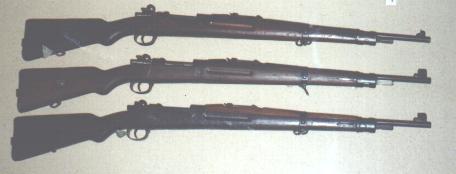
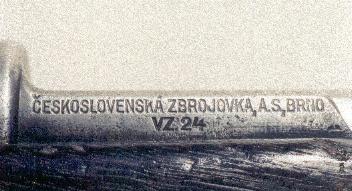
A major production center was in Brünn, or Brno, as the city is called in the Czech language. The rifles made in Brno, the Czechoslovakian model, are known as VZ24 (for Vzor24, or Model 24 in the Czech language) and had the word Brno imprinted on them.


Czechoslovakian VZ24


Markings of a VZ24

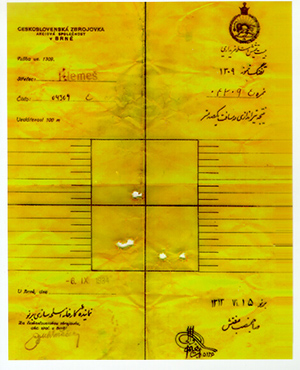
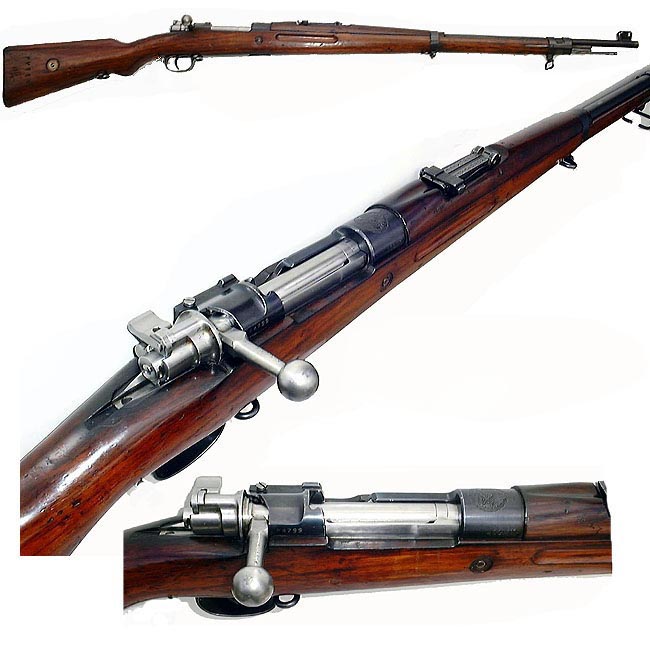
Officially, the Mauser rifle was selected for the Iranian army during Reza Shah’s time. But Iran didn’t go for the original German and ordered the identical Czechoslovakian version, the so-called Brno. The Czech firm provided Iran rifles made of many German parts. It was similar to the longer barrel version Germans designated as K98. Some official test results are available from antique arms dealers today, featuring signatures of the Brno factory representative, the Iranian in charge, and of course, satisfactory ‘grouping’ or bullet marks.


A 1934 test result document


Full length ‘Brno’ with markings in Persian

At that time two other rifles were in use and very well known in Iran: the British Lee Enfield and the Russian Mosin Nagant (Noghaan, or Naaghaan, (نوغان- ناغان) in popular parlance in those days). The exact reason for preferring Brno over its rivals is not known, but one can speculate that those in charge of the Iranian army, or maybe Reza Shah himself, tried to avoid dependence of Iran to either of the two neighboring powers. Besides, the Brno and it’s Mauser original were considered to be the best military rifle of its day.

The Iranian government ordered three versions of this weapon. It was manufactured in Czechoslovakia by two firms. One was called Ceskoslovenska Zbrojovka, or CZ. These rifles are known to collectors as Persian CZ98, Persian Mauser or Persian Brno.

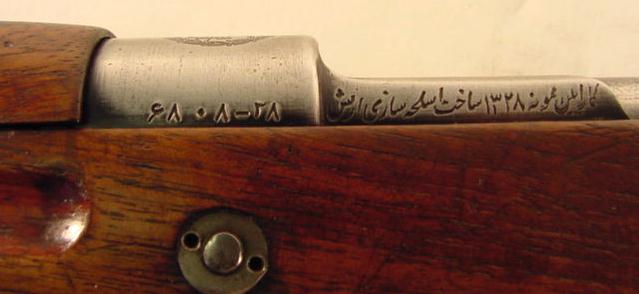
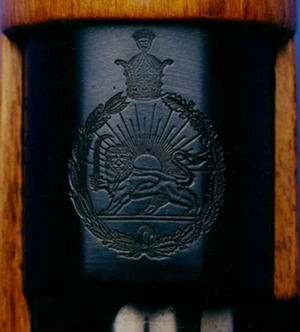
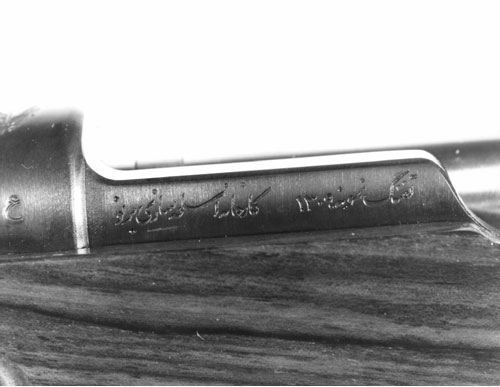
A Pahlavi crown, lion and sun crest appears near the feeding ring, as an inscription in Persian (in Nasta’liq script) on the side of its magazine giving the model and the factory name, which was in Brno. From then on the name, Brno was used by Iranians to refer to this rifle.


Lion and Sun crest of a Persian Mauser


Persian markings of a Brno made rifle

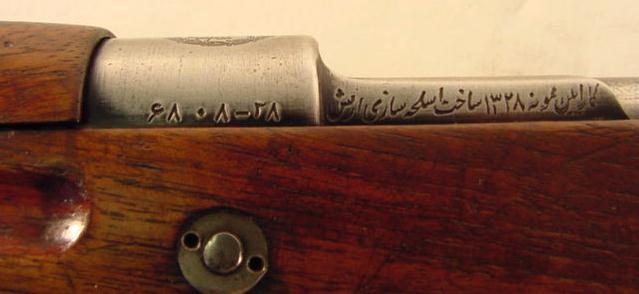
One typical such inscription read “tofang-e nemoone 1309 karkhane-ye aslahe sazi berno” (“Rifle model 1309 Made at Brno Arms factory.” The number 1309 refers to the Persian year 1309 which is the year 1930 in the Gregorian calendar).

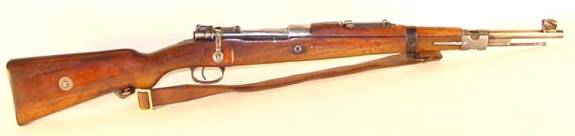
In the late 1940s Iran’s Taslihat-e Artesh (Arms Factories of the Army), popularly known as Mosalsal-sazi (the machine-gun factory), in Tehran started production of these Brno rifles. The needed machinery and technical assistance were provided to Iran through the industrial firm Škoda, which had a long history of cooperation with Iran. Iran produced two models: the regular VZ24 rifle (similar to the German Kar98k, overall length 1110 mm) and the short version (similar to the German G30, overall length 993 mm) known as “Berno kootah” (short Brno).


Berno Kootah (short Brno)

Under a licence from CZ. The difference was only in the markings on the side of reciever: instead of naming Brno as the maker, it was written “sakht-e aslah-e sazi-e artesh” (made by the Army arms factory).


Markings on an Iran made short Brno

The products are known among the collectors as Persian Mauser and are regarded to be the best and smoothest of the Mauser family of bolt-action rifles.

For many years Brno was the standard personal weapon of the Iranian armed forces, until it was replaced by the more modern, semi-automatic, American Garand M1, and later by the German Heckler & Koch G3.

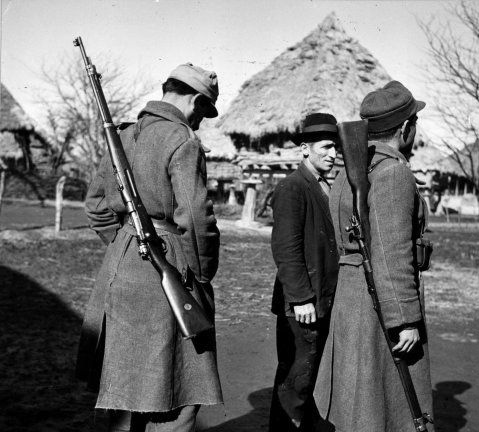
The rifle was especially cherished by Iranian tribes, who are known to be firearms aficionados and able shooters. A tribesman sharpshooter would settle for nothing less than a Brno. Tribal rebels did everything to acquire one of these rifles, and they did get their hands on these in many tribal wars during Reza Shah and Mohammad Reza Shah’s time. And probably the tribal chieftains, or Khans, did get shipments from foreign sources, to be distributed among their savars (mounted fighters). One single event, which contributed to the widespread availability of Brno rifles among the tribes in Iran, was the fall of Reza Shah following the invasion of Iran by the Allied forces in 1941. At that time the Iranian army, after a short resistance, was almost disbanded and many people, especially tribesmen, got hold of the Brnos left after the soldiers abandoned the barracks.

There are many stories of the gun’s accuracy among the tribes. When Dadshah rebelled against the shah’s government in Baluchistan in the 1950s, people said that his wife, Bibi Khatoon, who accompanied him in the mountains, at one occasion, took her Brno and shot a bullet right into the barrel of the gun of a poor gendarme who was aiming at her over a long distance. Its popularity among Iranian tribes was so much that it was mentioned in some of their songs. A version of a well-known Boyer Ahmad song has a refrain that says “Mastom, Mastom, Brno kootah be dastom” (I’m drunk and have a short Brno in my hand).

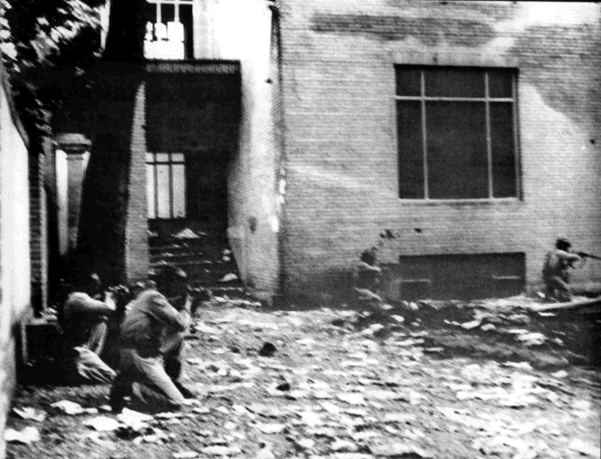
For the politically minded intellectuals of 1950s and 1960s, the rifle was a symbol of the Shah’s repressive rule. It can be seen in the pictures of soldiers attacking the house of Dr. Mossageq on the fateful day of 19 August 1953 (the infamous day of the US-British coup).


Soldiers attacking the house of Dr. Mossadiq, Aug. 1953

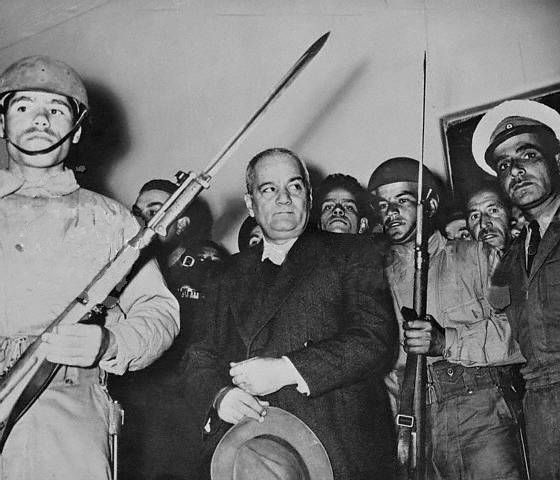
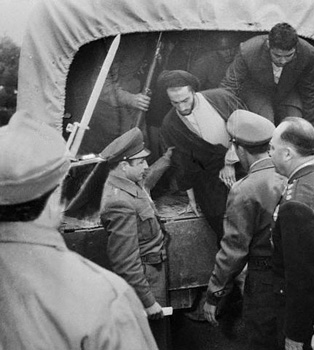
Gory pictures of executions of Tudeh party officers in the Chitgar shooting range in 1955 shows defiant young officers strapped to the stake minutes before execution, with Brnos present to do the task. When Navab-Safavi, the fundamentalist leader of Fadaiian Islam was arrested, Iranians saw his pictures being transferred to a prison under bayoneted Brnos.


Dr. Yazdi, the Tudeh party leader, after arrest in 1953, surrounded by soldiers with Brnos


Navab-Safavi, the Fadaiian-e Islam leader arrested

You can see it in pictures of 15 Khordad (June 1963) uprising in Tehran. In fact, when the Shah’s opposition cried against his “rule of the bayonet”, it was the sight of these Brnos with their bayonets attached that they were referring to.

Ordinary people usually had their first encounter with the rifle while passing a guard in the street, or when they were (willingly or otherwise) recruited for the military service.


A deserter is taken to military service in a Gilan village, circa 1955

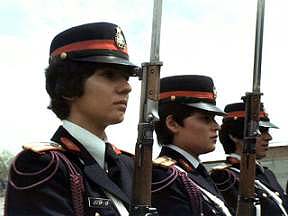
In the 1960s the semi-automatic US made M1 replaced Brno in the Iranian army, and Brno use was confined to the gendarmerie and the game wardens for a while, before it was decommissioned from active use. In the 1970s it was used mainly in ceremonial occasions.


Girl cadets of the police academy in graduation ceremony, circa 1972

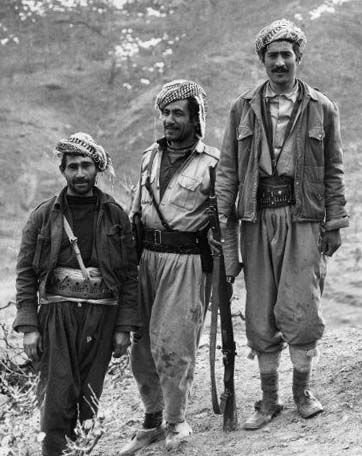
During the 1979 revolution, the gun reappeared in the hands of the revolutionaries and tribesmen, who never abandoned their Brnos. When Kurds challenged the newly established Islamic government, they used mostly modern assault rifles. But Brno still had a use: The Kurds claimed that with special cartridges that can pierce 2cm of steel, Brno can down aircraft and helicopters.


Kurdish ‘Peshmarga’s with Brno

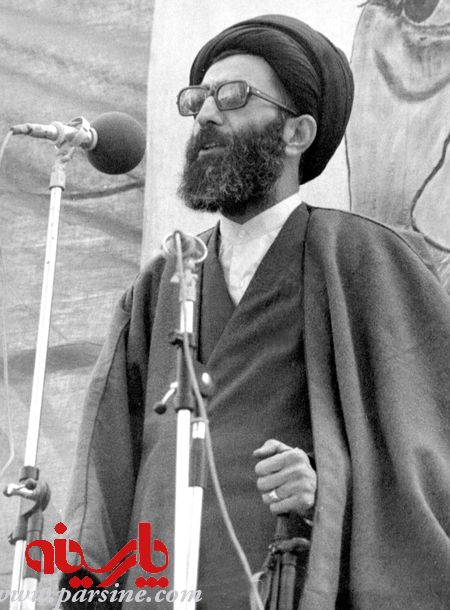
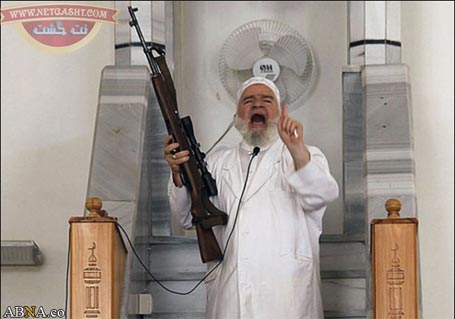
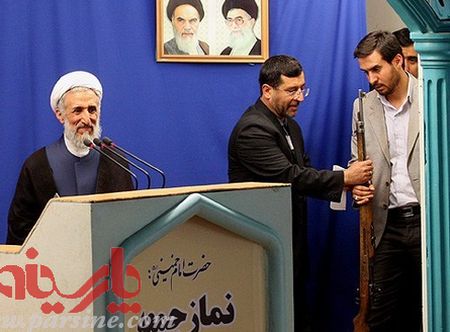
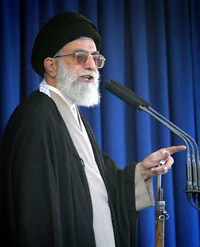
Besides the rebels, the Islamic government too had a use for Brno: It was, and is, used in official Friday prayer ceremonies. The speaker is required to have ‘the weapon of the day’ by his side, according to the tradition of the Prophet (he apparently used a sword).


A Friday prayer session, with Brno

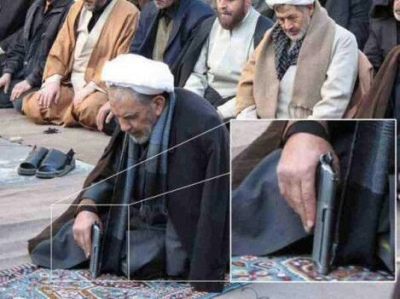
These images were collected and published on an Iranian website Parsine asking the question of “What kinds of weapons do Imam’s like?”


A different news source, but this shows a handgun being held by an imam leading the Khutbah.
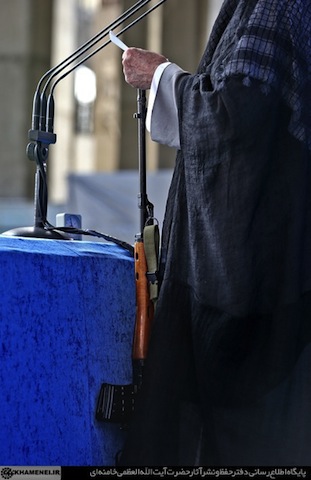
Supreme leader Ayatollah Khamenei with what appears to be a Dragunov derivative.
https://www.theblaze.com/news/2015/07/20/can-you-spot-what-irans-khamenei-was-holding-during-his-speech-on-the-nuclear-deal-the-mainstream-media-ignored-it

The most likely reason for its use in such ceremonies is that it is long enough for the speaker to hold it like a walking stick while he is standing and preaching. The Mauser brothers would have been happy to hear that their rifle would be considered a ‘weapon of the day’ a century later.

For people of my generation Persian Mauser, or Brno, brings back many bittersweet memories. The coup, the executions, the NoghlAli (Iranian version of GI Joe) with his Brno in a watch-cabin, the pain of being hit by its butt in street demonstrations, the greedy gendarme guy looking for a chicken to steal, the poor poacher in a remote town using the old rifle to feed his family with meat once in a while. You see it in the old newspaper pictures of battles, ceremonies, riots and executions. It is a piece of history.

Thank you Ali Parsa for contributing to Silah Report!

Tabuk Sniper Rifles Turn up in Baghdad Small Arms Cache

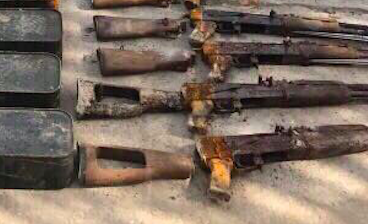
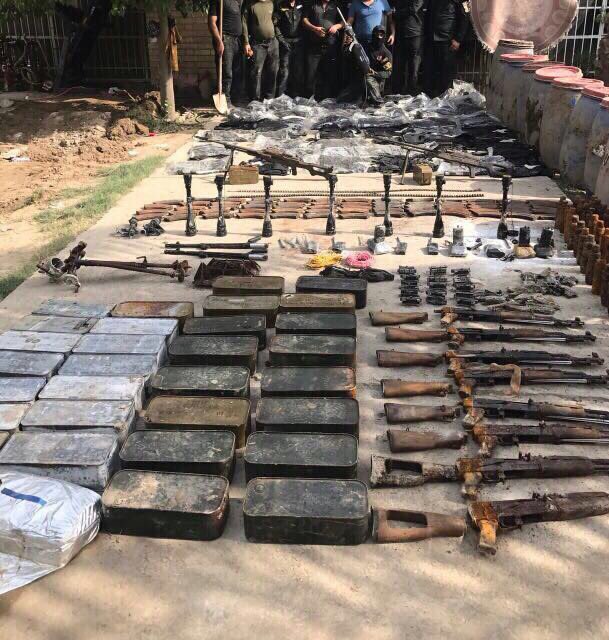
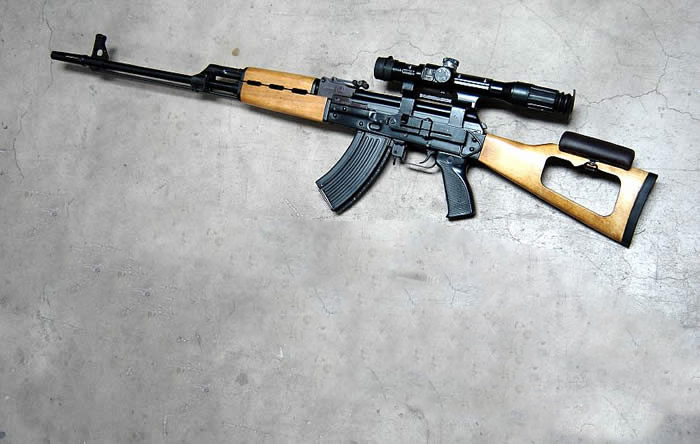
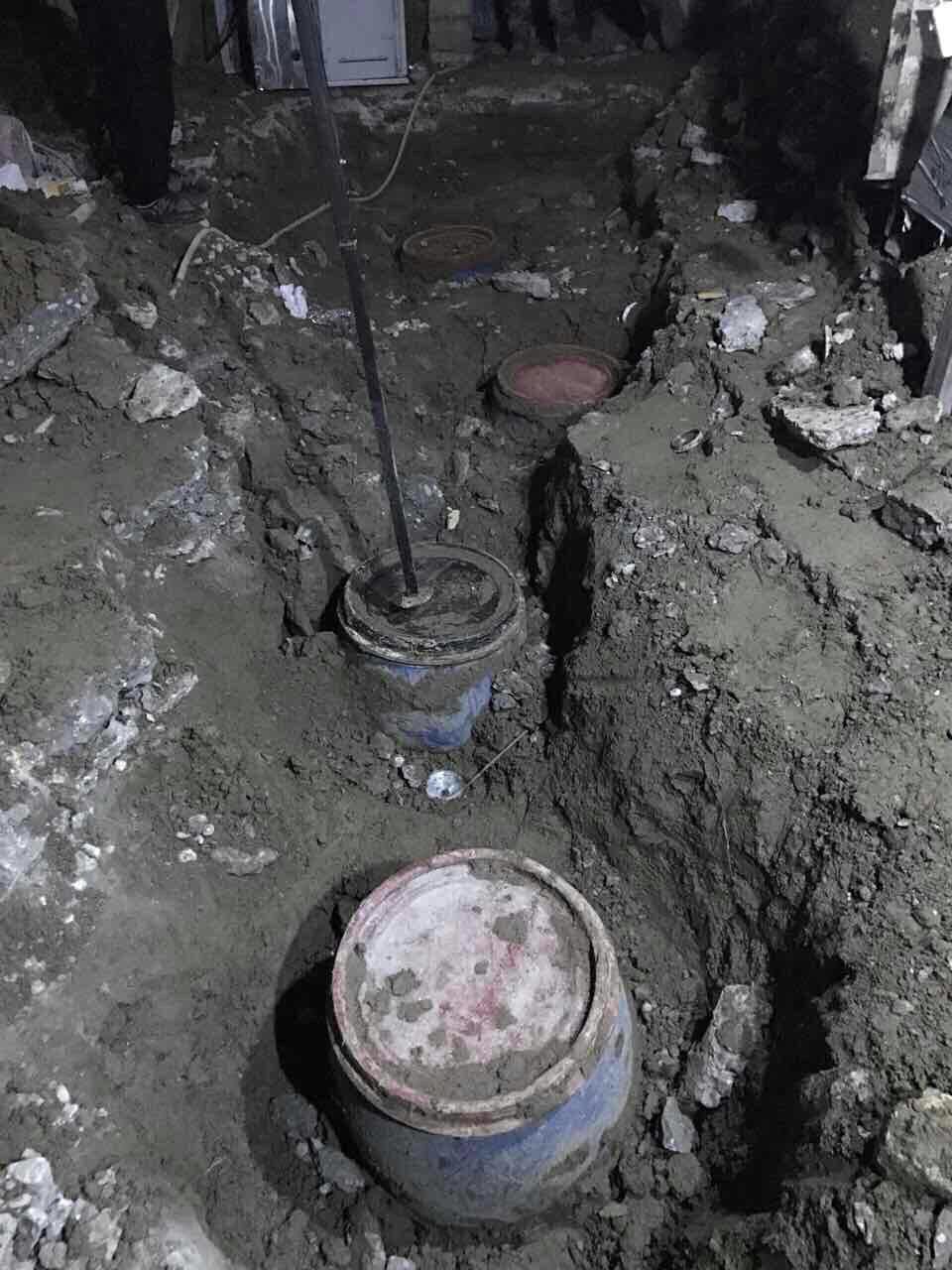
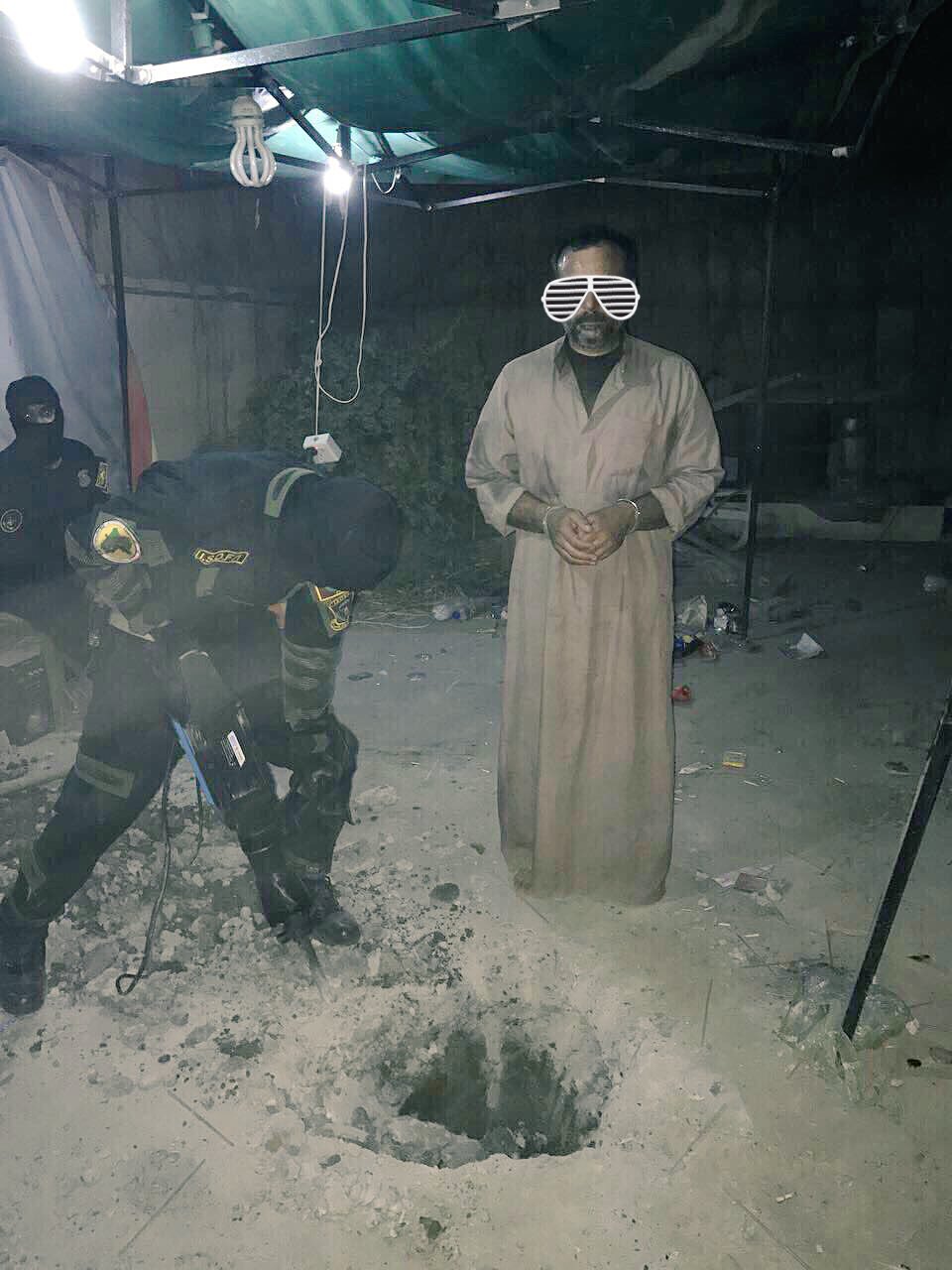
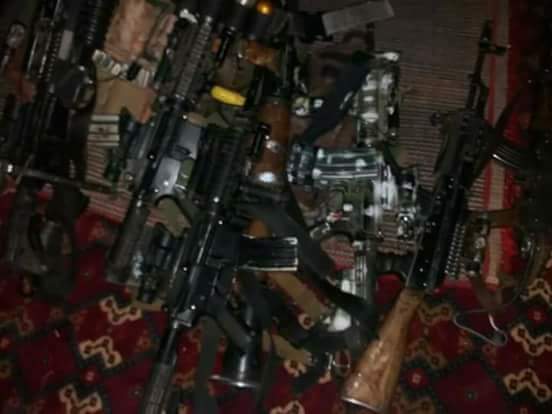
At a recent weapons cache that was turned up by Iraqi Counter-Terrorism Forces in Baghdad, what appears to be two Iraqi Tabuk Sniper rifles were among the rifles discovered in the buried cache. The Tabuk Sniper is uniquely identified by the cutout in the rear stock. Based on the Yugoslavian M70, the Tabuk sniper is a variant of the standard Tabuk rifle with full wooden stock, and the shorter version with a folding stock. It is unique among designated marksmen rifles in that it is chambered in 7.62x39mm, a round not known for its accuracy in the years it was adopted and used.

The two Tabuk Snipers in this photograph are distinguished by the aforementioned stocks and the three vents in the wooden handguard. On the above rifle there does seem to be some doubt as the receiver looks to be milled instead of stamped due to the magazine cut out portion. In addition, it is difficult to tell if the pistol grips are plastic or wooden, a key identification point about the Tabuk and M70 series. The stocks themselves are actually reversed, you are looking at the left side of the stock when it should have been the right side if aligned properly with the rifle.

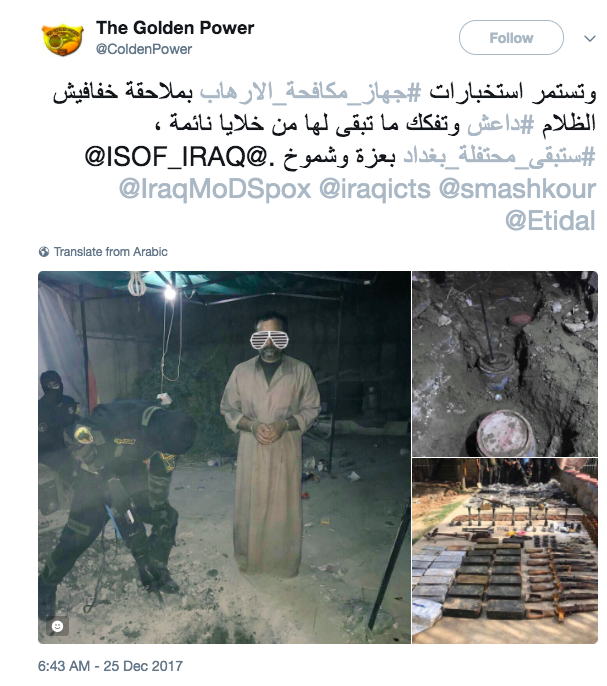
The Twitter account “The Golden Power” shared the images.

Forgotten Weapons discusses Peshmerga Anti-Material Rifles

Ian from Forgotten Weapons  has put together an interesting overview of the 12.7mm Zagros And 14.5mm Sahar Anti-Material Rifles in use by the Kurdish Peshmerga. These improvised rifles are making quite the headway in the current Syrian civil war, due to the prevelance of VBIEDs and the complexity of fighting in urban settings.