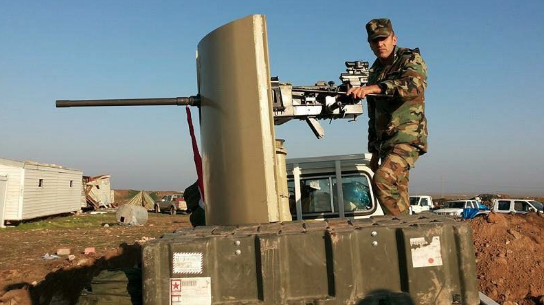
SUSAT On Peshmerga M2

A photograph has recently come out showing a Peshmerga fighter with what appears to be a SUSAT mounted on his M2 .50 BMG Heavy Machine Gun. The mount that the machine gun is cradled in also appears to be a of British design, formerly seen in use on British armored vehicles. SR’s suspicion is that the entire contraption is supplied by British forces to the Peshmerga as defensive material. However, it would also appear that the SUSAT isn’t calibrated to the trajectory of the .50 BMG cartridge, nor is it very well suited for a heavy machine gun in the first place, being designed for a 5.56x45mm rifle.

Arabic Guides to Kalashnikov and Ammunition Nomenclature

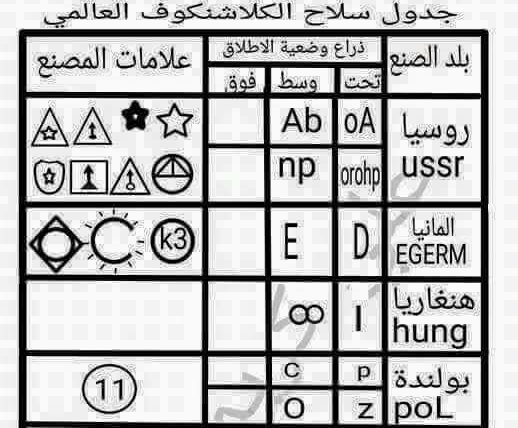
Much like in the United States Kalashnikov collector or enthusiast market, Iraqi Kalashnikov owners understand the differences in quality between AKs from different countries. The European ones take precedence over Chinese, and Russian variants when original remain supreme and commandeer a premium when it comes to cost.


These sets of markings are designating the country of origin stamps in addition to examples of serial number blocks.

While still maintaining the country origin markings, this chart explicitly shows the selector markings as well. Understanding and making sure all the markings add up is very important if a seller is to ensure the Kalashnikov he is purchasing is indeed genuine.

In addition to country of origin markings, these are guides in Arabic to ammunition markings and nomenclature. With the Iraqi flag imprinted in the graphics, the photographs appear to have been edited and translated by an Iraqi enthusiast.

Introducing our Country Database with Armenia

Although reporting recent developments and writing historical posts is the primary function of the Silah Report, we are now introducing a new feature to the website. This is our Country Database that you see in the upper left-hand corner. The intent of the database is to be able to learn as much general information about small arms usage, manufacture, and trade within any particular country within the Middle East & North Africa and Central Asian regions since 1916. Although right now our database isn’t populated, we hope to have most of it online within the next year or so. It certainly is a stretch goal and it will be continually improved upon and changed as better researchers and information is added to the pages.

Right now we have our first country profile posted and that is Armenia, written by our very own Hrachya! Please give it a look to learn some more about the current and historical small arms situation in Armenia.

Israeli “Hitchhiker” Modified M16 Magazine

(SR welcomes our first guest author, Yoel M. who will be discussing an interesting historical phenomena when it comes to the Israeli Defense Forces)

To understand the root of the IDF “hitchhiker’s magazine” we must begin with some context. Israel is a

small nation geographically, from North to South the country is only 263 miles (420Km). This same geography

that dictates military strategic plans also dictates military leave arrangements.

Because the front line are based just an hours drive from population centers, this enabled the IDF to release

soldiers for weekend vacations to return home. Not all the bases have good public

transportation options and as a result soldiers use to hitchhike on their way home and back

to base.

In the late 1980s and early 1990s, Palestinian fighters would take advantage of this situation and start to

kidnap soldiers to bargain for their comrades at Israeli prisons. These fighters

pretending to be Israelis would offer soldiers a ride. The tactic was usually to

arriving with no passengers to bus stations and offer a soldier a ride, the soldier would seat in

the front seat next to the driver, a few minutes down road the driver would stop and take in another

hitchhiker, this time the driver’s companion would sit behind the soldier and when the time

is right to attack and strangle the soldier from the rear.

IDF orders at that times were that soldiers are prohibited from moving with magazine inside the

rifle on their way to or from home. Most Israeli drivers having been IDF veterans themselves

usually also demanded the soldier to remove the magazine and cycle the

gun manually to check there is no round in the chamber before allowing the soldier in.

To counter the threat of kidnapping soldiers and against military orders, some troops would retrofit their

M-16 STANG magazines. They would saw off the magazine box and spring and weld the magazine

bottom floor plate to the new shorter box forming a magazine short enough to be totally

concealed inside the M-16 magazine housing.

There is, of course, no official data regarding the capacity of those homemade devices but it

fair to assume that 10 rounds is their maximum theoretical capacity.

Extracting the magazine was also an issue as those magazines were lighter than regular

STANG and often the welds on the floor plate brushed against the magazine housing inner

walls they often won’t drop when needed. With no exposing surface to grip to

extract the “hitchhiker magazine” some soldiers chose to shorter the magazine further and

weld or rivet small knob to the floor plate for easier magazine extraction.

The way the magazine would potentially work is that the soldier would insert it into the magazine

well and simply walk with it as a seemingly unloaded rifle to avoid any military police

checks and drivers demanding that a magazine be removed before entering the vehicle. If

the driver demands to manually cycle the bolt, the soldier will pull the charging handle while

pretending to verify that the chamber is empty only to load a round into the chamber from

the magazine.

Either way, the soldier plan to enter with his rifle loaded, only to be used in case of a hijacking

attempt. Iif the soldier is right handed when he sits in the passenger seat, the rifle would lay on his lap with the

barrel pointing towards the driver. In case of strangling from the rear the soldier could

theoretically operate the gun to shoot the driver.

The main problem with these magazines was the reliability. Those homemade fabrications

often misfed rounds, stacked in the housing and would drop or break open un-

expectantly when the welding failed.

Another problem was the increase in firing accidents the magazine caused, soldiers at home or

back at base could forget there is a magazine in the gun. More dangerous is the soldier’s

young siblings that might find the seemly unloaded gun and try to play with it.

Needless to say, the IDF didn’t take kindly to its soldiers initiative or the hitchhiking for that

matter and set to prohibit both. The military police was ordered to find and confiscate

hitchhiker’s magazines and penalties of up to a month in military prison to whom it was in

possession or those who tried hitchhiking.

Simultaneously officers were instructed to release soldiers for vacation only at days and

hours when public transportation was due. Moreover the army reluctantly spent money

paying private bus companies for transporting to and from central bus stations during the weekends.

Eventually, usage of the magazine became redundant as there was no longer a threat to IDF soldiers and the practice

went away.

As for its actual combat test and evaluation the magazine was never reportedly used in any kidnapping

attempt. One potential use I found in an online forum which I can’t verify or disprove was to

insert the magazine in the gun in what called “Peaceful Patrols” in Gaze and West Bank urban areas,

as the brass had the novel idea of “Winning Hearts and Minds” by send patrols without

magazines in the guns (only in the pockets of their vests). Some soldiers realized that their lives were worth more than

any hearts and minds campaign, and thus used these “Hitchhiker Magazines” while they were patrolling, to give them a

better chance of reacting to a threat.

Sadly there is no photos of the “Hitchhiker Magazine” online, the manufacturing of it done

against IDF orders and the magazine before social media and cell phones with

cameras appeared. In the end the concealed “Hitchhikers Magazine” achieved its goal as it still

invisible from Google’s all seeing eye.

Although not an Israeli magazine modification, this commercial five round magazine would have approximated what the “Hitchhiker’s Magazine” would have looked like in the 1980s and 1990s.

“Major League Infidel” Comes Full Circle In Iraq

16649184_216451905494784_3182529706248954656_n.jpg

Early in the invasions of Iraq and Afghanistan, an emblem lifted from the Major League Baseball symbol was used to demonstrate the feelings of many American Soldiers and Marines deploying in support of OIF and OEF. It depicted a soldier in place of the traditional baseball hitter, against a background of red and blue, with the figure in white. Of course, the colors red, white and blue were synonymous with the American flag. The phrase “Major League Infidel” was attached at the bottom. Infidel, “Kafir”, or کافر is a popular moniker within the U.S. Military because this is the language used in propaganda videos put out by Al Qaeda, Taliban, or current Daesh groups. Soldiers and Marines hear this and take to the term as a sort of endearment as being unliked. Of course, these same Soldiers and Marines don’t realize that the word “Kafir” exists in Arabic versions of the Christian bible as used by Christian Arabs across the MENA region.


Even the extremely popular Crye Precision brand, that makes top quality camouflage clothing and patterns, has this on their website–


We created this trademarked slogan and icon to remind everyone that all “non-believers” in senseless violence are “infidels” and to celebrate the ones who actually do something about it… the Major League Infidels™

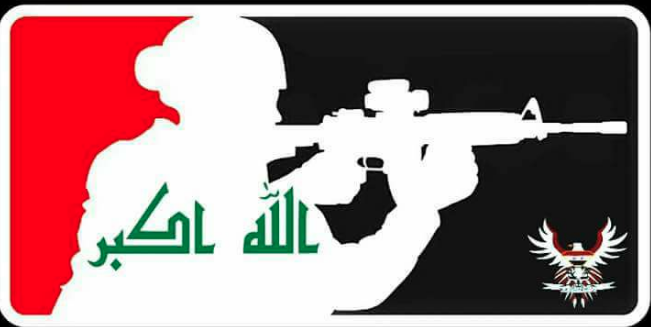
The Islamophobic rhetoric notwithstanding, the symbolism has interestingly made its way into Iraq, by way of the Iraqi ISOF forces. This time the logo is depicting the colors of the Iraqi flag; red, white, and black, with the motto found on the flag- الله اکبر, Allah Ak’bar, or translated as “God is Great”. The figure depicted is that of an Iraqi Special Operations Forces soldier with a raised Rock River Arms 14.5″ LAR-15, and Aimpoint CompM4 optic, both standard issue among ISOF forces. It is probable that the creator of this image wasn’t entirely sure of the original intent and meaning of the MLI originating from the States, but regardless he took the image and used it in a very pro-Iraqi context, which is actually anything but what the intention of the symbol was in the beginning. Thus, it has literally come full circle in the meaning, essentially changing it entirely.

In addition, it is cognisant of a much more important dynamic and that is the admiration and imitation of Iraqi and Afghan forces for U.S. forces. Copying everything from the way pouches are being set up on their plate carriers, helicopter safety lines, even attachments on their small arms to include Airsoft M203 imitations trying to replicate the look of real ones.

Below is a gathering of the original form of the meaning, to demonstrate just how clear the original intent was-

This particular logo has actually gone past the political and cultural ramifications and moved into Call of Duty. 
AK-74s of Kazakhstan Army’s Military Exercises

Kazakh AKs 660x405.jpg

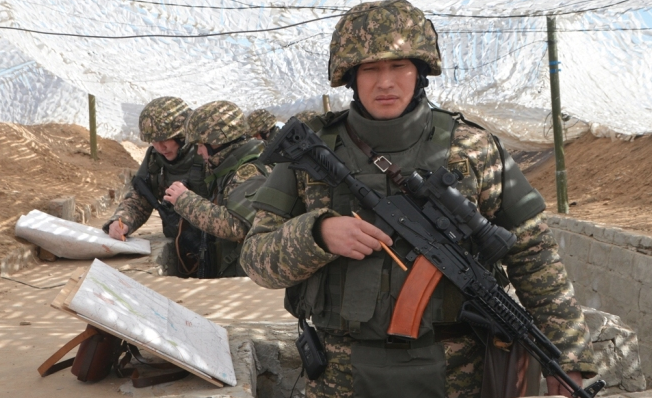
Ministry of Defense of Kazakhstan has recently posted news releases on their website concerning military exercises of high-ranking officers.

Kazakh AKs.jpg

Particularly, battalion commanders of mechanized infantry, paratrooper and marine regiments took part in mentioned exercises. The purpose of that event was to upgrade the qualification of the officers by a number of tactical and strategic classes, defensive and offensive scenario studies, as well as familiarization with new weapon systems.

img_3427_12691.jpg

During these exercises, the officers were carrying AK-74 assault rifles, which had some interesting upgrades and mods on them. Let’s take a closer look at each of them.

The railed dust cover, handguard and gas tube cover are most likely made by Russian company Zenit. The dust cover is Zenit B-33 (Зенит Б-33), the handguard is a Zenit B-10M (Б-10М) and the railed gas tube cover is a Zenit B-19 (Б-19). Here is a picture of all three accessories:

Зенит 1.jpg


The stock adapter is probably made by Israeli company FAB Defense. It is the model M4-AK P or a similar one. Some of these stock adapters differ only by the material, which is almost impossible to distinguish by only a visual reference. In any case, it is a conversion stock which allows mounting AR-15/ M-4 rifle stocks on the AK platform. It also has a built-in side folding mechanism. Here is the image of M4-AK P model:

! Kazakh stock FAB.jpg

The buttstock itself is also made by FAB Defense and it is their GLR-16 CP model with an adjustable cheek riser.

704-glr-16-cp-3d-png-Sun-Jan-6-15-34-22.jpg

The angled foregrip mounted on the handguard has the distinct shape of another FAB Defense product – PTK.

699-ptk-png-Sun-Nov-18-13-21-16.jpg


The scope is unidentified, but it is presumably a Russian made one. It is a night vision or thermal scope judging from the looks. Possibly, it is a newer version of NSPU scope. We’ll update this post as soon as we find out the exact model of the scope.

Similar exercises of squad leaders were held too and it is interesting to note that squad leaders were equipped with AK-74 rifles in stock configuration. Judging from that, the upgrades for AK-74s are available for high ranking officers only. Here is a picture of squad leader sergeants firing their AK-74s:

img_3526_13066.jpg

FYI: here is the small arms’ list of Armed Forces of Kazakhstan (from Wikipedia):

Small Arms

  • 9×18mm Makarov PM Standard issue pistol for armed forces.
  • 9×18mm PP-90M1 Submachine gun, used by special forces.
  • 5.45×39mm AK-74 Standard issue rifle of Kazakh military.
  • 5.45×39mm RPK-74
  • 7.62×39mm AKM Reserve units
  • 7.62×54mmR SVD Dragunov sniper rifle
  • 7.62×54mmR PKM machine gun
  • 7.62×54mmR PKP Pecheneg machine gun, used by special forces.
  • 7.62×39mm ARX-160 Assault rifle, used by special forces
  • 12.7mm NSV machine gun

Homemade Anti-Materiel Rifle With Iraqi Militia

C5rKjNRWAAAvjh5.jpg

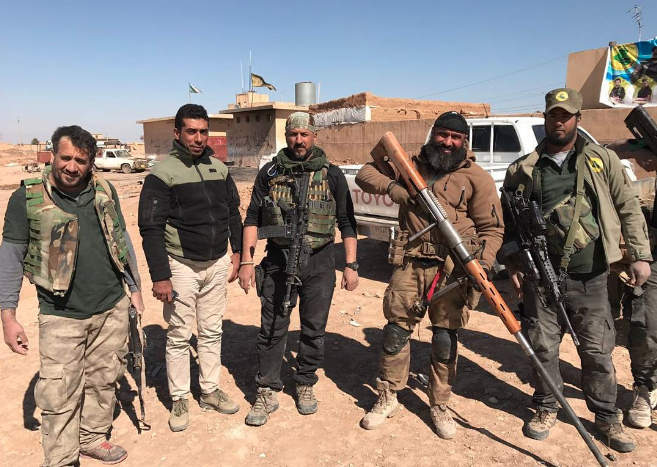
A Polish small arms magazine recently posted this to their social media page. It appears to be of a group of Iraqi militiamen from the Imam Ali Brigade, as is evidenced by the circular yellow patch with a Kalashnikov over an image of a green country profile of Iraq . The bearded militiaman is posing with a huge bolt action anti-materiel rifle. These DIY conversions had been seen multiple times during the Syrian conflict. Supposedly this gun uses either 14,5mm (from KPV or KPVT) or 23 mm (from ZU-23-2) barrel with an improvised receiver, bolt, trigger mechanism, furniture and bipod. You can also see a picatinny rail section mounted on top of the receiver for attaching a scope.

I guess they use the survived barrels from guns with damaged or destroyed mechanisms. Otherwise, it won’t be justified to take the barrel from a functional heavy machine gun or automatic cannon. Although depending on the situation it can be the case, too.

When making the new stock and forearm, the gunsmith definitely tried to make it look like an SVD/Al-Kadesiah.

Note also the other guys’ weapons: an AK, M4 Carbine and an M249 SAW LMG.

334

The Shi’a Imam Ali Brigade (Cited Source- The Observers)

The Iraqi Shiite militia known as the Imam Ali Brigades is accused of having committed multiple war crimes in the fight against the Islamic State organisation in Iraq, including summary executions and torture of captives. But its brutality isn’t the only thing fuelling the militia’s notoriety – it also has a well-oiled communications strategy.

In June 2014, Shiite leader Ayatollah Sistani made an appeal for mobilisation against the Islamic State organisation. Numerous Iraqi Shiite militias were formed after this announcement.

These new formations joined the four large, already-existing Shiite militias in Iraq: the Badr Brigade, founded in Iran in 1982; Saraya al-Salam (the “Peace Brigades”), which is directed by the radical Shiite religious cleric Moqtada al-Sadr; Asaib Ahl al-Haq (the “League of the Virtuous”); and, lastly, the Iraqi Ketaeb Hezbollah.

The Imam Ali Brigades have distinguished themselves by resorting to extreme violence. The militia, made up of combatants trained in Iran or Lebanon, has faced widening criticism since the release of a YouTube video showing men wearing the Imam Ali Brigades insignia burning a man.

Optic Mounted PKM in Syria (2016)

Kurdistan Insider posted this video of a Syrian Army advance in Aleppo in 2016. Most of the PKM variants being used in the Syrian conflict have been seen without any sort of optics platforms mounted to them, this is mostly because of the lack of equipment that many of these rebel groups can capture.

However in this case, it appears to be a thermal or at least an IR capable optic platform due to the bulbous appearance, in addition to the numerous knobs which might be battery caps for power. In addition the eye piece appears to be fitted or contoured to the shooter’s eye, indicating a bright screen that needs to be shielded during times of low light. Because this is a Syrian Army position, it is most likely that the optic is Russian supplied.

Screen Shot 2017-02-20 at 11.34.11 PM.png

In the same video clip, what appears to be an AK century series rifle being used by frontline soldiers, possibly in 5.45x39mm due to the straighter magazine in use.
Screen Shot 2017-02-20 at 11.34.31 PM.pngScreen Shot 2017-02-20 at 11.34.21 PM.png

WW II Small Arms in Libya

Although this these images are from a post that is several years old and on an Airsoft forum, the historical relevance is still very important to consider when examining small arms in the MENA region. These photographs came out during the massive unrest in Libya during and following the Libyan unrest otherwise known as “17 February” that overthrew long-time ruler Muammar Gaddafi. Although many of these small arms were actually used in fighting, the photographs appear to show a lull, where militia forces aren’t actually engaged but are rather conducting target practice or celebrating.

Two variants of the U.S. 1919 are shown, the first one appears to be a heavily modified 1919A4 variant, while the second one is a 1919A6. At first glance, these may appear to be 7.62x51mm NATO variants that Israel modified to use in the IDF during the 1950s and 1960s. However, a closer look at the belt of ammunition reveals the length of the rounds do appear to be .30-06 Spr and thus are most likely original manufacture 1919A4s and A6s.

libyanrebs15 libyanrebs07 libyanrebs06The photo below shows a Browning Hi Power, Sterling SMG, and a Caracano rifle in the background.
libyanrebs

The proceeding two photographs are of a Russian 7.62x54Rmm DP28 light machine gun. These might have arrived in Libya as a form of surplus support from the Soviet Union during the Cold War.

libyanrebs17
libyanrebs05

At an initial glance, this would appear to be a German 9x19mm MP40, but instead, due to the circular opening in the magazine well it is in fact, the predecessor to the MP40, the MP38.

libyanrebs10

This rifle appears to be a Mauser K98 with a broken stock that has been replaced

libyanrebs02

17 February Unrest Summary (Wikipedia)-

The first Libyan Civil War, also referred to as the Libyan Revolution[33] or 17 February Revolution,[34] was an armed conflict in 2011, in the North African country of Libya, fought between forces loyal to Colonel Muammar Gaddafi and those seeking to oust his government.[35][36] The war was preceded by protests in Zawiya on 8 August 2009, and finally ignited by protests in Benghazi beginning on Tuesday, 15 February 2011, which led to clashes with security forces that fired on the crowd.[37] The protests escalated into a rebellion that spread across the country,[38] with the forces opposing Gaddafi establishing an interim governing body, the National Transitional Council.

The United Nations Security Council passed an initial resolution on 26 February, freezing the assets of Gaddafi and his inner circle and restricting their travel, and referred the matter to the International Criminal Court for investigation.[39] In early March, Gaddafi’s forces rallied, pushed eastwards and re-took several coastal cities before reaching Benghazi. A further UN resolution authorised member states to establish and enforce a no-fly zone over Libya, and to use “all necessary measures” to prevent attacks on civilians.[40] The Gaddafi government then announced a ceasefire, but fighting continued.[41][42] Throughout the conflict, rebels rejected government offers of a ceasefire and efforts by the African Union to end the fighting because the plans set forth did not include the removal of Gaddafi.[43]

Basij Militia Selfie Stick


photo-2017-02-21-18-07-08

During the training exercises of Iranian Basij militia forces, the personnel found a controversial use for what looks to be a Chinese made underfolder AK-47. The guy in the image has mounted a phone on the stock and uses the gun as a selfie stick! Why controversial? Well, at first it looks to be a nice trick, which various armies’ soldiers have been doing lately. On the other hand, the Basij soldier violates key safety rules by pointing the gun at himself. He actually doesn’t care about three of four safety rules. I hope at least he has a good trigger discipline.

basij-warriors

About the Basij Militia, from Wikipedia-

The Basij (Persian: بسيج‎‎, lit. “The Mobilization”), Niruyeh Moghavemat Basij (Persian: نیروی مقاومت بسیج‎‎, “Mobilisation Resistance Force”), full name Sāzmān-e Basij-e Mostaz’afin (Persian: سازمان بسیج مستضعفین‎‎, “The Organization for Mobilization of the Oppressed”), is one of the five forces of the Army of the Guardians of the Islamic Revolution. A paramilitary volunteer militia established in Iran in 1979 by Ayatollah Khomeini.
It was an independent organization from inception until 17 February 1981, when it was officially incorporated into the Revolutionary Guards organization structure by the Iranian Parliament.
Today the force consists of young Iranian volunteers. Basij serve as an auxiliary force engaged in activities such as internal security, law enforcement auxiliary, providing social services, organizing public religious ceremonies, policing morals, and suppression of dissident gatherings. The force is named Basij and individual members are called basiji.