Israeli “Hitchhiker” Modified M16 Magazine

(SR welcomes our first guest author, Yoel M. who will be discussing an interesting historical phenomena when it comes to the Israeli Defense Forces)

To understand the root of the IDF “hitchhiker’s magazine” we must begin with some context. Israel is a

small nation geographically, from North to South the country is only 263 miles (420Km). This same geography

that dictates military strategic plans also dictates military leave arrangements.

Because the front line are based just an hours drive from population centers, this enabled the IDF to release

soldiers for weekend vacations to return home. Not all the bases have good public

transportation options and as a result soldiers use to hitchhike on their way home and back

to base.

In the late 1980s and early 1990s, Palestinian fighters would take advantage of this situation and start to

kidnap soldiers to bargain for their comrades at Israeli prisons. These fighters

pretending to be Israelis would offer soldiers a ride. The tactic was usually to

arriving with no passengers to bus stations and offer a soldier a ride, the soldier would seat in

the front seat next to the driver, a few minutes down road the driver would stop and take in another

hitchhiker, this time the driver’s companion would sit behind the soldier and when the time

is right to attack and strangle the soldier from the rear.

IDF orders at that times were that soldiers are prohibited from moving with magazine inside the

rifle on their way to or from home. Most Israeli drivers having been IDF veterans themselves

usually also demanded the soldier to remove the magazine and cycle the

gun manually to check there is no round in the chamber before allowing the soldier in.

To counter the threat of kidnapping soldiers and against military orders, some troops would retrofit their

M-16 STANG magazines. They would saw off the magazine box and spring and weld the magazine

bottom floor plate to the new shorter box forming a magazine short enough to be totally

concealed inside the M-16 magazine housing.

There is, of course, no official data regarding the capacity of those homemade devices but it

fair to assume that 10 rounds is their maximum theoretical capacity.

Extracting the magazine was also an issue as those magazines were lighter than regular

STANG and often the welds on the floor plate brushed against the magazine housing inner

walls they often won’t drop when needed. With no exposing surface to grip to

extract the “hitchhiker magazine” some soldiers chose to shorter the magazine further and

weld or rivet small knob to the floor plate for easier magazine extraction.

The way the magazine would potentially work is that the soldier would insert it into the magazine

well and simply walk with it as a seemingly unloaded rifle to avoid any military police

checks and drivers demanding that a magazine be removed before entering the vehicle. If

the driver demands to manually cycle the bolt, the soldier will pull the charging handle while

pretending to verify that the chamber is empty only to load a round into the chamber from

the magazine.

Either way, the soldier plan to enter with his rifle loaded, only to be used in case of a hijacking

attempt. Iif the soldier is right handed when he sits in the passenger seat, the rifle would lay on his lap with the

barrel pointing towards the driver. In case of strangling from the rear the soldier could

theoretically operate the gun to shoot the driver.

The main problem with these magazines was the reliability. Those homemade fabrications

often misfed rounds, stacked in the housing and would drop or break open un-

expectantly when the welding failed.

Another problem was the increase in firing accidents the magazine caused, soldiers at home or

back at base could forget there is a magazine in the gun. More dangerous is the soldier’s

young siblings that might find the seemly unloaded gun and try to play with it.

Needless to say, the IDF didn’t take kindly to its soldiers initiative or the hitchhiking for that

matter and set to prohibit both. The military police was ordered to find and confiscate

hitchhiker’s magazines and penalties of up to a month in military prison to whom it was in

possession or those who tried hitchhiking.

Simultaneously officers were instructed to release soldiers for vacation only at days and

hours when public transportation was due. Moreover the army reluctantly spent money

paying private bus companies for transporting to and from central bus stations during the weekends.

Eventually, usage of the magazine became redundant as there was no longer a threat to IDF soldiers and the practice

went away.

As for its actual combat test and evaluation the magazine was never reportedly used in any kidnapping

attempt. One potential use I found in an online forum which I can’t verify or disprove was to

insert the magazine in the gun in what called “Peaceful Patrols” in Gaze and West Bank urban areas,

as the brass had the novel idea of “Winning Hearts and Minds” by send patrols without

magazines in the guns (only in the pockets of their vests). Some soldiers realized that their lives were worth more than

any hearts and minds campaign, and thus used these “Hitchhiker Magazines” while they were patrolling, to give them a

better chance of reacting to a threat.

Sadly there is no photos of the “Hitchhiker Magazine” online, the manufacturing of it done

against IDF orders and the magazine before social media and cell phones with

cameras appeared. In the end the concealed “Hitchhikers Magazine” achieved its goal as it still

invisible from Google’s all seeing eye.

Although not an Israeli magazine modification, this commercial five round magazine would have approximated what the “Hitchhiker’s Magazine” would have looked like in the 1980s and 1990s.

“Major League Infidel” Comes Full Circle In Iraq

16649184_216451905494784_3182529706248954656_n.jpg

Early in the invasions of Iraq and Afghanistan, an emblem lifted from the Major League Baseball symbol was used to demonstrate the feelings of many American Soldiers and Marines deploying in support of OIF and OEF. It depicted a soldier in place of the traditional baseball hitter, against a background of red and blue, with the figure in white. Of course, the colors red, white and blue were synonymous with the American flag. The phrase “Major League Infidel” was attached at the bottom. Infidel, “Kafir”, or کافر is a popular moniker within the U.S. Military because this is the language used in propaganda videos put out by Al Qaeda, Taliban, or current Daesh groups. Soldiers and Marines hear this and take to the term as a sort of endearment as being unliked. Of course, these same Soldiers and Marines don’t realize that the word “Kafir” exists in Arabic versions of the Christian bible as used by Christian Arabs across the MENA region.


Even the extremely popular Crye Precision brand, that makes top quality camouflage clothing and patterns, has this on their website–


We created this trademarked slogan and icon to remind everyone that all “non-believers” in senseless violence are “infidels” and to celebrate the ones who actually do something about it… the Major League Infidels™

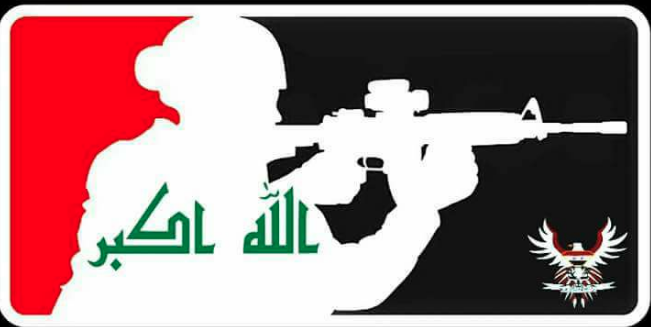
The Islamophobic rhetoric notwithstanding, the symbolism has interestingly made its way into Iraq, by way of the Iraqi ISOF forces. This time the logo is depicting the colors of the Iraqi flag; red, white, and black, with the motto found on the flag- الله اکبر, Allah Ak’bar, or translated as “God is Great”. The figure depicted is that of an Iraqi Special Operations Forces soldier with a raised Rock River Arms 14.5″ LAR-15, and Aimpoint CompM4 optic, both standard issue among ISOF forces. It is probable that the creator of this image wasn’t entirely sure of the original intent and meaning of the MLI originating from the States, but regardless he took the image and used it in a very pro-Iraqi context, which is actually anything but what the intention of the symbol was in the beginning. Thus, it has literally come full circle in the meaning, essentially changing it entirely.

In addition, it is cognisant of a much more important dynamic and that is the admiration and imitation of Iraqi and Afghan forces for U.S. forces. Copying everything from the way pouches are being set up on their plate carriers, helicopter safety lines, even attachments on their small arms to include Airsoft M203 imitations trying to replicate the look of real ones.

Below is a gathering of the original form of the meaning, to demonstrate just how clear the original intent was-

This particular logo has actually gone past the political and cultural ramifications and moved into Call of Duty. 

Optic Mounted PKM in Syria (2016)

Kurdistan Insider posted this video of a Syrian Army advance in Aleppo in 2016. Most of the PKM variants being used in the Syrian conflict have been seen without any sort of optics platforms mounted to them, this is mostly because of the lack of equipment that many of these rebel groups can capture.

However in this case, it appears to be a thermal or at least an IR capable optic platform due to the bulbous appearance, in addition to the numerous knobs which might be battery caps for power. In addition the eye piece appears to be fitted or contoured to the shooter’s eye, indicating a bright screen that needs to be shielded during times of low light. Because this is a Syrian Army position, it is most likely that the optic is Russian supplied.

Screen Shot 2017-02-20 at 11.34.11 PM.png

In the same video clip, what appears to be an AK century series rifle being used by frontline soldiers, possibly in 5.45x39mm due to the straighter magazine in use.
Screen Shot 2017-02-20 at 11.34.31 PM.pngScreen Shot 2017-02-20 at 11.34.21 PM.png

WW II Small Arms in Libya

Although this these images are from a post that is several years old and on an Airsoft forum, the historical relevance is still very important to consider when examining small arms in the MENA region. These photographs came out during the massive unrest in Libya during and following the Libyan unrest otherwise known as “17 February” that overthrew long-time ruler Muammar Gaddafi. Although many of these small arms were actually used in fighting, the photographs appear to show a lull, where militia forces aren’t actually engaged but are rather conducting target practice or celebrating.

Two variants of the U.S. 1919 are shown, the first one appears to be a heavily modified 1919A4 variant, while the second one is a 1919A6. At first glance, these may appear to be 7.62x51mm NATO variants that Israel modified to use in the IDF during the 1950s and 1960s. However, a closer look at the belt of ammunition reveals the length of the rounds do appear to be .30-06 Spr and thus are most likely original manufacture 1919A4s and A6s.

libyanrebs15 libyanrebs07 libyanrebs06The photo below shows a Browning Hi Power, Sterling SMG, and a Caracano rifle in the background.
libyanrebs

The proceeding two photographs are of a Russian 7.62x54Rmm DP28 light machine gun. These might have arrived in Libya as a form of surplus support from the Soviet Union during the Cold War.

libyanrebs17
libyanrebs05

At an initial glance, this would appear to be a German 9x19mm MP40, but instead, due to the circular opening in the magazine well it is in fact, the predecessor to the MP40, the MP38.

libyanrebs10

This rifle appears to be a Mauser K98 with a broken stock that has been replaced

libyanrebs02

17 February Unrest Summary (Wikipedia)-

The first Libyan Civil War, also referred to as the Libyan Revolution[33] or 17 February Revolution,[34] was an armed conflict in 2011, in the North African country of Libya, fought between forces loyal to Colonel Muammar Gaddafi and those seeking to oust his government.[35][36] The war was preceded by protests in Zawiya on 8 August 2009, and finally ignited by protests in Benghazi beginning on Tuesday, 15 February 2011, which led to clashes with security forces that fired on the crowd.[37] The protests escalated into a rebellion that spread across the country,[38] with the forces opposing Gaddafi establishing an interim governing body, the National Transitional Council.

The United Nations Security Council passed an initial resolution on 26 February, freezing the assets of Gaddafi and his inner circle and restricting their travel, and referred the matter to the International Criminal Court for investigation.[39] In early March, Gaddafi’s forces rallied, pushed eastwards and re-took several coastal cities before reaching Benghazi. A further UN resolution authorised member states to establish and enforce a no-fly zone over Libya, and to use “all necessary measures” to prevent attacks on civilians.[40] The Gaddafi government then announced a ceasefire, but fighting continued.[41][42] Throughout the conflict, rebels rejected government offers of a ceasefire and efforts by the African Union to end the fighting because the plans set forth did not include the removal of Gaddafi.[43]

Type 1, 2 Kalashnikovs Spotted

This photograph recently appeared on the social media account of a Kalashnikov aficionado, showing both a Type 1 and Type 2 Ak47 (not AKM) featured in the photograph. The Type 1 and Type 2 are exceedingly rare today, having been taken over by the much more produced AKM and associated variants across the world.


This was taken in Helmand province, Afghanistan by a contractor based there, probably in the Kajaki district. His testimony to this photograph is as follows-

I took that pic in Helmand Province, Afghanistan while I was there between 2012-2014. We had 7 or 8 Type I’s, 6 of which were issued to local national security force members we were mentoring. There were maybe 5-6 Type II’s including one that I estimated had less than 500 rounds through it (the underside of the trigger and disconnector still had cosmoline on it, and the auto sear and other internal parts still showed 99% blued finish with ZERO signs of wear.

The Type 1 is easily recognizable by the curved trunnion, while the Type 2 is identified by the square depression above the magazine, on the receiver. The Type II is a stamped receiver, while the AKM, Type I and Hungarian AMD65 above them are stamped.


Much Thanks to Buck T. for the input on this post!

Iraq Spotlight: STG44 & MP40 Pair

Recently coming out of Baghdad are these images of a very well worn down German STG44 and what comparatively appears to be a less used 9x19mm MP40 submachine gun. There were not any close up photographs of the internals of the small arms so it is hard to ascertain what year in WWII either was made in.

16640661_1307580419322630_6634988205963306852_n 16649575_1307580435989295_4333584821653400111_n 16681784_1307580485989290_8186590511940828433_n 16807711_1307580285989310_6590856711305527722_n

STG44s have been reported in abundance in neighboring Syria, often arming Daesh troops in Raqqa. There is even an inside report on these rifles by a source in Syria from TFB. The largest issue with them is that 7.62x33mm Kurz is extremely hard to come by, although the rifles themselves are very plentiful and in like new condition.

Notice on the MP40 the grip sleeve. These are used on a number of handguns in Iraq and is actually an Airsoft import from China. They come in a number of colors, from green to tan, to black.

16830653_1307580562655949_2649343178168701307_n 16830913_1307580519322620_5621271676205644916_n

Dostum’s Krinks

The AKS74U “Krinkov” has gained a cult-like following in Afghanistan, dating back to the high status of the carbine in the Mujahideen’s fight against the Soviet Union. Because it was mostly helicopter and armored BMP crews that were issued it, capturing one from a downed helicopter gave tangible evidence to Afghan fighters that they had achieved a battlefield success. In 1981 a Krinkov could be bought for the price of four “Dhushka” heavy machine guns in the gun markets of Dharra Adam Khel.

Today we see the Krinkov alive and well, arming Uzbek General Rashid Dustom’s (now Vice President) security detail. The photographs below are a compilation of instances in which we see Dustom in public with his armed escort, in addition to some photographs of his son at the front with him. The presence of the Krinkov among his security force is both as an effective close range weapon but also is portraying an image of high status and power among all who see him.
%d8%ac%d9%86%d8%b1%d8%a7%d9%84-%d8%af%d9%88%d8%b3%d8%aa%d9%85-%d8%b3%d9%81%d8%b1-%d8%ac%d9%88%d8%b2%d8%ac%d8%a7%d9%86-%d9%88-%d9%be%d9%8a%d9%88%d8%b3%d8%aa%d9%86-%d8%a7%d9%81%d8%b1%d8%a7%d8%af 38295ad7-cff7-4717-ae3e-5dc0d532d9ce_cx0_cy19_cw0_w1023_r1_s 13151489_612021732278536_7452548539425481202_n 82269631-71096696 gen-dostum3

Notice the PSD member in suit with the Krinkov, and how he appears in a number of these other photographs. Warlords, Generals, and Government figures in Afghanistan and Iraq usually have a very narrow circle with whom they can trust and depend because of the nature of their work. This circle of trust is especially small when it comes to their security detail, as these members are fully armed and have an intimate knowledge of their client. Many times in the past, assassinations of major figures have come from these men precisely because of that, dating back to ancient times as well. Whomever this man is, Dustom must have much faith in his abilities, in addition to being fully able to trust him. 11011683_719811008148239_2701183093922873274_n n00069917-b cmect2dukaatuvx gen-_doustum2_770222849 n00070381-b

This photograph is particularly interesting because it shows a modified AkS74u, with Trijicon ACOG, attached flashlight, and what appears to be a picatinny section replacing the handrails.143928811128

AR70s in Iraq

Images gained from Iraqi social media groups have indicated the transfer and usage of 5.56x45mm NATO Beretta AR70s. Specifically there has been one rifle spotted with the Shi’a Al-Abbas Brigade. The Al-Abbas Brigade was originally formed in Syria in 2012 but after heavy losses with Daesh moved to Iraq in 2014.

c4jfmovuoaa-ofj

Some of these AR70s appear to have been modified with Airsoft picatinny rail handgun systems to provide a picatinny interface. The Italian rifle never received an upgrade to a picatinny system having been replaced by Beretta’s ARX-160 instead. The rail in the title photograph looks to be a very common AR Airsoft rail coming out of China with the oval vents, very similar to many handguards from UTG. However the example below might be one of the Daniel Defense fakes with the 12 o’clock gas tube vents actually installed at the 6 o’clock position. Both examples show an M16A4 handguard mounted to a rail section that covers the top portion of the rifle, leading S.R. to believe that they might originate from the same source or small arms market.

c0gmajoviaebsn9

Safir AR Magazines in use by Peshmerga, Iran

Safir Arms is a Turkish firearms company that primarily produces .410 AR clones. However, the company debuted a 5.56x45mm NATO AR magazine in 2014 along with a bullpup rifle under the name T-14 that shared a number of AR components. The rifle never seemed to have advanced past a prototype stage, but the magazine design included was turned into a manufacturing run. Currently it is listed on the company’s website and in the catalog. The listed magazine and bullpup rifle appear below along with a modular adaption of an AR rifle.

t1816730509_959895579865_6921342533509956338_n screen-shot-2017-02-13-at-10-28-04-pm

Unlike similar polymer magazines such as Magpul’s Pmag and ProMag’s signature polymer magazine, the Safir Arms version has four columns along the side of the magazine, in addition to a ribbed portion that sits below the magazine well of an AR when inserted. Observe the differences in the photographs of the Magpul and Promag-

cola18-1-large images

However, recently the same magazine design has appeared in usage with certain Peshmerga forces, specifically security forces armed with NEA Arms PDWs in Kurdistan. In addition it also appeared in a recent Iranian defense weapons exposition in Tehran. Whether or not the magazine has been copied by the Iranians and being manufactured locally is unknown at this point in time.

With the Peshmerga in the ARES post-

7

And at the Iranian exposition-

screen-shot-2017-02-13-at-5-12-39-pm 991098-1000