More Kalashnikov Nomenclature Charts In Arabic

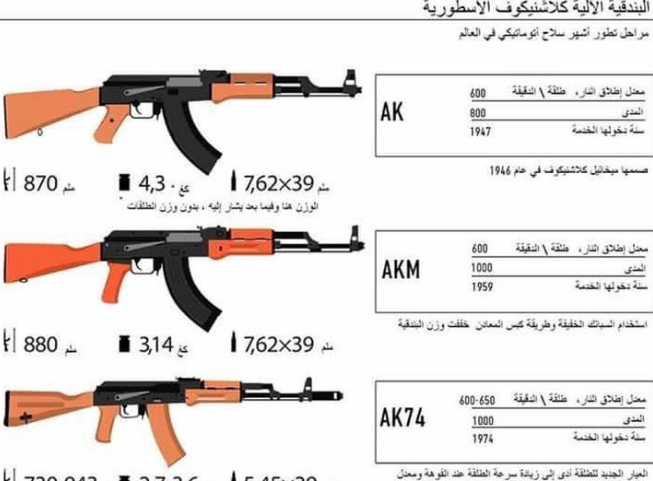
Earlier on Silah Report we showcased a number of Kalashnikov and small arms nomenclature and terminology charts in use by Iraqi small arms traders and enthusiasts. Since then we’ve gathered some more material, this time much more Kalashnikov centric. These charts continue to show perceptions of the rifles in use throughout the region and what is available. Although we have similar charts in the United States the unfortunate reality is that many of those charts are tailored to the Kalashnikov civilian market. By observing what Iraqis, Syrians, or Yemenis are concerned with identifying, we can gain a better perspective on what rifles are in the region that people want to know about.


Airsoft Accessorized to the Max!

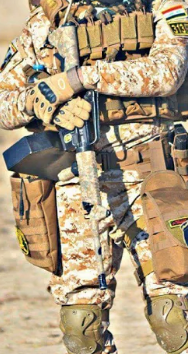
This photograph has been on the internet for awhile and appears to be depicting an Iraqi with an odd M249 SAW drum mounted around the STANAG magazine of his Airsoft M4 carbine. We doubt that this is a functioning 200 linked belt inside the drum that is being fed into the rifle and is most likely glued or taped to the magazine that is actually inserted.

Screen Shot 2017-04-22 at 9.03.19 PM.png

From the appearance of the soldier, it doesn’t look like a combatant, possibly not even an enlisted soldier in the Iraqi Army. Rather this might be an enthusiast that is “dressing up” the part. Although his equipment bears some resemblance to gear issued within the Iraqi Army, he is overloaded with equipment that isn’t standard issue. The rifle itself appears to be a U.S. civilian legal 16.5 inch barrel AR15 with a permanently attached carrying handle, he has what looks like Kalashnikov magazines in his pouches, his visor and helmet don’t look to be ballistically rated at all, and it looks like he has mounted a Kalashnikov bayonet over his right shoulder as well. Essentially, nothing matches!


UPDATE

Due to an ever watchful reader, we were able to identify several of the products pictured. The rifle is indeed an airsoft product, with an AEG magazine and an AWT Armor Warrior Tactical G4 Protection Helmet. Much thanks to Irfan!

Arabic Guides to Kalashnikov and Ammunition Nomenclature

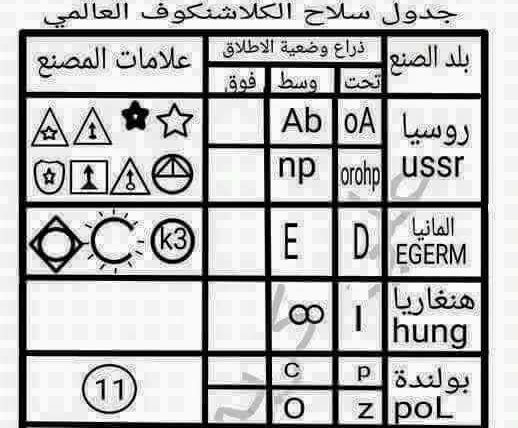
Much like in the United States Kalashnikov collector or enthusiast market, Iraqi Kalashnikov owners understand the differences in quality between AKs from different countries. The European ones take precedence over Chinese, and Russian variants when original remain supreme and commandeer a premium when it comes to cost.


These sets of markings are designating the country of origin stamps in addition to examples of serial number blocks.

While still maintaining the country origin markings, this chart explicitly shows the selector markings as well. Understanding and making sure all the markings add up is very important if a seller is to ensure the Kalashnikov he is purchasing is indeed genuine.

In addition to country of origin markings, these are guides in Arabic to ammunition markings and nomenclature. With the Iraqi flag imprinted in the graphics, the photographs appear to have been edited and translated by an Iraqi enthusiast.

WW II Small Arms in Libya

Although this these images are from a post that is several years old and on an Airsoft forum, the historical relevance is still very important to consider when examining small arms in the MENA region. These photographs came out during the massive unrest in Libya during and following the Libyan unrest otherwise known as “17 February” that overthrew long-time ruler Muammar Gaddafi. Although many of these small arms were actually used in fighting, the photographs appear to show a lull, where militia forces aren’t actually engaged but are rather conducting target practice or celebrating.

Two variants of the U.S. 1919 are shown, the first one appears to be a heavily modified 1919A4 variant, while the second one is a 1919A6. At first glance, these may appear to be 7.62x51mm NATO variants that Israel modified to use in the IDF during the 1950s and 1960s. However, a closer look at the belt of ammunition reveals the length of the rounds do appear to be .30-06 Spr and thus are most likely original manufacture 1919A4s and A6s.

libyanrebs15 libyanrebs07 libyanrebs06The photo below shows a Browning Hi Power, Sterling SMG, and a Caracano rifle in the background.
libyanrebs

The proceeding two photographs are of a Russian 7.62x54Rmm DP28 light machine gun. These might have arrived in Libya as a form of surplus support from the Soviet Union during the Cold War.

libyanrebs17
libyanrebs05

At an initial glance, this would appear to be a German 9x19mm MP40, but instead, due to the circular opening in the magazine well it is in fact, the predecessor to the MP40, the MP38.

libyanrebs10

This rifle appears to be a Mauser K98 with a broken stock that has been replaced

libyanrebs02

17 February Unrest Summary (Wikipedia)-

The first Libyan Civil War, also referred to as the Libyan Revolution[33] or 17 February Revolution,[34] was an armed conflict in 2011, in the North African country of Libya, fought between forces loyal to Colonel Muammar Gaddafi and those seeking to oust his government.[35][36] The war was preceded by protests in Zawiya on 8 August 2009, and finally ignited by protests in Benghazi beginning on Tuesday, 15 February 2011, which led to clashes with security forces that fired on the crowd.[37] The protests escalated into a rebellion that spread across the country,[38] with the forces opposing Gaddafi establishing an interim governing body, the National Transitional Council.

The United Nations Security Council passed an initial resolution on 26 February, freezing the assets of Gaddafi and his inner circle and restricting their travel, and referred the matter to the International Criminal Court for investigation.[39] In early March, Gaddafi’s forces rallied, pushed eastwards and re-took several coastal cities before reaching Benghazi. A further UN resolution authorised member states to establish and enforce a no-fly zone over Libya, and to use “all necessary measures” to prevent attacks on civilians.[40] The Gaddafi government then announced a ceasefire, but fighting continued.[41][42] Throughout the conflict, rebels rejected government offers of a ceasefire and efforts by the African Union to end the fighting because the plans set forth did not include the removal of Gaddafi.[43]
Iraq Spotlight: STG44 & MP40 Pair

Recently coming out of Baghdad are these images of a very well worn down German STG44 and what comparatively appears to be a less used 9x19mm MP40 submachine gun. There were not any close up photographs of the internals of the small arms so it is hard to ascertain what year in WWII either was made in.

16640661_1307580419322630_6634988205963306852_n 16649575_1307580435989295_4333584821653400111_n 16681784_1307580485989290_8186590511940828433_n 16807711_1307580285989310_6590856711305527722_n

STG44s have been reported in abundance in neighboring Syria, often arming Daesh troops in Raqqa. There is even an inside report on these rifles by a source in Syria from TFB. The largest issue with them is that 7.62x33mm Kurz is extremely hard to come by, although the rifles themselves are very plentiful and in like new condition.

Notice on the MP40 the grip sleeve. These are used on a number of handguns in Iraq and is actually an Airsoft import from China. They come in a number of colors, from green to tan, to black.

16830653_1307580562655949_2649343178168701307_n 16830913_1307580519322620_5621271676205644916_n

AR70s in Iraq

Images gained from Iraqi social media groups have indicated the transfer and usage of 5.56x45mm NATO Beretta AR70s. Specifically there has been one rifle spotted with the Shi’a Al-Abbas Brigade. The Al-Abbas Brigade was originally formed in Syria in 2012 but after heavy losses with Daesh moved to Iraq in 2014.

c4jfmovuoaa-ofj

Some of these AR70s appear to have been modified with Airsoft picatinny rail handgun systems to provide a picatinny interface. The Italian rifle never received an upgrade to a picatinny system having been replaced by Beretta’s ARX-160 instead. The rail in the title photograph looks to be a very common AR Airsoft rail coming out of China with the oval vents, very similar to many handguards from UTG. However the example below might be one of the Daniel Defense fakes with the 12 o’clock gas tube vents actually installed at the 6 o’clock position. Both examples show an M16A4 handguard mounted to a rail section that covers the top portion of the rifle, leading S.R. to believe that they might originate from the same source or small arms market.

c0gmajoviaebsn9

Safir AR Magazines in use by Peshmerga, Iran

Safir Arms is a Turkish firearms company that primarily produces .410 AR clones. However, the company debuted a 5.56x45mm NATO AR magazine in 2014 along with a bullpup rifle under the name T-14 that shared a number of AR components. The rifle never seemed to have advanced past a prototype stage, but the magazine design included was turned into a manufacturing run. Currently it is listed on the company’s website and in the catalog. The listed magazine and bullpup rifle appear below along with a modular adaption of an AR rifle.

t1816730509_959895579865_6921342533509956338_n screen-shot-2017-02-13-at-10-28-04-pm

Unlike similar polymer magazines such as Magpul’s Pmag and ProMag’s signature polymer magazine, the Safir Arms version has four columns along the side of the magazine, in addition to a ribbed portion that sits below the magazine well of an AR when inserted. Observe the differences in the photographs of the Magpul and Promag-

cola18-1-large images

However, recently the same magazine design has appeared in usage with certain Peshmerga forces, specifically security forces armed with NEA Arms PDWs in Kurdistan. In addition it also appeared in a recent Iranian defense weapons exposition in Tehran. Whether or not the magazine has been copied by the Iranians and being manufactured locally is unknown at this point in time.

With the Peshmerga in the ARES post-

7

And at the Iranian exposition-

screen-shot-2017-02-13-at-5-12-39-pm 991098-1000