Saudi Adds AK-103 to MIC Production Line Up

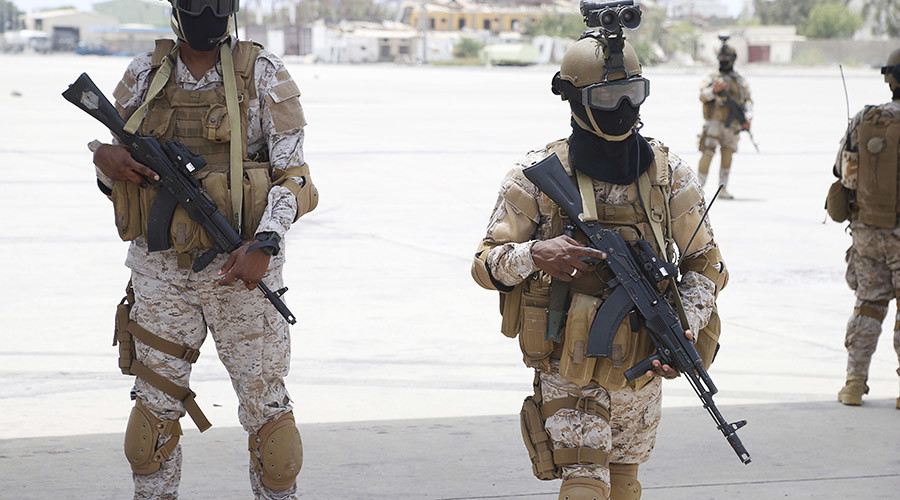
The Russian defense export company Rosoboronexport has recently announced within a larger agreement that the Saudi Arabian state owned Military Industries Corporation will soon be manufacturing 7.62x39mm AK-103 rifles in the Kingdom, along with ammunition. Saudi Arabian armed forces are already using the AK-103, along with the 5.56x45mm NATO G36K within the National Guard, but these are mostly imported from Russia itself. G36Ks have already been seeing local production for some time, many of which are ending up on arms markets in Yemen on the side of the Houthis. One of the main reasons for this move is possibly due to the cheaper cost of producing the rifles rather than buying them outright.

From the news report on Arab News-

Russia’s Rosoboronexport said it has struck an initial licensing agreement that could lead to the Kalashnikov being made in the Kingdom.
The agreement covers the “production of Kalashnikov AK-103 assault rifles and cartridges for various purposes,” a statement said.
A memorandum of understanding between the two sides could also see Russia supply Saudi Arabia with Kornet anti-tank guided missile systems, rocket launchers and automatic grenade launchers.
The preliminary deal also involves the transfer of knowledge in the defense field to Saudi Arabia. The Kingdom has set a target for half of its significant defense budget to be spent within the country.
This plan now includes the “localization” of the AK-103 assault rifle and its ammunition, according to the Saudi Press Agency.

Improvised Mauser Suppressor (OIF)

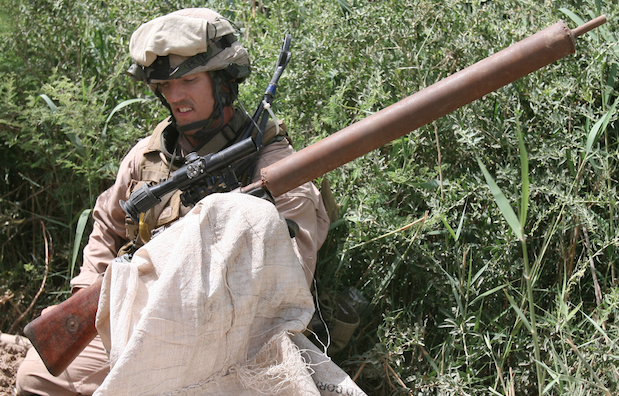
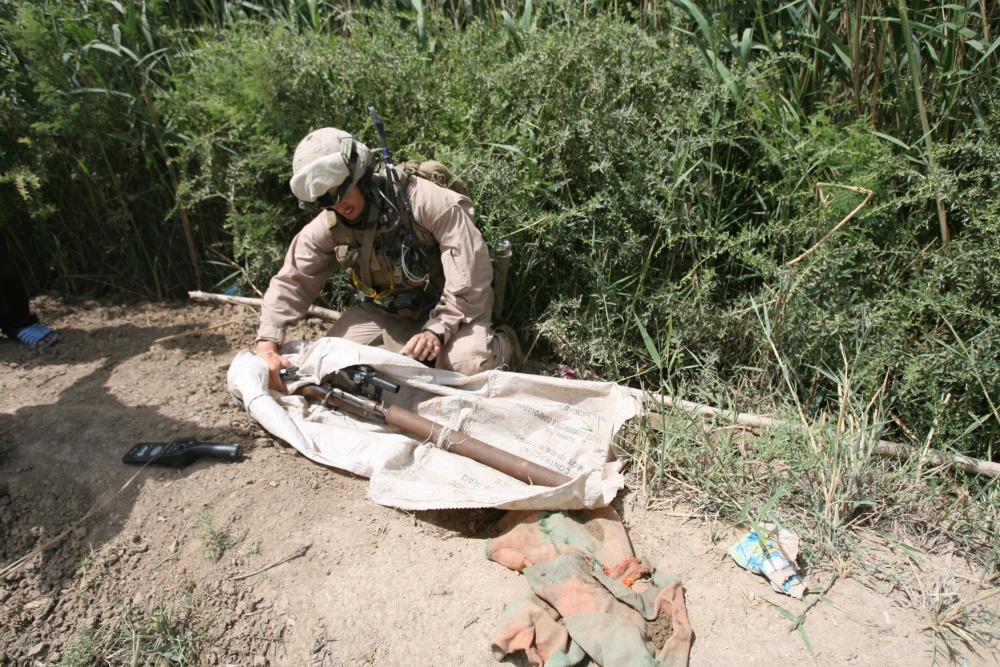
This photographs was posted on the U.S. Department of Defense Media Activity’s public domain website DVIDS along with another one featured on Silah Report. Both depict improvised suppressors captured by U.S. Infantrymen while on operations in Iraq.

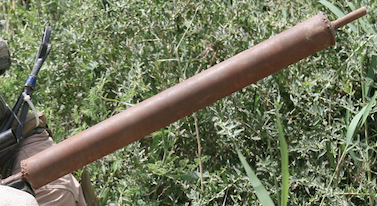
The rifle appears to be a Mauser 98K with the stock sawed off just past the chamber. Because of the proximity to Iran and the incredible amount of Iranian surplus found in Iraq, it would appear from conjecture that this rifle is a Persian Mauser, manufactured in the time of the Shah in the 1940s-50s, later being replaced by the M1 Garand through U.S. Foreign Military Sales programs in the 1960s. Unlike the previous M16A1 rifle we posted about, this improvised suppressor appears to have involved much more work, with a much larger diameter pipe being welded around the actual barrel of the rifle at both the front and rear of the pipe. There is a section of much smaller diameter pipe protruding from the main one, but this doesn’t appear to be the barrel.

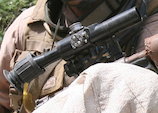
The scope mounted on this rifle is a Cold War era PSO-1 optic designed to mount on the optics rails usually riveted to the left side of a Kalashnikov or Dragunov receiver. It is unclear how this is mounted to the Mauser’s wood stock, unless an actual Warsaw Pact rail were somehow screwed into the wood stock itself.

Silah Report Has a New Look!

Silah Report recently undertook a massive transformation, moving servers, changing appearances, working out the new kinks. Because this website is personally run, all this had to take place between actual jobs and other commitments. But we hope you like the new appearance, it certainly is much more professional than the previous one.

We will also update the country database. Originally we intended the country database to be an all encompassing snapshot at the small arms history within a particular country. Although ideal in theory, in practice we found out that it was far too much work. Instead, what we want to do now is to maintain the individual country pages, but ONLY concentrate on small arms exported/imported in large quantities into a country, and small arms produced domestically, either under license or designed indigenously. Essentially we want to recreate what World.Guns.Ru, which is fantastically run by Maxim Popenker, but centered around small arms from the MENA and Central Asian region.

The goal of this database is to allow researchers and future writers to be able to reference back to it, so they can historically piece together how a particular small arm came into a country, or where it might have been bought from, and especially in what time period.

Krinkology: For Every Saudi, There is a Yemeni…

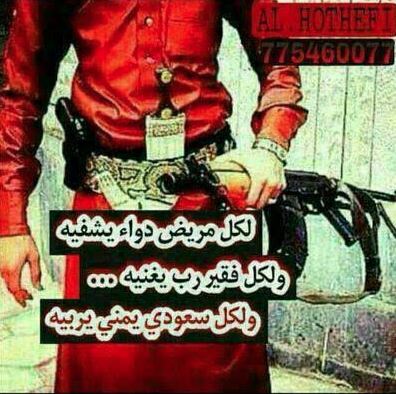
This image of a Yemeni Houthi, armed with a Zastava 7.62x39mm M92, what appears to be a Makarov, and a traditional Jambiya knife tucked into his belt has made numerous waves throughout Houthi social media over the previous several months. The rifle has a more or less standard Kalashnikov pattern sling, and as the stock unfolded.

The photograph itself of the man dressed in red has been circulated with a number of sayings attached to it as a sort of meme, some religious, but most appear to be Yemeni nationalist slogans. For example, in this iteration-

Translated from Arabic, this reads-

For every sick person, there is a cure

For every poor person, there is a God to make him rich

For every Saudi, there is a Yemeni to teach him how to behave

This version from a Twitter user–

Many of the photographs are being spread through the use of Instagram, with the different sayings attached to the pictures.

This one from Imgrum-


Krinkology is a unique SR post that exemplifies what the site stands for, in discussing the indigenous manufacture, trade, and use of small arms and light weapons within the MENA and Central Eurasian regions. Specifically, Krinkology examines the usage of short barrel Kalashnikov pattern rifles within popular culture and on the battlefield.

Analysis of Taliban Firing Positions in OEF

Due to the efforts of ISAF forces during Operation Enduring Freedom, Taliban fighters had to change their tactics constantly to stay tactically ahead of coalition efforts. Because of the reliance on fire support assets and modern armament that much of ISAF could afford, the Taliban in Helmand and Kandahar provinces couldn’t sustain a protracted fight as they could against ANA or AUP positions. Thus the insurgent force had to adapt and overcome. One of the ways in which they employed small arms against ISAF forces was through their usage of compounds and firing positions. Being in Helmand or Kandahar, firing from an open position or fields is almost certainly suicide against ISAF forces because of the lack of egress routes and being cut down. Thus, many Taliban fighters adopted the technique of utilizing “murder holes” as firing positions from compounds. Most of these compounds were taken over from the families that owned them, often threatening them with death if they spoke to coalition forces about the compound’s usage.

Compound/housing structures in rural southern Afghanistan have a number of advantages for maneuver insurgent warfare. Because the walls are made from mud, they can have holes busted through them to use as firing ports, but at the same time can be extremely resistant to incoming rounds, even up to .50 BMG. These compound walls can be anywhere from six feet to twelve feet in height and easily conceal the numerous motorcycles that the Taliban used. Motorcycles are essential for the kind of “shoot n’ scoot”maneuver warfare because of the ease of transportation and the possibility of swiftly getting away from lumbering  MRAPs and MAT-Vs along twisting narrow roads. In addition, a single PKM machine gun team could be concealed and broken up among three or five motorcycle driving Talibs. One carrying the receiver, another the barrel, another the ammunition. This way, all three could move to a new firing location discreetly, and most importantly separately.

The Taliban’s worst threat was being fixed in place and destroyed. The force knew that it could not sustain a long drawn out, small arms fight even against a single ISAF patrol. Once their position has become known, the key to surviving a protracted fight is to quickly pick up, mount up, and push to another firing position to further engage the patrol, preferably from a completely different angle than the first one. The problems thus presented to the ISAF patrol were twofold. One the one hand, it would be very difficult to determine the source of the fire, especially if it was from a PKM beyond 400-600 meters. And second, even if the Taliban location was found and positive identification was made, the patrol would have to maneuver around to get into a position to return accurate rifle and light machine gun fire, by which time the PKM position would already be broken down, and repositioned at a completely different angle to the patrol. This entire scenario is also not even taking into account the IED threat that complex ambushes would often be initiated with, thereby adding another layer of complexity to the mix of that ISAF patrol maneuvering.

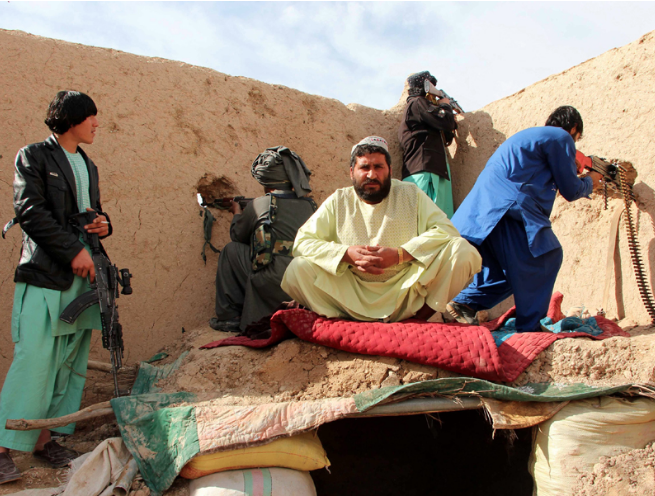
Firing positions themselves are very well thought out. As an example in the title photograph, typically Talib fighters will use a pre-existing “murder hole” or they will create one themselves as the other photograph shows. Using blankets, they will place them underneath the PKM, and then on the base of the murder hole as well. This way, the ground blanket will catch all the spent shells, and the murder hole blanket will prevent the PKM from leaving black residue on the caked mud. When the MG team leaves the position, all they have to do is wrap up the blanket with shells in it, then use the murder hole blanket to conceal the PKM parts in it and the firing position will appear to have been relatively unoccupied even if an ISAF patrol were to literally get to it after a firefight.

And to conclude this analysis, this a Talib fighter wearing a Marine Corps woodland digital utility jacket!

Note- The title photograph of the firing position is actually of Government ALP fighters, and not Taliban fighters. This photograph was used because it does display what the TTPs that the Taliban utilize. 
Sudanese AR10 in the wild, Yemen edition

This photograph was recently found on social media and features a local Yemeni man posing with an 7.62x51mm NATO AR10 next to his friend with what appears to be a modified 7.62x39mm RPK (due to the compensator) mounted with a 45 round magazine. The AR10 in question appears to be one of the largest contracts that Armlite produced of AR10s, which was the Sudanese contract of approximately 2500 rifles in the 1950s. This inference is taken from the proximity of Sudan to Yemen, so it must be stated that this is only a guess as to it’s origins and not a complete conclusion. If we could have seen the rear sight, that would remove all doubt, depending on whether or not the graduations are in Arabic numerals.

This is a little bit about it from Wikipedia-

Firearms historians have separated AR-10 production under the A.I. license into at least three basic identifiable versions, along with various sporting, carbine, and other experimental designs and calibers. The three main variants have been termed the Sudanese model, the Transitional, and the Portuguese model AR-10. A.I. built all of these rifles, beginning with the Sudanese model AR-10. The Sudanese version derives its name from the sale of approximately 2,500 AR-10 rifles of to the government of Sudan in 1958. The Sudanese model was equipped with a very lightweight, fluted steel barrel fitted with a trim, prong-style flash suppressor, a bayonet lug, lightweight fiberglass furniture, and sight graduations in Arabic.[21][22] The Sudanese model weighed only 3.3 kg (7.3 lb) with an empty magazine.[21] The price, including cleaning kit and four magazines, was US $225 per rifle.[23] All AR-10s, whether produced by ArmaLite or by A.I., used the same Stoner-designed 20-round lightweight aluminum ‘waffle’ magazine with pressed-in, corrugated sides, intended to be discarded in combat once emptied.[24]

This particular rifle appears to be in excellent condition considering that it is most likely 60 years old and has existed in a very rough part of the world when it comes to firearms care and maintenance. The young man looks to have affixed a canvas sling to the rifle, in addition to embedding a circular metal piece in the stock, also wrapping something around the buttstock by the rear sight and charging handle.

Weight 3.29–4.05 kg (7.25–8.9 lb) w/o magazine
Length 1,050 mm (41.3 in)
Barrel length 528 mm (20.8 in)

Cartridge 7.62×51mm NATO

.308 Winchester

Action Gas-operated, rotating bolt
Rate of fire 700 rounds/min
Muzzle velocity 820 m/s (2,690 ft/s)
Effective firing range 600m/656yd (ca 700m/765 1/2yds with A.I. 3.6× telescopic sight)
Feed system 20-round detachable box magazine
Sights Adjustable aperture rear sight, fixed post front sight


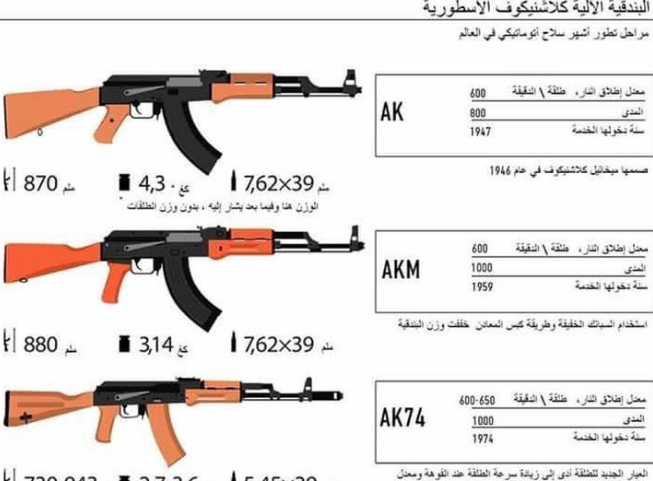
More Kalashnikov Nomenclature Charts In Arabic

Earlier on Silah Report we showcased a number of Kalashnikov and small arms nomenclature and terminology charts in use by Iraqi small arms traders and enthusiasts. Since then we’ve gathered some more material, this time much more Kalashnikov centric. These charts continue to show perceptions of the rifles in use throughout the region and what is available. Although we have similar charts in the United States the unfortunate reality is that many of those charts are tailored to the Kalashnikov civilian market. By observing what Iraqis, Syrians, or Yemenis are concerned with identifying, we can gain a better perspective on what rifles are in the region that people want to know about.


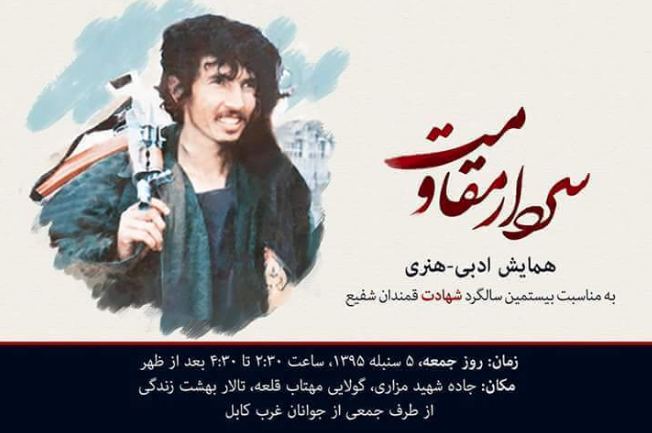
Commander Shafi’s AKSU

Earlier we covered the significance of the AKSU in the hands of Rashid Dustom’s security detail, and especially with one of his favored guards. In this example, we have another case of the AKSU being utilized as a status symbol. These photographs are a memorial to Hazara Commander Shafi who was commemorated and memorialized between 2:30 and 4:30 in the afternoon, Friday, Sombole 5 1395 After Hijra (subsequently after Jummah Prayer that day as well). This would be August 26, 2016 in the Gregorian year. The photo above is advertising that the venue would be in West Kabul along an address on Martyer’s Road. The occasion is that it is the 20 year anniversary of his death in what would appear to be 1996. Very little information is available on the English internet but from the date of his death in 1996, of the year of the Taliban taking over Kabul, this commander was possibly killed while fighting the Taliban. Thus, in a post-OEF setting, it would appear to make sense that Hazaras would be celebrating the life of a famous Hazara who was fighting the ideologically same Islamic Emirate of Afghanistan that exists today.

From the original Dari-

به مناسبت بیستمین سالگرد شهادت

زمان: روز جمعه، ۵ سنبله ۱۳۹۵، ساعت ۲:۳۰ تا ۴:۳۰ بعد از ظهر

مکان: جاده شهید مزاری، گولایی مهتاب قلعه، تالار بهشت زندگی از طرف جمعی از جوانان غرب کابل

Similar with Dustom and Osama bin Laden, the symbolism of the AKSU (note especially the 45 round magazine) with this commander is especially evident through the photograph chosen to represent his life at an anniversary of his death. There might be multiple photographs taken of him but yet this one, with an AKSU was chosen. We don’t know when this was taken, but we are taking a chance that it might be after the Soviet withdraw due to the fact that many of the major players fighting each other in the 1990s were lower level commanders in the 1980s with the exception of such examples of Massoud and Hekmatyar of course. Note that this commander could have just had easily carried an AKMS that fits a similar profile of the AKSU but he didn’t.


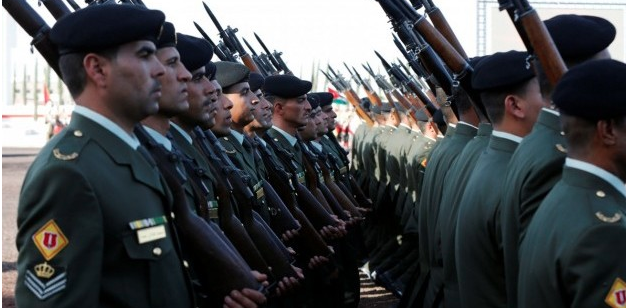
M1 Garands in Jordanian National Parade

Although not recent (Summer 2016), M1 Garands were plentiful at a parade put on by the Royal Jordanian Armed Forces in honor of King Abdullah II. Among numerous small arms used in the ceremony were M1 Garands (among a contingent of SMLEs) in use by both marchers and cavalry. Obviously, these rifles have been downgraded to a ceremonial status in recent times but they are indicative of an era in which the Jordanians actually used M1s as frontline rifles. How they got there could either be through a Foreign Military Sales purchase from the United States, or it could have been surplus Greek M1s as well. Notice that most of the marchers have their M1s mounted with their bayonets as well.

arab legion1229200_900

This image is from Getty Images, showing Jordanian troops armed with M1s in previous years.

Screen Shot 2017-04-26 at 9.43.26 PM

Airsoft Accessorized to the Max!

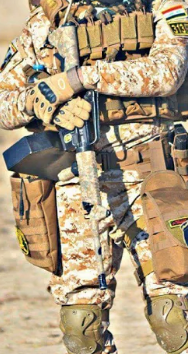
This photograph has been on the internet for awhile and appears to be depicting an Iraqi with an odd M249 SAW drum mounted around the STANAG magazine of his Airsoft M4 carbine. We doubt that this is a functioning 200 linked belt inside the drum that is being fed into the rifle and is most likely glued or taped to the magazine that is actually inserted.

Screen Shot 2017-04-22 at 9.03.19 PM.png

From the appearance of the soldier, it doesn’t look like a combatant, possibly not even an enlisted soldier in the Iraqi Army. Rather this might be an enthusiast that is “dressing up” the part. Although his equipment bears some resemblance to gear issued within the Iraqi Army, he is overloaded with equipment that isn’t standard issue. The rifle itself appears to be a U.S. civilian legal 16.5 inch barrel AR15 with a permanently attached carrying handle, he has what looks like Kalashnikov magazines in his pouches, his visor and helmet don’t look to be ballistically rated at all, and it looks like he has mounted a Kalashnikov bayonet over his right shoulder as well. Essentially, nothing matches!


UPDATE

Due to an ever watchful reader, we were able to identify several of the products pictured. The rifle is indeed an airsoft product, with an AEG magazine and an AWT Armor Warrior Tactical G4 Protection Helmet. Much thanks to Irfan!