SR is Interviewed by Popular Front Podcast!

Recently Silah Report had the honor of being an interviewee on the Podcast ran by the journalist Jake Hanrahan, otherwise known as Popular Front. The episode is entitled “Tracking Guns Across the World with Silah Report” and is available for download on iTunes, Soundcloud, and Spotify for any readers who are interested in listening in.

We talked about the scope of Silah Report’s research and article content, most of which will have been very familiar to any reader of our blog. For example, we covered the presence of Sudanese contract AR10s in Yemen, the encroachment of Beretta ARX160s in Central Asia and M1 Garands present in Iran (original TFB work). We covered some other topics as well, but I’ll let readers listen in to hear the rest.

At Silah Report we’re very thankful for the opportunity to be present on the Podcast, and are proud of the small community of writers and readers that believe in what we find fascinating and interesting. Thank you.

Keeping it Quiet Part 3: Common Platforms, Designs, and Ammunition

Keeping it Quiet is a series of articles by the Twitter account Everest65. First published on the webpage Calibre Obscura, he has been extremely generous in allowing Silah Report to republish his findings here. Content has been lightly edited. Be sure to look for the rest of the series as it becomes published.

Pistol Caliber Suppression

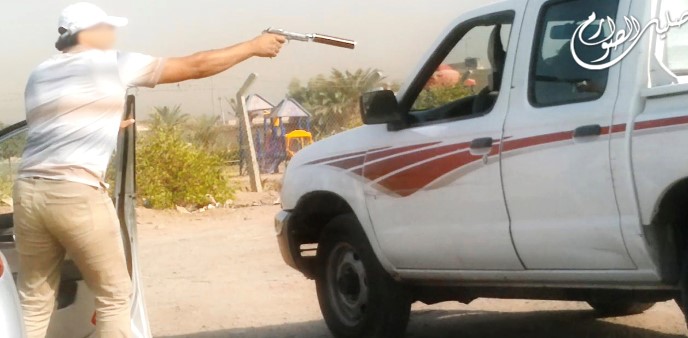
The blowback action of many PPK/Makarov type pistols is liable to be caused issues by suppression (Particularly with weaker calibers, which may lack the power to always successfully cycle with the suppressor attached). This can be observed in this video and above, in which one Terrorist clearly is encountering issues with the action cycling. These cheap and common pistols, which may well be eastern bloc clones, seem to get the job done, however there are a variety of issues why a pistol (In particular cheaper pistols and weaker cartridges) may not cycle- this including but not limited to:

  • Addding the extra weight to the barrel by screwing on a suppressor interfering with the gun’s ability to properly cycle the action after each shot- this can be experienced with browning tilting barrel design pistols- a great explainer over at The Firearm Blog, such as the Glock 19 often used by ISIS.
  • The suppressor requiring a lighter recoil spring in order to cycle the action- the suppressor reduces the recoil of the round, meaning the pistol can fail to cycle.
  • Inconsistent/weak ammunition also causing the above issue.

These issues can be solved via the use of a Muzzle booster (Also known as a Nielsen device), which typically come with a commercial suppressors in order to ensure correct operation of the pistol. This means also that the pistol does not require a change of recoil spring to use unsuppressed.

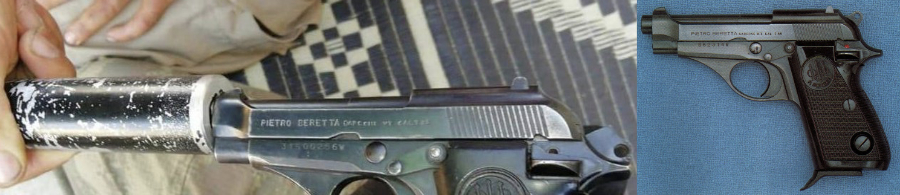
The by far most popular pistol family that I have observed being suppressed is Beretta. Including the 85FS, 70, M1935/1934, and M1951, the latter being by far the most commonly suppressed pistol- appearing in almost 40% of the occurences of suppressed pistols I have catalogued. This 9×19 pistol is extremely common in both Iraq and Syria due to the production of it by the Saddam regime from 1981-2003 (Production restarted from 2009 also, it continues today) and is known as the Tariq for Iraqi-production models. It’s currently in service with the Iraqi Police and other Iraqi forces. The M1951 was also produced in Egypt as the Helwan, and was imported by Libya. It carries 8 rounds of 9×19 ammunition, and is easily confused with a Beretta 92 (Or M9) but is actually its predecessor in terms of design.

Beretta_M1951Left Image: Tariq Pistol captured by HTS from ISIS, Idlib, July 2017.

Right Image: Credit- Bob Adams NM

This is very commonplace in general, so is naturally more likely to be used as a suppressor host.

Another pistol with a very similar operation to the Beretta M1951 is the Beretta 85, a more compact pistol than the M1951.

Beretta_85FSLeft Image: Beretta 85FS (May be 84 or similar, but closest match is 85FS) in use by the YPG to assasinate TFSA (Turkish-Free Syrian Army) militant in Jindires, Syria. 24 June 2018

Right Image: Chromed Beretta 85FS, .380 ACP, Commerical Sale in the United States

The Model 70 series is smaller again. It is chambered in .32 ACP, again uses the falling locking block design and is famously popular amongst intelligence agencies such as the Mossad, though I have only seen it used once in Syria- by the YPG. This example may be a 70, 70S or 71, meaning that it could be chamberd in .22 LR, .32 ACP, or .380 ACP. This pistol is likely the to be the quieter suppressed compared to 9x19mm Pistols.

Beretta_Model_70Left Image: Turkish Army and FSA arrested an YPG member who was carrying a Model 70 with suppressor. Afrin, Syria, July 2018. This was evidently for covert operations by the YPG.

Right Images: Beretta Model 70 Example- .32 ACP

Libya_Dec_2015(For Sale on Illicit Arms Sales Group on Facebook, Libya. December 2015. .380 ACP or .32 ACP- Beretta M1935/1934. This suppressor may be commercial production.)

It’s easy to mistake all of these pistols on first glance to the Beretta 92 (Made famous as the M9), but curiously I have yet to see any examples of these being suppressed by any party in Iraq, Syria, Yemen or Libya. One of the key advantages of these Berettas are their falling locking block operation- this results in much much less barrel movement compared to pistols such as the Glock 19, Ruger P95 (Both seen in Iraq) pistols with browning tilt-barrel designs – that need a booster or light recoil spring to cycle effectively as mentioned above.

The design of the suppressors used by ISIS Baghdad is detailed by two arabic-language videos from ISIS Baghdad in 2015, which shows some impressive craftsmanship with suppressors that resemble western supppressors such as those from Silencerco or AAC. We can see an Glock 19 in use- many thousands of these flooded Iraq after the Iraqi Police/Army was supplied them, and users promptly sold them on. A 2007 estimate gives 80,000lost, a number which is sure to have risen since.

Glock_19_23Left to right: Manufacturing the suppresor baffle, spraying the suppressor tube, and testing it. There is a noticable volume decrease.

The manufacturing abilities of ISIS are evidently mature, which any observer would know from their existing arms manufacture (Mortars, Rocket Launchers, RPG-7 clones etc.) Here’s an image of the internals of the AAC Ti-Rant 9MM, which appear similar to this ISIS design:

Ti-Rant

Glock_19_Baffle
Left 3 Images: A comparison of ISIS K baffle design
Other Images: Images of various pistol calibre K baffle designs from American commercial manufacturers

They have separate removeable baffles (Stacked as opposed to a monolithic core) that are machined using a metal lathe and certainly appear to be of high quality. These “K baffles” are regarded as harder to manufacture than a monolithic core.

The monolithic core is one solid piece of metal which has had sections machined out of it or sometimes created through casting. The stacked baffles are a series of individually created baffles which are stacked together to create the core. From a manufacturing standpoint, the monolithic core is much easier to create from time and materials. It is simply a matter of programming the design into a CNC machine then setting the machine to begin cutting the pieces of metal into the core. The stacked baffles take a little more precision, supplies, and labor. The baffles must be perfect to ensure that they are aligned straight to avoid baffle strikes, plus the baffles must almost lock into place together to keep them from moving and messing up the alignment. The second difference involves the length of the silencer in comparison to the amount of decibel reduction; “silencer efficacy”. A stacked baffle design can more effectively work the gases and therefore can make a quieter silencer with less length. The increased surface area of the stacked baffle design also helps to pull the heat out of the gases faster which also aids in reduced decibels.

Dakotasilencer.com, Monolithic Core Baffles vs Stacked Baffles

The manufacturing process for the K baffles is very similar to this video on YouTube:

This suppressor design is also modular, as an very similar design is shown and used on an MP5A3, a rare gun in ISIS hands. This Submachine gun fires at a rate of 800 rounds per minute, and is a highly formidable close quarters weapon.

Firing_MP5-1Note ejection of 9×19 casing
Muzzle_CapNote custom muzzle cap/device. This gives the appearance of an integrally suppressed to MP5 to a degree, but this model is standard.
In_OperationThe suppressed MP5A3 in action. This full auto spray put at least 10 rounds in a very short time into the side of the car in the first image. It then crashes.

Specifications given for this suppressor are identical to the Glock one, which is conceivable, but we cannot tell if the device for the Glock contains a Muzzle Booster (SMGs and Rifles don’t require one), but the diagram spotted on the wall in one section of the MP5 Video may contain a sketch of one, as well as dimensions for baffles and the suppressor itself.

hu2w-C2B.jpg-large

I’m currently trying to translate this rough draft and dimensions given into a detailed diagram of this ISIS-designed suppressor- any assistance on this would be very helpful, please contact me on Twitter if you think you recognise the parts/or read the writing.

The Video also gives some dimensions of this suppressor, whilst also allowing other observations:

  • Outside diameter is given as 38mm, inside diameter of the muzzle is given as 9mm (This must probably higher, as an exact 9mm diameter hole wouldn’t allow the .355 bullet to exit cleanly), and the length is 20cm.
  • They claim it was designed and manufactured by their mechanical workshop of Wilayat Baghdad and that tt was manufactured with “high precision” and the manufacturing division used “computers and other advanced mechanisms” in their work.
  • The size of the silencers are in line with international standards
  • The silencer can be used for a long time (Claims to be forever, though all silencers wear) and doesn’t break down easily.
  • The normal 3 lug mounting device on the MP5A3 has been removed and replaced with a new mounting system, which appears to be a threaded end welded to a end cap. This would allow using both suppressors on either weapon system, assuming a thread similar to 1/2X28. However, a possible muzzle booster would have to be removed or vice versa for interchangeable use.

There isn’t any current public data I can find regarding the manufacture of threaded barrels for any weapon that IS employs, but it would be well within their capabilites. It’s also possible that ISIS have a source for a threaded barrels for the Glock 19, as by default supplied to the Iraqi Police these did not have a threaded barrel, which disallows attachment of a suppressor. This also applies to the Beretta models shown in use, though it is entirely likely that there has been Syrian regime (Or Iraqi) leakage of suppressor ready pistols (And suppressors themselves), given the sheer amount of Ghanimah captured by IS over time. ISIS suppressors share a fairly consistent design in ISIS hands in Syria and Iraq, varying only in size, showing some level of standardisation and skill across their areas of operation.

A Second Variant?

Yemeni and Libyan examples vary in size and design details- here’s an image of a PPK Captured from ISIS in Libya with what appears to a cup style suppressor adaptor (With no suppressor visible) welded to the barrel:

Libya_PPK_CapWalther PPK in .32ACP Captured in ISIS houses along with FN FAL & AK rifles, huge quantity of ammo, Benghazi, Libya, August 2015.

Circled is what seems to be a screw hole- I think this is for mounting of suppressors- a different method than the ISIS Baghdad one above, but one that is simpler and requires less machining. In the below screenshots of a video from Yemen, a screw is shown:

Yemen_Close-1

The assasins hold the suppressor, which is not something that’s recommend or required with commerical suppressors. We also don’t see this with IS Iraq. If the mounting solution is inferior, then this can be explained, or this may just be a variation of training or typical practice of their fighters in Yemen. This below image seems similar, yet lacks the screw:

More_Workbench_Silencers_2An alternate design- From “More More Workbench Silencers – George Hollenback”

They seem to function reliably, or reliably enough to usually run through a whole magazine for the purposes of an covert assassination of a single target (Or multiple unresisting ones, which can be seen in the 2012 video mentioned above). After all, at the tactical level, if multiple rounds are being fired in quick succession, the militant is in a firefight, which these pistols and suppressors are not meant for- as opposed to their use on Rifles, though both are used for sudden covert attacks.

Rifle Calibre Suppression

My conversations with Abu Salman Belarus (A Malhama-linked Twitter account) has confirmed various details- That Malhama produce these suppressors themselves and they are indeed standardised, that these suppressors screw straight onto the rifle- meaning the muzzle break is removedand that they have at least 2 individuals (Some kind of workshop/engineering division) that manufacture these suppressors that aren’t fighters.

Whilst Western Forces have very stringent requirements for construction and durability of these devices, groups such as HTS, who are using indigenously produced versions in every recent image or video I have seen so far of them putting suppressors to use, would be able to fabricate and replace as desired.

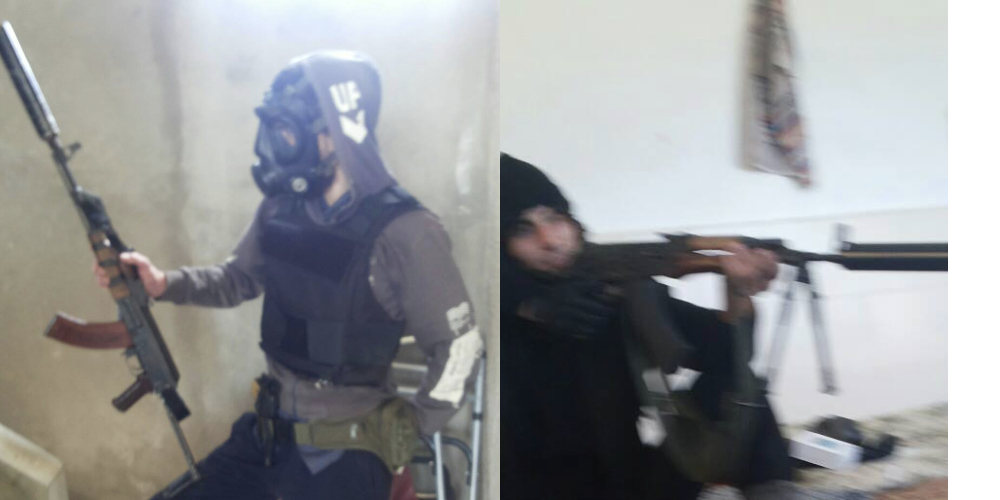
These designs are similar in external appearance to modern russian (Zenitco) suppressors and western designs. Whilst suppressors are far from generally issued (Standard equipment being essentially an AK variant, mag pouches, and some form of uniform with some body armour usage) HTS and affiliates’ Inghimasi units have used suppressors in attacks on regime positions on a number of occasions, as shown by the images in this piece.

There is also sporadic examples of Rebel suppressor use, manufacture and sale. This is again reflective of the overall trend in the theatre, but these examples do not seem to be as standardised as those shown by ISIS etc.
Keeping it Quiet Part 2: HTS, Malhama Tactical & Rebel Groups

Keeping it Quiet is a series of articles by the Twitter account Everest65. First published on the webpage Calibre Obscura, he has been extremely generous in allowing Silah Report to republish his findings here. Content has been lightly edited. Be sure to look for the rest of the series as it becomes published.

In contrast to ISIS, The most publicly visual use of suppressed long guns by non-state groups in Syria has mainly been by HTS and their semi-affiliate/trainer/self-titled PMC Malhama Tactical, though ISIS has also used suppressors more sparsely.

Malhama Tactical is the infamous “Jihadi Blackwater“, and have a liking for applying Western/Russian SOF style, equipment and accessories, although their abilities, as assessed by Miles at The Firearm Blog, do not at all meet the standard of SOF, whilst generally superior to Irregular Opposition Forces and Conscripts. They are also fond of suppressors, and have shown videos of them using them in operations and training. This has also imbued into HTS- a Malhama-linked Twitter Account has proclaimed HTS militants seen using suppressors in a surprise attack in Latakia as “students”:

Ganzz@GanzzzH

Malhama Tactical?

Abu Salman Belarus@SalmanBelorus

This is our students, not our strike team, we are working now to recover our assault team, very soon inshaaLlah, now we are teaching brothers. Malhama Tactical.

It seems that these groups have recognized the tactical benefits of use of suppressors on the battlefield, particularly in attacks and ambushes, and retain a somewhat standardized design for AK platform suppressors. This again is a reflection of current increasing trends in Western and Russian Forces to issue suppressors more widely- the Marine Corps publicly testing silencing every weapon of a battalion. It doesn’t seem that every fighter from Malhama carries suppressors also, which may indicate simple personal preference- this obviously somewhat dilutes the tactical benefits of suppressions if some in the squad are running unsuppressed.

The below 3 images and video show a small squad of HTS attacking Syrian regime troops in Latakia, and every member is using standardized suppressors, AK-74Ms and optics.

HTS_Raid

HTS_Raid2

HTS_Raid3

(Hay’at Tahrir al-Sham footage of a recent storming attack on a Syrian Ba’th regime artillery position in Jabal al-Turkman, Latakia governorate)

JaN_AKMS(Jabhat al Nusra (Later HTS) Canadian Fighter in Syria, with tripod and large suppressor. Rifle is a AKMS)

(Alwiya al-Furqan fighter identified as Abu Adam testing an AKMS with a self-manufactured silencer. Quneitra, October 2013. Similar design to the above JaN suppressor)

HTS_Bashkuy_Syria

HTS_Bashkuy_Syria2(HTS, Bashkuy, Syria. Storming regime fortifications.AK-74M, AKM, MPi-KMS-72, AK-74. Suppressors are camo wrapped.)

At least 2 of the fighters involved in the above attack were later killed and their weapons seized:

View image on TwitterView image on TwitterView image on Twitter

Syria Free News@Syria_FreeNews

killed the well-equipped militants of Jabhat al- which attacked their positions in the province of

Below are confirmed appearances of suppressors in the hands of Malhama Tactical.

group_shot(Syria, March 2017. Note M16A4 and a Steyr AUG unsuppressed. Rifle on the left is an AK-74, On right is an AKM. Note the overall optics and equipment attempting to mirror Western/Russian SOF.)

Malhama1

(Steyr Aug, Near Aleppo, Syria. 2016)

Malhama_2017

Malhama_ak74(Syria, 2016-2017. Same design as suppressors above. Training footage.)

This use of a suppressor by the YPG in Afrin on July 5 2018 as part of their campaign against the Turkish-FSA forces in that areas is unique, in that this is the first time I’ve seen the YPG use a PBS-1 Suppressor, likely on an AK variant- as the weapons used are referred to as sniper rifles this possibly a Tabuk, a “Dragunov-Lite” DMR that is based on the AK platform (Zastava M72 in particular). It has an open sight hood and the suppressor doesn’t look like a TGP-V (For Dragunov), but rather a PBS-1, a well known Soviet suppressor for 7.62×39.

The shot also seems rather loud, but the PBS-1 is at the lower end of volume reduction (AK platforms tend to suppress worse than the M16 family anyway, due to the different gas system and looser tolerances), at about 15 dB according to Wikipedia/US Testing. Modern western commercial suppressors are closer to 30 db. This is the only clearly military or commercial origin suppressor that I have seen in use by non-government actors in Syria or Iraq.

YPG_Afrin

Keeping it Quiet Part 1: Suppressor Use by ISIS, Al Qaeda in Iraq

Keeping it Quiet is a series of articles by the Twitter account Everest65. First published on the webpage Calibre Obscura, he has been extremely generous in allowing Silah Report to republish his findings here. Content has been lightly edited. Be sure to look for the rest of the series as it becomes published.

Amongst various militant groups in the Middle East there is a sporadic yet noteworthy use of suppressors used on firearms. I’ve been tracking this and have found that suppressors, also known as silencers or moderators, have been used by Hayat Tahir al-Sham (HTS), Islamic State (ISIS), People’s Protection Units (YPG), and some other groups. This has lead to some interesting conclusions from my observations. Whilst there doesn’t seem to be a great dearth of video or still imagery of suppressor use by any major rebel group in Syria, in this article I’ll be looking at analyzing some of them.

ISIS & AQ in Iraq

One of the most shocking videos of AQ in Iraq in the Summer of 2012 was a disguised night-time raid, which Long War Journal details:

The al Qaeda fighters are then issued uniforms that are worn by SWAT teams in the Iraqi National Police. Later that night, the militants, disguised as police commandos, get in the pickup trucks, some which have heavy machine guns mounted in the bed. Lights flashing, the al Qaeda fighters cruise the desert highways before they hit their targets: police barracks, checkpoints, and two senior Iraqi police commanders.

The Iraqi policemen appear to be stunned by the raids and comply with the al Qaeda operatives, clearly believing them to be INP commandos. The al Qaeda fighters flex-cuff the policemen, drag them outside of their positions, and line them up on the ground. The insurgents then walk down the line, and coldly shoot the policemen in the head with silenced pistols.

Whereas this raid did stand out to me because it was published online, there is evidence to suggest that this insurgent tactic was used much earlier- an article from The Guardian mentions waves of bomb and “silenced pistol” attacks across Baghdad, taking advantage of the disarray caused by the widespread issues in the 2010 election. A Senior Iraqi officer, Brigadier General Abdel-Hussein al-Kadhoumi, was killed by gunmen with suppressed pistols in May 2009. We know this tactic generally isn’t rare-with Canadian Artillery Engineer Gerald Bull being killed by suspected Iraqi or Israeli Hit Team with 5 .32 ACP bullets shot into his neck and back by a suppressed weapon- most likely to be a Beretta Model 70- another example being the unfortunate case of Laurence Foley, an American Diplomat killed in Jordan by men working on behalf of AQ in Iraq using a suppressed .32 ACP pistol in 2002. Without going over the history of use of small calibre suppressed pistols by intelligence agencies over time (Hint: It’s out of the scope of this article), it’s safe to say that this tactic is a common and oft-used one, the events quoted above being nowhere near rare. This is touched on in this excellent 2008 post from the Jamestown Foundation on Insurgent use of suppressed pistols. It refers to “7mm Pistols” which we can assume refers to 7.65mm Browning, or 32 ACP.

Here’s a two (cropped) images from the video that show the suppressed pistols in use:

2012_1

1: A pistol in use.

2:The same pistol, having failed to cycle, having the slide pulled back to re-cock

The size of these handguns appears to show a steel-framed pistol that seems to resemble a Walther PPK or derivative, of which cheap Interarms Clones are apparently popular. This video also gives an estimation of the volume reduction offered by a commercial suppressor- the Stealth Engineering Group “Jefferson”. In this case, this pistol could be chambered in .22lr, .32ACP or .380, all of which can be successfully suppressed:

Below are some examples of suppressed handguns in the hands of ISIS, ISIS derivatives and others being used for covert ops and assassinations, a task for which a suppressor, rudimentary & homemade it may be, would certainly assist with the destabilization of the security situation of the state the group is fighting. Also included are ones for sale, captured etc.

yemen_aug16
yemen_aug16_cycling(ISIS, Yemen, August 2016, Assassination of a Yemeni Colonel in Aden. This shows the pistol cycling)

ISIS_nov_2012-2(November 2012, then ISI, Now ISIS. Note chromed pistol- possible officer or ceremonial model- and civilian dress with lack of beard)

Desu_Dogg(ISIS, Syria, April 2015. .32 ACP Walther PPK.)

ISIS_North_Bagdad_2016-17(2017, ISIS, North Bagdad. Note successful cycling of pistol. I have obscured victim’s faces.)

Glock_19_Early(2012-13, ISIS, Iraq. Glock 19 is in use. Green laser is attached to M16, off-screen)

ISIS_Aleppo_2014(ISIS, Aleppo, Syria. Feb 2014. Pistol is PPK clone in .380 ACP or 32 ACP with Interarms import/export markings on it.)

ISIS employs rifle suppressors in seemingly a more limited role, as opposed to their common use on pistols mentioned above. The group appears, as part of its strategy of using long/accurate 5.56mm platforms in the DMR Role, to embrace suppressors to assist in the concealability and survivability of its close range and urban sniper squads. POI Shift (The shift of the bullet when a suppressor is installed) would be naturally less of an issue at shorter ranges.

M16_Iraq(Iraq, December 2016. M16A4 used in close fighting)

ISIS_Fallujah_June2016(Fallujah, Iraq, June 2016. Short Suppressor on AK type rifle. Direct Thread Mount. This shorter type would naturally be louder.)

Dragunov(Raqqa, Syria. July/Aug 2017. Rifle is SVD Dragunov used in DMR role, notice painted/sprayed camo and spotter)

ISIS_Raqqa_2017_Urban_1

ISIS_Raqqa_2017_Urban_2

ISIS_Raqqa_2017_Urban_3(In the midst of Urban Fighting against SDF, Raqqa, 2017. Note Steyr AUG used in close range role, Glock 19 as sidearm, and tape-wrapped M16A4 on spotter.)

It’s interesting to note that the Chechen sniper is using a suppressor wrap very similar to a product such as a SilencerCo Suppressor Cover:

SilencerCo_Suppressor_Cover

This wrap has a variety of uses- concealment/camouflage, ease of quick removal (Protects against burns), and also mitigating the “mirage affect” from repeated firing- as the rifle is used, the suppressor gathers a lot of heat. This heat begins to rise off of the suppressor and creates a mirage- this mirage can obstruct the users’ view making it almost impossible to see the target. In the hot conditions of Iraq and Syria this would be made worse.

Below is an interesting case-an improvised 12.7mm or 14.5mm anti-material rifle in use by ISIS (A fairly common phenomenon), but with a very large suppressor:

12.7_ISIS(Raqqa, Syria. July/Aug 2017)
The Muscat Martini: Martini Pattern Rifles in Oman

This guest article is written by Christopher Cowan, an avid reader and supporter of Silah Report.

Alongside Brown Bess muskets and Lee-Enfield pattern rifles, Martini pattern rifles are perhaps one of the most iconic and ubiquitous guns of the British Empire. First fielded in the 1870s, the Martini-Henry saw service in all corners of the Empire, from the plains of the Serengeti to the peaks of the Hindu Kush.

The Martini-Henry Rifle. Photo courtesy Creative Commons.


A single shot rifle, the Martini Henry utilizes a falling block action. It is chambered in the rather burly .577/.455 Martini Henry, a .45 caliber round-nosed slug fitted into a necked-down .577 Snider casing. The Martini Metford and Martini Enfield were the natural progression of the platform. Both firearms utilize the same falling block action, merely rechambered and/or rebarreled in .303 British. By the time they were fielded in the mid 1880s, they were of little practical use to frontline combat units given the adoption of the magazine-fed Lee-Metford (1).

That said, both the Martini Metford and Martini Enfield saw continued use among local colonial forces, as well as by civilians as sporting rifles (2). Perhaps owing to its proliferation, reliability, and simplicity, Martini-pattern rifles existed long past their official retirement as a service rifle. Widely manufactured and traded across the Middle East and South Asia for a good deal of the 20t h century, these rifles saw usage among irregular fighters as late as the Soviet invasion of Afghanistan. While likely the last time Martini-pattern rifles saw any serious usage in armed conflict, examples continue to turn up on occasion (3).

The proliferation of Martini-pattern rifles throughout South Asia is a subject for another article if not a book. Beyond Afghanistan and Pakistan, Martini-pattern rifles have remained prolific in the Sultanate of Oman. Martinis are as common a sight in souvenir shops in Muscat’s Sooq Mutrah as they are for sale alongside other assumedly functional firearms in Nizwa Sooq.

Martin-pattern rifles for sale alongside other firearms in Nizwa Sooq, Nizwa, Oman. Note modifications to the rifle in all three photos, including the polished receiver and refinished stock and handguard of the latter example. Photos by author.

Given Oman’s history, the widespread presence of the Martini-pattern rifles is understandable. Oman has historically occupied a major crossroads of Indian Ocean trade; at one point the Omani Empire itself stretched from Zanzibar off the coast of modern-day Tanzania to Gwadar, modern-day Pakistan. At the center of this empire was Muscat. Even following decline in imperial power and prestige, Muscat remained an important center for trade well into the early 20t h Century. Trade in all manner of goods, including weapons, was largely unrestricted; Muscat subsequently grew into a major regional hub for arms trading at the turn of the century (4).

While the early Twentieth Century marked a high-point in the proliferation of Martini-pattern rifles in the Arabian Peninsula as well as South Asia, Martinis remained popular weapons in Oman until rather recently. There are cases of them being used to hunt the now-protected Arabian Oryx in the 1960s, as well as documented cases of their use by irregular fighters in the Dhofar War during the 1960s and 1970s (5).

Al Wahibi Bedu man with his Martini-pattern rifle. Note the ornate barrel bands as well as the khanjar – or dagger – affixed to his belt. From “Bedouin: Nomads of the Desert” by Alan Keohane.

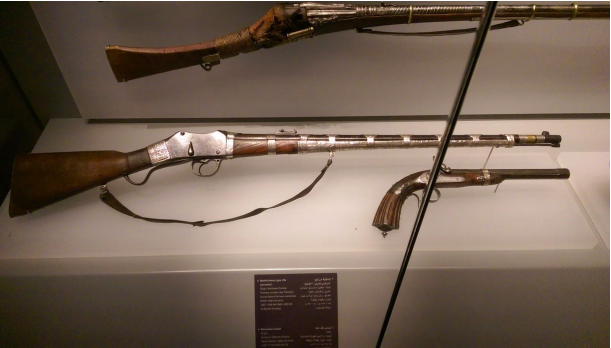
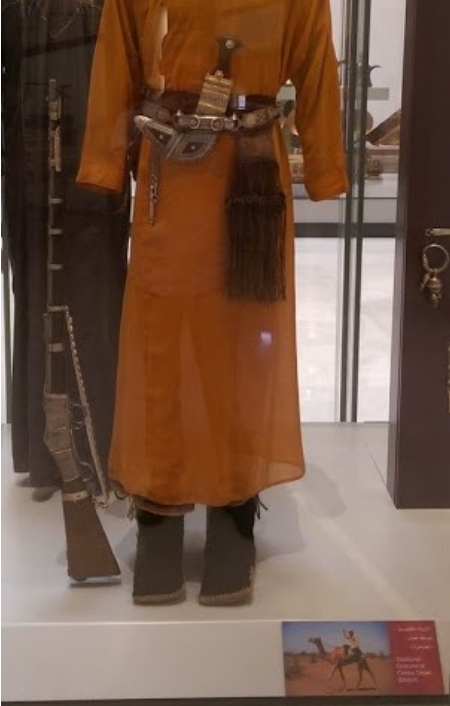
To this day, it is possible to occasionally see Martini-pattern rifles toted for ceremonial as well as practical purposes. In Dhofar, for example, shepherds can be observed carrying Martini-pattern rifles to protect their animals from predators. As a ceremonial piece ornately decorated Martinis are a commonplace, as are their accompanying cartridge belts. Both are often highly decorated, and frequently observed for sale to tourists. Good examples of both can also be observed in the National Museum in Muscat.

Examples of Martini-pattern rifles and cartridge belts at the National Museum in Muscat, Oman. Photos by author.

Despite being outdated by modern firearms technological and doctrinal standards, the Martini-pattern rifle has persisted long past its official military retirement in both a practical and cultural capacity. There just as much to be said of the simple elegance of the design as there is the skill required to use one effectively. Likewise, the continued prominence of the Martini-pattern rifle in Arabian firearms-culture alongside other weapons speaks to the eminence of the rifle.

Various examples of Martini-pattern rifles and cartridge belts at the National Museum in Muscat – including alongside the traditional garb of central Oman. Photos by author.

Sources

(1) Rifles and Machine Guns
(2) Rifles and Machine Guns
(3) https://atwar.blogs.nytimes.com/2010/12/10/rifles-of-advanced-age-remain-in-use-in-afghanistan/

(4) R.M. Burrell 10; Arming the Periphery 116 5 Oryx Martini; 9781780969053

Works Cited

Burrell, Robert M. “Arms and Afghans in Makrān: an episode in Anglo-Persian relations 1905–1912.” Bulletin of the school of oriental and African Studies 49, no. 1 (1986): 8-24.

Cashner, Bob. The FN FAL Battle Rifle. Botley, Oxford: Osprey Publishing, 2013.

Chew, Emrys. “3: The Arms Trade in the Western Indian Ocean.” In Arming the Periphery: The Arms Trade in the Indian Ocean during the Age of Global Empire, 98-159. Basingstoke (GB): Palgrave Macmillan, 2012.

Chivers, C.J. “One Way to Retire an Old Rifle.” The New York Times. December 10, 2010. Accessed June 02, 2018.

https://atwar.blogs.nytimes.com/2010/12/10/rifles-of-advanced-age-remain-in-use-in-afg hanistan/.

F, Nathaniel. “Jumping The Gun (Literally): Saudis Dancing With Guns.” The Firearm Blog. August 12, 2015. Accessed June 02, 2018. http://www.thefirearmblog.com/blog/2015/08/12/jumping-the-gun-literally-saudis-dancin g-with-guns/.

Fowler, Will, and Patrick Sweeney. The World Encyclopedia of Rifles and Machine Guns. London: Anness Publishing, 2007.

Keohane, Alan. Bedouin: nomads of the desert. Trafalgar Square, 1994.

Leung, Canice. “Jumping the Gun | Pictures.” Reuters. August 11, 2015. Accessed June 02, 2018. https://uk.reuters.com/news/picture/jumping-the-gun-idUKRTX1NTN7.

Loyd, M. “The Arabian oryx jn Muscat and Oman.” African Journal of Ecology 3, no. 1 (1965): 124-127.

The Voice of the Gun in Central Asia

This guest post was written by Marcello Fantoni, an avid reader and supporter of Silah Report.

“The question is not about the weapon, but the spirit in which you use it.”(1)

For those raised within the dichotomous paradigm of Westphalian war and peace, war is the end of sociability, the exhaustion of every social recourse. Likewise, when that war is over, and sociability is said to return the memories of fracture become encased in temporal and Cartesian distinctions, the material culture of conflict sequestered to the appropriate sterile cases in the vaults of armouries and museums. Yet, conflict is inherently and inescapably sociological (2). It is the birth of a new form of sociability, on the level of both the individual and the collective, and this is a relationship in which the material culture of conflict retains an agency beyond the moment of fighting itself. It is not a relic but becomes the assurance against repeat and symbolic of the new addition to the cultural history and citrisis of a society. We have seen time, and again that material culture is good for thinking, feeling and expression, even eating and drinking (3), but we must, however, remember that it is also for fighting.

Conflict and the conceptualising, organisation and negotiation of it are shaped by the society which engages in it, and the community itself in is turn influenced by it. Conflict and its material culture become inexorable parts of the society’s post-conflict identity, having a fundamental impact on the ordering of the post-conflict reality (4). In this change, the material culture which provided the means to act for the individual attains a symbolic position. It may bestow both a new social life and physical death. Through the analysis of how specific weapons have come to be identified with cultures and the role of conflict in that culture, we shall see that those weapons are far more than the nefarious amalgamations of elements, but intrinsic parts in the development, manipulation and organisation of a society from both the emic and etic perspective. The thick sociological (5) description of the tools which both create and destroy sociability. The voice of the gun.

In Central Asia and the Caucuses, firearms have become ingrained in the identity of societies, for many as a response to the years of oppression under successive regimes, but also as part of customary law and social differentiation. But, the adoption of these weapons also reflects the rebirth of an often constructed martial tradition and ideology which often idealises of a fictive golden historical age as a central rallying point for future conflicts. Military traditions are written deep into their histories, and those histories are contained in the weapons which come to symbolise them. In Chechnya and Dagestan, the APS Stechkin machine-pistol has replaced the Shalt Kama traditional dagger and is illustrative of the independence movements of the 1990s and early 2000s as a high-status prestige item linked to the presidential guard of Dudayev and Maskhadov. But, its concealability also reflects the banditry which was born of those same conflicts. For the ethnocultural group of the Cossacks, the traditional Nagaika whip now serves side by side the AK-74M as their identity as an irregular military force is becoming ever more tied to their exploitation as the Russian State’s ready supply of disposable mercenaries and the new Tsar’s enforcers (6). For the cultures of the Northwest Frontier, the AK-74SU and Glock pistols as prestige pieces have usurped the venerable Enfields and Jezails, reflecting both the recent history of the region since 1979 and the preferences of FATA’s ever more discerning customers. Yet, constants remain, the Kukri of the Gurkha and the Kirpan of the Sikhs. Though, for both the colonial manipulation of the, as a “martial race” was born of their use of the 1856 Enfield rifle, which set them apart from the bulk of the British Indian Army who revolted in 1857 over the rumour that the bullets were lubricated with the fat of pigs and cows. Abhorrent to Muslims and high-caste Hindus, but not to the Gurkha and Sikhs.

Through the analysis of the social function and conceptualisation of weapons and those who use them within Central Asian and Caucasian societies, we shall see how they have become inexorably linked to both the past and present of a culture and how it is viewed internally and externally.

Marcello Fantoni can be reached at Marcello.p.a.fantoni@gmail.com

Sources

______________________

(1) Thoreau, H. D. 1860. The Echos of Harper’s Ferry.

(2) Richards, P. 2005  (ed) No Peace, No War: An Anthropology of Contemporary Armed Conflicts. Oxford: James Currey.

(3) Douglas, M. and Isherwood, M. 1979. ‘the world of goods’. London: Allen Lane.

(4) Hallpike, C. R. 1973 Functionalist interpretations of primitive warfare, Man (n.s.) 8/3, 451-70

(5) Geertz, C. 1973. ‘The interpretation of cultures’. New York: Basic Books.

(6) RFE/RL. 2018. Cossack Fighter Laments Russian ‘Utilization’ Of Mercenaries In Syria. https://www.rferl.org/a/syria-Russian-mercenaries-cossack-shabayev–interview/29056934.html. Retrieved 03/05/18.

Suggested Readings.

•    Jersild, A. 2002. Orientalism and empire, North Caucasus Mountain Peoples and the Georgian Frontier, 1845-1917.  McGill-Queen’s University Press.

•    Bourgois, P & Scheper-Hughes, N (2004) ‘Introduction: Making Sense of Violence.’ In Scheper-Hughes, N & Bourgois, P (eds) Violence in War and Peace: An Anthology. (Oxford, Blackwell, 2004)

•    Lee. E. W. 20110. Warfare and culture in world history. New York University Press.

A German DWM Luger in Helmand Province

This guest post was written by Jeffrey Reardon, an avid reader and supporter of Silah Report. 

In the past one hundred and eighty years, Afghanistan has been the target of multiple foreign invasions. From the British, (1839-1842, 1878-1880 and 1919) Soviet (1979-1989) and United States (2001-Present) involvement in Afghanistan. As such, we have a unique opportunity to see the small arms of yesterday back in action. Let’s look at one such example today. 

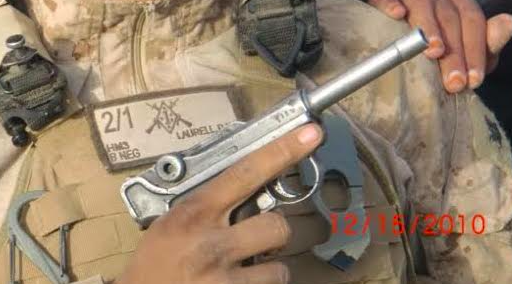
An American Marine of personal acquaintance was assigned to a Police Mentor Team (PMT) apart of 2nd Battalion, 1st Marines. These units were responsible for mentoring and training the Afghan National Police (ANP). The PMT duty consisted of patrolling to different ANP checkpoints. The PMT would spend a few days at each checkpoint then move on to thier next scheduled checkpoint. This Marine also happened to be an avid military surplus collector. This assignment would give him many opportunities to meet new people and see a myriad of Curio and Relics (C&R) in Afghanistan. In 2010, while in Garmsir, Helmand Province, Afghanistan, that’s exactly what happened to this Marine.

While on patrol with the ANP unit, this Marine noticed the unmistakable silhouette, of a Luger pistol that one of the ANP members was carrying. Naturally, the Marine was curious and just had to have a look at this interesting piece of military history.

In this picture, we can clearly make out the DWM rollstamp. The Deutsche Waffen- and Munitionsfabriken (German weapons and ammunition factories) was created in 1896 by, Ludwig Loewe & Company. They combined their weapons and ammunition facilities under one company. Simultaneously, Loewe transferred all shares it owned in other weapons producing companies to the newly formed DWM. These included, lesser know production facilities along with the Waffenfabrik Mauser and Fabrique National(FN). This pistols date is a little obscure in the picture. However, I was told this example is dated 1916. Just during WWI, from 1914-1918, there were approximately 2,000,000 Luger pistols made.

In this picture, another Marine poses with Luger. Here, we can see clearly see the front sight is missing. We can only guess as to what happened and how long it’s been missing. This goes along with my theory that this particular Luger is more if a badge of honour and sign if rank. Although, it would certainty get the job done in close quarters. Not having a front sight at all will put you at a disadvantage for the Marine Corps 25 meter pistol qualification.

As evident by the pictures, there is absolutely nothing left of the original finish. Which would have been a very beautiful and high gloss blue oxide on the major components. With small pieces such as the trigger and takedown lever being strawed. This process turns the metal a soft, golden colour which closely matches that of dried hay or, “straw.” In all actuality, this is exactly what one would expect. After all, it is almost a century old. Very easily a veteran of two world wars and countless other conflicts. It’s current location in southern Afghanistan, with its frequent sand storms, certainly does not help.

The Marine function tested the pistol. On a Luger, this is accomplished by grabbing the top of the toggle link and pulling up. With an empty magazine in place,  the slide will stay fully locked back in then open position. I was assured that it is in operable condition. Although, the Marine did not test fire it. 

There are, by this point, more than a few things I’m curious about. One question I would love to know the answer to is, to know if the ANP had the holster and spare magazine? If he didn’t, what was he using for a holster? If he wasn’t in possession of the spare magazine, was he worried about the lack of capacity? 

I was told that the ANP officer was very proud of his pistol. He made it known that he was not at all interested in selling it. I often wonder, by what route did that pistol get to Afghanistan? How did that ANP officer acquire it? 

Sadly, we will never know the answers to these questions.  We can only be happy that our beloved military surplus small arms are still serviceable after all this time.

*Special thanks and photo credit to Timothy Arndt

70 Firearms Stolen from Kabul Police Station

A report on Television One has revealed that 70 firearms and a number of cameras capable of operating at night (possibly meaning infrared capabilities) have been stolen from a central Police armory in Kabul. The article inferred that the firearms were possibly being smuggled to Pakistan but this isn’t known as of yet.

From Television One–

منابع خبرداده اند که هفتاد میل جنگ افزار از یک ذخیرگاه مهمات پولیس در کابل دزدی شده است.

منابع امنیتی که نخواستند نام شان فاش شود از دزدی شدن هفتاد میل جنگ افزار و سه دوربین در ذخیرگاه های مهمات پولیس در کابل خبر داده اند.

این جنگ افزارها شامل تفنگچه ها و دوربین های شب بین بوده که از یک بخش حمایوی پولیس در کابل دزدی شده است.

بر بنیاد گفته های منابع، چندین تن از سوی وزارت داخله در پیوند به این رویداد بازداشت شده اند.

با وجود تلاش های زیاد وزارت امور داخله نخواست در این باره ابراز نظر کند، اما یک مقام وزارت داخله به تلویزیون یک این موضوع را تایید کرده گفت، بررسی ها درباره این موضوع جریان دارد.

Firearms being stolen from a central police repository is somewhat alarming, especially that observing that it has happened the day before Now-Ruz, or the Persian New Year. There is the possibility that maybe the theft was to supply a possible attack in the upcoming festivities but this is most likely not the case as the firearms stolen were mostly handguns. This is most likely a case of lax regulations right before the holiday and an insider taking advantage of them. Similar to many other attacks and thefts within the Afghan government, this was most likely an inside job possibly helped by a corrupt official.

Taliban Raid on Afghan Militia Post Reveals Modern Small Arms Inventory

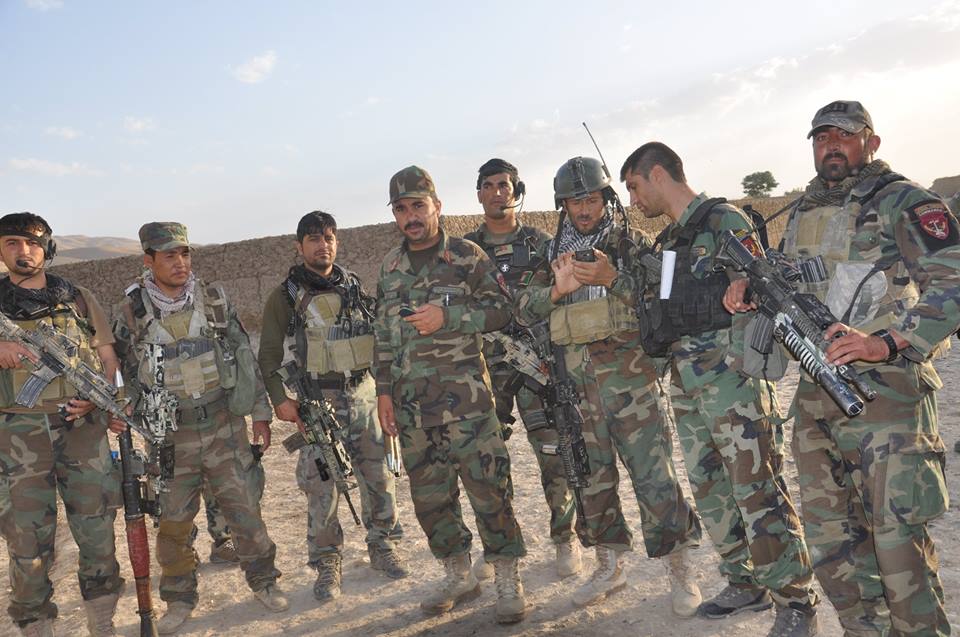
Recently disclosed photographs supplied to Silah Report have suggested that the local GoIRA supported militias are armed with more than the standard Kalashnikov self-loading rifles often seen throughout the country. One example of these forces is the Afghan Local Police, or ALP. Although these forces are seen as cost-effective, many local Afghans compare them to the days of the War Lords that roamed the country in the Civil War.

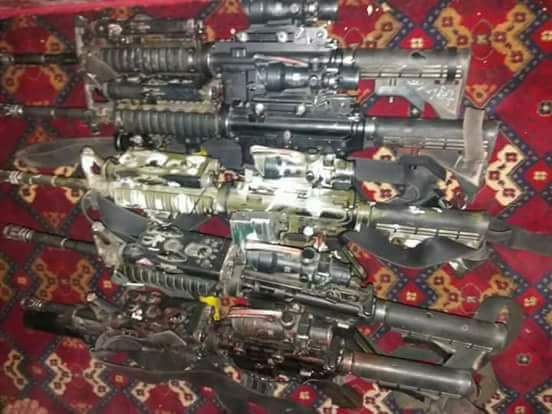
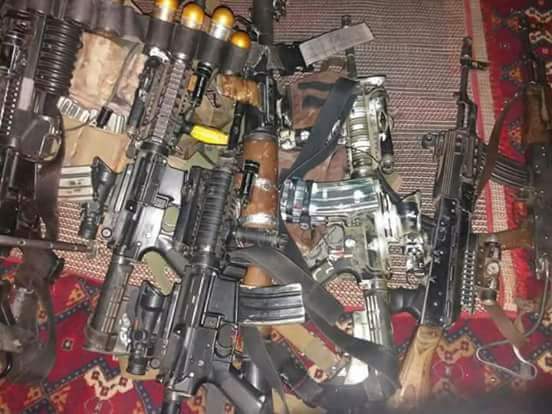
The photograph below depicts five 5.56x45mm NATO M4-patterned carbines in configurations that are identical to that of the ANA Commandos. This includes the AN/PEQ-2 TPIAL mounted at the 12 o’clock position on the Picatinny rail, the Trijicon 4x RCO day optic, the MaTech BUIS, and even the spray painted rifle in the center. Also present is a 40x46mm NATO M203 UBGL mounted to the carbine at the bottom. Notice on the painted carbine the coupled STANAG magazine inverted from a usual “rounds up” position.

As indicated by this photograph, a small arms inventory such as this is consistent with what the ANSF Commandos are generally issued.

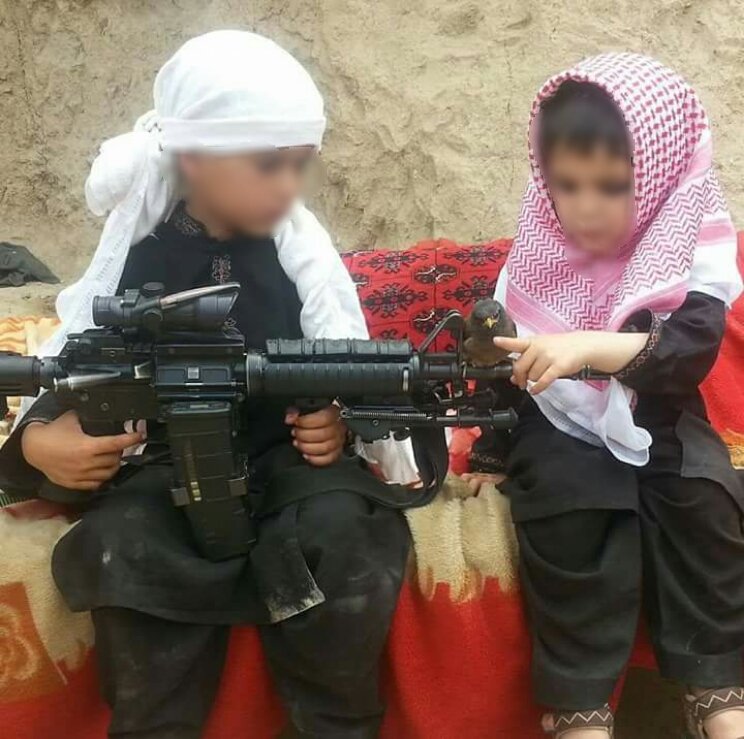
This photograph was provided by the same source and features a similar magazine coupling technique as illustrated above. What appear to be UTG rail covers and what is most likely a Harris bipod copy appear to be third party modifications from the standard issue. Myna Bird perched on the 6-inch barrel comes unissued.

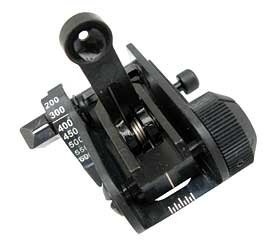
MaTech BUIS as in use.

However in this angle present are Streamlight TLR Picatinny mounted weapon lights, in addition to Kalashnikov patterned rifles, which are rarely in use by ANSF Commandos, if at all. Although rare, there are some TLRs that have been spotted among the group.

Although contextual information about the photographs are scare, a source has suggested that the militia checkpoints are perhaps funded by a shadow entity with a large supply budget. Such as the “Kandahar Strike Force” that was indeed set up by the CIA. In Afghanistan, this is immediately assumed to be the “CIA”, but until we have further information, we cannot venture more into the origins of these carbines.

Weapons and Ammunition Seized in Ghouta by the Syrian Army

Weapons and Ammunition Seized by Syrian Army (6)

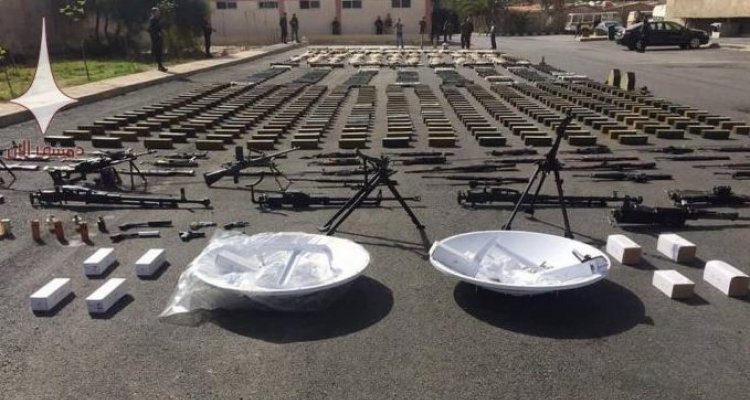
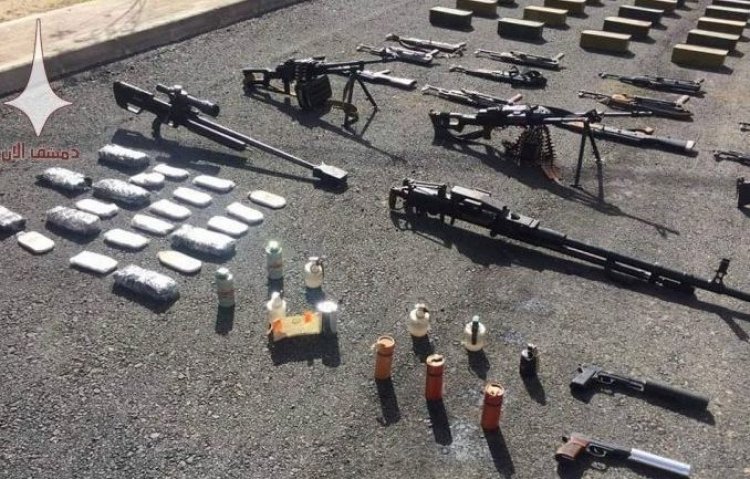
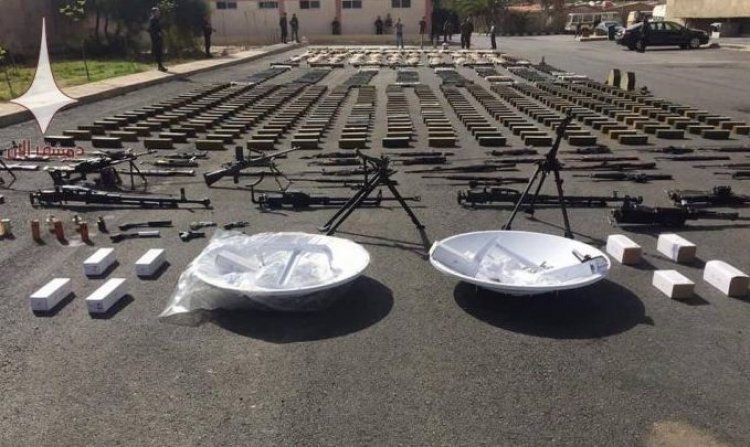
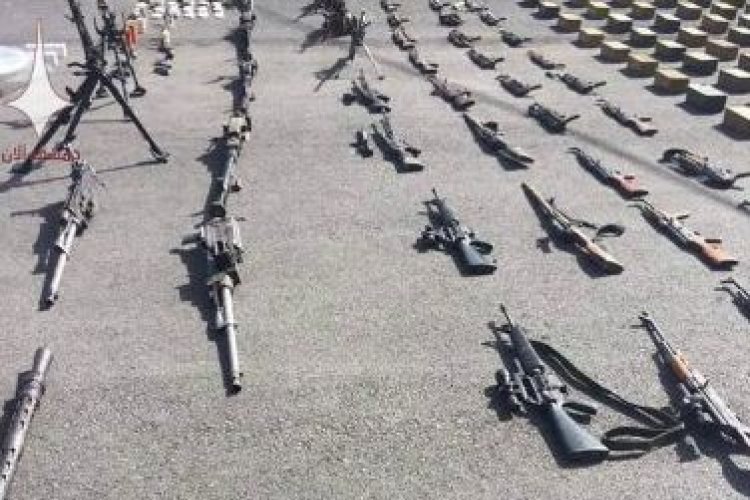
Recently, a number of news agencies reported that Syrian Army has seized a truck carrying a variety of weapons and ammunition addressed to one of the forces opposing the Syrian government. Reportedly, the truck was heading from eastern Qalamoun to East Ghouta. Let’s take a look at the photos of the seized weapons and see what types of small arms we can spot there.

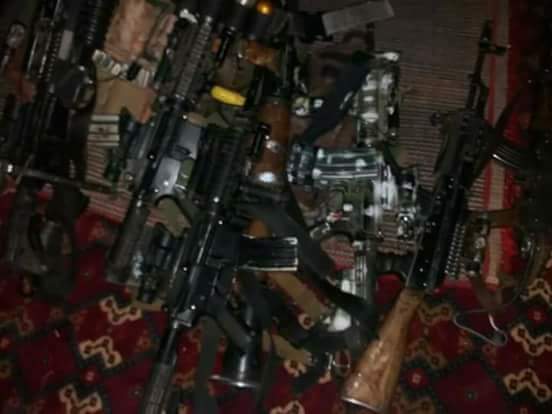
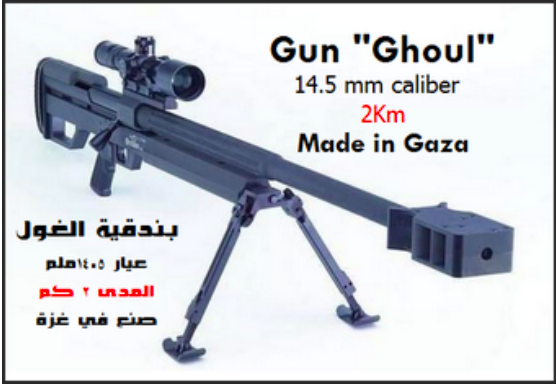
In the image below you can clearly see two PKM machine guns, a number of AK rifles and what looks to be a DShK heavy machine gun. Interestingly, there are two suppressed pistols one of which has a bright nickel colored suppressor. It should simply lack a finish which may indicate that it is a “homemade” suppressor. Arguably the most interesting piece in this picture is the scoped anti-materiel rifle. It is extremely similar to Steyr HS-50. It is also possible that this rifle is an Iranian copy of HS-50 called Sayyad or Palestinian copy called Ghoul. The Ghoul rifle is chambered in a larger caliber – 14.5x114mm. The Firearm Blog has recently published an article telling about the Ghoul anti-materiel rifle.

Weapons and Ammunition Seized by Syrian Army (1)

Weapons and Ammunition Seized by Syrian Army Ghoul
Palestinian Ghoul anti-materiel rifle

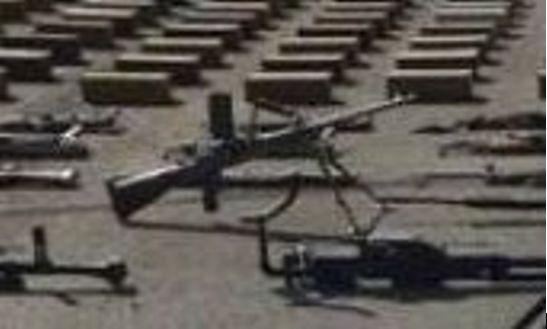
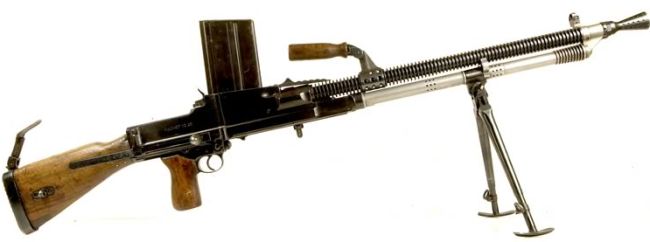
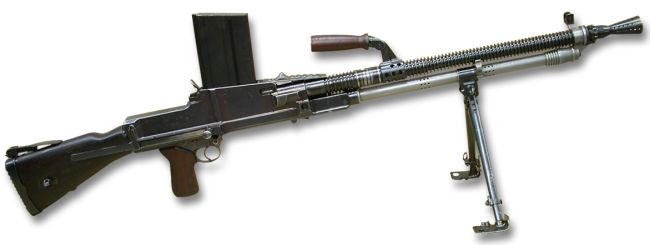
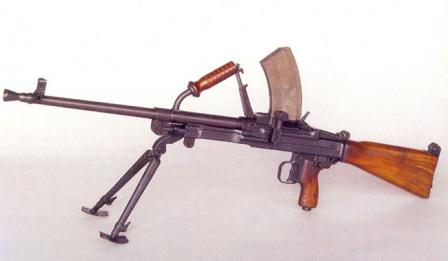
In another picture taken at a different angle, we see the silhouette of what looks to be a Czech ZB vz. 26 or ZB vz. 30 or Vz. 52 (Vz. 52/57) light machine gun.

Weapons and Ammunition Seized by Syrian Army (4)

Weapons and Ammunition Seized by Syrian Army (7)

Weapons and Ammunition Seized by Syrian Army ZB-26
ZB vz. 26
Weapons and Ammunition Seized by Syrian Army ZB-30
ZB vz. 30
Vz 52/57
Vz. 52/57

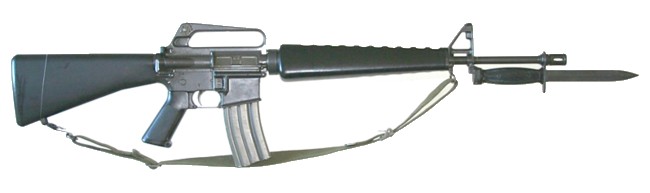
In the next image, there are several AR-15 pattern rifles among the more common (for the region) AK rifles. Judging by the stock shape, existence of a forward assist and carry handle, and by the distinctive triangular handguard, at least the closest one must be an M16A1.

Weapons and Ammunition Seized by Syrian Army (8)

Weapons and Ammunition Seized by Syrian Army M16A1

Weapons and Ammunition Seized by Syrian Army М16А1
M16A1

Here is also a video published by the Russian Federal News Agency showing other types of seized weapons and munitions:

https://www.youtube.com/watch?v=1A-4pZWyxzs


Sources:

“Syrian Army foils rebel attempt to smuggle heavy weapons into East Ghouta (video)”. (2018, February 28). Al-Masdar News. Retrieved from:  https://www.almasdarnews.com/article/syrian-army-foils-rebel-attempt-smuggle-heavy-weapons-east-ghouta-video/

Images from: www.almasdarnews.com. www.modernfirearms.net, www.thefirearmblog.com